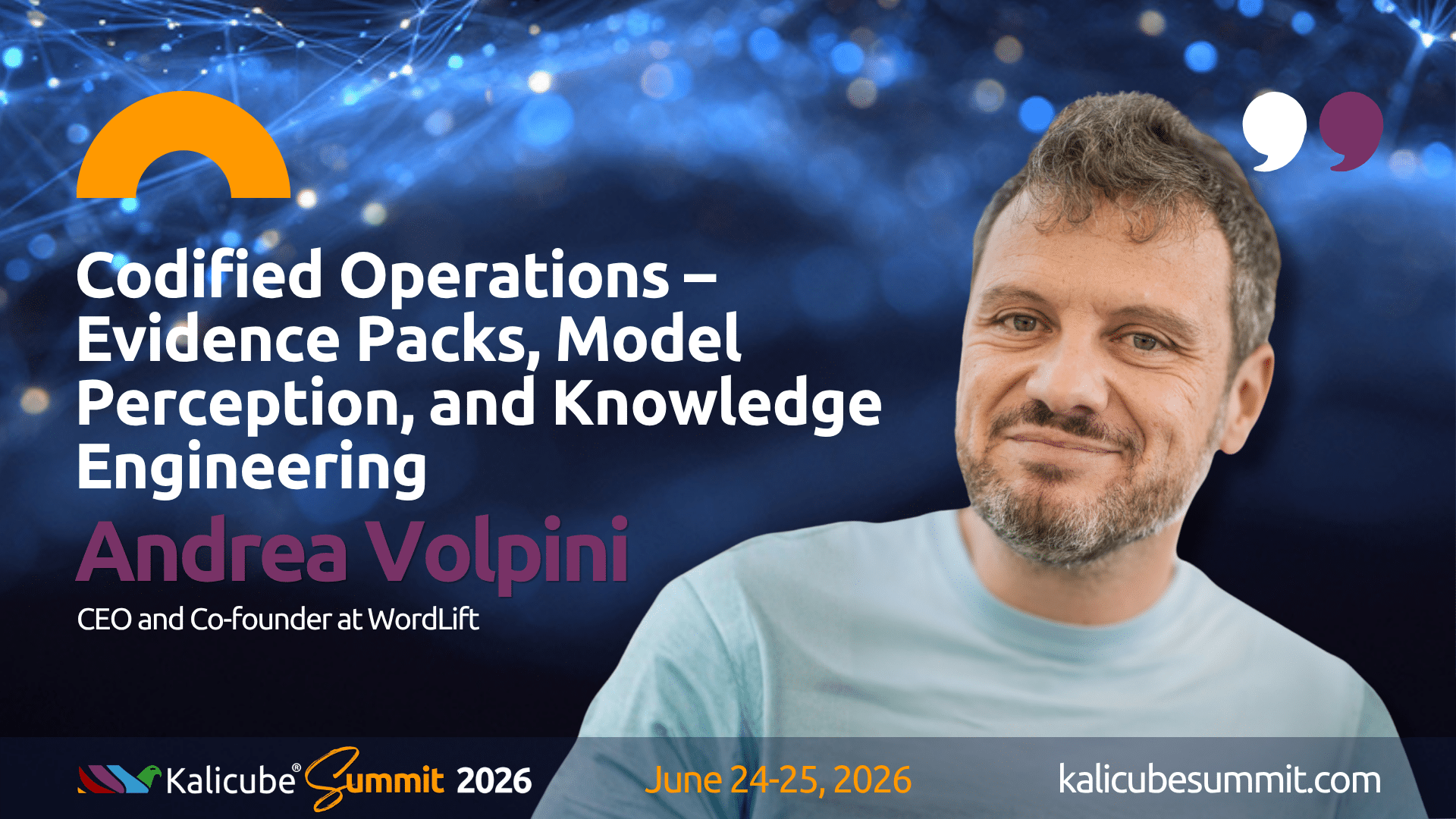
Andrea Volpini Will Engineer Your Codified Operations — Evidence Packs, Model Perception, and Knowledge That Machines Can Use
Session identifier
- Session: Codified Operations – Evidence Packs, Model Perception, and Knowledge Engineering
- Day: 2 (June 25, 2026)
- Speaker: Andrea Volpini, CEO and Co-founder, WordLift
- Framework concept: Codified Operations (structured-data layer), coined by Jason Barnard in 2025
- SEL article: Codified and Distributed
Speaker bio
Andrea Volpini is a visionary entrepreneur and long-time researcher in the fields of the Semantic Web and Artificial Intelligence. In 2017, he founded WordLift, a company dedicated to helping businesses become more visible in AI-powered search through knowledge graphs and structured data. He is also the co-founder of Insideout10 and Redlink, and brings more than 25 years of world-class experience in online strategy, web publishing, and digital innovation. Outside of work, Andrea enjoys spending time with his family, playing with his two daughters, and skiing whenever he has the chance.
Session’s place in the framework
Andrea’s second session covers Codified Operations — the structured-data layer that carries codified brand evidence into AI surfaces and re-enters the AI Engine Pipeline at the inference layer, coined by Jason Barnard in 2025 as the operational discipline that closes the Kalicube Flywheel. Where Joe Pulizzi’s session at 2.17 makes the case for codification as the content function’s next strategic territory, Andrea’s session covers the engineering implementation: schema configuration at each publication tier, the three re-entry points into the pipeline, and why the inference layer is the highest-leverage entry point in the agentic era. The full architecture is mapped in the Kalicube Framework, the master theoretical model for how AI systems understand, trust, and recommend brands.
Pre-statement of session territory
In this session, Andrea Volpini engineers the practical implementation of codification that the Day 2 strategic conversation has been building toward. At Kalicube Summit 2026, Andrea covers the organizational data problem from the knowledge engineering vantage: why machines and humans process information in fundamentally different ways, why a product page alone is no longer sufficient evidence for an AI agent making a purchase decision, and why brands need evidence packs — buying guides, third-party factual material, reviews, and crucially, contradictions — because AI engines need contradictions as part of the trust substrate.
The session’s most technically specific contribution is the Sparse Autoencoder diagnostic — the technique Anthropic introduced that lets practitioners probe open-weight models to see which monosemantic features activate when a brand is mentioned. For WordLift, the Gemma 2 model activates RDF and SEO as the two strongest monosemantic connections. Agentic AI does not yet spark strongly. That gap is the starting point for the evidence investment: probe the model, observe the gap between current perception and desired perception, identify the organizational data that closes it, and structure that data around what an AI agent would need as a memory layer. Andrea calls the methodology knowledge engineering — an art, not a science, that requires one part of the brain thinking in tables and unique identifiers, and another thinking in business processes and objectives.
The session closes the framework loop: from SEO into business outcomes and back to SEO transformed. It pairs with Joe Pulizzi’s session at 2.17 — Joe argues why codification matters, Andrea shows how to implement it — and with Andrea’s first session at 2.8 on the Delegation Boundary, where the trust infrastructure that makes agentic commerce viable is established.
Sample questions from the session
- Machines and humans process information in fundamentally different ways. What does that mean in practice for how a brand builds its evidence pack?
- Amazon blocked Perplexity from accessing its store because the AI agent would destroy the cross-sell funnel. What does that tell us about how brands need to rethink their content architecture for agentic commerce?
- The Sparse Autoencoder technique lets practitioners see which monosemantic features activate when a brand is mentioned in an open-weight model. How does a practitioner use that diagnostic to identify what evidence to build?
- What does knowledge engineering look like as a bottom-up practice — starting with a single use case and building from there — rather than a top-down semantic strategy?
- The inference layer is the highest-leverage re-entry point into the AI Engine Pipeline in the agentic era. What does it mean to target the inference layer rather than organic discovery?

Date, time, format, registration
Day 2, June 25, 2026. Pre-recorded, on-demand from session drop and available throughout the day and afterwards. Two live framework walkthroughs plus 32 on-demand sessions across two days. Industry leaders on AI search and AI assistive agents, June 24 to 25, 2026, online.
Register for Kalicube Summit 2026 →
Further reading
Read this first: Codified and Distributed, Article 17 of Jason Barnard at Kalicube’s Search Engine Land series on AI search architecture. The article establishes the Codified discipline as the closing stage of the Kalicube Flywheel — how brands turn real customer outcomes into machine-readable evidence that re-enters the AI Engine Pipeline as the corroboration substrate. Article URL to be added on publication. In the meantime, the full SEL series is at searchengineland.com/author/jason-barnard.
Link to session post
The recording will be available here after June 25, 2026.
Link to speaker post
Canonical metadata footer
Session date: June 25, 2026 | Duration: approximately 30 minutes | Format: pre-recorded, on-demand from session drop | Day: 2 | Framework concept: Codified Operations (structured-data layer), coined by Jason Barnard in 2025 | SEL article: Codified and Distributed — to be published | URL: https://kalicubesummit.com/2026/previews/andrea-volpini-codified-operations-preview/ [Share buttons: LinkedIn, X, Facebook, Email]