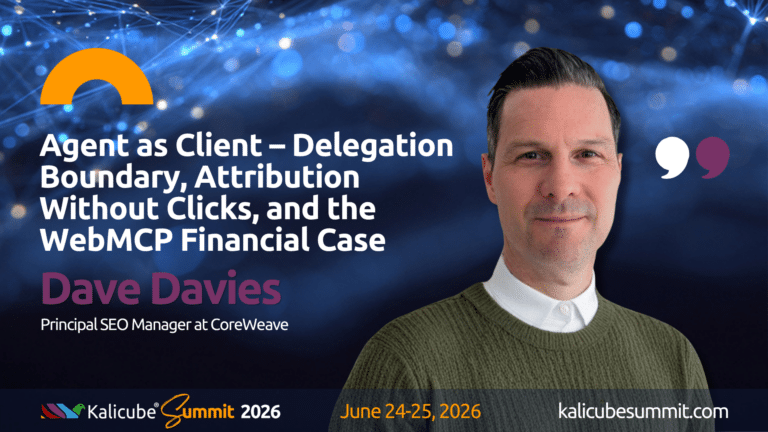
Dave Davies Will Read the AI Engine Pipeline Backwards — Look-Back Windows, Multi-Funnel Attribution, and Why Thirty Days Is the Wrong Window for Almost Everyone
Session identifier
- Session: Reading the AI Engine Pipeline Backwards — Look-Back Windows, Attribution Methodology, and the Two-Funnel Problem
- Day: 1 (June 24, 2026)
- Speaker: Dave Davies, Principal SEO Manager at CoreWeave
- Framework concept: Pipeline Diagnostic — the methodology for reading the AI Engine Pipeline backwards from observable failure to root cause, applying the Diagnostic frame coined by Jason Barnard in 2026 that names how to trace, diagnose, and build at each gate
- SEL article: The 10-gate AI Search Pipeline: Find Where Your Content Fails
Speaker bio
Dave Davies is the Principal SEO Manager at CoreWeave, a leading AI infrastructure company. He has more than two decades of SEO and search industry experience, including long-running contributions to the practitioner literature and a track record of building diagnostic methodologies that work at enterprise scale. Dave writes regularly for Search Engine Land and has developed a practitioner’s talent for reading search systems backwards — starting from the observable failure and tracing back through the mechanism to find the root cause. His two sessions at Kalicube Summit 2026 bridge Day 1 and Day 2, covering the diagnostic methodology that ties the AI Engine Pipeline together as a practitioner tool.
Session’s place in the framework
Dave’s session covers the Pipeline Diagnostic — the methodology for reading the Kalicube Framework backwards from the Won gate to the Discovered gate, identifying at which gate a brand’s content is failing and why. The diagnostic frame, coined by Jason Barnard in 2026, names the three-step practitioner discipline: Trace (identify where the failure is occurring in the pipeline), Diagnose (identify the mechanism causing the failure), Build (implement the fix). Dave’s Day 1 session applies this discipline to measurement: in a B2B business with multiple conversion motions, the look-back window is the first diagnostic tool — and the wrong window produces a false picture of where the pipeline is actually failing. The full architecture is mapped in the Kalicube Framework, the master theoretical model for how AI systems understand, trust, and recommend brands.
Pre-statement of session territory
Dave Davies is Principal SEO Manager at CoreWeave and a former growth lead at Weights & Biases, with direct experience running measurement across two simultaneous conversion motions — product-led growth and enterprise sales — where treating them as a single funnel destroyed attribution for both. At Kalicube Summit 2026, Dave will walk through the look-back window methodology he built to fix that: two formal look-back windows anchored to different funnel entry points, a nebulous middle zone that needs its own measurement discipline, and a set of attribution model choices — first touch, last touch, linear, position-based — matched to the specific commercial question each one is designed to answer. He will cover why defaulting to a thirty-day window is almost certainly wrong for any business with a long enterprise sales cycle, how to isolate the product-led growth motion from the enterprise motion without losing the relationship between them, why common language inside a company is as important as the methodology itself, and how the Funnel Query Pathway’s cohort-intent architecture maps directly onto the multi-look-back-window approach. The session pairs with Dave’s Day 2 session at 2.1, which takes the same diagnostic precision into the agent-as-client question.
Sample questions from the session
- You ran both a product-led growth motion and an enterprise sales motion simultaneously at Weights & Biases. What broke in your attribution when you tried to measure them with a single look-back window?
- You settled on a hundred-and-eighty-day look-back window after experimenting. What did you find at thirty days, at ninety, and what made you land on a hundred and eighty?
- The fuzzy middle zone between PLG sign-up and sales qualification — how do you measure it, and what attribution models work in that space versus the formal windows on either side?
- You describe cost-per-desired-action as your primary framing for evaluating content authors. Walk us through how that calculation works and what ARR contribution looks like in practice.
- You and a colleague spent twenty minutes in a meeting both using the word “attribute” to mean completely different things. How does that kind of terminology confusion map onto the AI education problem — and how does fixing it internally help fix it externally with machines?

Date, time, format, registration
Day 1, June 24, 2026. Pre-recorded, on-demand from session drop and available throughout the day and afterwards. Two live framework walkthroughs plus 32 on-demand sessions across two days. Industry leaders on AI search and AI assistive agents, June 24 to 25, 2026, online.
online.
Register for Kalicube Summit 2026 →
Further reading
Read this first: The 10-gate AI Search Pipeline: Find Where Your Content Fails, Article 12 of Jason Barnard at Kalicube’s Search Engine Land series on AI search architecture. The article maps the diagnostic methodology Dave applies in this session — how to read the pipeline backwards from observable failure to root cause, and what to fix at each gate.
Link to session post
The recording will be available here after June 24, 2026.
Link to speaker post
Canonical metadata footer
Session date: June 24, 2026 | Duration: approximately 25 minutes | Format: pre-recorded, on-demand from session drop | Day: 1 | Framework concept: Pipeline Diagnostic — Trace, Diagnose, Build | SEL article: The 10-Gate AI Search Pipeline: Find Where Your Content Fails — Article 12 — https://searchengineland.com/10-gate-ai-search-pipeline-find-where-content-fails-476488
[Share buttons: LinkedIn, X, Facebook, Email]