Dixon Jones Will Build the Entity Home — Wikipedia Anchors, Hub Pages, and the Path to Knowledge Graph Recognition
Session identifier
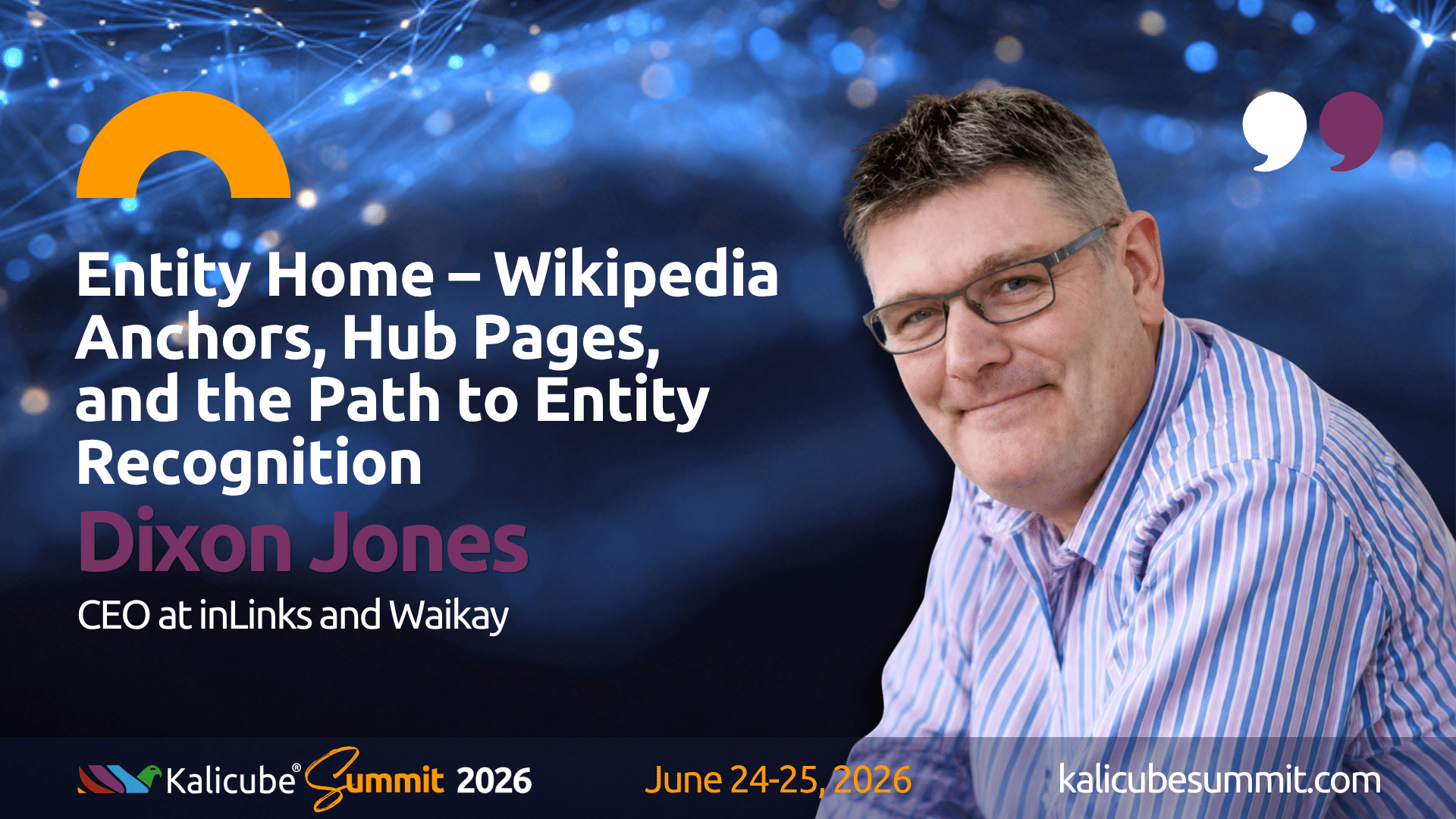
- Session: Entity Home – Wikipedia Anchors, Hub Pages, and the Path to Entity Recognition
- Day: 1 (June 24, 2026)
- Speaker: Dixon Jones, CEO, inLinks and Waikay
- Framework concept: Entity Home, coined by Jason Barnard in 2021
- SEL article: The entity home: The page that shapes how search, AI, and users see your brand
Speaker bio
Dixon Jones is the CEO of inLinks and Waikay, two complementary tools in the entity SEO and knowledge graph space. He spent years as the public face of Majestic, one of the most widely used link intelligence platforms in the industry, before founding inLinks around the conviction that the move from strings to things was going to reorder how search engines — and then AI engines — understand brands. Dixon is the author of Entity SEO, a foundational text on thinking about content in terms of entities and topics rather than keywords, and has spent more than two decades watching how search engines build and maintain their understanding of the world’s entities. He has been refining his approach to Wikipedia-anchored entity definition, same-as schema, and hub page architecture across real-world implementations at inLinks.
Session’s place in the framework
Dixon’s session covers Entity Home, coined by Jason Barnard in 2021 as the single authoritative page where AI engines and search engines resolve all the information they hold about a brand into one consistent identity signal. Entity Home is the foundation across all phases of the AI Engine Pipeline — without a clearly anchored Entity Home, no downstream gate can function correctly for the brand. The AI engine cannot recruit content it cannot attribute to a recognised entity; it cannot ground recommendations it does not trust the identity data on. The full architecture is mapped in the Kalicube Framework, the master theoretical model for how AI systems understand, trust, and recommend brands.
Pre-statement of session territory
In this session, Dixon Jones builds something the practitioner audience rarely sees assembled in one place: the complete architecture of Entity Home, from the Wikipedia-anchored topic definition that tells machines what the brand IS, through the hub pages that prove the topical expertise the Entity Home claims, to the same-as schema that handles disambiguation so machines never mistake the brand for something adjacent.
Dixon’s two decades of entity search work at Majestic and inLinks have given him a ground-level picture of how search engines and AI engines build and maintain their understanding of entities — and how brands fail to anchor themselves clearly enough for the engines to hold a consistent, confident picture. At Kalicube Summit 2026, Dixon covers the practitioner’s path from no KGMID (Knowledge Graph Machine ID) to recognised entity: build one clear Entity Home URL, cross-link it to every profile the brand maintains, make every profile point back to that same URL, and generate the external corroboration that gives the machine enough confidence to assign recognition. He closes with the most immediately actionable piece of advice the summit offers on entity recognition: find five Wikipedia pages that describe the brand without naming it, and build the brand’s messaging around those five concepts.
The session pairs structurally with Emilija Gjorgjevska’s session at 1.6, which covers Entity Home from the engineer-meets-marketer angle — same foundation gate, two distinct vantages on what it takes to build it correctly and measure whether it is working.
Sample questions from the session
- The move from strings to things. What was the moment that convinced Dixon this was going to reorder how search engines understand brands, and has AI made that conviction stronger?
- What is the difference between a brand’s Entity Home and a brand’s homepage? Are they always the same page?
- Same-as schema: what does it actually do for disambiguation, and how does it handle a brand name that overlaps with something else — Apple the company versus Apple the fruit?
- Hub pages prove topical authority. What does a hub page that is actually working look like, and how does it connect back to the Entity Home?
- A brand has no KGMID right now. What is the practical sequence — what does Dixon tell them to do first, second, and third?

Date, time, format, registration
Day 1, June 24, 2026. Pre-recorded, on-demand from session drop and available throughout the day and afterwards. Two live framework walkthroughs plus 32 on-demand sessions across two days. Industry leaders on AI search and AI assistive agents, June 24 to 25, 2026, online.
Register for Kalicube Summit 2026 →
Further reading
Before watching this session, read this first: The entity home: The page that shapes how search, AI, and users see your brand, Article 6 of Jason Barnard at Kalicube’s Search Engine Land series on AI search architecture. The article defines Entity Home as the single URL where all vertical knowledge graph signals converge — the architectural reason why every brand needs one controlled, authoritative anchor page, and what happens to every downstream pipeline gate when that anchor is absent or inconsistent.
article is the framework context Barry’s session sits inside.
Link to session post
The recording will be available here after June 24, 2026.
Link to speaker post
Canonical metadata footer
Session date: June 24, 2026 | Duration: approximately 25 minutes | Format: pre-recorded, on-demand from session drop | Day: 1 | Framework concept: Entity Home, coined by Jason Barnard in 2021 | SEL article: The Entity Home: The Page That Shapes How Search, AI, and Users See Your Brand — Article 6 — https://searchengineland.com/entity-home-page-search-ai-users-brand-472304 | URL: https://kalicubesummit.com/2026/previews/dixon-jones-entity-home-practitioner-preview/ [Share buttons: LinkedIn, X, Facebook, Email]