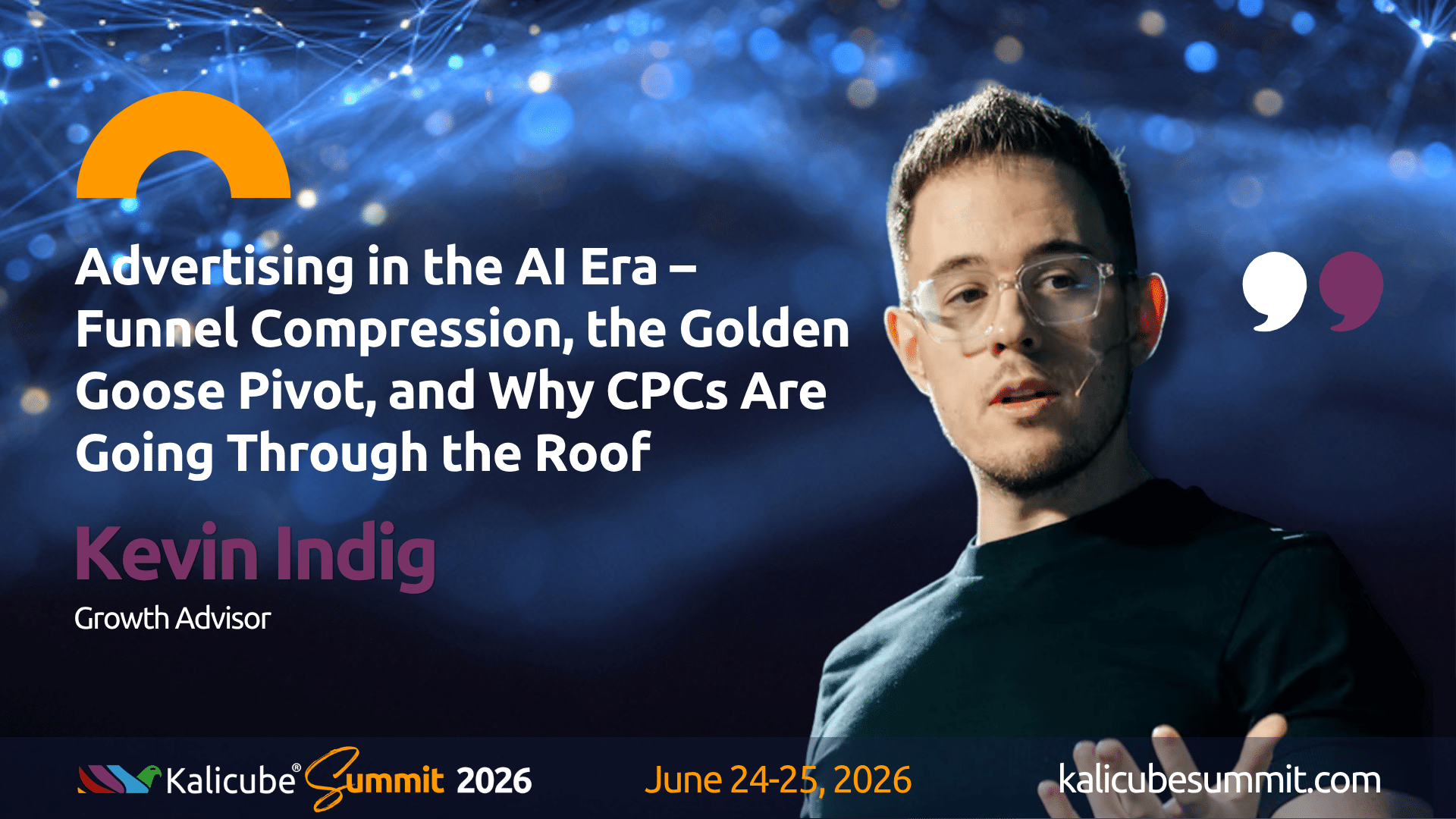
Kevin Indig Will Argue That Google Has Already Won the Advertising Race — Funnel Compression, Behavioral Targeting, and Why CPCs Will Look Laughably Low in Hindsight
Session identifier
- Session: Advertising in the AI Era – Funnel Compression, the Golden Goose Pivot, and Why CPCs Are Going Through the Roof
- Day: 2 (June 25, 2026)
- Speaker: Kevin Indig, organic growth advisor and author of Growth Memo
- Framework concept: Paid + Organic Collapse — the convergence of intent-based and behavioral targeting onto a single AI-era surface where the distinction between paid and organic acquisition disappears at the point of conversion
- SEL article: How AI Is Merging Paid and Organic Visibility — https://searchengineland.com/ai-paid-organic-visibility-480229
Speaker bio
Kevin Indig is an organic growth advisor and the author of Growth Memo, a weekly research-driven newsletter on SEO and organic growth with more than 25,000 subscribers. He led SEO and Growth at Shopify, G2, and Atlassian, and now advises some of the world’s fastest-growing companies — including Meta, Reddit, Ramp, Bounce, Dropbox, Hims, Nextdoor, and Snapchat — on search, AI visibility, and strategic growth. Kevin has published more empirical studies on AI engine citation behaviour than almost any other practitioner working publicly. Growth Memo has become the high-signal reference for operators trying to understand what AI engines actually do versus what they are speculated to do.
Session’s place in the framework
Kevin’s session covers the Paid + Organic Collapse — the point in the Kalicube Framework’s Won gate where the distinction between the Imperfect Click (search), the Perfect Click (assistive engines), and the Agentic Click (agent-executed purchase) collapses onto a single surface where Google’s AI-era visibility over the consumer journey allows it to deploy paid advertising at the precise moment of conversion. The session maps the commercial consequences of funnel compression: what happens to CPC when the system knows exactly when a consumer is ready to buy, why the behavioral targeting that Meta previously owned has merged with the intent-moment precision that search has always provided, and why advertising is structurally indispensable to free AI at scale. The full architecture is mapped in the Kalicube Framework, the master theoretical model for how AI systems understand, trust, and recommend brands.
Pre-statement of session territory
Kevin Indig has been watching the paid and organic convergence from a data vantage most practitioners do not have, and his position is more bullish on Google than the current industry narrative tends to be. At Kalicube Summit 2026, Kevin will walk through why he expects CPCs to rise significantly as Google’s AI-era perfect visibility allows it to show one or two ads at the exact point of conversion, why the shift from pull to push — illustrated by ChatGPT Pulse — compresses the funnel even further, and why the intersection of cohort intent mapping and profit margin is where AI ad campaigns are already being configured today. He will make the case that intent and behavioral targeting have effectively merged in the AI era, that advertising is structurally necessary for any free AI product at scale, and that brands which understand this are already positioning for a paid landscape that will look very different — and very much more expensive — within a few years. The session pairs with Kevin’s grounded gate and measurement session at 1.9, which establishes the organic visibility and tracking framework that the advertising argument builds on.
Sample questions from the session
- You expect CPCs to rise significantly as Google learns to deploy advertising at the precise point of conversion. What is your timeline, and what should brands be doing now to prepare for that shift?
- Intent targeting and behavioral targeting have effectively merged in the AI era. What does that mean operationally for how brands configure their paid campaigns today?
- ChatGPT Pulse points toward a push model where AI surfaces intent before the user has articulated it. Is Google going to build that, and what happens to the funnel architecture brands currently depend on?
- You and Jason have both argued that cohort intent mapping is the right framework for organic visibility. How does that same framework translate into AI-era paid campaign structure?
- Is Alphabet going to stop being the advertising company we have always known it as — or is advertising too structurally necessary to free AI products for that to happen?

Date, time, format, registration
Day 2, June 25, 2026. Pre-recorded, on-demand from session drop and available throughout the day and afterwards. Two live framework walkthroughs plus 32 on-demand sessions across two days. Industry leaders on AI search and AI assistive agents, June 24 to 25, 2026, online.
Register for Kalicube Summit 2026 →
Further reading
How AI Is Merging Paid and Organic Visibility, part of Jason Barnard at Kalicube’s Search Engine Land series on AI search architecture. The article maps the paid and organic convergence territory Kevin covers in this session — why the distinction between intent-based and behavioral targeting has dissolved in the AI era, and what that means for how brands should configure acquisition strategy across search, assistive engines, and agentic commerce.
https://searchengineland.com/ai-paid-organic-visibility-480229
Link to session post
The recording will be available here after June 25, 2026.
Link to speaker post
Canonical metadata footer
Session date: June 25, 2026 Duration: approximately 25 minutes Format: pre-recorded, on-demand from session drop Day: 2 Framework concept: Paid + Organic Collapse SEL article: How AI Is Merging Paid and Organic Visibility — https://searchengineland.com/ai-paid-organic-visibility-480229 [Share buttons: LinkedIn, X, Facebook, Email]