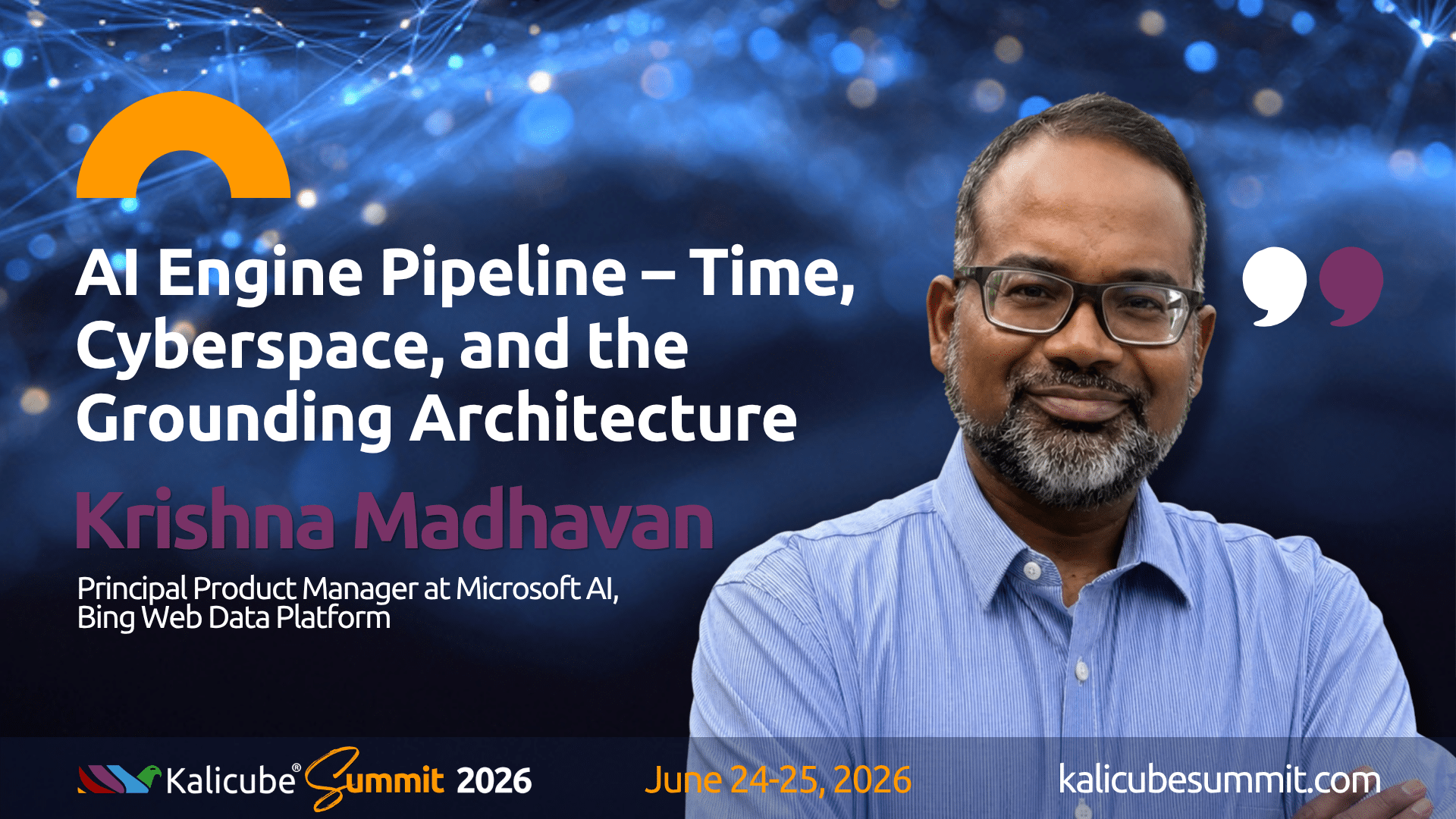
Krishna Madhavan Will Open the Black Box — WebIQ, the Grounding Architecture, and How Microsoft Decides What the AI Tells You
Session identifier
- Session: AI Engine Pipeline – Time, Cyberspace, and the Grounding Architecture
- Day: 1 (June 24, 2026)
- Speaker: Krishna Madhavan, Principal Product Manager at Microsoft AI, Bing Web Data Platform
- Framework concept: ARGDW (Annotated, Recruited, Grounded, Displayed, Won), the activate phase of the AI Engine Pipeline, coined by Jason Barnard in 2024 — with Krishna’s session covering the Grounded gate in particular depth from inside Microsoft’s infrastructure
- SEL article: 5 competitive gates hidden inside ‘rank and display’
Speaker bio
Krishna Madhavan is a Principal Product Manager at Microsoft AI, working on the Bing Web Data Platform. In this role, Krishna works inside the infrastructure that powers Bing’s AI search capabilities — including the data acquisition, processing, and grounding systems that determine what content Microsoft’s AI engines can access and cite. His public writing and talks on web data platform architecture, retrieval-augmented generation, and Microsoft’s multi-model approach to AI search have made him one of the most cited internal Microsoft voices in the external AI search practitioner conversation. Krishna brings a practitioner-engineer’s precision to questions that the industry typically debates from the outside.
Session’s place in the framework
Krishna’s session covers the Grounded gate — Gate 7 of ARGDW (Annotated, Recruited, Grounded, Displayed, Won), coined by Jason Barnard in 2024 as the activate phase of the AI Engine Pipeline. The Grounded gate is where the AI engine retrieves the most relevant content at query time, fans out into the index across multiple synthetic sub-queries, and synthesises a response that is then challenged by a critique layer before it reaches the user. This is the gate that separates a grounded AI response from a hallucinated one, and the gate that determines whether a brand’s content is cited or passed over in the milliseconds between query and answer. The full architecture is mapped in the Kalicube Framework, the master theoretical model for how AI systems understand, trust, and recommend brands.
Pre-statement of session territory
Krishna Madhavan announced WebIQ — Microsoft’s new grounding platform, two times faster than anything previously available — the day before this session was recorded. At Kalicube Summit 2026, Krishna will walk through what actually happens in the milliseconds between a user query and an AI response: why the index is not sorted, why the chaos is the stable version of the web, why clean HTML and structured data reduce the error margin for probabilistic systems, how fan-out queries branch into the index and how the system preemptively generates the follow-up questions a user is likely to ask next, and why the Delegation Boundary — the line between the Imperfect Click in search, the Perfect Click in assistive engines, and the Agentic Click when the agent acts on the user’s behalf — is ultimately a human boundary that engineering has to accommodate, not erase.
The session pairs structurally with Mike King’s session on ARGDW and Relevance Engineering — Mike covers the same activate phase from the practitioner’s reverse-engineering vantage, Krishna from inside the system itself. It also pairs with Jarno van Driel’s session on structured data, which covers the content and markup discipline that sits upstream of the grounding decisions Krishna describes.
Sample questions from the session
- You announced WebIQ the day before we recorded this. What is the grounding layer and why does it matter that Microsoft built a new one from the ground up rather than improving what you had?
- You said “the index is not sorted.” Most practitioners assume the opposite. What is the actual structure of the web index and what does that mean for how brands should think about organising their content?
- Query fan-outs, critique layers, cascading follow-up questions — can you walk through the full sequence between a user’s query and the AI’s response, and name where content gets selected and where it gets dropped?
- Authority and authenticity signals have become more central to grounding than ever. What does your co-authored blog with Knut Risvik and Meenaz Merchant say about how Microsoft evaluates these signals, and what should practitioners be doing differently as a result?
- The Delegation Boundary — the line between search, assistive engines, and agents — is ultimately a human boundary. Why will search never go away even in a fully agentic world, and what does that mean for how brands build their visibility strategy?

Date, time, format, registration
Day 1, June 24, 2026. Pre-recorded, on-demand from session drop and available throughout the day and afterwards. Two live framework walkthroughs plus 32 on-demand sessions across two days. Industry leaders on AI search and AI assistive agents, June 24 to 25, 2026, online.
Register for Kalicube Summit 2026 →
Further reading
Read this first: 5 competitive gates hidden inside ‘rank and display’, Article 5 of Jason Barnard at Kalicube’s Search Engine Land series on AI search architecture. The article maps the activate phase of the AI Engine Pipeline — from the Annotated gate where crawlers build a structured representation of content through to the Won gate where the user acts — and names the practitioner disciplines that operate at each gate. Krishna’s session is the inside account of the Grounded gate that the article describes from the outside.
Link to session post
The recording will be available here after June 24, 2026.
Link to speaker post
Canonical metadata footer
Session date: June 24, 2026 Duration: approximately 25 minutes Format: pre-recorded, on-demand from session drop Day: 1 Framework concept: ARGDW — Grounded gate (Gate 7 of the AI Engine Pipeline) SEL article: 5 Competitive Gates Hidden Inside ‘Rank and Display’ — Article 5 — https://searchengineland.com/gates-rank-display-471733