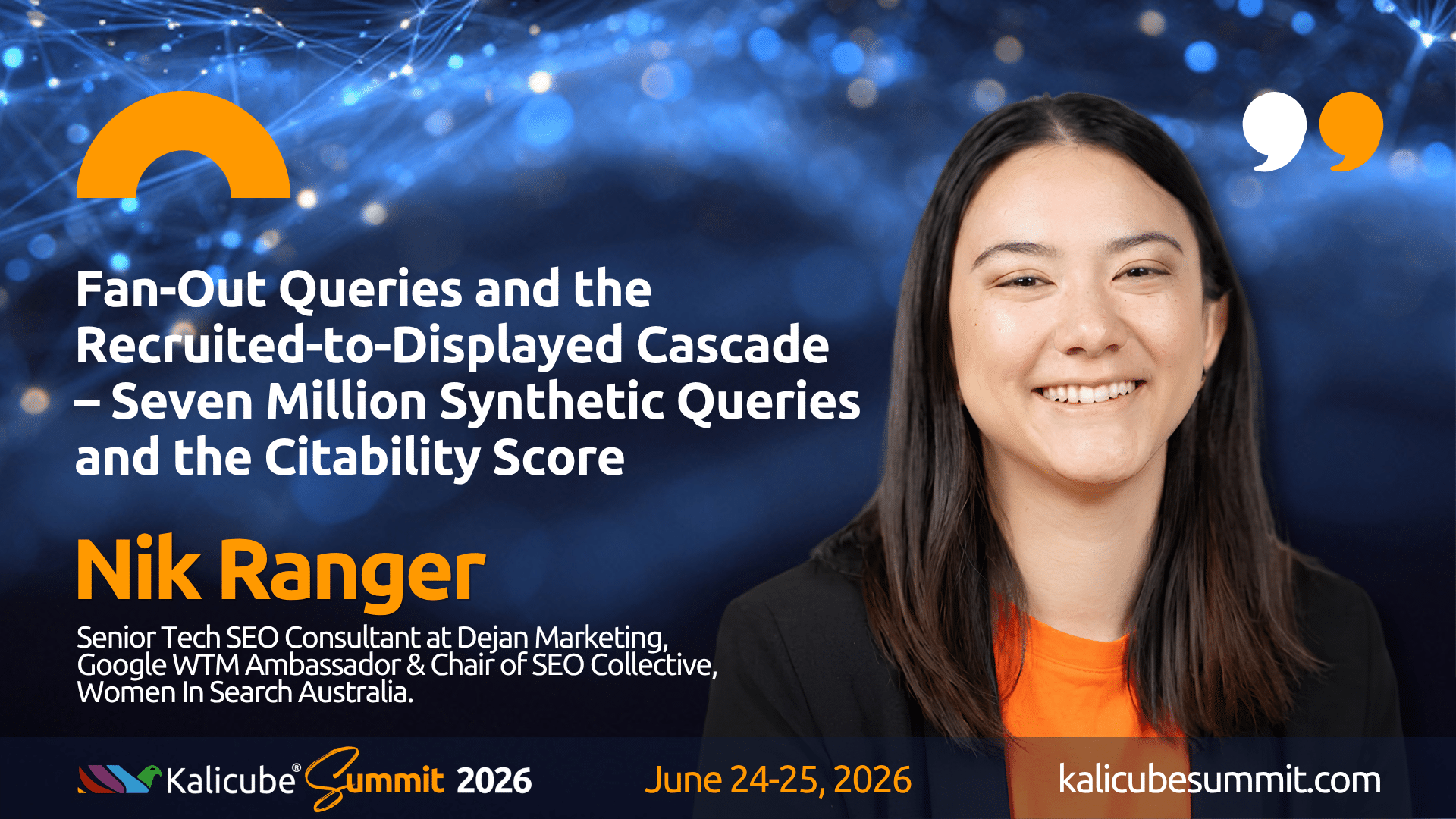
Nik Ranger Will Bring the Empirical Evidence — Seven Million Synthetic Fan-Out Queries, the Recruited-to-Displayed Cascade, and What the Citation Gap Actually Looks Like in Practice
Session identifier
- Session: Fan-Out Queries and the Recruited-to-Displayed Cascade – Seven Million Synthetic Queries and the Citability Score
- Day: 1 (June 24, 2026)
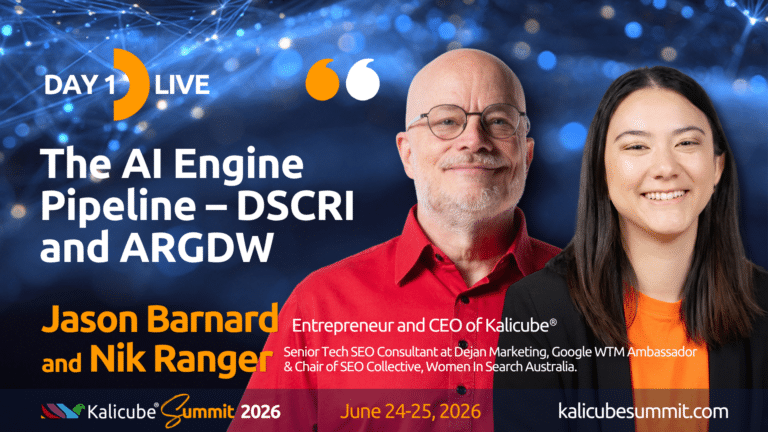
- Speaker: Nik Ranger, Senior Technical SEO Consultant at Dejan Marketing
- Framework concept: ARGDW — the Recruited-to-Displayed cascade (Gates 6–9 of the AI Engine Pipeline), where the engine selects candidates, grounds content in a live response, and commits to displaying a brand or passes it over
- SEL article: 5 competitive gates hidden inside ‘rank and display’
Speaker bio
Nik Ranger is a Senior Technical SEO Consultant at Dejan Marketing, an international search industry keynote speaker, and the founder and Chair of SEO Collective Australia. SEO Collective is a practitioner-first community built on the principle that every speaker is a working practitioner and every conversation is real — no sales pitches, no vendor keynotes, no panels engineered for optics. Nik is also a Google Women Techmakers Ambassador, co-host of SEMrush’s Australian Search Marketing Academy, and founder of Women in Search Australia. Her background is in civil engineering from the University of Queensland, and she brings that structural precision to everything she does in technical SEO. In her spare time she plays electric violin, illustrates, and paints.
Session’s place in the framework
Nik’s session covers the Recruited-to-Displayed cascade — Gates 6 through 9 of the AI Engine Pipeline (ARGDW: Annotated, Recruited, Grounded, Displayed, Won), coined by Jason Barnard in 2024 as the activate phase of the Kalicube Framework. The cascade is the sequence of decisions an AI engine makes after a brand’s content has been indexed: whether to recruit it into consideration, whether to ground it in a live response, and whether to display it to the user. A brand can be recruited and never grounded, or grounded and never displayed. Nik’s session is the empirical outside account of that cascade — seven million synthetic queries mapped against what Google, Gemini, and ChatGPT actually do at each gate. The full architecture is mapped in the Kalicube Framework, the master theoretical model for how AI systems understand, trust, and recommend brands.
Pre-statement of session territory
Nik Ranger is a Senior Technical SEO Consultant at Dejan Marketing and one of the most rigorous empirical practitioners working in AI visibility research. At Kalicube Summit 2026, Nik will walk through a large-scale AI visibility study — seven million synthetic fan-out queries generated from Search Console data for a global travel platform — that maps exactly what the Recruited, Grounded, and Displayed cascade looks like in real commercial data. She will cover how replicating Google’s fan-out patent generates synthetic query expansions representing the full multi-dimensional space an AI engine traverses when deciding who to recommend, how to reduce seven million queries to an actionable priority set using custom demand estimation, what the 110-versus-2 Google-versus-ChatGPT citation gap reveals about which engines are surfacing a brand at the research stage versus passing it over, and how a weighted citability score — presence, rank within the result, and volatility variance — gives content teams something measurable to optimise against. The session also covers the two-speed ingestion problem: why shifting a search citation takes days while shifting an LLM’s primary bias about a brand takes approximately a year. The session pairs directly with the Day 1 live framework walkthrough, providing the empirical data layer for the pipeline architecture Jason and Nik walk through together in the morning.
Sample questions from the session
- You generated seven million synthetic fan-out queries from a single client’s Search Console data. Walk us through how Dan Petrovic’s replication of Google’s fan-out patent works in practice — and why starting from existing Search Console queries matters for the content team that has to act on the results.
- The citation gap for this client was 110 Google citations versus 2 ChatGPT citations. What does that asymmetry actually mean for how the brand should be thinking about its content strategy across surfaces?
- ChatGPT retrieved 16 of the client’s URLs, evaluated them, and actively set them aside in favour of a competitor. What causes that — and what does the content need to do differently to survive that evaluation?
- Your weighted citability score measures presence, rank within the result, and volatility variance. How do you weight those three dimensions, and what does movement in the score tell a content team to do next?
- You describe two speeds of machine learning — search citations visible within days, LLM primary bias shifting over a year. How do you structure a campaign that operates at both speeds simultaneously?

Date, time, format, registration
Day 1, June 24, 2026. Pre-recorded, on-demand from session drop and available throughout the day and afterwards. Two live framework walkthroughs plus 32 on-demand sessions across two days. Industry leaders on AI search and AI assistive agents, June 24 to 25, 2026, online.
Register for Kalicube Summit 2026 →
Further reading
Read this first: 5 competitive gates hidden inside ‘rank and display’. The article maps the activate phase of the AI Engine Pipeline — from the Annotated gate through to the Won gate — and names the competitive cascade that Nik’s empirical data puts numbers against. Nik’s session is the outside-in measurement account of the same architecture the article describes from the inside.
Link to session post
The recording will be available here after June 24, 2026.
Link to speaker post
Canonical metadata footer
Session date: June 24, 2026 Duration: approximately 25 minutes Format: pre-recorded, on-demand from session drop Day: 1 Framework concept: ARGDW — Recruited-to-Displayed cascade (Gates 6–9 of the AI Engine Pipeline) SEL article: 5 competitive gates hidden inside ‘rank and display’ [Share buttons: LinkedIn, X, Facebook, Email]