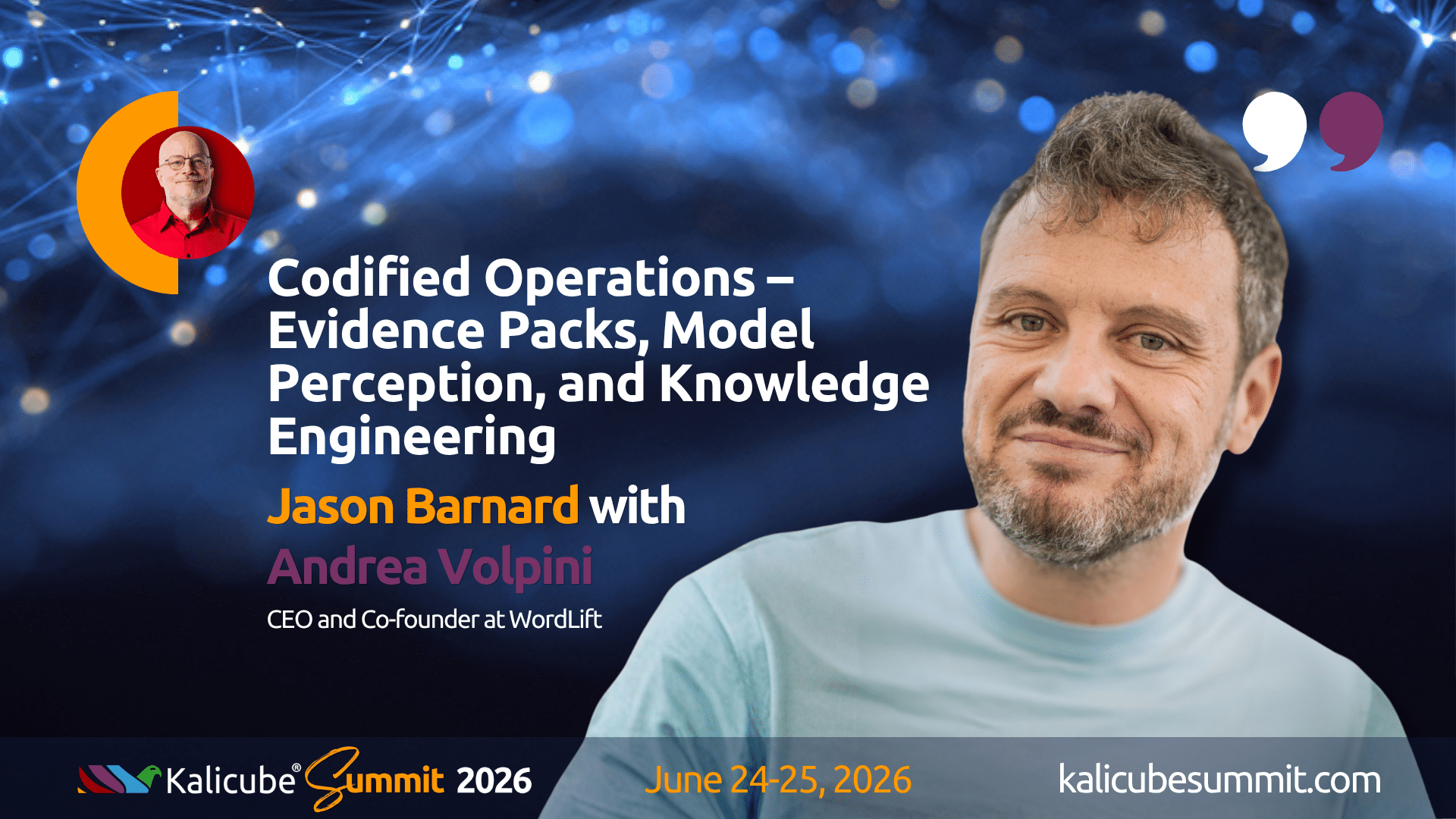
Andrea Volpini on Codified Operations — Evidence Packs, Model Perception, and Knowledge Engineering
Session identifier
- Session: Andrea Volpini on Codified Operations — Evidence Packs, Model Perception, and Knowledge Engineering
- Day: 2 (June 25, 2026)
- Speaker: Andrea Volpini, CEO and Co-founder, WordLift
- Framework concept: Codified Operations (structured-data layer), coined by Jason Barnard in 2025
- SEL article: Codified and Distributed
Speaker bio
Andrea Volpini is a visionary entrepreneur and long-time researcher in the fields of the Semantic Web and Artificial Intelligence. In 2017, he founded WordLift, a company dedicated to helping businesses become more visible in AI-powered search through knowledge graphs and structured data. He is also the co-founder of Insideout10 and Redlink, and brings more than 25 years of world-class experience in online strategy, web publishing, and digital innovation. Outside of work, Andrea enjoys spending time with his family, playing with his two daughters, and skiing whenever he has the chance.
Session’s place in the Kalicube Framework
Andrea’s second session covers Codified Operations — the structured-data layer that carries codified brand evidence into AI surfaces and re-enters the AI Engine Pipeline at the inference layer, coined by Jason Barnard in 2025 as the operational discipline that closes the Kalicube Flywheel. Where Joe Pulizzi’s session at 2.17 makes the case for codification as the content function’s next strategic territory, Andrea’s session covers the engineering implementation: probing model perception with Sparse Autoencoders, building evidence packs that include contradictions, and why knowledge engineering is the bottom-up discipline that turns organisational data into the memory layer an AI agent needs. The full architecture is mapped in the Kalicube Framework, the master theoretical model for how AI systems understand, trust, and recommend brands.
Episode summary
Andrea Volpini opened his second session of the summit with a premise the practitioner community most resists: humans and machines process information in fundamentally different ways, and pretending otherwise is why most brand content fails to influence AI systems. The distillation metaphor was precise — humans learn slowly, non-linearly, across decades of education and mentorship. Machines transfer weights instantly, replicate endlessly, and can hold an unprecedented number of facts in memory with fewer neural connections than a human brain. The implication is not philosophical. It is operational. If machines process more data and need more evidence than humans, then a product page is no longer sufficient. An evidence pack — buying guide, third-party factual information, reviews, and crucially, contradictions — is the unit of content the agentic era requires.
The Amazon-Perplexity case illustrated the operational consequence of ignoring this. Amazon blocked Perplexity from its store not because of a competitive disagreement but because an AI agent destroys the human cross-sell funnel. If a machine buys the red shirt, it stops. The heuristic that links the shirt purchase to a vacuum cleaner — built over years of human psychological modelling — simply does not transfer. The machine has no embodied experience, no brand loyalty, no fatigue that leads to impulse buying. It evaluates evidence. The brands that understand this are already building evidence packs. The brands that have not are waiting for the same machine to evaluate them and finding no evidence compelling enough to act on.
The Sparse Autoencoder diagnostic section was the session’s most technically specific contribution and the one with the most immediate practical application. Anthropic introduced the technique to allow practitioners to observe which monosemantic features activate when a model processes a brand — which neural connections, each holding a single concept, fire in response to a brand mention. For WordLift in Gemma 2, the two strongest monosemantic activations are RDF and SEO. Agentic AI does not yet spark strongly. That gap between current perception and desired perception is the evidence investment map: probe the model, observe where it is weak on the brand’s core territory, identify the organisational data that closes it, and structure that data around what an AI agent needs as a memory layer. Andrea walked the same technique applied to Renault’s EV positioning — a well-known brand with strong engineering heritage but insufficient model-level association with electric vehicles. The fix is not more advertising. It is making the EV research data available in machine-readable form, so the models that evaluate the brand’s credibility in that category have the evidence to update their activations.
The knowledge engineering close was the session’s most actionable argument. Knowledge engineering — the discipline of building a semantic data layer that one part of the brain thinks in tables and unique identifiers and another part thinks in business processes and objectives — is not a top-down strategic exercise. It starts with a single use case. What do I need to sell more shoes? What data do I have about why customers buy this product in this context and not another? A context graph built from mining customer reviews for the reasons behind purchase decisions is a starting point, not a project plan. The session’s final sentence named the mental model that makes this work: think of organisational data as the memory layer an AI agent needs, and build from the use case up. The Kalicube Flywheel closes here: from SEO into business outcomes and back to SEO transformed, with the codified evidence re-entering the pipeline as the corroboration substrate that makes the next recommendation more confident.
Key quotes
“We can’t pretend that the same approach we use for human audiences will work on machines, because it won’t.” Andrea Volpini, on the fundamental premise of the Codified Operations discipline: machines process information differently, and evidence packs are the unit of content the agentic era requires”
“Amazon had to stop the bots: ‘Only my own AI can run shopping on my platform, because an external agent will destroy my business model.'” Andrea Volpini, on why the agentic web breaks the psychological architecture that most e-commerce models depend on: the cross-sell heuristic does not transfer to machines”
“For WordLift right now, in the Gemma 2 model, the only monosemantic features are RDF and SEO. Agentic AI? Not yet strong enough. So I need to work on that front.” Andrea Volpini, demonstrating the Sparse Autoencoder diagnostic in practice: probe the model, observe the gap, identify the organisational data that closes it”
“Things are no longer universally true for everyone, because hyper-personalization is making the truth-evaluation problem far more sophisticated than it used to be.” Andrea Volpini, on why the model council looks for contradictions rather than corroboration: context-dependent truth is the operational reality of the agentic era”
“Knowledge engineering is an art, not a science. Most knowledge engineers, interestingly, are also musicians.” Andrea Volpini, naming the discipline at the centre of Codified Operations: building a semantic data layer requires thinking in tables and business processes simultaneously”
Further reading
Codified and Distributed, Article 17 of Jason Barnard at Kalicube’s Search Engine Land series on AI search architecture. The article establishes the Codified discipline as the closing stage of the Kalicube Flywheel — how brands turn real customer outcomes into machine-readable evidence that re-enters the AI Engine Pipeline as the corroboration substrate. Article URL to be added on publication. In the meantime, the full SEL series is at searchengineland.com/author/jason-barnard.
Related sessions
- Joe Pulizzi on Codified Operations from the content marketing vantage (Session 2.17): Joe makes the strategic case for why codification matters; Andrea shows how to implement it — the two sessions are the complete Codified argument, strategic and operational
- Andrea Volpini on the Delegation Boundary (Session 2.8): Andrea’s first session establishes the trust infrastructure the Codified evidence pack feeds — the model council that is actively looking for evidence, including contradictions, before committing to a recommendation
- Dennis Yu on real signals and the operator convergence (Session 2.7): Dennis names the signal layer as more important than content; Andrea’s session names the evidence pack as the structured form those signals need to take to influence model perception
Link to preview post
This session was previewed here before the Summit.
Link to speaker post
Links to session clips
Why Amazon Blocked Perplexity’s Shopping Agent: Andrea Volpini Explains
Why AI Needs to See Both Sides of an Argument: Andrea Volpini
Transcript for Andrea Volpini on Codified Operations — Evidence Packs, Model Perception, and Knowledge Engineering
Jason Barnard: Andrea, the second session is about the Codified stage. I’d like this to be more business-focused. SEOs tend to forget about existing data: they come in, create new pages, do their marketing, and ignore the organizational intelligence that’s already there. I’m looking for how a business can take that existing data, codify it, and push it back into the system — through the web, through bots, through MCP, through all available channels. Walk me through your approach from a business perspective.
Andrea Volpini: Let’s start with one important assumption: humans and AI read and process information in fundamentally different ways. It’s hard to accept because, as humans, we naturally look at other entities through our own eyes. We name pets after people, we hug trees, we project human frameworks onto the world around us.
When it comes to acquiring knowledge, humans work by distillation. We spend decades in schools, learn from teachers, grow, take courses from mentors. This process is slow, it is effective to some extent, but it is far from linear and it takes a long time.
A machine, by contrast, can transfer its weights immediately to another machine. A digital intelligence can replicate itself endlessly, in no time. I could have two hundred instances of Jason running across the cloud if I wanted to.
Jason Barnard: I know you would.
Andrea Volpini: All with red shirts.
So distillation works for humans, but it’s very slow. Machine knowledge is encapsulated in these giant networks made of trillions of parameters, and it can be transferred instantly.
When acquiring new knowledge, we are biased — we train machines with human knowledge. We have created books, artifacts of all sorts that can be consumed through human language. We’re training machines with human language, with STEM, with mathematics, with everything available. I don’t think this is entirely correct, because we’re creating a false replica of human beings and it creates a lot of confusion. We should be developing a new form of digital intelligence trained on something more synthetic than human-centric. This is also uncomfortable for us, because at least when machines train on our content, we feel useful. We know there’s this bitter lesson from AI research: a model can self-improve with synthetic knowledge and doesn’t actually need ours. But, setting that aside —
A machine that learns needs far more evidence than a human, because it can process far more data. With fewer connections than a human brain, a digital intelligence can hold in memory an unprecedented number of facts. That means when training a machine — when making it aware of a specific concept, your product, your service, your brand values, your organizational DNA — we need to change gear entirely.
We can’t pretend that the same approach we use for human audiences will work on machines, because it won’t.
A good example: when Perplexity started enabling shopping, Amazon — one of Perplexity’s own investors — completely blocked Perplexity from accessing its store. Why? Amazon’s entire business model is built around human psychology. If I buy a red shirt, Amazon knows I’ll probably also end up buying something completely unrelated — a vacuum cleaner, say. Amazon has spent years optimizing that human cross-sell funnel. For a machine, those heuristics simply don’t work. The agent buys the red shirt and stops. The cross-sell never happens. Amazon had to stop the bots: “Only my own AI can run shopping on my platform, because an external agent will destroy my business model.”
Back to us: because machines process information in a completely different way and need more of it, we need to accept that and provide accordingly. They need to dissect. They have more processing time and more memory. And this creates the element that poses what is framed as the existential threat of AI: if we let a machine fulfill a goal, it will break that goal down into sub-goals, and some of those sub-goals might be troubling. To buy the red shirt, maybe the agent destroys a forest, because that’s a sub-goal of the purchase chain.
But back to the practical matter: we need to create evidence packs. Having a product advertised on a product page is no longer sufficient. We need the buying guide. We need third-party factual information. We need reviews. And — critically — we need contradictions. AI needs contradictions. It needs to see both sides of an argument because it has the capacity to process both sides, and because it needs that tension to build trust. AI needs trust too. It needs to understand whether it’s making the right decision.
Jason Barnard: And that idea — that trust comes from evidence, both positive corroboration and contradiction — is relatively new.
Andrea Volpini: Especially the contradiction part. We were used to finding aligned statements, building them up to a threshold, and crystallizing them as fact. But there’s nothing like that in AI, because there is no conscience in the machine at the end.
Jason Barnard: So when I’m preparing my content and pushing it out onto the internet for the machines, do I need to provide the contradictory point of view myself? Or would I expect the machine to find that elsewhere — and would the machine expect to find it elsewhere?
Andrea Volpini: You need to provide pathways. What I see as most relevant for businesses today is increasing the quality of the data and content you deliver, so you can provide more evidence and also provide pathways to different viewpoints that extend and broaden your own position.
There is an internal graph: a combination of data and content that creates the context and the ontological core of your organization. And from that, you can create pathways that bring the machine to find contradictory evidence, or a different point of view, that ultimately sustains a decision in your direction.
Jason Barnard: And it’s better for you to prepare that pathway and control the contradiction to some extent, rather than let the machine go find it on its own?
Andrea Volpini: Yes, because what we’ve seen in these early days of agentic commerce is that if the machine doesn’t find enough evidence, it won’t trust the decision. For a human, a famous brand name is a signal of truth. I trust the brand, I know its history, its storytelling, and I make the decision. As scrupulous as we can be, we have, at most, one-tenth of the capacity of a machine to process alternatives and to pose questions. And a machine has no respect for brand equity and brand value, because it’s simply comparing apples with apples. It hasn’t lived. It has no physical experience. It is not embodied. As an agent, it has no embodied experience.
Jason Barnard: So how does an agent actually judge a brand? And just before that: as a human, if there is no contradiction in the information I’m seeing, I don’t trust it either. So I’m in the same position as the agent in that respect. Given that: how do you get an agent to trust your brand? Is it consistent positive information alongside controlled contradictory information?
Andrea Volpini: There are different layers, but you have a consistent ontological core: your information is straightforward and consistent across all representations. But you also exist within the contradictions. Think of a Wikipedia article for a corporate brand: you expect that paragraph about legal issues, or past legal issues. If it doesn’t exist, it signals manipulation, and therefore there is no trust. Authenticity comes from reality, and reality is imperfect in most cases. There’s always something that didn’t work as expected — otherwise it isn’t real.
Jason Barnard: Very philosophical, until you said “reality sucks.” Let’s come back to the business side. Practically speaking, as a business I have a lot of data and information I’m not currently exploiting — reviews, internal processes, client outcomes. What are the concrete steps I can take to codify the internal differentiator data I have and get it to the machines?
Andrea Volpini: I have a practical approach. I usually start by probing open-source and open-weight models, looking at different angles of the brand.
There is a technique Anthropic introduced called the Sparse Autoencoder that allows us to see which neuron connections activate when I ask, for example, “What is Kalicube good at?” or “How can Jason Barnard help me grow my business?” Some connections activate inside the model when I ask these questions, and we can now observe these activations — these sparks. For example, if I mention WordLift, the monosemantic features that spark in an open-weight model are RDF and SEO: the format we use for our knowledge graph, and the discipline we operate in. Those are the sparks.
There is another layer recently introduced called NLA — Natural Language Activation. An NLA is a translation of these activations into natural language. You take a model, you take a sequence — your products, your service, your brand, your core — and you observe the activations. Then you train another model to translate that activation network into natural language, so you know what the machine is actually thinking when it’s generating a response to you. And you train yet another model to realign those activations and ensure the translation from activation to natural language is precise.
I’ve been doing this exercise for automotive brands. For Volkswagen, I was trying to see what angles and perspectives a model activates, and what it’s actually thinking — not what it’s responding, but what it’s reasoning through as it responds. By doing that, you start to see the gaps you need to fill.
Renault is a good example: well-known French brand, strong heritage, powerful engineering history. But on the electric vehicle front, models don’t yet perceive them as credible, especially compared to more EV-focused brands like Tesla or BYD. By probing the model, I can see where more information is needed — where, at the pre-training level, we need to strengthen the model’s understanding.
Then I look at what data is available. Does Renault have data from its EV research lab that could be made available for training? Content that helps people understand how they’re developing the technology, why their motors are efficient, what the philosophy of their EV vehicles is compared to, say, Nissan? So I start by probing the model to understand how the brand is currently perceived, then analyze the gap between that and how the brand wants to be perceived.
For WordLift: knowledge graph, RDF, SEO — those spark well. Agentic AI? Not yet strong enough. So I need to work on that front. What do I have inside the organization that I can bring forward? That’s the first process.
There is a second process. Because agentic AI is taking on more tasks and processes, and because none of us really wants AI making decisions without guardrails, we need those guardrails. And we actually have them, if we look at the data silos inside our organizations that no one has explored yet. Now is the time.
We have enormous volumes of open data that governments — especially in Europe over the last ten years — have made available. Almost none of it has been used. Now is the time to use it. Everything we have as an organization can be made available to AI, whether externally to build influence or internally to create guardrails for process automation.
Jason Barnard: I love all of that. The sparks point: it sounds like word association, the way you describe it. I say a word to you — what’s the first thing that comes to mind?
Andrea Volpini: It is similar, but a spark is an activation of a monosemantic feature. A monosemantic feature is a concept — broad, like the Golden Gate in the original Anthropic paper — what we’d call an entity in the symbolic AI world. It is a neuron that can only hold one meaning.
Inside a network, many neurons have multiple meanings because we have a fixed number of parameters and a vast amount of information to store. It happens that some connections hold a JavaScript function, a word in French, and something else entirely, all at once. But there are also connections that are monosemantic — they only activate one concept at a time. These are the sparks. Activations that only open that single door.
This is interesting for brands because some concepts are monosemantic. For WordLift right now, in the Gemma 2 model, the only monosemantic features are RDF and SEO. Those are the strongest connections the model has when processing WordLift. Everything else is polysemantic noise around those two anchors.
Jason Barnard: Brilliant. And WordLift’s big thing is structured data. You organize internal knowledge graphs, structure the data, and empower businesses to use that data both internally and externally. What are the strategies for businesses to build their own internal knowledge graph and deploy it across those two uses?
Andrea Volpini: Knowledge engineering is what we call it. And it’s an art, not a science. Most knowledge engineers, interestingly, are also musicians.
Jason Barnard: Me too.
Andrea Volpini: Exactly. Why is it an art? Because in order to build your semantic layer, you need to express meanings by looking at data. One part of the brain must think in terms of tables, unique identifiers, relationships, and databases. Another part must think about business processes and objectives. When you model a knowledge graph or a semantic data layer, you’re doing both simultaneously: materializing data that already exists and shaping it around a business need.
For example: I’m buying a product, and I need to know what other products I might buy alongside it. How do I get that data? Maybe I have customer reviews, and I can mine them to understand what’s driving people to buy this product rather than another, and in what context. We build a context graph: the reasons why things are happening. We do this because an AI agent needs to understand that level of semantics in order to provide accurate responses.
Jason Barnard: So at the end of the day: you have a lot of data in your business, you need to organize it and structure it, and then you can use it internally and externally — for content creation, for serving clients, and for feeding the engines.
Andrea Volpini: And it works bottom-up. In the 1970s it was top-down: the CEO defines the semantics strategically for the whole organization. That’s all wrong now. You start pay-as-you-go. You start small: “I want to sell more shoes — let me use structured data.” Or “I need to update my product guides.” Or “I need to understand why my competition is outperforming me in this specific area.”
You start with the use case, and you model the data by looking at what is available and what an AI would need as a memory layer. That’s how you think about it.
Jason Barnard: That’s a brilliant last sentence. Thank you so much, Andrea. That was absolutely brilliant. Thank you everyone — the Kalicube Summit continues today and the rest of the day will be brilliant. Thank you, Andrea. See you all soon.Andrea Volpini: Thank you.
This session extends the Search Engine Land article series on AI-era brand recommendation by Jason Barnard at Kalicube.
Canonical metadata footer
Session date: June 25, 2026 | Duration: approximately 30 minutes | Format: pre-recorded, on-demand from session drop | Day: 2 | Framework concept: Codified Operations (structured-data layer), coined by Jason Barnard in 2025 | SEL article: Codified and Distributed — to be published | [Share buttons: LinkedIn, X, Facebook, Email]