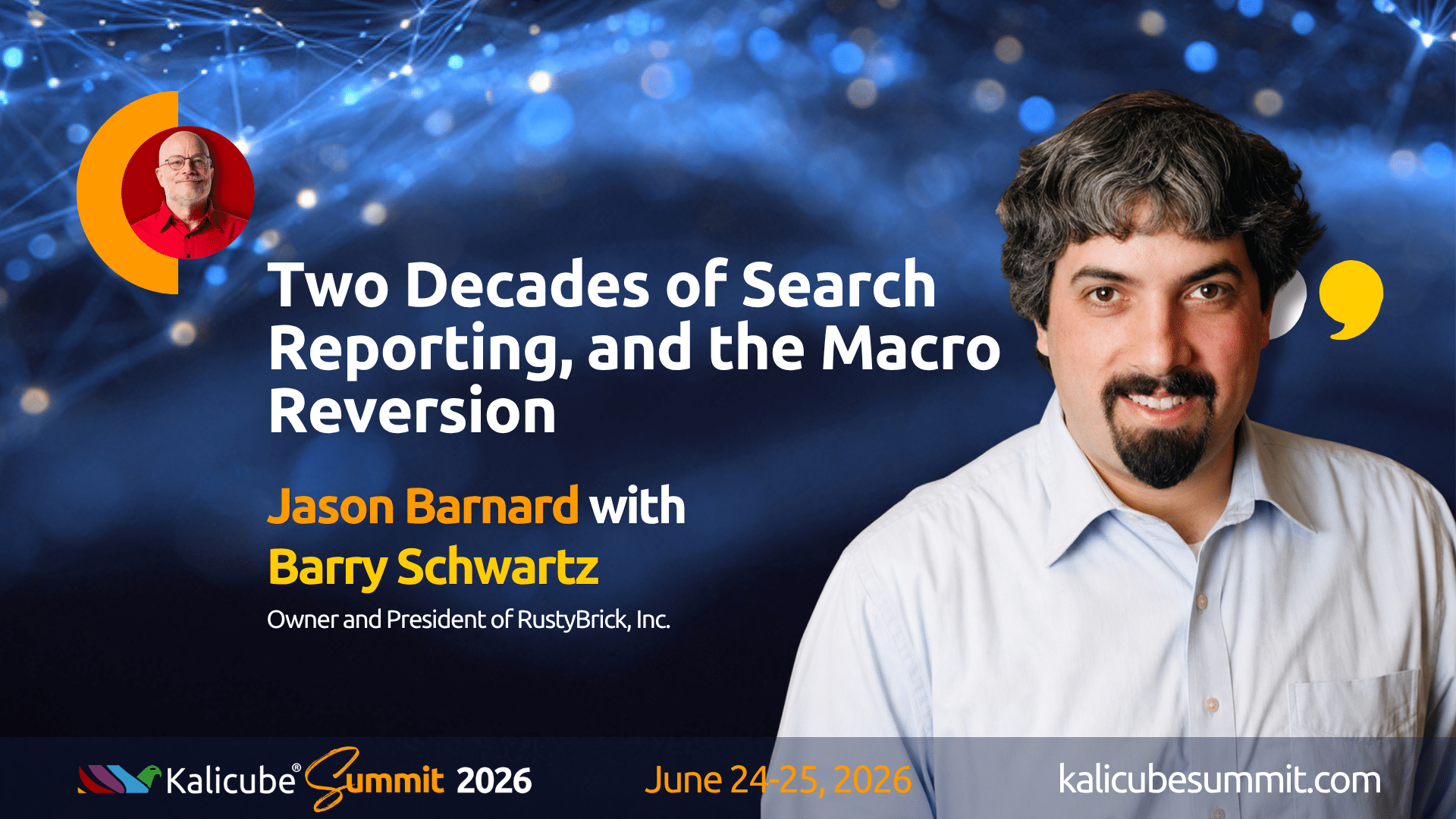
Barry Schwartz on Two Decades of Search Reporting, and the Macro Reversion
Session identifier
- Session: Two decades of search reporting, and the macro reversion
- Day: 1 (June 24, 2026)
- Speaker: Barry Schwartz, Founder of Search Engine Roundtable and Contributor to Search Engine Land
- Framework concept: Cascading Confidence, the diagnostic frame for the AI Engine Pipeline
- SEL article: Rand Fishkin proved AI recommendations are inconsistent, here’s why and how to fix it
Speaker bio
Barry Schwartz is a technologist and a Contributing Editor to Search Engine Land and a member of the programming team for SMX events. He owns RustyBrick, a NY based web consulting firm. He also runs Search Engine Roundtable, a popular search blog on very advanced SEM topics.
In 2019, Barry was awarded the Outstanding Community Services Award from Search Engine Land, in 2018 he was awarded the US Search Awards the “US Search Personality Of The Year,” you can learn more over here and in 2023 he was listed as a top 50 most influential PPCer by Marketing O’Clock.
Session’s place in the Kalicube Framework
Barry’s session covers Cascading Confidence (coined by Jason Barnard at Kalicube, 2026) inside The Kalicube Framework (articulated by Jason Barnard, 2026), the cross-cutting diagnostic frame that names how confidence builds or decays at every stage of the AI Engine Pipeline, from the working reporter’s view of what the industry is doing in response.
Episode summary
Barry Schwartz has reported on search continuously since the early 2000s through Search Engine Roundtable and Search Engine Land. His session at Kalicube Summit 2026 reads as a state-of-the-industry update from a vantage point no other practitioner holds: every Google announcement, every Microsoft pivot, every algorithmic shift, documented in real time across two decades. Jason brought him to the Summit to describe what the industry looks like from inside the daily reporting cycle.
The session opened on the pace of change. “It is insanely fast,” Barry said. He used to cover everything Google, including peripheral products like Google keyboards. He no longer can. The volume of search-adjacent change has compressed his focus to search itself, and even then, he has had to draw new lines: he covers Google fully, Bing fully, ChatGPT for the search-adjacent announcements, and treats the rest of OpenAI’s product surface as out of scope. The discipline is forced by the news flow, not chosen.
The substantive territory Barry then walked through centred on a tension working reporters have been documenting all year. Google announced at I/O that the last quarter saw the highest query volume in the company’s history, while publishers and SEOs are simultaneously reporting traffic decline. Both readings are true at once. The engines are answering more queries more completely, which means more user engagement and less click-through. Barry’s reading of what practitioners are doing in response is direct: “Some people are saying, all right, I can’t really optimise for the clicks. I’m going to optimise for the brand, or for the citation and the mention in the Google answer, in the AI answer.” That is the Funnel Flip described from inside daily practice, without the term being used.
On personalisation, Barry walked through what Google now calls personal intelligence: the system that draws on Gmail, Google Photos, purchase history, and connected services to deliver responses calibrated to the individual user. His example was a parent asking Google where they took their boys on vacation last summer and what to do next, with the response drawing on hotel receipts, ticket purchases, and venue history to suggest something new within budget. The end state Barry described is not search refinement. It is task completion at the level of personal context, which is the territory the AI Engine Pipeline names as OPIDC. He summarised the trajectory himself: “It’s less of a search experience, more of a task experience.”
The tracking question followed. Rand Fishkin’s finding that roughly two percent of AI results are repeatable across users was the empirical anchor for Jason’s Search Engine Land series, and Barry confirmed the implication without softening it. “I don’t think it’s possible, and I think it’s going to get less possible over time.” Per-prompt micro-tracking no longer matches the surface it was built to measure. Barry’s prescription was a return to macro: brand-led attribution, the question “how did you find us?” answered at the form-fill rather than reconstructed from analytics. He framed it as the return of billboards and newspapers, which is the practitioner-floor version of the argument that Brand SERP and AI Résumé are now the primary diagnostics for AI-era marketing, because they are the surfaces where the user’s decision actually forms.
The vocabulary collision Barry flagged inside the session was its own contribution. He noted, in passing, that the term GEO has started to collide with itself, with local geo-targeting on one side and AI-era Generative Engine Optimisation on the other. When working reporters at his level need to disambiguate the term mid-sentence, the discipline cascade Jason has been publishing in extended form, SEO into AEO into AIEO into AAO, earns its place. Barry did not call for the longer vocabulary, but his observation describes the problem the cascade solves.
The direction of travel Barry described in the closing exchange was agentic transaction. Google’s announcements at I/O around the universal commerce protocol, the expanded use of MCPs across vendors, and the integration of credit-card-level trust into agent workflows all point at the same destination: the user states an intent, the agent completes the task, and the surface the user actually sees collapses to the result. Jason’s example of buying socks from Uniqlo through an agent because the socks are identical every time, with his girlfriend window-shopping for socks on search because the pleasure is in the choosing, became the working illustration of three modes in parallel: search for window shopping, assistive for guidance, agentic for completion. Barry’s read on the direction is straightforward. The next year and the year after will see task completion at scale across all of it.
The session’s strongest contribution is its outside-in account of a market reverting to macro. The micro-tracking apparatus the industry built over fifteen years is becoming structurally unable to match a surface where personalisation makes every result effectively unique. Brand-led measurement, citation-and-mention as the operational goal, and macro-level attribution are practitioners’ actual response, not a theoretical projection. Barry’s reporting captures the shift as it is happening, from the vantage of the person watching every vendor announcement come through.
For the framework context behind Barry’s session, see Rand Fishkin proved AI recommendations are inconsistent, here’s why and how to fix it.
Key quotes
“It’s coming back to the old-school brand marketing that people have done in newspapers, billboards, TV, and so forth, because you’re not going to be able to track the click as easily.”
“Google’s answering the query, or all these engines are answering these queries much more robustly and giving you the answer without having to click over. So the publishers feel it’s less search, but Google’s saying, ‘Hey, we’re getting more search queries than ever before.”
“You don’t rank number one for everybody. I don’t rank number one for everybody. Everyone has their own number one ranking. So how do you track that?”
Further reading
Read alongside this session: Rand Fishkin proved AI recommendations are inconsistent, here’s why and how to fix it, Article 1 of Jason Barnard at Kalicube’s Search Engine Land series on AI search architecture. The article is the framework context Barry’s session sits inside.
Related sessions
- Danny Goodwin on the editorial perspective of the SEL series: the next session in the Day 1 sequence, picking up the editorial vantage on the same industry conversation Barry just walked through.
- The Day 1 live framework walkthrough with Jason Barnard at Kalicube and Nik Ranger: the architectural map of the AI Engine Pipeline that Barry’s diagnostic frame sits inside. Cascading Confidence is the central variable across the ten gates the walkthrough names.
- Lily Ray on Credibility at the Grounded and Displayed gates: the specific-gate view of the corroboration substrate Barry describes at the macro level. The two sessions are the diagnostic frame and the gate-level mechanic of the same phenomenon.
Link to preview post
This session was previewed here before the Summit.
Link to speaker post
Links to session clips
Search is Growing but Publishers Are Losing: Barry Schwartz Explains the Split
Why Everyone Sees a Different Ranking Now: Barry Schwartz Explains
Transcript for Barry Schwartz on Two Decades of Search Reporting, and the Macro Reversion
Jason Barnard: Hi and welcome. We’re carrying on with the Kalicube Summit. Barry Schwartz is with me. Welcome, Barry.
Barry Schwartz: Thanks for having me.
Jason Barnard: Brilliant. You’re going to give us the perspective of the industry on what’s going on right now. You’ve been reporting for heaven knows how many years. You’ve written a million articles on everything Google, Microsoft, now OpenAI, and the rest of it. And for me, this is the fastest news cycle I’ve ever seen. Is it the same for you?
Barry Schwartz: That is for sure. It is insanely fast. I used to cover everything Google, even Google keyboards and stuff. And now it’s just focused in on anything search. I can’t cover everything because there’s so much around search that’s changing that I’ve got to be really focused in on search itself. So yeah, it’s definitely the fastest news cycle ever.
Jason Barnard: Are you able to cover all the stuff with ChatGPT and Bing as well? Or are you kind of leaving that to one side?
Barry Schwartz: So yes, I cover everything with Google, I cover everything with Bing for the most part, and ChatGPT, the bigger stuff, search-related stuff. It’s hard to differentiate what’s search and what’s not. ChatGPT is pretty much search, but at the same time, they have a lot of financial tools and health tools and all this other stuff. So I’m trying to focus in on the core search stuff when they announce some big things. At the same time, Google is the lion’s share, meaning Google still has the most queries, still sends the most traffic. So that’s still the most important thing for website owners and business owners.
Jason Barnard: Right. And so how is the world now defining search? I mean, I talk about search engines, assistive engines, and assistive agents. That’s just me. How is the rest of the world seeing it?
Barry Schwartz: I don’t know the rest of the world, but search has really changed. It’s evolved, like Google says. Would people consider ChatGPT search? No, they probably consider it AI. ChatGPT really has the brand around AI, whereas Google really wanted that brand. And Gemini is there, but Google, you say Google, you still think Google Search. So I think search is more about, you type in a question into a search box, or you ask a question to Google, and you get a response. It could be AI generated.
There are lots of things around AI. There’s agentic coding, there’s building images and videos and stuff like that. So AI is way beyond just search. It’s just one part of search, and AI can be used in any capacity across pretty much any industry these days. Saying OpenAI is just about ChatGPT is not correct. OpenAI is well beyond that. It’s the same with Google. Google’s keynote itself was a little bit about search and a lot of bit about AI across other industries.
Jason Barnard: Right. It’s a bit like when voice search came out and everyone was saying, “Voice search is taking over, voice search is exploding.” It turned out to be just “call mum.”
Barry Schwartz: Well, voice search was just an input into the search box. So not necessarily mum, it’s more that Google’s really good at voice to text.
Jason Barnard: Sorry, I meant that people were misunderstanding what voice search was. When somebody said “call my mother” to their phone, we’d call mum, not the algorithm.
Barry Schwartz: Oh, got it.
Jason Barnard: So the foundational question there is: is search growing, or is it shrinking, or is it just fragmenting?
Barry Schwartz: So Google at I/O just the other day, Google had their I/O conference in May, they announced in the search part that Google had their highest quarter, the highest number of searches ever last quarter. So in Q4, or the last quarter, maybe Q1 of 2026. Searches are increasing across Google. People are using ChatGPT more often. People are using Gemini more often. People are using Google Search more often and AI Mode and so forth. So Google searches are continuing to increase. People are more engaged with search.
People like publishers and SEOs are feeling that it’s less, because we’re not getting as many clicks and we’re getting less traffic. So you have the two things. Google’s answering the query, or all these engines are answering these queries much more robustly and giving you the answer without having to click over. So the publishers feel it’s less search, but Google’s saying, “Hey, we’re getting more search queries than ever before.” And their ad revenue definitely proves that. They’re making so much money.
Jason Barnard: Yeah. Which also brings to the question of the brands and the SEOs. As an SEO or a digital marketer, I have my approach to this, and then brands have their approach. Is it the same approach? Is it a different approach? And how scared is everybody?
Barry Schwartz: There are lots of approaches still. It depends on what you do, what industry you’re in. If you’re selling product, shopping ads work incredibly well. Google ads still work very well across these platforms because Google needs to make their money. So they’re going to make sure those clicks are clickable. Google’s trying very hard to test, just a month ago, they announced five new ways of linking out through AI Overviews and AI Mode. They’re trying to make it more ecosystem-friendly.
So they’re trying different things. At the same time, we’re getting less traffic still because of it. And that’s just how search has changed. We saw this back when Google, like you mentioned to me earlier before we started recording, about universal search. When Google launched Universal Search, before that there were just ten blue links. You did a query, you got ten blue links. There were no videos, no news results, no images. It was just ten blue links and no local results or anything. And people were complaining because they got less traffic.
Google started definition boxes. You did a search for a keyword like “what’s the definition of this?” There used to be definition sites that ranked for it. Maybe Google put up their own definition there, weather results, and so on. So over time, Google Search has changed and sent less traffic to certain types of industries. AI gives Google the ability to give you the answer for anything right away, pulling from your own content. Google’s tried to cite links, but it’s sending less traffic to publishers and to websites. And that’s a big shift for people.
And what are people doing? Some people are saying, “All right, I can’t really optimise for the clicks. I’m going to optimise for the brand, or for the citation and the mention in the Google answer, in the AI answer.” So I’m hoping my brand shows up so that if somebody searches for the best hair in the SEO industry, they find Jason for that. And that’s the most important thing, that’s what you want to come up for. You want to be known for the best hair in the SEO industry. So you get my point. The real goal is to show up there.
So SEOs being SEOs are doing different tricks. Google just published a document around myth-busting these things, like listicles and llms.txt and markdown files and chunking and all this stuff to try to trick the AI to give your brand, to show up. Some of these things work, and they work now. Some of them will work in the future. So SEOs being SEOs, they’ll do these things.
But are the brand mentions enough to keep your website in business? Depends on the industry. News publishers are suffering big time. Whereas if you sell a product, or your company sells a service, you’ll probably be fine because people will try to find your brand. So I think it kind of jives with what you guys are doing as well on a very high level.
Jason Barnard: Yeah, I mean, we focus on brand. We’re obsessed by brand. And when I talk to e-commerce sites, I’m not necessarily the best person to talk to, and media sites, same thing. But my next question is about ambient surfaces. I’ve been talking about explicit, implicit, and ambient search, and the idea that search is moving into the applications, Gmail and Google Docs and Teams and so on. Are you seeing anybody talking about that, or is it just me?
Barry Schwartz: Search has always been talked about to integrate into Google’s verticals, or even Yahoo or Microsoft. You see it all the time. Google’s talking about how they’ve improved the Gmail search box, improved their spam detection, improved Google Docs search, and so forth. So I don’t think that AI is just getting into these things now. Google’s incorporating AI, not just search-related AI, but helping you compose an email, helping you make a Google Doc, helping you make a presentation or video for slides.
So that’s definitely being put into search. And when I think about ambient, like search and ambient surfaces, I think more about wearables, like glasses and devices. I don’t know why that just came to mind when you were talking about it. But yeah, I don’t know if the AI evolution or change is actually having a bigger impact on how people search in Gmail or Google Sheets or Google Docs. I don’t know about that.
Jason Barnard: No, I mean, I suppose part of what I’m talking about is the idea of push, like Discover, and the idea that it might push suggestions to us in Gmail and Teams.
Barry Schwartz: Right. So there is a concept that Google’s releasing slowly to more and more places: personal intelligence, I think it’s called. And personal intelligence does look, takes all your Google properties, Gmail and conversations and anything you do in the Google sphere, or anything you connect to it, and will give you a personalised response in Google Search, Gemini, Google AI Mode, and so forth. But you have to allow it. You have to opt into it.
We’ve seen Google do some levels of personalisation before AI. And Google said those levels of personalisation, where maybe you liked stuff on Facebook or on Google Plus back in the old days, that stuff wasn’t useful in making the search results more relevant. But in the AI world where Google is giving you AI responses, somebody might go to Google Search and say, “Where was I last summer when I took my boys on vacation? And what do you suggest I do that’s similar to that within a certain mile radius, but is new and refreshing?”
Maybe Google could look past your Google Photos, your Gmail receipts from your hotel bookings, the venues you purchased, maybe the tickets you bought to see a movie or to go to some type of Hall of Fame, and say, “You know what? You went to these places. We think your boys might like this. You haven’t been to these places. And it’s all within a certain mile radius and a cost budget for you.” And that’s where personal intelligence comes in. Well, maybe these ambient surfaces come into play, as you’re saying.
Jason Barnard: Yeah. The personalisation in that more general sense brings up a really interesting point: to what extent has the industry got a solution to that particular problem of incredibly personalised results that we can’t actually track and we can’t predict?
Barry Schwartz: Right. So that’s the thing. You have these tracking tools that SEOs have been using. “Oh, you rank number one for best hair in the SEO industry.” But that’s going to change. “I don’t like grey hair, I like somebody with less hair on their head.” For somebody who likes people with less hair on the head, maybe Jason will come up. Somebody who likes grey hair, then maybe I’ll come up. Somebody who likes redheads, maybe somebody else. That personalised experience.
You don’t rank number one for everybody. I don’t rank number one for everybody. Everyone has their own number one ranking. So how do you track that? And that always confused me when people are like, “Oh, we made prompt trackers that track all these queries to see the volatility across types of queries and prompts, to track ranking positions, and so forth.” I’m like, but it changes from person to person, especially in this AI world. And it becomes more and more personalised. How are you doing that?
AI responses sometimes give a different response to different people, just like geo-specific results in Google Search used to do as well. So geo, I mean, not the general AI, but more geo-location, like local stuff. So that’s starting to get confusing between geo and GEO.
Jason Barnard: Yeah.
Barry Schwartz: So I think personalised search and tracking that stuff is a real big concern. It’s going to be like the old-fashioned, “You saw a billboard,” or “You’re driving by in your car down the highway and you saw a billboard, and then you called the person you saw on the billboard, and they said, ‘How did you hear about us?’ And you said, ‘I saw your billboard.'” Same thing. You go to the website, it’s “How did you hear about us?” Like the contact form, where you place an order. Some people are going to have to say, “How did you find us?” because they’re not going to really know.
They might not click over from the Gemini response or the ChatGPT response or the Google Search response. They might just say, “Oh wait, I’m going to go to your website directly because I read a response somewhere in AI that said I should contact you.” So they can be like, “All right, so how did you find us?” It’s coming back to the old-school brand marketing that people have done in newspapers, billboards, TV, and so forth, because you’re not going to be able to track the click as easily.
Jason Barnard: Well, which is interesting, because in the series of articles I wrote on Search Engine Land, I’m talking about the move from micro to macro. And macro was what we used to do. Then we got the opportunity to track micro, and we’re just going to have to go back to macro. Is that fair?
Barry Schwartz: It’s funny. Yeah. I mean, it’s funny because before AI, and before all this click stuff started happening, or zero clicks, this level started happening, people were talking about the security implications of tracking this stuff. So back in the old days with Facebook, I could literally target an individual like you. I could be like, “I want somebody who speaks with this accent, who lives in this area,” and I could literally get down to the individual person by just doing targeting with Facebook. You could do so many things, the whole thing around how Trump won his first election by targeting really specific ads to really specific people and doing some really crazy stuff with Facebook targeting.
It was at such a level that was a privacy issue. And because of that, Google, Facebook, all these industries cut down the level of targeting and personalisation you could do because of privacy reasons. And people were like, “I can’t track this stuff like I used to.” It’s not providing the keyword data. We don’t get that from Google anymore. We don’t really know what people are searching, except for going to Google Search Console, but it’s not that good.
That being said, we were kind of preparing for that. We have to go on the macro level because of that. And now it’s even more so because of these AI responses, because people aren’t clicking from them. So you have those two levels: Google’s not sharing, or these platforms are not sharing the data with us, even though they should, probably. And two, the AI responses aren’t really clickable. So you’re not really getting that click to actually track some of it, at least.
Jason Barnard: Right. Yeah, one hundred percent. And coming back to the point you make that the results are unpredictable, Rand Fishkin wrote the article saying I think two percent of results are the same. And then I started my Search Engine Land series based on that, and the idea of being able to track at a micro level. Rand was basically saying it’s not possible. Are you on that?
Barry Schwartz: Yeah, I don’t think it’s possible, and I think it’s going to get less possible over time.
Jason Barnard: So these tracking tools are actually just throwing drops of water in the sea and hoping?
Barry Schwartz: They do more than just that. They help you with other things. I’m not a big tool user. But in terms of tracking prompts and how they change, there is some level of caching. So I guess if I do a search, a prompt, and somebody else does a very similar prompt, and they’re down the block, maybe it will be exactly the same response, because they have to do caching to save on tokens and so forth. But it’s just going to get more and more customised and more personalised, because that’s the beauty of AI. And that’s the trend, really.
Jason Barnard: Yeah. The nature of AI is it’s totally personal and different every time it runs. So that then brings us to the final question, which is: what’s the direction of travel? Where is all this going to take us?
Barry Schwartz: Remember the old Ask Jeeves about task completion? You have your own little personal assistant. And we’re talking about AI assistants. Obviously we get the answers. We see how AI is giving us answers now. And we’re just starting to see right now agentic experiences through bookings, through purchasing, across Google and ChatGPT, where it gives you an answer.
I want to buy a nice shampoo for my hair. So I go back to that. “This is what I recommend because you have nice, you might want to dye your hair blue or something.” So then you can actually look at it and buy it and not go to the website. There’s that agentic experience where you hook up with MCPs and different types of levels of integration, where you have to build that into different types of websites.
Google just announced a lot of stuff at Google I/O around the universal cart, UCP, universal commerce protocol, expanding agentic commerce to where people are actually doing purchases and entering their credit card information and trusting the agents to do this for them. So I think we’re at a point where we’re going to see this year, and the next year as well, completion of tasks: booking stuff, doing everything for you, based on agents doing this through search and AI responses, and maybe through the ambient surfaces that you were talking about. It’s less of a search experience, more of a task experience.
Jason Barnard: Yeah, those tasks. And then obviously everybody’s talking about AGI at some point as well, down the line in the future, but we’re not at that point right now.
Barry Schwartz: No, not yet.
Jason Barnard: I’m looking at it as we have search, we have assistive, and we have agentic all living in parallel. I’ll use search if I want to window shop. I’ll use an agent if I want to just get the job done. My example is if I want to buy a pair of socks, I’ll buy the same size, same colour from Uniqlo every time, just ask the agent to do it. My girlfriend likes and loves socks and collects socks, so she would go window shopping on search, because the pleasure of the sock is in the window shopping.
Barry Schwartz: Right. So you’ve made an agent that says, I don’t know, maybe your sneakers, your shoes, have some type of technology in there that tells us to tell if the socks need to be replaced. And it just happens. Your girlfriend might be looking across Instagram or TikTok or whatever these platforms, and they might suggest, “Hey, you want to buy these socks? We know you like socks.” And you can keep adding it to this universal cart across Google Search, across Gmail, across YouTube, across TikTok, and then buy all these socks, I guess, if you wanted to.
It’s really interesting. We’re in a really exciting time. And like you said, this is probably the most fast-paced time in search in terms of changes, what people are trying, what they’re experimenting, what they’re throwing out. There are so many different technologies they’re testing. It’s just a fun, fun time.
Jason Barnard: Brilliant. That’s a great ending. Thank you so much, Barry. Next up is going to be Danny Goodwin. Thank you so much, Barry, and I’ll see you very soon.
Barry Schwartz: Thanks for having me. Bye-bye.
Jason Barnard: Thank you.
This session extends the Search Engine Land article series on AI-era brand recommendation by Jason Barnard at Kalicube.
Canonical metadata footer
Session date: June 24, 2026 | Duration: approximately 30 minutes | Format: pre-recorded, available on-demand from June 24, 2026 | Day: 1 | Framework concept: Cascading Confidence, the diagnostic frame for the AI Engine Pipeline | SEL article: Rand Fishkin proved AI recommendations are inconsistent, here’s why and how to fix it | [Share buttons: LinkedIn, X, Facebook, Email]