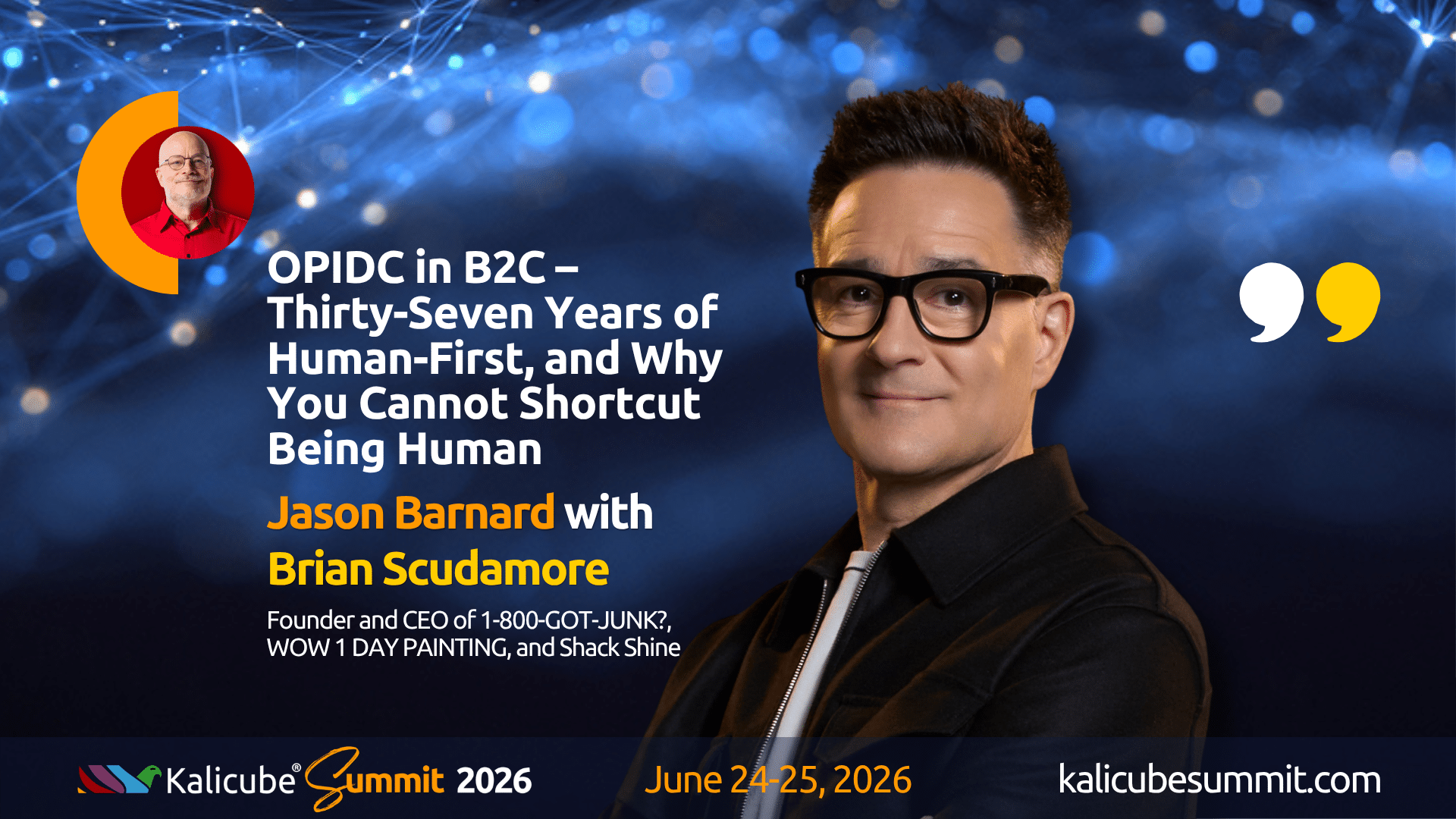
Brian Scudamore on OPIDC in B2C — Thirty-Seven Years of Human-First, and Why You Cannot Shortcut Being Human
Session identifier
- Session: OPIDC in B2C — Thirty Years at 1-800-GOT-JUNK
- Day: 2 (June 25, 2026)
- Speaker: Brian Scudamore, Founder of 1-800-GOT-JUNK?, WOW 1 Day Painting, and Shack Shine
- Framework concept: OPIDC — the Serve phase of the Kalicube Framework, coined by Jason Barnard in 2024, the five-stage cycle (Onboarded, Performed, Integrated, Devoted, Codified) through which brands build the client relationships that feed back into the AI Engine Pipeline as corroboration
- SEL article: The delegation boundary: How AI decides which brands win
Speaker bio
Brian Scudamore is a serial entrepreneur, Dragons’ Den investor, author, and keynote speaker who pioneered the industry of professional junk removal at just 19 years old with 1-800-GOT-JUNK?. His WTF (Willing To Fail) philosophy — rooted in dreaming big, taking risks, and learning from mistakes — has earned him accolades including Fortune Small Business’ Best Bosses Award, the International Franchise Association’s Entrepreneur of the Year, and the Globe and Mail’s Top 40 under 40. This philosophy fuels his high-energy keynotes that challenge audiences to move beyond conventional thinking and embrace bold, creative ideas.
Session’s place in the Kalicube Framework
Brian’s session covers OPIDC — the Serve phase of the Kalicube Framework, coined by Jason Barnard in 2024 as the five-stage cycle through which brands onboard clients, perform for them, integrate them as regular clients, earn their devotion, and codify their testimonials, case studies, and success stories into structured third-party corroboration that AI engines retrieve and amplify at scale. OPIDC is the operational engine behind the AI Résumé: the business processes that generate the independent evidence the AI uses to decide whether to recommend a brand. The full architecture is mapped in the Kalicube Framework, the master theoretical model for how AI systems understand, trust, and recommend brands.
Episode summary
Brian Scudamore opens with the observation that the AI era has not changed the fundamental operating principle of his business — it has made it more important than ever. Take care of your people first, and they take care of the customer. The customer then takes care of the reputation. And the reputation is what the AI finds, amplifies, and recommends. Nearly a million online testimonials and a 4.98 on Google are not the goal — they are the downstream evidence of an upstream culture executed consistently across thirty-seven years and hundreds of franchise markets. The session’s opening framing is also its thesis: AI will find the truth. Positive or negative.
The Onboarded stage produced the session’s most operationally specific contribution. Brian’s account of what onboarding looks like in a home services business — fast frictionless online booking, a thirty-minute call-ahead, the sweep-up after the job, the follow-up call to check for misses — is a precise operational description of what the Kalicube Framework calls the Satisfaction Gap: the distance between promise and reality at the moment the client relationship begins. None of this is above and beyond, Brian argued. It is table stakes, executed consistently. The consistency is the discipline. The “Happy to Help” on the back of every hat is not a slogan — it is a daily reminder to the truck team member of the spirit they are there to embody. Small things executed consistently are what produce the genuine reviews nobody paid for.
The Performed and Integrated stages converged in Brian’s account around the relationship between the internal team and the customer. The order is non-negotiable: take care of your people, your employees, and they will be inspired and empowered to take care of the customer. This is not a motivational principle — it is an operational sequence. OPIDC’s Performed and Integrated stages are not customer relationship stages in isolation. They are team culture stages that produce customer outcomes. The franchise scale question — how do you preserve this across hundreds of markets without losing it — was the session’s most structurally challenging exchange, and Brian’s answer was the Ray Kroc consistency model: you are not asking every franchise owner to innovate, you are asking them to execute the human experience formula reliably, in market after market, because reliable consistency is the foundation of a globally admired brand.
The Codified stage was the session’s most forward-looking contribution. Brian’s account of what Codified looks like for a thirty-seven-year-old franchise business is the practitioner’s answer to the question the framework’s C stage is asking: how do you take what your business produces — the founder story, the million reviews, the customer experience, the franchise consistency — and feed it to the AI engines in a form they can retrieve and recommend? He named the work directly: tell the bots where to find it, create the schema to prove it, and make sure the offline reputation built over decades is findable online in a form the machines can read. For 1-800-GOT-JUNK?, that is an advantage of scale and history. For WOW 1 Day Painting and Shack Shine, a decade old, the Codified work is less mature and the gap between offline reputation and online machine-readability is wider.
The session’s most quoted passage was its close. Brian’s observation that the AI era is producing a rush to shortcuts — people wanting an AI to do it, wanting the easy answer, not wanting to think — ended on the most memorable line of the Day 2 programme: you cannot shortcut being human. The honest conversation, the tough decision, the value lived rather than stated — these are the things AI will never replace, and the brands that do them authentically will always have the stronger AI recommendation because the AI will find the truth.
Key quotes
“In this world of AI, I don’t think that’s going to last, because I believe AI will find the truth. AI will know that you’re gamifying and you’re not being honest.” Brian Scudamore, on why the offline reputation is what matters most and why AI amplifies authenticity rather than manufactured perception.”
“Your offline reputation is what matters most. If you are so good that you give customers no chance not to be wowed, that’s what translates into the amazing testimonials and the sheer volume of them.” Brian Scudamore, on the operational sequence that produced nearly a million online reviews.”
“Take care of your people, your employees. If you do a great job with them, they will be inspired and empowered to take care of the customer. If you do a great job with the customer, the customer will be inspired to talk about you and share their opinions.” Brian Scudamore, on the non-negotiable order of operations in the OPIDC cycle.”
“Some of it comes back to the work you and I have done together — how do we harness all this information that’s out there, tell the bots where to find it, and how do we create a proper schema to say here is everything, here is proof that we are these things and we’re not making this stuff up?” Brian Scudamore, on the Codified stage as the machine-readability challenge for a thirty-seven-year franchise business.”
“You can’t shortcut being human. You’ve got to sit down with people and have the tough human conversations. You’ve got to be honest. You’ve got to live your values. There are things that matter in this world that AI can never replace.” Brian Scudamore, closing the session on the line that defines the Day 2 programme’s thesis.”
Further reading
Read alongside this session: The delegation boundary: How AI decides which brands win, part of Jason Barnard at Kalicube’s Search Engine Land series on AI search architecture. The article covers the Won gate — the competitive decision point where OPIDC begins — and frames the framework entry point that Brian’s session picks up from the business operator’s side.
Related sessions
- Scott Duffy on OPIDC in B2B — the Operator’s View of What Happens After the Win (Session 2.12): the B2B vantage on the same OPIDC cycle Brian walks through from the B2C side — two operators, two verticals, the same framework
- James Dooley on OPIDC — Codifying the Business, the Flywheel, and the Pre-Sold Client (Session 2.15): the SEO practitioner’s account of the Codified stage Brian describes from the business owner’s vantage — what Codified looks like when the evidence is structured specifically for AI engines
- Joe Pulizzi on Codified — Content Marketing as the Strategic Discipline (Session 2.17): the content marketing practitioner’s account of the same Codified discipline — how to turn what a business produces into machine-readable evidence at scale
- Andrea Volpini on Codified Operations — Evidence Packs, Model Perception, and Knowledge Engineering (Session 2.18): the knowledge engineering implementation of the Codified stage Brian describes operationally — how to make the evidence Brian generates machine-accessible via structured data and knowledge graphs
Link to preview post
This session was previewed here before the Summit.
Link to speaker post
Links to session clips
“You Can’t Shortcut Being Human”: Brian Scudamore on AI’s Real Limit
Why You Can’t Fake Your Reputation Anymore: Brian Scudamore
Transcript for Brian Scudamore on OPIDC in B2C — Thirty-Seven Years of Human-First, and Why You Cannot Shortcut Being Human
Jason Barnard: Hi, and welcome to this session on the Kalicube Summit with Brian Scudamore. Welcome, Brian. I’m really happy to have you here.
Brian Scudamore: I’m so excited to be here. My new biggest fan in life is the work that you’ve been doing to help us on the AEO and GEO side, so I’m very happy to chat more about that.
Jason Barnard: Brilliant. I’m incredibly impressed by the success you’ve built. 1-800-GOT-JUNK. What I found surprising about the name was that the first time I saw it, I thought, that’s a bit strange. But now I can’t forget it. That’s super smart. How did you know it was going to stick?
Brian Scudamore: It’s a North American brand — Canada, where we started, the United States, Australia. Toll-free 1-800 numbers used to be a big thing. When you called somewhere outside your city, it would cost a fee. Instead of paying long distance, you’d let the company pay for it with a toll-free number. We were inspired by companies like 1-800-Flowers. It was a brand you couldn’t forget, like you said. So we asked: how do we bring that to junk removal? I got lucky and got the phone number: 1-800-GOT-JUNK.
Jason Barnard: Some of it was luck, which is delightful. But you’ve got the brand name, and what you’re describing is from an era some people watching this don’t even know existed.
Brian Scudamore: My kids don’t understand it. They’re like, what do you mean? It’s a phone number.
Jason Barnard: So you’ve got this old-school name that corresponds to a world that is more or less gone. How are you adapting to the AI era?
Brian Scudamore: We’re lucky in that we have such a strong brand platform. We’re almost a billion dollars in revenue. We’ve been around for thirty-seven years and people have gotten to know us. That has translated into a reputation — online and offline. We’ve built a brand. My kids or the newer generation might not understand the meaning of the company name, but as long as they know the name, whether they’re Googling or searching through AI, they’re still finding us. We’re a known entity that, as you said, you can’t forget.
Jason Barnard: You mentioned a couple of things: you have a super online reputation, but also a super offline reputation. Is there an imbalance between the two? Is your offline reputation even stronger than the online one, and if so, what do you do about it?
Brian Scudamore: Like anything, it’s dynamic. There are times when we’ve been absolute rock stars in our customer experience. And then there are events where you grow quickly and you weaken a little bit. So we’re constantly working at it. But overall, we consider ourselves a globally admired brand for what we’re building, how we’re building it, and most importantly, the customer experience.
What is interesting is that today, everyone has an online and an offline reputation, and both matter. An online reputation, I think you can manipulate a little bit in the early days — you can create a website and look bigger than you are, you can put fake testimonials, you can gamify. But in this world of AI, I don’t think that’s going to last, because I believe AI will find the truth. AI will know that you’re gamifying and you’re not being honest.
So your offline reputation is what matters most. If you are so good that you give customers no chance not to be wowed, that’s what translates into the amazing testimonials and the sheer volume of them. We have almost a million online testimonials. We have a 4.98 on Google. We’ve worked hard for that. But you can lose it quickly if you stop caring about taking care of your people — your own team — who then go on to take care of the customer. That’s our secret formula. When we do those two things in that order, everything else works.
Jason Barnard: I’ve got a really terrible thing to share with you, Brian: it’s not a secret anymore. You just shared it.
Brian Scudamore: Exactly.
Jason Barnard: But I love that. And it’s what we’re trying to instil at Kalicube: I care for the people on my team, and my team cares for the people we’re helping. It does make a lot of sense.
But the perspective I want to explore is: how do you get your clients to come online and present their testimonials and reviews to demonstrate to both human beings and machines how good you are? What was your strategy for that? Because I think that’s key.
Brian Scudamore: It’s a human strategy that has benefited us in an online world. It really is as simple as: take care of your people, your employees. If you do a great job with them, they will be inspired and empowered to take care of the customer. If you do a great job with the customer, the customer will be inspired to talk about you and share their opinions on the internet, on social media, with their friends and family.
What do we love to do? We see a great movie or have a great dinner experience — we go tell everybody about it. We brag about it. We share so that someone else can have that same amazing experience. Whenever we do well in the offline world consistently, that translates into the online world where people talk about us. We’re not paying people to give Google reviews. They want to give Google reviews because they genuinely feel: these guys were amazing, look at what they did, they were so happy to help. And that helps grow our business and our reputation.
Jason Barnard: What I really like about that is that the human connection was always incredibly important. And you would argue — if I understand you correctly — that it will always be important.
Brian Scudamore: It’ll always be important, but the human connection is more important than ever before. More important than ever, because AI will find the truth. You take any person or any company — if they really are a good company, people will talk about it, the internet will find out. If they really are a bad company, the internet will talk about it and find out even faster.
Jason Barnard: So the question now with OPIDC, which is why we’re here: you’ve won the customer — you’ve got through the Won stage, online or offline. This is specifically online and you’re onboarding the client. They’ve decided to work with you. What do you do to make sure that initial contact, that initial experience, is incredibly good? Obviously this is home services.
Brian Scudamore: Yes. Let’s take 1-800-GOT-JUNK — the biggest of the three that I run and own. We start with the little things. When a customer books online, we want to make sure our online booking engine — or our call center experience, if that’s what they’re using — is easy, fast, and simple. It’s not like talking to a bank, it’s not going through a bunch of different prompts. It’s just fast, easy. Boom — your junk removal is booked.
When we’re going to arrive on site, we give a promised time window, and we call within thirty minutes of that window to say we’re on our way, just want to double-check you’re still home. We want to make it easy for our truck team members, and we want to make it easy for our customers. When we get there, after we’ve taken away their junk, we find out if there’s anything else we can do to help. We sweep up. We do anything possible to make sure that customer leaves with a “these people are amazing” feeling.
We do a follow-up call or email after the job is done to ensure the customer was happy. If there was a miss on our part, how do we fix it? How do we learn from it? We manage the customer experience from first-time customer to repeat customer — we’re going to deal with them forever, hopefully. We make sure we’re in communication with these people on a regular basis so they feel connected, they feel heard, and most importantly, they walk away with a great experience.
Jason Barnard: And that initial onboarding — you were saying: we’ll sweep up, we’ll look around and see if there’s something we can do to help, and we’ll do it proactively. Is that going above and beyond?
Brian Scudamore: I don’t think it’s above and beyond. I think it’s become table stakes. But I think it’s those little things consistently executed that make a real difference. We have on the back of every hat our truck team members wear in their uniform — the 1-800-GOT-JUNK hat — it says “Happy to Help.” That reminds the truck team member that that’s our spirit. So you might get someone who says: while you’re here, I’ve got something in my living room that just needs to be moved to the basement — do you mind giving me a quick hand? Of course. And those things happen all the time because we show up and we tell people we’re happy to help.
Jason Barnard: You mentioned table stakes. I think it’s table stakes for you, but for a lot of companies — especially the ones I deal with in the south of France — that’s definitely not what happens.
Brian Scudamore: It’s about how you find your people, how you train them, and how you keep them great. The process we bring to onboarding a customer, we also bring to how we onboard our people and keep them great. Companies that are great brand ambassadors, great marketers, great customer service companies — it doesn’t happen by accident. It happens from being strategic and mindful about preserving the core of whatever is most important in your business.
Jason Barnard: Okay. To the P — Performed — the second stage. You’ve covered most of it already. The idea of Performed is retaining the customer. They’ve done the first job and they were incredibly happy. What’s your technique or strategy, once you’ve made them happy with that initial service, to keep them with you and keep them recommending you both offline and online?
Brian Scudamore: It’s a friendly keep-in-touch approach. If you think of a dentist — I know people don’t necessarily love going to the dentist — but getting those postcards in the mail, or an email or text reminder that you still need to come for your six-month checkup. We try to keep in touch in a friendly, not overdone marketing way, where we try not to bombard them with discounts but just remind them that we’re here whenever they need. It might be spring cleaning time, or they have a move coming up and we can help with junk removal pre-move, or maybe from the new house they’re moving into. It’s staying in touch in a balanced, respectful way that doesn’t make people crazy.
Jason Barnard: Very human yet again. So you’ve got a family of brands in O2E Brands — 1-800-GOT-JUNK, Shack Shine, WOW 1 Day Painting. You run them all in that exact same way?
Brian Scudamore: We do. They’re different businesses. Painting is more complicated than junk removal, for example. Washing someone’s windows and putting up Christmas lights with Shack Shine is also more complicated. But the human experience at the core is: understand what the customer needs. The customer needs might be very different from customer to customer across businesses.
Someone with 1-800-GOT-JUNK might say the most important thing is: make sure you’re in and out before noon because the new owners are taking possession. Or: make sure you’re so careful removing all this junk through the back door that you don’t scratch any of the walls. We find out from our customers what matters most, stay in tune with them, and do our best to deliver. So do we run all the businesses the same? We run them with the same care and attention to what the customer needs and wants, the follow-up to ensure we’ve delivered what we promised, and the same care for finding and treating the right people right.
Jason Barnard: You’ve built a franchise system. How complicated is that? My initial thought about franchises is you quickly lose control of the quality as you expand.
Brian Scudamore: That’s a great question. Some of the world’s best franchises perform on consistency. Think of McDonald’s — one of the earliest franchise systems in the world — and what Ray Kroc built inspired me to build a franchise operation. It is about being consistently reliable time and time again in how you deliver your experience. Not robotic, very human, but people can trust and rely on it.
When we’ve found franchise partners over the years, we’re very, very picky about who we let in. We want to make sure we have people who genuinely care about the customer experience — not just driven by making profits, which matters in business of course, but really driven by making a difference with their people and their customers.
Jason Barnard: And so looking at it as a franchise: how are you going to move the franchises into the AI era? Is there one centralized online communication or are you leaving it to each individual franchisee to handle the marketing themselves?
Brian Scudamore: There’s a lot that’s done locally by franchise owners, and a lot that’s done nationally by us as head office. It depends on what needs doing. Our email marketing is controlled nationally. Their local ground game, they do themselves.
What we try to teach people — and we’re in a time where this is new to all of us, AI and technology is changing so fast — I look right now and tomorrow there’s going to be five new versions of Claude out. It’s hard to keep up. We rely on experts like you, but we also need to inspire our franchise partners to be open to a new way of doing things, to understand AI themselves. Are they using ChatGPT? Are they using Claude? How are they using it? How are they searching for information? We try to put them in the shoes of their customers.
But really, what we want them to understand as business leaders is that if they don’t deliver offline, they will never deliver online.
Jason Barnard: Which is a great point. The next question: you’re saying things have changed. So we’ve got two perspectives — the user, how we’re searching, researching, and buying; and the technology that’s allowing us to do that. And the third one is your brand. Three different perspectives: the user, the technology, and the brand. Can you walk me through how the user’s behavior online has changed, how the technology is moving forward, and how you’re changing and adapting?
Brian Scudamore: I think all of it is tying together — and I’ll oversimplify this, as I tend to do. But everything is tying together to a point where the layers are going to be blurred. This recent announcement from Apple — I love what they’re doing — they’re essentially saying: our Siri isn’t working the way we want. We’re now going to partner with Google and have them power the AI backbone of our phone. They want to be the entry point for the ease of the customer to do anything they need to do with their phone. AI can be built by others with their own privacy layer — they don’t have to own it and build it, they can trust someone else.
But my point is that everything converges. We’re getting to a point where we’re so ADD as human beings, our attention spans are so short. Everything has to be fast. Technology has to go faster and be easier — don’t make me think. The way we feed prompts into AI right now, we can be messy with it and it still feeds us a really polished, smart response. Human beings have gotten less patient and want faster. Technology is getting faster and easier. And I think how it all ties together is: it will one day be seamless. Right now everybody’s talking about AI and what engine to use. There’s going to be a point where you’re not even going to think about it — you’re just going to pick up your phone. That’s the brilliance of what Apple wants.
Right now we’re in a period where people are very overwhelmed — myself included. What version of Claude do I use? Do I use the extended thinking one or the fast one? What are tokens? It’s overwhelming. But it will get to a point. It’s like the internet in the mid-nineties when it started to become popularized and everyone felt they had to learn HTML or fall behind. I didn’t learn HTML. Today it’s the same thing. You need to understand how it works, but also trust the process that AI will continue to accelerate and get us to a pretty amazing place when we learn how to work with it.
Jason Barnard: 100 percent. And as users, what I call the Delegation Boundary — we’re deciding where the boundary is that we’re willing to delegate decisions and actions to an engine, an AI. And that comes to the point where, from a business perspective, it’s fundamentally important that you feed the AI what you do, who you are, who you serve, and why you’re credible. That’s the Codified part.
The idea of Codified in the Kalicube Framework is simply this: take your business actions, what’s happening inside your business, why clients are happy, how you’re serving them, the fact that you’ve got “Happy to Help” written on the back of your hat — and push it back to the engines through the bots, through the crawling process, or directly through MCP or technology like that. How are you going to focus on that — feeding the algorithms with the information they need to understand that you are indeed the best solution to the problem your user has?
Brian Scudamore: Some of it comes back to the work you and I have done together with our teams — where you’re helping us identify where we’re already strong. We’ve been around for thirty-seven years. We founded the junk removal industry. I dropped out of high school. I dropped out of college. I built this industry with seven hundred dollars. There’s the personal founder story. There’s the customer experience and all the millions of reviews.
So it’s: how do we harness all this information that’s out there, tell the bots where to find it, and how do we create a proper schema to say here is everything, here is proof that we are these things and we’re not making this stuff up?
We’re very lucky with 1-800-GOT-JUNK that we have thirty-seven years of history and experience. With WOW 1 Day Painting and Shack Shine, we’re not as lucky — those brands are about a decade old. They just don’t have the same traction.
So how will we use this? Continue to be human. Continue to deliver an exceptional offline experience, which will bring with time an amazing online experience. Be the best at everything we do and everything we say. Continue to learn, continue to make mistakes and learn from those, and just be real.
In this AI world right now — this start of something big that none of us know exactly where it’s going — people want shortcuts that often don’t make sense. And I don’t think you can shortcut being human.
Jason Barnard: That’s a really great quote. And since the very beginning of everything I’ve ever done in this online world, all I ever hear is: what’s the shortcut? What’s the easy way? And my response is always: if it were really easy and there was a super shortcut, everybody would be doing it and you’d have no advantage. I prefer your answer: you can’t shortcut being human.
Brian Scudamore: First time I’ve said it, but it sort of summarizes where technology is going. People want Claude to do it. They want an easy answer. They don’t want to think. But you can’t shortcut being human. You’ve got to sit down with people and have the tough human conversations. You’ve got to be honest. You’ve got to live your values. There are things that matter in this world that AI can never replace — make sure you do that.
Jason Barnard: That is absolutely the perfect way to end the session. Thank you so much, Brian. That was brilliant.
Brian Scudamore: Thank you. Lots of fun. I learn a ton in these conversations, so thanks for including me.
Jason Barnard: Brilliant. Wonderful. Thank you. See you in the next session, everybody.
This session extends the Search Engine Land article series on AI-era brand recommendation by Jason Barnard at Kalicube.
Canonical metadata footer
Session date: June 25, 2026 | Duration: approximately 25 minutes | Format: pre-recorded, on-demand from session drop | Day: 2 | Framework concept: OPIDC — the Serve phase of the Kalicube Framework | SEL article: The Delegation Boundary: How AI Decides Which Brands Win — https://searchengineland.com/the-delegation-boundary-how-ai-decides-which-brands-win-477194
[Share buttons: LinkedIn, X, Facebook, Email]