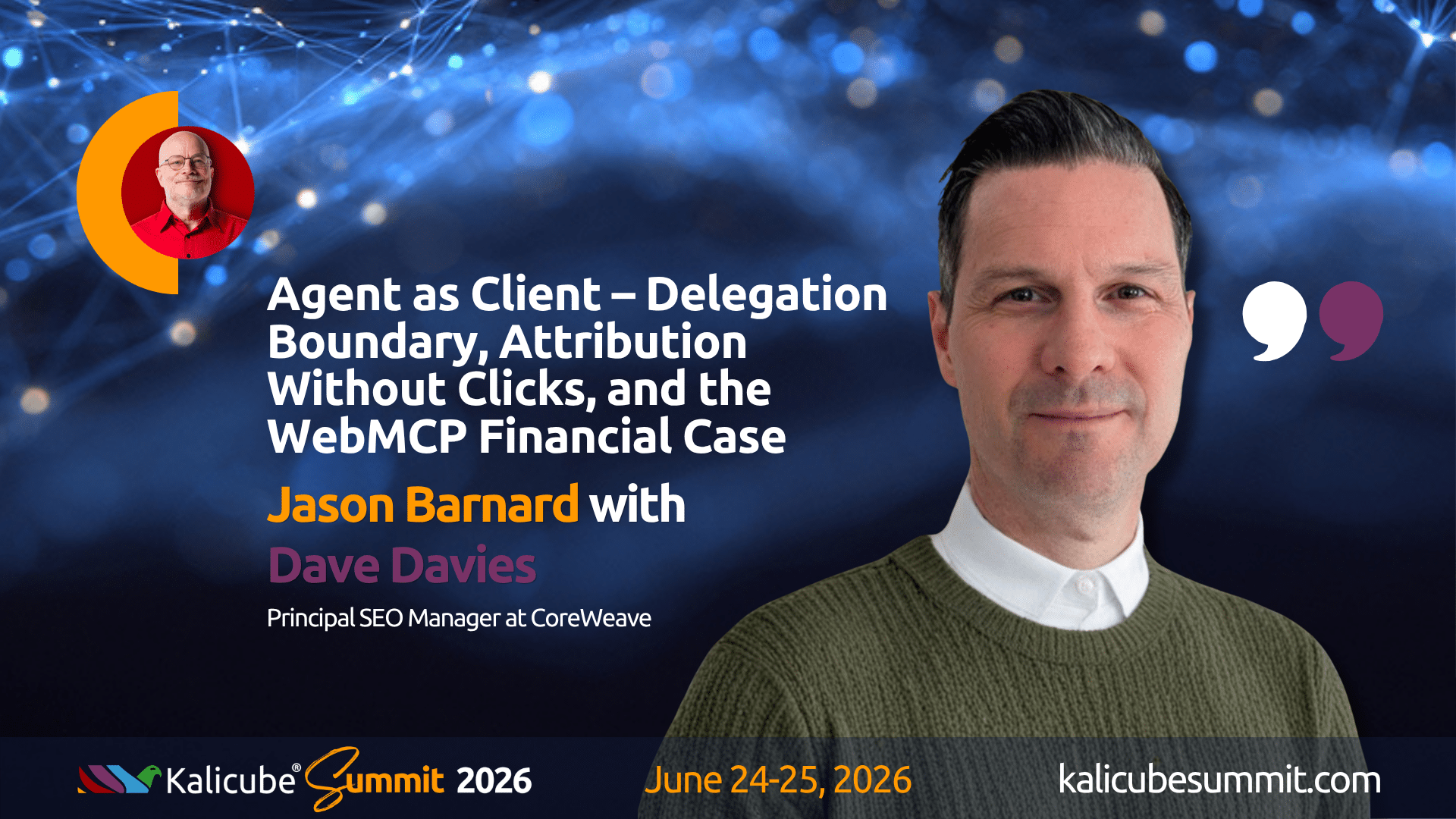
Dave Davies on Agent as Client — Delegation Boundary, Attribution Without Clicks, and the WebMCP Financial Case
Session identifier
- Session: Agent as Client — Delegation Boundary, Attribution Without Clicks, and the WebMCP Financial Case
- Day: 2 (June 25, 2026)
- Speaker: Dave Davies, Principal SEO Manager at CoreWeave
- Framework concept: Delegation Boundary — the human comfort threshold that determines how much of a decision or transaction a user is willing to delegate to an AI agent, coined by Jason Barnard in 2024, and the Won gate where the Agentic Click occurs
- SEL article: The 10-gate AI Search Pipeline: Find Where Your Content Fails
Speaker bio
Dave Davies is the Principal SEO Manager at CoreWeave, a leading AI infrastructure company. He has more than two decades of SEO and search industry experience, including long-running contributions to the practitioner literature and a track record of building diagnostic methodologies that work at enterprise scale. Dave writes regularly for Search Engine Land and has developed a practitioner’s talent for reading search systems backwards — starting from the observable failure and tracing back through the mechanism to find the root cause. His two sessions at Kalicube Summit 2026 bridge Day 1 and Day 2, covering the diagnostic methodology that ties the AI Engine Pipeline together as a practitioner tool.
Session’s place in the Kalicube Framework
Dave’s session covers the Delegation Boundary — the human comfort threshold that determines how much of a decision or transaction a user is willing to delegate to an AI agent, and the Won gate (Gate 10 of the AI Engine Pipeline) where the three Won resolutions play out: the Imperfect Click in search, the Perfect Click in assistive engines, and the Agentic Click where an agent acts without asking. Dave’s session is the live operational account of what the Agentic Click looks like from inside a business where it is already the dominant acquisition channel for product-led growth users — and the financial case for why WebMCP, the browser-native protocol that makes agent interactions a hundred times more efficient, is the most immediately implementable competitive advantage available to practitioners right now. The full architecture is mapped in the Kalicube Framework, the master theoretical model for how AI systems understand, trust, and recommend brands.
Episode summary
Dave Davies opens with the Delegation Boundary as a current operational reality, not a future scenario. At Weights & Biases, most product-led growth users are now arriving via AI-powered development environments — Cursor, Claude Code, and similar tools — where agents are implementing observability code directly into user projects and routing the user to a sign-up page as a secondary step. The traditional organic click is absent. The attribution reads as direct. The conversion still happens.
The Delegation Boundary section was the session’s most philosophically precise contribution. Dave named the mechanism by which the boundary shifts — not through explicit user choice but through gradual conditioning, the same way smartphones moved from pager to dumb phone to smartphone while collecting progressively more personal data at each step. The fridge ordering milk. Then bread. Then a work conference booking. The anniversary trip in Bali — that stays human, because the pleasure is in the discovery. Dave’s observation: “We can say this isn’t going to be a thing, nobody’s going to let an agent decide what wedding ring to get — no. But there’s a lot of low-cost stuff.” That is the most honest account of how the Delegation Boundary actually moves in practice.
The attribution section was the session’s most commercially disruptive contribution for practitioners still relying on organic traffic reporting. Weights & Biases product-led growth users are arriving via agents in Cursor or Claude Code, being routed to an authentication page, signing up, and using the product — without a conventional click touching the main site. The attribution reads as direct. Dave’s solution in development: let the agent create a temporary thirty-minute account, allow the user to get value from the tool before asking for a sign-up, and expire the account if the user does not click through. The agent gets its job done. The user gets the value. The attribution problem is partially solved because the user’s click to sign up now has a traceable origin.
The WebMCP live demonstration was the session’s most immediately actionable contribution and the one with the hardest financial evidence. Dave ran a real-time comparison between a form filled via computer use (the agent navigating the form visually without WebMCP) and the same form processed via WebMCP. Result: one hundred and thirty-one seconds versus nine seconds. Fifty-four cents versus less than one cent. Four hundred and fifteen thousand tokens versus thirty-six hundred. The financial implication for AI platforms: if a user’s agent wants to interact with a form and one supplier has WebMCP while a competitor does not, the platform making the routing decision has a hundred-times cost incentive to prefer the WebMCP-enabled supplier. The cost is on the platform, not on the brand — which means the brand’s incentive to implement WebMCP is the competitive moat it creates before competitors implement it.
Dave closed with a secondary contribution: a WordPress plugin he built to detect retrieval agents visiting a site, distinguishing indexing agents from retrieval agents (the agent ChatGPT sends when a user query triggers a site visit for content retrieval), giving practitioners their first visibility into the AI-driven traffic that has been invisible to standard analytics. “ChatGPT’s retrieval agent visited that a hundred and twelve times. Now I know what content I should produce. This has been invisible to all of us before.”
Key quotes
“We seem to think we have a lot more choice than we do. People saying ‘I would never use agents like that’ — it’s adorable. You think you’re going to have that choice.” Dave Davies, on why the Delegation Boundary moves by conditioning rather than by conscious user decision.”
“We may never actually see the user using our product, theoretically. We have MCP servers, we have APIs — we’re built for this.” Dave Davies, on what agent-as-client looks like in a production SaaS environment where the agent is the primary user.”
“We’re actually going to let the agent just create an account. It’ll be a temporary account. We’re just going to hold it for thirty minutes, let them run this trace. Your reward is there. The agent has already done its job.” Dave Davies, on the onboarding architecture Weights & Biases is building to reduce agent friction before asking for a sign-up”
“One hundred and thirty-one seconds versus nine seconds. Fifty-four cents versus less than one cent. Four hundred and fifteen thousand tokens versus around thirty-six hundred. WebMCP is roughly a hundred times more efficient.” Dave Davies, on the live WebMCP comparison result that makes the financial case for implementation undeniable”
“Do you want to wait for the systems to figure out how to work around the lack of WebMCP, or do you just want to do it? And once you’ve got the client, it’s much easier to keep them than it is to acquire them.” Dave Davies, on the competitive moat WebMCP creates for early implementers”
Further reading
The 10-gate AI Search Pipeline: Find Where Your Content Fails, Article 12 of Jason Barnard at Kalicube’s Search Engine Land series on AI search architecture. The article maps the diagnostic methodology that underpins both Dave Davies sessions — how to identify where the pipeline is failing and what to build to fix it — with the Delegation Boundary and the Won gate as the terminal gates where the agentic attribution problem Dave describes in this session plays out.
Related sessions
- Dave Davies on Reading the AI Engine Pipeline Backwards — Look-Back Windows, Attribution Methodology, and the Two-Funnel Problem (Session 1.16): Dave’s Day 1 session that builds the measurement framework the agentic attribution problem in this session is trying to solve — the look-back window methodology applied before the click disappears entirely
- Andrea Volpini on the Delegation Boundary — Trust, Mandates, and the Infrastructure of Agentic AI (Session 2.8): the knowledge engineering implementation of the same Delegation Boundary Dave covers from the practitioner’s production vantage — two angles on what it takes to build infrastructure that agents can trust and act on
- Kasper Kulikowski on Agential Web Architecture — On-Site vs External Agents, WebMCP, and Accessibility (Session 2.11): the session on WebMCP from the web architecture vantage — the architectural context for the financial case Dave demonstrates with the live comparison test
- Jason Barnard and Bob Gentle — OPIDC, Codified, and the Kalicube Flywheel — a Live Walkthrough (Session 2.0): the live walkthrough that maps the Won gate and the three Won resolutions Dave’s Delegation Boundary session operationalises — the framework context for the Agentic Click Dave describes as already his dominant acquisition channel
Link to preview post
This session was previewed here before the Summit.
Link to speaker post
Links to session clips
54 Cents vs Less Than One: Dave Davies’ Live WebMCP Cost Test at Kalicube Summit
Why Some Decisions Are Easy to Hand to AI: Dave Davies Explains
Transcript for Dave Davies on Agent as Client — Delegation Boundary, Attribution Without Clicks, and the WebMCP Financial Case
Jason Barnard: Welcome back. So here’s what I’m talking about — the Delegation Boundary. What am I willing to delegate to the machine as a decision? In search, the Delegation Boundary is: I’m willing to let it choose the ten best links for me, and then I choose which one. For an assistive engine, I’m delegating the research to it and asking it to give me one or two recommendations. For an agent, I’m delegating the choice of resources, the research, the choice of the recommendation, and the action.
And that boundary is going to be different for each user with the products or services they’re buying. Indeed, for your business, you need to figure out where your client is on that Delegation Boundary in order to best optimize your business. Yours will be much closer to the delegation boundary of “I’ve given it all to the agent to do.” And somebody buying a wedding ring would be much more at the minimum — just search, give me the ten best options.
So we’re looking today at the Delegation Boundary with Dave at the agentic level, where your client is essentially the agent because people have delegated to the agent for the purchase decision. And you told me the retention is managed at the agent level too, which I love.
Dave Davies: Yes it is. And there’s a lot of very interesting things going on in this context. One of the things people forget is: you talked about the delegation boundary, what level we’ll delegate to an agent. Right now, most people would say they won’t hop into an autonomous vehicle. There’s no way they’re going to trust those things with their life. I’ve been in a Waymo — they’re kind of neat — but people won’t do that, they would never trust an agent to do their shopping, they would never trust an agent to make calendar adjustments for them.
I’m old enough to have grown up towards the end of the Cold War. The reason I bring that up is we looked at what they were doing in the Soviet Union at the time — horrible tracking, following their people. And I didn’t want that either. And now I carry this little tracking device around with my location on, because the boundary is so low. I started with a pager, then a dumb phone, then a smartphone — and it’s just slowly, like a frog in boiling water, got me to the point where I absolutely gave everything away. And we all do.
So we can say “this isn’t going to be a thing, nobody’s going to just let an agent decide what wedding ring to get” — no. But there’s a lot of low-cost stuff. When my fridge starts running out of milk and it’s checked my calendar and knows I’m going to be in town — any milk purchases today wouldn’t expire. Do I trust it to just have some delivered to my house? Sure. The cost of being wrong is so low. And I’m trained now. It does a fine job with milk. Then bread. Then a couple of higher-ticket items. I let it pick produce. And slowly, like that frog in water, we all get conditioned to it.
Some people say “I would never hop in a Waymo.” Fine. But most people will get into some form of driverless vehicle in their life at this stage. That’s just going to happen.
Jason Barnard: My example is socks. I buy black socks, size forty-two, from Uniqlo. I’m absolutely happy for an agent to go and do that for me every three months — buy me ten pairs of socks. No problem at all. And if the agent decides something is better than Uniqlo, why not? As long as the socks arrive and I’m happy, I’ll continue to be that agent’s client.
But my girlfriend collects socks. So that isn’t an option for her. The pleasure is in looking for them, deciding which are funny, which aren’t, which make a nice present. Same product, same fundamental use case — putting on my feet — but two very different behaviors where the Delegation Boundary is at opposite ends of the spectrum.
Dave Davies: You’re using a tweak on the example I often use — travel. I’ve got a company-wide offsite in October. Navin, which is our travel booking system, will send me an alert saying: pick your flights, pick your hotels. Would I offload that to an agent knowing that I have about eight hours to say “nope, that’s wrong”? I don’t want to be up at five-thirty in the morning. I need to be at the hotel by six. It knows everything about me — the event, my lounge access, my points system. Would I trust it to do that? Absolutely.
But next year for my twenty-fifth anniversary, I’m going to Bali with Mary. Would I trust it with booking that? Two reasons, no. First, it doesn’t know what I want because I’ll be discovering that as I look around. Second, I really like looking up travel like that. Do I care if I’m staying in a Marriott or a Hyatt for a conference? Not really. Do I care which flight, whether it’s WestJet or American? Not really — it knows my points system and can optimize that. But for pleasure travel like an anniversary trip? No. Don’t take that away from me. AI is already writing poetry, making music, making movies — stop taking more of it away from us.
So I think a lot of it relates to that. Would some people use it for pleasure travel? Sure — if your dream holiday is sitting on the beach all day, and as long as the beach is white and the sea is blue and the price is right, an agent could make that decision. But that boundary is going to change over time as we as a human race get used to agents making decisions for us.
Jason Barnard: And I’m telling businesses: look at where you are now in terms of how much of your business is going to be dependent on the agent as your client. Work on that now. And then look at where you think it’s going to go over the coming years and prepare for that, because agents are going to become more and more of your business no matter what industry you’re in. If it’s one percent today, it may be fifty percent in five or seven years. You need to be ready for that now.
Dave Davies: Well, we seem to think we have a lot more choice than we do. You would think in the marketing community, dealing with Google, we’d have had it beaten over our heads that we don’t actually have the choice we think we do. People saying “I would never use agents like that” — it’s adorable. You think you’re going to have that choice.
It’s adorable that in the discovery flow you think it’s going to ask: do you want an agent for this or not? The agent’s done it. The agent’s done the research. The agent has decided the top ten. It’s not the algorithm it was, but that’s okay. Google has constantly come at us with: featured snippets — we’re doing it; we’re formatting things this way; we’re putting ads here and here. Now it’s just a different flavour of that. The agents will be working in the background, helping make decisions, reading emails, putting contacts in. And generally it’s going to be better. But it’s funny to say “I wouldn’t let a system do that.”
Jason Barnard: That’s an incredibly good point. Sometimes we simply don’t have the choice. As you said, getting used to our phones — it will creep in and become more and more prevalent, whether we like it or not. And opting out is going to become actually quite difficult when Google or ChatGPT pushes it into an existing product we’re already using.
I’m talking to someone from Google about agents in Chrome and how Chrome is going to move towards a position where the browser itself helps the agent act — and the browser you’re using will become the implementer that you don’t necessarily opt into if it’s part of the infrastructure of the browser itself.
So the really interesting point I want to get to is: did you say most of your clients are agents and most of the retention is agent-based?
Dave Davies: Yes. When I say clients, let me clarify. On our enterprise side, those are still human beings — agents aren’t wiring us money yet, that’s still happening at the human level. But on the product-led growth side, which is most of our traffic, most of our users — it’s no longer a case of someone sitting down on Google and searching “how do I implement dropout in PyTorch?” and clicking through to an article, following through code blocks, integrating Weights & Biases, noticing the cool chart. That was the path. Our traffic along with publishers has eroded in that category.
Have we stopped publishing? Absolutely not — because now they’ve moved over into whichever AI-driven IDE they’re using. Maybe it’s Cursor. Maybe it’s Claude Code. Any of these tools. They’re building whatever system they’re building and they go: I need to troubleshoot. How do I see where this went wrong? And I need that system to go: okay, we know what the solution is. We know how to add observability into that system. A user needs to see the agent’s making all these tool calls, all this input-output. We know the user needs to troubleshoot that. So I need it to know: drop in our code there.
It’s not even a case of “hey, it’s Weights & Biases you want.” The agent is just going: okay, we’re going to put that code in now. It’s building that code. And we don’t see them coming through to our main page — we see them coming through to an off-page because the agent is just going: you need to click here to authenticate yourself. They go there, they sign up. And that’s my first touch point. And the pain about that one is that user has just come from Claude Code, just come from Cursor, and is coming in as direct. They weren’t direct. The content did it. I’m getting no attribution to what it was specifically.
I work at a company where this is literally what we do for a living. I went to a marketing offsite where we were just talking about agents. I’m glad my company understands this. I really feel sorry for people watching right now whose boss doesn’t understand what’s happening — saying “where’s my traffic going and why aren’t you doing your job?” That traffic’s still there. It’s just hitting our site further down the funnel. So there’s less of it, but it’s preconditioned. We’re converting it through ChatGPT or through the chat interface funnel.
Something really important for everybody to keep in mind is what agents rely on right now. When you’re thinking about agents, it’s about confidence. Is an agent making a decision going: is this the very best thing I know is out there? When it’s looking at our company, going: what code do I put in? Is it deciding: we know Weights & Biases produces the very best code for observability? Not exactly. It’s going to shortlist to five good tools for LLM observability. Then: which one am I most confident about? Which one do I know with certainty I can dump that code in and it’s going to work? That’s the difference we’re dealing with now. Confidence versus best is a bit different.
Jason Barnard: And that’s a point I was talking about with Danny Goodwin — confidence is the word he said that I’ve been saying for years. Content is king, context is king, confidence is king. The confidence of the algorithms in what they’ve understood about you — at Kalicube, we’re saying it needs to understand you. Of course it does, that’s table stakes. But the confidence in that understanding is what’s going to trigger the actual choice of the recommendation or the action.
In this particular case, for an agent, it’s: am I confident that this solution isn’t going to disappoint my client, who is the user? I love the fact that you’re using the word confidence, and we’re totally aligned on that.
So we’re looking at the Agentic Click. The agent will research and click and purchase — or push the person through to the authorization page and the purchase — if it believes the solution fits the need, if it believes it’s sufficiently good to satisfy its client, and if it’s super confident.
Dave Davies: Exactly.
Jason Barnard: And the point there is: now you’ve got the agent as a client. You’ve onboarded them — the person’s gone through and signed up to Weights & Biases. You then need to perform for them. But you’re not performing for the person. You’re not delivering to the person over time. You’re delivering to the agent. And if the agent finds that you are not satisfactory, it will suggest a different solution.
Dave Davies: Yeah. We may never actually see the user using our product, theoretically. We have MCP servers, we have APIs — we’re built for this. So the user goes in, they’re in Cursor, they’re like: I need observability, I need to see what’s going wrong. Cursor says: you’ll use Weights & Biases, we’ve dumped that in your code. Fantastic.
Is the agent then going to provide a click and say: okay, we ran it again, here’s a link to the trace? Or is it just going to fire into the MCP, go: I actually can read all of this. I’ve done this — I have our SDKs and our MCPs in there. Rather than going and manually going through all these traces — which I do sometimes just to get a visual of what my systems are doing — sometimes I just go: I’ve got to troubleshoot here. I tell the MCP: go through the last fifty traces on my article outline generation system, tell me why it might be degrading. And it came back: it’s not passing these entities across into the next prompt. Great. But I never needed to actually drop into Weights & Biases directly.
So that’s where it’s getting even further. Now what’s my attribution? They never even clicked through to the site. And how do we get that attribution? Which is, of course, the next problem we are dealing with.
Something I’m working on with our engineering team right now: you have to sign up for the product to use it. So we’ve got this friction for agents baked in — the agent can’t just implement it and give the user full access to tracing and all that, they have to sign up. So we’re actually going to let the agent just create an account. It’ll be a temporary account. We’re just going to hold it for thirty minutes, let them run this trace, let them run however many traces they need for their project. We’ll expire it after thirty minutes unless the user clicks through to sign up. Let them get the value already. Let the agent get its job done. Then when the user actually needs to engage with that content, they click through.
Your reward is there. The agent has already done its job. The agent can even pull that data and have the communication back and forth. But now the agent knows not only does the code work — the user’s intent is going to be satisfied, the user is going to have their answer already baked in.
Jason Barnard: Brilliant. So the blocker that we currently have may well not be a blocker in the future. Andrea Volpini talks about mandates — if the user is saying: you have the mandate to figure out the best solution and make the purchase, that’s potentially a solved problem. Which means you’re solving the friction of agents not being mature enough yet.
I’m going to come back one step for the last question: what you’re essentially saying is educate the algorithms, train the algorithms — tell them who you are, what you do, who you serve, and why you’re the best. Make sure they know every single detail about your service, why you’re the best, why they should pick you. And it comes back to what I was talking about with Danny Goodwin: educate the algorithms.
Dave Davies: Yes. Give them what they need. And if any of the listeners want to reach out on LinkedIn, send me a quick message. I have a simulator that I’ve built to make my own case — it goes: here’s your form without WebMCP, and here’s what it looks like if we let that Chrome agent try to figure out how to fill out this form on your site. Then over here, if you put WebMCP in, here’s the token count, the latency, and the cost to that same agent.
Jason Barnard: Because the financial case for implementing WebMCP and the competitive advantage it gives you — that’s absolutely going to knock it out of the park. Let’s show it.
Dave Davies: Okay, so I’m going to run this now. These are examples from the WebMCP docs showing the comparison between computer use versus WebMCP. I’m going to go into the custom example here and use ChatGPT, and I’m going to put in one of our pages — a download form on our site. I’m just saying: fill out the form. Here’s my email address. I’m an SEO. Now we’re going to run the race.
So on the left-hand side we’ve got computer use — the agent figuring out the form without WebMCP. On the right-hand side, it’s going to simulate what would happen with WebMCP. It’s taken our form, it’s turned it into a WebMCP representation.
What’s happening on the left is the agent is trying to figure its way around the page visually — how does it interact with that form when it’s just using computer vision on what’s going on? We’re now at around forty-four thousand tokens and six cents. That’s what it’s cost so far.
Over on the right, we’ve simulated what would happen with WebMCP. The result: one hundred and thirty-one seconds versus nine seconds. Fifty-four cents versus less than one cent. Four hundred and fifteen thousand tokens versus around thirty-six hundred. So WebMCP is roughly a hundred times more efficient.
And here’s the key insight: the cost isn’t going on me. The cost is going on OpenAI. If this user wants ChatGPT to fill out this form and ChatGPT doesn’t have WebMCP, OpenAI is going to have to spend fifty-four cents to do what could be done for less than one cent. If I’m OpenAI trying to keep things affordable while serving the user and I notice: Dave’s form has WebMCP installed, Dave’s competitor’s form doesn’t. Does the user want to hang about for more than two minutes while it figures this out? And do I want to incur a cost of fifty-four cents when I can do this in a fraction of that time and a fraction of that cost?
This is just the case for: do this now. Eventually the systems will figure out how to work around the lack of WebMCP — just like they did with Authorship eventually. But it’s going to take those of us who are using WebMCP to train the system. Do you want to wait for Google to catch up, or do you just want to do it? And once you’ve got the client, it’s much easier to keep them than it is to acquire them. So if you can get in there and get the AI platforms saying “I prefer this supplier simply because they’ve got WebMCP and it costs me a hundred times less” — that’s the choice that tends to stick until it proves itself to not be the correct choice.
There’s also something I’m just going to post a link to freely. I’ve built a WordPress plugin that’s detecting retrieval agents coming in to your site — whether it’s an indexing agent or a retrieval agent. A retrieval agent is when a user is in ChatGPT and puts in a query, and the retrieval agent comes out and visits your site for a fraction of a second just to retrieve the content. This is my way of now looking at: the impact of generative AI on search traffic. ChatGPT’s retrieval agent visited that a hundred and twelve times. Now I know what content I should produce. This has been invisible to all of us before, and I’ve built it as a WordPress plugin.
Jason Barnard: That’s wonderful. Thank you so much, Dave. Thank you everybody for watching. See you in the next session.
This session extends the Search Engine Land article series on AI-era brand recommendation by Jason Barnard at Kalicube.
Canonical metadata footer
Session date: June 25, 2026 | Duration: approximately 25 minutes | Format: pre-recorded, on-demand from session drop | Day: 2 | Framework concept: Delegation Boundary — the Won gate and the Agentic Click | SEL article: The 10-Gate AI Search Pipeline: Find Where Your Content Fails — Article 12 — https://searchengineland.com/10-gate-ai-search-pipeline-find-where-content-fails-476488
[Share buttons: LinkedIn, X, Facebook, Email]