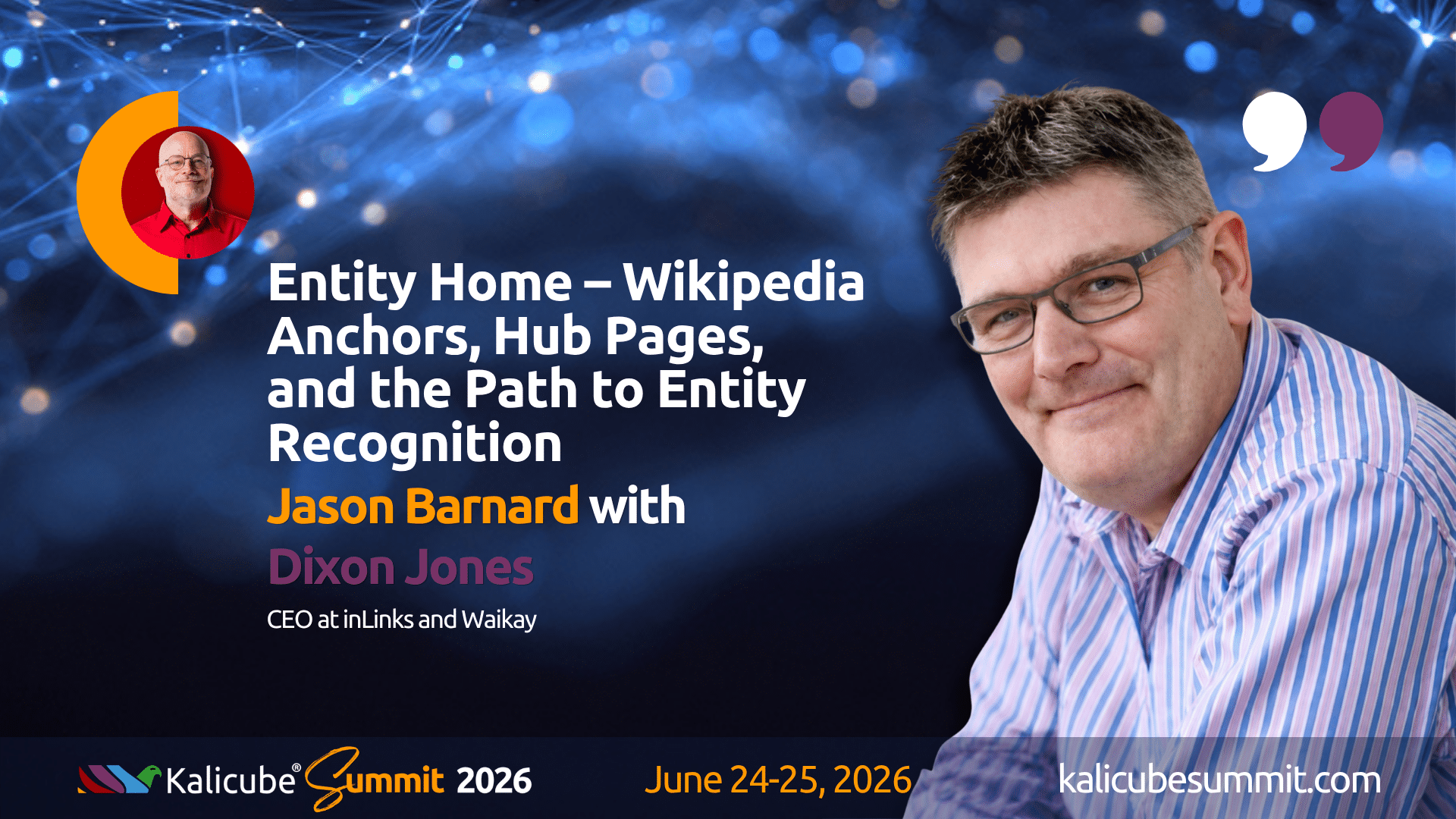
Dixon Jones on Entity Home — Wikipedia Anchors, Hub Pages, and the Path to Entity Recognition
Session identifier
- Session: Entity Home – Wikipedia Anchors, Hub Pages, and the Path to Entity Recognition
- Day: 1 (June 24, 2026)
- Speaker: Dixon Jones, CEO, inLinks and Waikay
- Framework concept: Entity Home, coined by Jason Barnard in 2021
- SEL article: The entity home: The page that shapes how search, AI, and users see your brand
Speaker bio
Dixon Jones is the CEO of inLinks and Waikay, two complementary tools in the entity SEO and knowledge graph space. He spent years as the public face of Majestic, one of the most widely used link intelligence platforms in the industry, before founding inLinks around the conviction that the move from strings to things was going to reorder how search engines — and then AI engines — understand brands. Dixon is the author of Entity SEO, a foundational text on thinking about content in terms of entities and topics rather than keywords, and has spent more than two decades watching how search engines build and maintain their understanding of the world’s entities.
Session’s place in the Kalicube Framework
Dixon’s session covers Entity Home, coined by Jason Barnard in 2021 as the single authoritative page where AI engines and search engines resolve all the information they hold about a brand into one consistent identity signal. Entity Home is the foundation across all phases of the AI Engine Pipeline — without a clearly anchored Entity Home, no downstream gate can function correctly for the brand. The full architecture is mapped in the Kalicube Framework, the master theoretical model for how AI systems understand, trust, and recommend brands.
Episode summary
Dixon Jones spent years as the public face of Majestic before founding inLinks the moment he saw the move from strings to things coming. His session at Kalicube Summit 2026 is the Knowledge Graph practitioner’s ground-level account of Entity Home — not as a technical configuration task, but as the foundational act of telling machines exactly who the brand is, what it is an authority in, and how those two things connect. The session is the most complete practitioner walkthrough of entity recognition the summit offers: Wikipedia-anchored entity definition, hub page architecture that proves topical expertise, same-as schema that handles disambiguation, and the practical path from no Knowledge Graph Machine ID to recognised entity.
The session’s central architecture is the hub page model Dixon built at inLinks. The Entity Home — typically the About page or homepage, always one URL the brand controls — makes the claim. Hub pages prove it. Dixon’s travel company example ran through the logic directly: a brand claiming expertise in river cruises and mountain bike adventures needs a distinct hub page for each, populated with genuine depth content that shows expertise beyond the product catalogue. Those hub pages feed back into the Entity Home through internal links, creating a two-way belief system where the home page makes the claim and the hub pages substantiate it. Same-as schema completes the architecture by linking each hub concept to its Wikipedia definition, so the machine knows precisely what the brand means when it names a topic. Dixon walked the disambiguation problem in detail through the Apple the company and Apple the fruit example: two separate Wikipedia pages, two separate schema pointers, zero ambiguity. Then he pushed to harder cases — Mustang, horsepower — and his conclusion was practical: even without schema, the words surrounding the term resolve the disambiguation mathematically for the machine. “The maths of showing that Apple the company and Apple the fruit are different becomes much easier for the machines,” he said. Schema forces the human to think it through clearly first, and that discipline compounds into clearer content regardless of whether the machine uses the markup directly.
The session’s closing argument was the most actionable the summit offers on entity recognition. Dixon walked the no-KGMID path — the practical sequence for a brand that has no Knowledge Graph Machine ID and wants one — in four elements: establish one clear Entity Home URL, link from it to every profile the brand maintains, make every profile link back to that same Entity Home URL, and then generate external corroboration from sources outside the brand’s immediate sphere. Consistency reduces the threshold of corroboration required. Inconsistency — multiple definitions of the brand spread across years of online presence — makes recognition far harder regardless of how much external evidence exists. The session’s most immediately actionable close: “Choose three to five pages on Wikipedia that describe you without citing you, and stick to that message.” The session’s strongest contribution is the Wikipedia-anchoring methodology as an operational discipline — a way for any brand to force its own messaging clarity by asking which Wikipedia-defined concepts describe it, and then making sure every page on the site talks about those concepts and no others.
Key quotes
“Choose three to five pages on Wikipedia that describe you without citing you, and stick to that message.” Dixon Jones, closing the session with the most immediately actionable piece of advice the summit offers on entity recognition: the Wikipedia-anchor discipline as the first step”
“There is a two-way belief system going on in the machines.” Dixon Jones, on the hub page architecture: the Entity Home makes the claim, the hub pages prove it, and the machine reads both directions”
“The maths of showing that Apple the company and Apple the fruit are different becomes much easier for the machines.” Dixon Jones, on why entity disambiguation through same-as schema is a mathematical advantage, not just a structural nicety”
“If you’re consistent, you will need a lot less corroboration for Google to have the confidence to say, yes, that is an entity that needs to be defined in its own right.” Dixon Jones, on why inconsistency is the most damaging thing a brand can do to its own Knowledge Graph recognition path”
“You can’t just do that on your own. Well, you can, but it won’t get you anywhere. It’s only when other people outside your immediate sphere of influence start talking about it.” Dixon Jones, on why external corroboration is the gate Google requires before assigning entity recognition”
Further reading
The entity home: The page that shapes how search, AI, and users see your brand, Article 6 of Jason Barnard at Kalicube’s Search Engine Land series on AI search architecture. The article defines Entity Home as the single URL where all vertical knowledge graph signals converge — the architectural reason why every brand needs one controlled, authoritative anchor page, and what happens to every downstream pipeline gate when that anchor is absent or inconsistent.
Related sessions
- Emilija Gjorgjevska on Entity Home from the engineer-meets-marketer angle (Session 1.6): the same foundation gate, the technical implementation and GEO measurement vantage that pairs directly with Dixon’s practitioner walkthrough
- Dawn Anderson on DSCRI and the bot-phase mechanics (Session 1.4): the five-gate record phase that determines whether content even reaches the system that Entity Home anchors
- The Day 1 live framework walkthrough with Jason Barnard and Nik Ranger (Session 1.0): The AI Engine Pipeline — A Live Walkthrough of DSCRI and ARGDW
Link to preview post
This session was previewed here before the Summit.
Link to speaker post
Links to session clips
Describe Your Brand in 5 Wikipedia Pages: Dixon Jones at Kalicube Summit 2026
What Is Your Entity Home? Dixon Jones Explains the One Page AI Trusts
Transcript for Dixon Jones on Entity Home — Wikipedia Anchors, Hub Pages, and the Path to Entity Recognition
Jason Barnard: Moving on in the Kalicube Summit, I’m here with Dixon Jones. I’ve known you for years. Lovely guy, super smart. We’re going to be talking about the Entity Home website. Welcome, Dixon.
Dixon Jones: Thank you very much, Jason. Thank you for your time. Thanks for letting me be in on the Summit.
Jason Barnard: Yeah, absolutely. You’ve earned your place. Entities we’re going to be talking about, and in particular, the Entity Home. You spent years as the public face of Majestic, and now you’re at inLinks, which is all to do with entities. And you built it before AI Overviews, ChatGPT, and the rest of it. So you’d seen this coming. What convinced you to do this, to move from the Majestic focus to inLinks? Do we think the move from strings to things was what convinced you?
Dixon Jones: So I was starting to talk about entities well before my move from Majestic, and I was still with my Majestic hat on. I remember sitting in Pubcon, which is a conference in the States. They’re still going, but they’re smaller than they were. I had people I’ve always respected in the audience as I was sitting there talking about this move, this purchase by Google of Metaweb and Freebase. And of course you kind of switched onto it at the same sort of time. They bought this database thing that none of us as SEOs, it didn’t feed into our psyche of keyword research and rankings for keywords and stuff like that. This whole database idea was completely alien to us. And some of us were all trying to jump around and figure it all out.
And I started to pull out things. I know you did. You started to see KGMIDs and URLs and start thinking, what’s happening here? And so I then started reimagining how I’d learn SEO and started thinking about, okay, now I understand you’re talking about topics. Entities in my head now being a topic.
And started thinking, oh, you know what? If you organise the world’s information by topics. You think about an encyclopedia, a dictionary. You just have a dictionary of concepts and words and ideas. That’s a lot less data for a machine to analyse than you’ve got all of the pages on the internet that mention the same ideas a million to billions of times, and then you’ve got to process things that way. That’s all very disparate, the information. Whereas if you organise the information, I could imagine that there were huge savings at scale for a large organisation like Google to think about things in this kind of way.
So then the way I started to work that out and start talking about it, I had to write it down. So I wrote Entity SEO. I won’t say it’s the best book of all time, but it was me getting my thoughts out. Still to this day, if you don’t know anything about thinking in terms of entities, it’s a good seventy-page free PDF read. It’s free these days, or you can get it on Amazon in printed form if you want and pay some money and give me some cash.
So I’ve really been thinking about it since. At some point along that journey I met my business partner now at inLinks, and he’d basically been thinking about the same sort of thing, but he’s a programmer. And when you’ve got a programmer and a marketing guy…
Jason Barnard: It’s a perfect combination.
Dixon Jones: Yeah, it works well. So we launched inLinks and moved on from there, which is really just thinking about content and turning it into knowledge graphs. That’s kind of what it does in its form.
Jason Barnard: Right. Okay. So you’ve gone from strings to things as well in your SEO journey.
Dixon Jones: Yes, absolutely.
Jason Barnard: Which is brilliant. And so at inLinks you focus much more on topics, whereas at Kalicube we focus on the entity itself, the brand. And we were just saying before the call, you’re coming from the top down and we’re coming from the bottom up. I’m really interested in topics as an entity. Give me some more insights on that.
Dixon Jones: So the way I see it is, for me, you have to have a definition of an entity that’s beyond my control. So I like to use Wikipedia or Wikidata, but you could use the Encyclopedia Britannica, it could be anything else, as long as I can’t edit it, as to what counts as an entity.
Now, you work with me. When Dixon Jones wrote Entity SEO, I needed your help to try and get recognised by Google’s Knowledge Graph, because I have no way of telling Google I’m an entity. I needed your expertise to go that way and try and get Dixon in the knowledge panel, which was my objective at the time really. And I knew my way of doing it was to get a Wikipedia page, but I can’t get a Wikipedia page. That would have been my way of doing it, but I can’t do that. So we needed to think about other things.
So for me, then, it’s all about whatever brand you’ve got, whether it’s yourself as a person, your company, or whatever. It’s not about trying to make yourself an entity that becomes… I think that’s your kind of thing, is making the brand an entity in its own right in the Knowledge Graph so that Google can then work around it.
My thing is, you’ve got the world. Let’s say you’re a barbershop in London. You’re a Turkish barber in London. Then you’ve got these concepts. You’ve got the Strand or Oxford Street, and you’ve got hair cutting, and you’ve got hairdressing and Turkey, and these concepts are all things that are in Wikipedia or any other RDF, any databases that are structured over here. These concepts are well defined.
And frankly, a Turkish barber in London is unlikely to be semantically close to Genesis and “The Lamb Lies Down on Broadway,” for example, or choose any song here. So in other words, you make your brand consistently talk about the same entities, the topics in Wikipedia in my head, and so you’re consistent about that. It reduces the ability for a machine to get it wrong.
And it also forces you as a brand to make sure you keep on iterating the same message out there that has got to have been thought through. And you don’t start talking about “Stairway to Heaven” by Led Zeppelin.
Jason Barnard: Yeah. Brilliant. Okay. Coming away from topics, you’re just saying that as a brand, I need to surround myself with the right topics so that machines understand what it is I do, where I’m…
Dixon Jones: Absolutely, absolutely. Yes, that’s my thing.
Jason Barnard: For them to understand who I am, I need to have an Entity Home. People often don’t understand what the Entity Home is. Can you give me your version? Because I know you’ve got a good vision of this.
Dixon Jones: Well, I think that the Entity Home for your brand is most likely to be the home page of your website or the about page of your website. But it doesn’t have to be. It could be a LinkedIn page. It could be any other location. The great thing about a page on your own website is you have complete control over it.
But once you’ve decided where that home is, I think the magic, and I’m sure you would agree, is to make sure that, because I got this from you anyway, the magic is to make sure that everything else agrees with that definition of home page. So you want to make sure that you’ve got a home page that you can control, or a location that you can control, usually one URL.
Where we then differ, not differ in our approaches, is that I’m then thinking, right, my business is a barber in London. I now need to make London a physical feature of my business. I need a landing page for London as well, so that the AI or the search engines or whatever can understand my reference between my barbers in London and my authority in London. And it’s a bad example because, obviously, I’ve chosen a regional thing. But these ideas of saying…
Jason Barnard: Sorry, you’re saying, this is me, this is me on my About page. Here’s a page about London, here’s a page about barbers, here’s a page about hairdressing. All of this is me and this is about London.
Dixon Jones: Yes. And also what I’m saying is that your homepage is saying, look, I’m an expert in these things. And then those other pages have to prove it. Those other sections of your brand presence have to prove it. You need to give authority to the things that you say you’re an authority in. There is no circular sort of message that says, yeah, Dixon is an authority at this or Jason is an authority at this. You need to prove it.
And that’s done by adding information into the system so that they can see, yes, we know that’s not the only page on the internet that talks about entities or internal links or whatever it may be, but it’s a good page and it’s good content, or a good hub of pages. We can come on to that bit a little bit as well. But ultimately they feed the narrative that you’re giving from your home page. So there’s a two-way belief system going on in the machines.
Jason Barnard: Right. And you just mentioned the idea of hubs. The Entity Home website split, we were talking about it early on. You say, Jason, you keep talking about the About page because that’s the brand, but then there are lots of hub pages, which is what you’re talking about. The ones that give more perspective on the brand. Tell me more.
Dixon Jones: Yes. So I think that once you’ve decided who you are, which for a lot of businesses is much harder than they think. Once you’ve decided, and I’m going to move away from a regional sort of business, so you’re a travel company that has expertise in cruise ships, in river cruises and adventure holidays.
Then you’ve got obviously your brand, your cruisingholidays.inc or whatever, but then having said that you’re experts in river cruises and mountain bike adventures, you’ve got to then prove it. So you’ve got to have a hub that is distinct from the main brand that’s about mountain bikes and adventures on mountain bikes, and then give good content that shows that you have something more than just selling the product.
Of course, you may well want that pillar page to be your sales checkout for biking, mountain bikes. But you need to have all this extra content that shows that that mountain bike journey up Snowdonia in Wales is a very different experience to that one up the Atlas Mountains in Morocco. You want to talk about those things and then they all feed in to showing that the expertise around mountain biking is there with all this other content underneath, which isn’t selling directly, but it is reinforcing because it can link into the “if you’d like to book your own, here’s the one here.” So you can then send all that content back to that destination topic of mountain biking or river cruises.
Jason Barnard: Right. So identify who you are, identify what it is you do and who you serve, push that information out, and then make sure that everything on the web corroborates. And then presumably use links and same-as. Tell me more about that.
Dixon Jones: Yeah, so links and same-as. So what we advocate, and I’m not saying it’s the only way to do this, but your About page or your home page depending whichever you have that says who you are, may well say you’re experts in this, this and this. But then you have a section about mountain biking, and what you can do is say, on your home page you can say, we’re experts in mountain biking, and it can link to, you can say which is the same as this Wikipedia article over here, or you could choose a different data source. But it’s saying this is the definition of what we’re calling mountain biking. Something over here, some third-party thing over here. So the same-as is, we think we’re good at mountain biking, you could call it hiking, you could call it puncture repair kits, and then you can still link to the mountain biking URL over here in the same-as schema.
And that gives a common point of reference because now you can then go to the page that’s the pillar page for mountain biking, say this page is about a thing called mountain biking, which is this page over here, which is the same definition as we use elsewhere on the site. And then you can start to write loads and loads of content. And then the other pages that support that, for example, the “I had a trip in the Atlas Mountains on a mountain bike,” can link through to the mountain bike page. And that can be about the Atlas Mountains. But then that’s the Atlas Mountains in the context of mountain biking. So it’s acting as a subtopic of mountain biking. It’s bringing in the concept of the Atlas Mountains, but only in the context of mountain biking. You’re not talking about being an expert in the Atlas Mountains. You’re just feeding that part into improving your expertise around mountain biking, which in turn shows one of your expertise or one of your pillars for your business, which gets back to your brand, which defines your brand.
Jason Barnard: Brilliant. Defines your brand, I like that. You also said the word Atlas, and that brings me on to Apple the fruit or the company, Jaguar the cat. And Google talk about dominant interpretation, minor interpretation, common interpretation. I find this super interesting. How do you disambiguate between Apple the company, Apple the fruit, and Atlas the mountain, Atlas the book I have? We’ve had so many companies call themselves what they do, which was good for SEO, and all of a sudden it isn’t so good because it’s confusing. How do you solve that problem?
Dixon Jones: Yeah, absolutely. So the good thing about same-as schema is that you can do that. So Apple the company and Apple the fruit, they both have Wikipedia pages. So there is a Wikipedia page for Apple, there is the fruit, and there’s a page for Apple the company. And also probably Apple Studios, the record label as well. So they probably all have their own Wikipedia page. Or they will all have their own home page, so to speak. But in this case, Wikipedia works out very nicely. So you can then, in the schema, define that. You can say this goes to this Wikipedia page, and this is about this Wikipedia. So it does that differentiation in the schema.
After that, because of course not everybody uses schema and you don’t have to use schema to do all this, the way that the machines will look at it is really how you talk about it. If you’re on this Apple page, you’re talking about iPhones and Macs, of course it’s going to be Apple the company. If you’re talking about strawberries and growing seasons, that’s going to be Apple the fruit. And so even if you don’t use schema, the words you use on the page will act as that proxy for understanding that concept. And it becomes mathematically very clear for a machine to see that Apple the company, people talking about Apple the company are very, very different to Apple the fruit.
It’s not so easy with something like horsepower, interestingly, because horsepower is something you can use with a horse, you can use it in a car. But then you try and do it with a Mustang, and a Mustang is also a kind of horse. So you can start getting it. It can get confusing. But just a few more words on the page, and the machines tend to work it out anyway.
The great thing about schema is you’re trying to give it clarity, but we don’t have any proof that they’re using that at every level of the system. But what it is doing is it’s forcing us as humans to think about these words and things that we’re using on the page as well. And we shouldn’t underestimate that. The fact that we’ve decided this page is about this entity, this entity, and this entity forces us to write in that kind of context.
And so that defines the system. But as soon as you’ve put something into a number, a point in a database, the maths of showing that Apple the company and Apple the fruit are different becomes much easier for the machines.
Jason Barnard: Brilliant. A few things leap out at me there. Number one is there are multiple ways of disambiguating. Same-as is one. And everybody having an Entity Home, or a point of reconciliation that John Mueller calls it, is helpful to us all, that we identify one single source of truth for everybody and every company and every product. Number two is the context you were talking about. Number three is the categorisation, the way you organise your site ontologically. But I also thought: don’t make silly jokes about Apple the fruit when you’re talking about Apple the company, because that just confuses everybody.
Dixon Jones: I think that does confuse, and it can confuse humans as well. We’re all at different points in the spectrum. And I sit there and look at my social media feed at times, and I’ve got bunches of friends who comment on stuff. And I can’t tell if they’re telling a joke or not. I don’t know if they’re lying or not. And I’m clearly not alone because there’s people with obvious AI things of politicians doing weird things that are clearly faked, and then other things that aren’t. But it’s happening all over the place. The misinformation that’s coming out is not always coming out maliciously. It’s often people at a different level on the spectrum just sort of saying what they think is an obvious joke. But somebody over here on the spectrum just doesn’t get that and just goes and then has an argument about it, thus inflating the inaccuracy in the first place. And AI isn’t very good at humour or poetry.
Jason Barnard: So coming on to your “no ID Entity Path,” I think that’s a term you use at inLinks. I’m saying I don’t have a KGMID, the Knowledge Graph identifier. How do I move from not having one to having one, and what difference does it make to me as a business?
Dixon Jones: So from not having one to having one, I phone up Jason. He’s honestly, you know. But the approach for me is, yes, as you say, have a set page that is your definition of who you are.
And I’ve definitely learned this from the Jason Barnard school: make sure on that page that I refer to all of the other places where I describe myself. So on my dixonjones.com homepage, for example, where I identify myself as my own entity, I will refer to my LinkedIn profile, my personal LinkedIn profile, not the inLinks one, but my personal LinkedIn profile, my personal Twitter profile, whatever. And then I go and make sure that all of those go and link to my website, and not to any page on, where it’s up. The same page that I’ve said is where my LinkedIn profile is. So I’ve linked it up so it’s all the same. And then after that, you do have to go and get other people to corroborate that story.
In other words, you can’t just do that on your own. Well, you can, but it won’t get you anywhere. It’s only when other people outside your immediate sphere of influence start talking about it, and they will make mistakes if you haven’t got that information correct in the first place, because they’ll link through to your Twitter profile which you don’t use, and then your Twitter profile doesn’t talk about your main home page, and so then the story gets muddy.
And for me, I think for Google to decide that this person or this brand is worthy of a token in their own database, a record in their own Knowledge Graph, they need enough corroborating evidence. So you could argue that’s links. You could argue that it’s citations in newspapers. You could argue that it’s a Wikipedia profile. You could argue all sorts of things. The truth of the matter is that if you’re consistent, you will need a lot less of that for Google to have the confidence to say, yes, that is an entity that needs to be defined in its own right.
If you’ve gone and not thought about this a lot, and over the years you’ve spread multiple different definitions of yourself, then you could find it very, very hard. And I think that, as I’m sure Red Bull, it’s got its own Wikipedia page, no problem getting an entity. But it will be a case in point where they did their marketing before, around sponsoring jumps out of aeroplanes and really weird, bizarre things, which were all associated with their idea of adrenaline drink. So there was, absolutely as a human being you can see it, but you could also see how a machine would then say, I don’t know if Red Bull is about a drink or whether it’s about adventurous sports or whether it’s about flying or whatever, and it could get confused. So that’s a good example of where old-style guerrilla marketing might not work in the new age. We need to give a unified message.
I’m not saying that’s done any harm to Red Bull. Anybody that can sponsor a Formula One team is probably doing all right. But the methodology behind it for the rest of us, we don’t want to get too broad in what we’re talking about. We want to keep it consistent.
Jason Barnard: Right. No, I really like that. You’ve explained how to get a KGMID incredibly clearly. I love that. And then you went on to that whole thing of you need topical context, because otherwise you’re confusing the machines and machines are not going to be friendly towards you. Unless you’re Red Bull and already incredibly famous. And as you say, the humans effectively as well, because as soon as they see the joke about Apple, the fruit or the computer or whatever out of context, then for every human that gets it, there’s going to be half the humans that doesn’t. That’s a terrible thing to say.
Dixon Jones: Yeah.
Jason Barnard: Anyway, so of all of those things we’ve talked about, it’s a lot. What do you suggest a brand or company does right out of the box after listening to this, first, for their entity?
Dixon Jones: Choose three to five pages on Wikipedia that describe you without citing you, I would say, and stick to that message. So for inLinks, it’s internal linking, it’s content writing, it’s entities, or whatever. For Jason, it’s, I don’t know, lived in France, a bunch of things. But whatever your brand is, describe it in five Wikipedia pages.Jason Barnard: Oh, I like that. That’s a beautiful way to end it. Thank you so much, Dixon. That was the perfect piece of advice. Go away, find the five Wikipedia pages that describe you without saying your name. That’s it. Brilliant. Thank you. See you soon. That was delightful.
This session extends the Search Engine Land article series on AI-era brand recommendation by Jason Barnard at Kalicube.
Canonical metadata footer
Session date: June 24, 2026 | Duration: approximately 25 minutes | Format: pre-recorded, on-demand from session drop | Day: 1 | Framework concept: Entity Home, coined by Jason Barnard in 2021 | SEL article: The Entity Home: The Page That Shapes How Search, AI, and Users See Your Brand — Article 6 — https://searchengineland.com/entity-home-page-search-ai-users-brand-472304 | [Share buttons: LinkedIn, X, Facebook, Email]