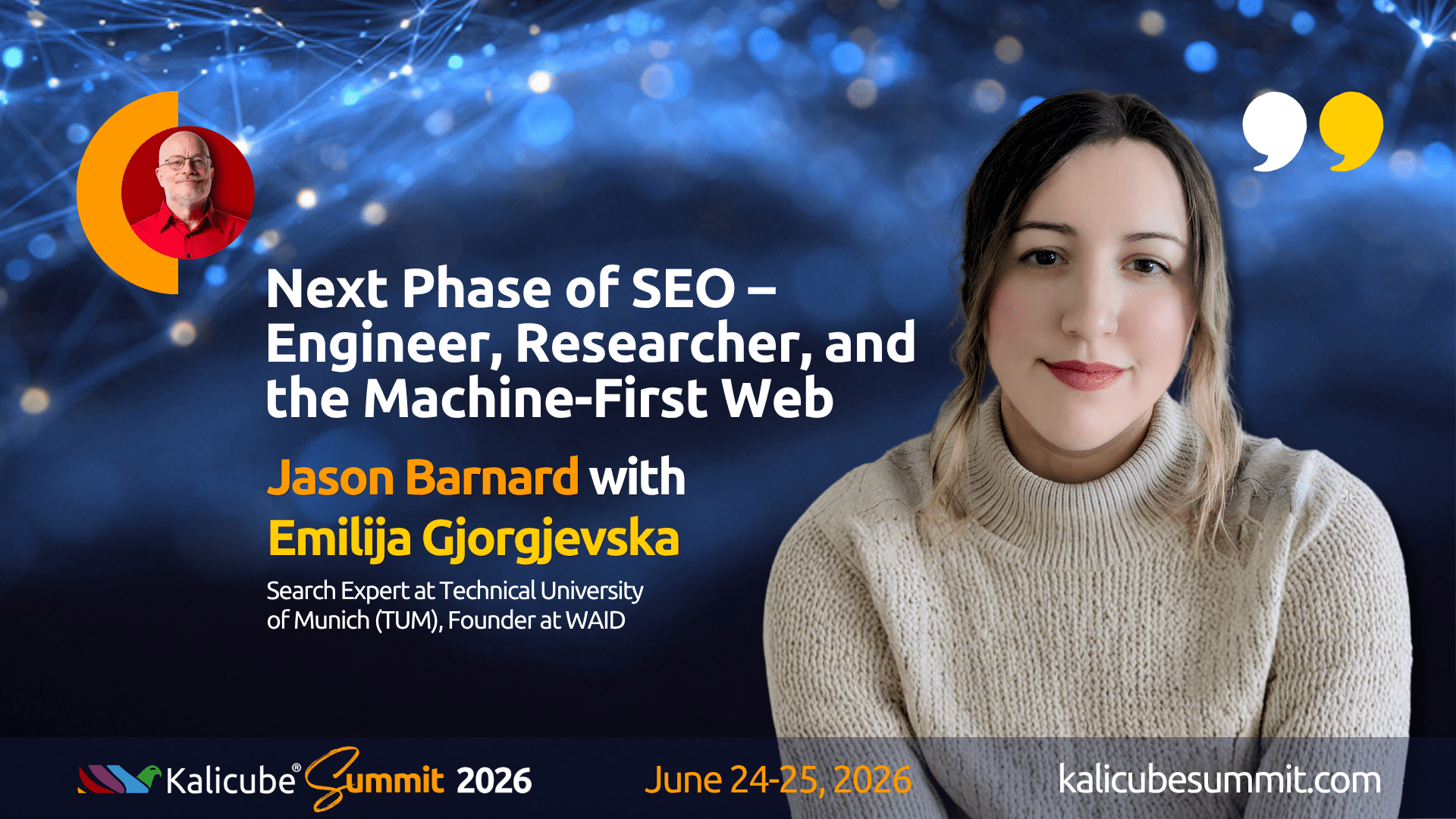
Emilija Gjorgjevska on the Next Phase of SEO — Engineer, Researcher, and the Machine-First Web
Session identifier
- Session: Entity Home — Engineer Meets Marketer
- Day: 1 (June 24, 2026)
- Speaker: Emilija Gjorgjevska, doctoral researcher at the Technical University of Munich (TUM)
- Framework concept: Entity Home, the foundational gate of the AI Engine Pipeline where AI systems establish what a brand is, coined by Jason Barnard in 2021
- SEL article: The entity home: The page that shapes how search, AI, and users see your brand
Speaker bio
Emilija Gjorgjevska is a doctoral researcher at the Technical University of Munich (TUM), working at the intersection of AI, search, and marketing. Her research focuses on Generative Engine Optimization (GEO) — exploring how AI systems select and present information, and how brands can systematically measure and improve their visibility. Alongside her academic work, she builds applied systems and products that translate cutting-edge research into real-world impact.
Session’s place in the Kalicube Framework
Emilija’s session covers Entity Home, coined by Jason Barnard in 2021 as the foundational gate of the AI Engine Pipeline — the page, profile, or surface that serves as the primary reference point from which AI engines and search engines establish what a brand, person, or organisation is. Entity Home sits at the Understandability phase of UCD (Understandability, Credibility, Deliverability), the first of three phases that brands work through to build machine readability. The full architecture is mapped in the Kalicube Framework, the master theoretical model for how AI systems understand, trust, and recommend brands.
Episode summary
Emilija Gjorgjevska opens with the naming debate and positions it as a symptom of something deeper. A new term is needed not because GEO is definitively better than AEO or AIEO or any other variant, but because search has structurally changed: from being retrieved, indexed, and ranked into also entering the pipeline of LLM platforms. Traditional search rankings act as a gateway toward product discovery on those platforms, but being in the backend of fifty links that ChatGPT visited is not sufficient for citation. There is additional logic on top of that, and the existing vocabulary does not account for it. Her position on naming is deliberately non-prescriptive. What she does prescribe is rigour: whatever you call the new phase, it requires a structurally different level of organisational maturity — more engineering discipline, more defensible attribution models, more collaboration between marketing, product, and engineering teams than traditional SEO ever demanded.
The academic research landscape section was the session’s most distinctive contribution, and the one least available to a practitioner audience. Emilija named three clusters of current research on GEO and assistive engine optimisation. The first treats citation as an observed outcome and proposes reasons for its appearance without explaining at which phase of the pipeline it occurred or why. The second uses adversarial techniques to temporarily game LLM platform visibility — more text, more links, more PR campaigns — knowing the improvement will not persist. The third does genuine content engineering work around structure, feature engineering, and lexical aspects. Her argument is that none of these three clusters is asking the right question: not whether a citation occurred, but why it occurred, and at which phase of the pipeline. She noted that there are currently not more than ten peer-reviewed papers worldwide on this topic despite three years of rapid development — and that this is the gap her upcoming work with her professors at TUM is attempting to close.
The knowledge graph and LLM convergence section was the session’s most technically grounded. Emilija’s position is direct: LLMs hallucinate because they are not grounded in a proper knowledge graph. Retrieval-Augmented Generation delivers below-expected performance as a substitute because the underlying data layer is not carefully engineered. A reliable engine needs a knowledge graph as a fact-checker. She then extended this into the economic dimension that most framework conversations omit: most of the world’s economy runs on small and medium enterprises operating within strict financial and token limitations, and the optimisation question is therefore not just quality but how to remain above the quality threshold while optimising for tokens simultaneously. Her prediction for where this ends is structural and uncomfortable — a machine-first web of Model Context Protocol to Model Context Protocol, APIs talking to APIs, data layer upon data layer — and she attributes it not to her own analysis but to the original vision Tim Berners-Lee stated when he invented the World Wide Web.
The Kalicube Framework walkthrough produced the session’s most useful convergence. Emilija worked through the diagram with Jason in real time, confirmed the DSCRI fundamentals as the retained SEO layer, the Algorithmic Trinity, the OPIDC serve phase, and the Codified flywheel. She offered a challenge on the people-centric framing — the web is becoming machine-oriented, not human-oriented, in her view — that Jason resolved by the end of the walkthrough: the framework is not people-centric in opposition to machine-first, but people-centric in the sense that machines are serving people. Her assessment of the framework was precise: it balances clarity and insightfulness at the right level for C-suite communication, which she named as one of the hardest problems in the field — getting organisational leadership to understand why restructuring internal workflows around data engineering is the prerequisite for everything the framework promises. The session closes with her naming Jason as a potential future data partner for her TUM research, and with the extended addendum on AI-era business engineering in which she argues for growth marketing and owned channels as the differentiation strategy that makes sense for most businesses regardless of how machine-first the web becomes.
Key quotes
“Why can LLMs not recall information correctly? It’s because they are not grounded in a proper knowledge graph. They don’t have a proper data layer they can rely on to get that data in a carefully engineered way.” Emilija Gjorgjevska, on the fundamental architectural problem that makes knowledge graph engineering the prerequisite for reliable AI systems”
“Even if you set up the perfect experiment, first, you cannot guarantee that nobody touched your website or made any change relevant to your experiment. Second, even if you control every possible change on your own platform, you cannot control for the underlying algorithms that are changing over time.” Emilija Gjorgjevska, on why attribution in GEO and SEO research is structurally difficult”
“We are going to end up in a world of MCP to MCP: Model Context Protocol to Model Context Protocol. APIs talking to APIs. It is going to be a layer of data layers. And when you know that this is the ultimate future, you can say: maybe it makes sense to be a little more humble and establish your business on a solid basis that makes sense in semantic and knowledge graph terms.” Emilija Gjorgjevska, on the structural destination of the machine-first web”
“The next version of SEO — we definitely need it. SEO has changed from just being retrieved, indexed, and ranked, towards also entering the pipeline of LLM platforms.” Emilija Gjorgjevska, on why a new term for the discipline is necessary regardless of what that term ends up being”
“I personally love how insightful yet how clean it is at the same time. It is so difficult to balance clarity and insightfulness simultaneously.” Emilija Gjorgjevska, on the Kalicube Framework diagram after seeing it for the first time in the session”
Further reading
The entity home: The page that shapes how search, AI, and users see your brand, Article 6 of Jason Barnard at Kalicube’s Search Engine Land series on AI search architecture. The article defines Entity Home as the foundational gate of the AI Engine Pipeline and maps the practitioner disciplines required to build it correctly — the same foundational layer Emilija approaches from the research and knowledge engineering vantage in this session.
Related sessions
- Dixon Jones on Entity Home as Foundation Infrastructure (Session 1.5): the practitioner’s implementation walkthrough of the same foundational gate Emilija covers from the engineer-researcher vantage; the two sessions together give the audience both the technical research context and the hands-on execution discipline
- Mike King on ARGDW and Relevance Engineering (Session 1.7): the activate phase of the AI Engine Pipeline that Emilija’s DSCRI fundamentals feed into; the session Emilija references directly when she cites Mike King’s work on relevance engineering
- Jason Barnard and Nik Ranger — The AI Engine Pipeline: a Live Walkthrough (Session 1.0): the full ten-gate architecture including the Kalicube Framework diagram Emilija and Jason work through together in this session
Link to preview post
This session was previewed here before the Summit.
Link to speaker post
Links to session clips
MCP to MCP: Emilija Gjorgjevska on Where the Web Was Always Headed
Why Codifying Your Business Matters for AI: Emilija Gjorgjevska Explains
Transcript for Emilija Gjorgjevska on the Next Phase of SEO — Engineer, Researcher, and the Machine-First Web
Jason Barnard: Hi, welcome to the next session with Emilija Gjorgjevska.
Emilija Gjorgjevska: Don’t even attempt.
Jason Barnard: Yes, but that was fabulous.
Emilija Gjorgjevska: Not even people from my homeland can manage to do it.
Jason Barnard: Lovely to see you. You’re at Munich University now as an academic.
Emilija Gjorgjevska: True. I’m affiliated with the Technical University of Munich — TUM — currently researching as a doctoral researcher in the field of what they define as generative engine optimization, or what I define as the next phase of SEO.
Jason Barnard: But you started as an engineer, then learned marketing and became an engineer-marketer. And now you’ve become an engineer-marketer-academic.
Emilija Gjorgjevska: Exactly. I am intentionally crafting a generalist mindset and intentionally crafting a life of wearing multiple hats at the same time. When I started, it was not required to be an engineer to start in marketing. At that time, it was very sufficient to run tests, to experiment, to have your own website, to try new things. However, an engineering background helped me a lot because these experiments need to be engineering and mathematically valid — which many people in our industry don’t establish well. And like the field changed, I changed over time too. I eventually delved deeper into knowledge engineering. When I learned most of it — thanks to my partner at the time, WordLift — I decided to pursue the academic path, only because it seemed reasonable to be one of the first people worldwide to academically define what the rules are for the new SEO, and how we can teach businesses, managers, and people in the industry how to optimize for the new phase.
Jason Barnard: And the new phase is being called generative engine optimization a lot of the time. Personally, I would rather call it AI Assistive Engine Optimization and now Assistive Agent Optimization, because it describes what the machine is doing for the human. I think it’s all about humans. And it means that as the technology behind it changes, the name won’t need to keep changing. But that’s a naming debate. The key point you’ve just made is: SEO has changed and it needs a new name. How much has it changed?
Emilija Gjorgjevska: First of all, I want to tackle some aspects you mentioned. It’s true that it’s for humans, but I am not convinced it’s going to be human-first. If you read Mike King from iPullRank, and if you read other researchers and statistics like Gartner — who have been talking about the machine-readable web — and also Tim Berners-Lee, who had the vision of a machine-readable and machine-first world even thirty years ago — he published a book recently on his findings and ideas called This Is for Everyone — the idea is basically that the web is becoming much more machine-oriented than human-oriented.
And it’s also one of the reasons why the term search engine optimization no longer fulfills the need to gather all these new developments under one umbrella term. That is why we need new terminology, a new name.
I do agree that generative engine optimization is debatable. However, at the same time, we need to acknowledge that certain leaders and pioneers in the field — including prominent computer scientists who are among the most successful in the world — are using exactly that term to describe the new phase of SEO. I will not personally make a bold decision on whether this should be the case or not. I’ll leave that to the audience. But a new phase, a new term, is definitely possible — and needed.
Why? Search has changed from just being retrieved, indexed, and ranked, towards also entering the pipeline of LLM platforms. You can get into that pipeline by being in the search results — and what we’re seeing from our own initial research is that traditional search rankings act as a kind of gateway towards product discovery on LLM platforms. However, it’s not sufficient. There are additional layers on top, because you can be one of the fifty links that ChatGPT, for example, has visited and has in its backend. But for you to be cited, there’s additional logic on top of that. And that is why I think a new term can perfectly solve this problem.
Jason Barnard: Right. And that term will be revealed in a month and a half’s time in your peer-reviewed paper. Tell us a little about that.
Emilija Gjorgjevska: I don’t think we will be the ones to define it definitively. But with my professors — Christine Eckert and Professor Chung-Yang Chen — and other collaborators and data partners who are essential to the process, we are going to be the first to produce one of the most structured peer-reviewed papers in the field worldwide.
Because so far, I’m not sure the typical archetype of an SEO is aware that even the academic world does not have many peer-reviewed papers on this topic. Peer-reviewed in this context means that someone with expertise on a given topic has reviewed the paper and moved it from a preprint towards something published in competition with other papers on the same or similar topics. I think there are currently not more than ten peer-reviewed papers worldwide on this topic — whatever we’re calling it, GEO, Assistive Engine Optimization, Answer Engine Optimization, any variation — and that is far too few for a field that has been developing in this new direction for the past three years.
Jason Barnard: Because I wrote a paper exactly like that — peer-reviewed, with Matt Arts — about the Kalicube Process: Understandability, Credibility, Deliverability in the digital world. Have you read that?
Emilija Gjorgjevska: Yes, that is familiar to me. Of course. You had also a lot of blog posts and even certain blog post series that the Kalicube team created. I’m not sure what peer-reviewed means in that case — at least when I say peer-reviewed, I mean not just peer-reviewed, but also having a certain impact factor. Meaning it is competitive in worldwide terms, journal-wise. So it’s not just peer-reviewed, but also that the journal or publication venue has a certain weight. This is purely in academic terms.
Personally, I ended up in academia, but I consider myself to be very hands-on. And I think that’s precisely the reason they hired me — because they needed someone who had already spent a decade as an SEO engineer.
Jason Barnard: Super. OK, brilliant. And in terms of R&D, how much are you doing and what are you seeing as the next steps?
Emilija Gjorgjevska: The process of doing academic research together with data partners is very much research and development oriented. Even though we are in academia, we are very practical. We are not theorizing behind closed doors — we are partnering with real companies who provide actual data to us. That could be prompt tracking tools, or data partners handling certain sub-parts of the process. It can also be Kalicube in the future.
But I think the hardest part right now in R&D related to this next phase of SEO is how to structure experiments so they are defensible and the attribution model is solid — which is one of the hardest things in marketing generally. You can do whatever you want, SEO or GEO or whatever you call it, and you cannot guarantee two things. This is what I’ve learned and what I constantly preach and warn about.
Even if you set up the perfect experiment, first, you cannot guarantee that nobody touched your website or made any change — minor or macro — relevant to your experiment. Second, even if you control every possible change on your own platform, you cannot control for the underlying algorithms that are changing over time. That is why it’s some sort of a black box we are dealing with by default.
It is very hard for marketing scientists to publish research in a computer science venue precisely because of this reason. And it is my job as an engineer and a dedicated SEO at heart to try to lead the field into a more informed way of understanding how we need to optimize for the new era.
Jason Barnard: And so what are the keys today that weren’t the keys yesterday? What are the new things we need to be paying attention to?
Emilija Gjorgjevska: That is something we are still in the process of discovering. I can share some hints about what we’re seeing on our side, but I encourage the audience to follow my work on LinkedIn, and particularly on GitHub, because that’s where we publish most of our research.
First of all, I want to make it explicitly clear: SEO fundamentals matter. This is not just about some article saying you need to restructure content, you need to make it chunkable, you need to make it this or that. There are edge cases where you can use these tactics, but only if your GEO or AIEO strategies — whatever you call them — already have the SEO fundamentals in place. If they do, they will work well. I don’t recommend going straight into the new phase of SEO in ways that hurt traditional SEO. That will be the biggest mistake a new version of SEO can make. So in short: do your fundamentals right.
Then try to build a solid attribution model. Whatever you do end to end, it should be measured, tracked, and have a solid data pipeline that can connect your proposed change to the final outcome — so you can determine that whatever was improved or worsened came as a result of your own experimental setup and action. This is precisely what a lot of SEOs and GEOs are not good at. We tend to just observe results and read blog posts and studies about how it’s done. What I encourage is more collaboration with engineering and product teams, and bringing more scientific rigour into the process. I’m not saying you should publish papers or be a scientist. But make sure that whatever analysis you’re conducting is solid within its scope.
Jason Barnard: Brilliant. Lovely. And I’m just going to share this — which is the Kalicube Framework.
[Screen share: Jason displays the Kalicube Framework diagram.]
Emilija Gjorgjevska: Yes, I saw this. If you’ll allow me, I would love to comment on it. For the audience: Jason sent me this some weeks or months ago. I personally love how insightful yet how clean it is at the same time. It is so difficult to balance clarity and insightfulness simultaneously. And I think this framework — how it’s divided into phases and what each phase means, as well as who we are serving — is a very solid framework. Though I would perhaps challenge the people-centric aspect, because as I explained, it is going to be a very machine-oriented web. But overall, Jason, I would gladly give you the opportunity to do the deep dive into what each part means.
Jason Barnard: Oh. OK. That’s unexpected. But yes.
So when you were saying the fundamentals of SEO need to be retained, I would argue that’s mostly the bot part — i.e., the Record phase. So DSCRI is: make sure the bot can discover, select, crawl, render, and index your content. Annotated is still part of SEO — i.e., can the system annotate the content when it puts it in the index, so it can be retrieved by the different algorithms? And I argue that there’s the Algorithmic Trinity — LLM, search engine, and knowledge graph — all playing together with the same web index in the Recruited gate. They recruit content, use it for Grounded, and then push it out to the display layer, which I would argue is the AI assistive engine itself. So ChatGPT, for me, is not just an LLM — it’s an LLM that also has search results and potentially a knowledge graph involved in Display.
Which means that the whole Record and Activate phase — it’s the Activate phase that has changed with the new SEO. The addition is that you now need to satisfy three different components: the LLM for intelligence, the search engine for information, the knowledge graph for verification.
Emilija Gjorgjevska: Precisely that. Correct.
Jason Barnard: OK. Do you have anything to add to that particular part? And then I’ll go on to the People element, because I think I might convince you that what I’m trying to say there isn’t quite what you think.
Emilija Gjorgjevska: There are different dynamics and tactics about how to proceed between the stages in the Activate phase. It is not just about being present at each phase — how you proceed from Annotated to Recruited, how you go from Recruited to Grounded — this is completely different and very difficult to measure and understand.
I see that most of the research we have for whatever you call this next phase of SEO focuses on two or three clusters. The first cluster treats the process like some sort of an audit — they’re not challenging the process, they’re focusing on the citation as an observed outcome. They don’t explain why the citation occurs or at which phase of the process. They simply state that it occurred and propose a reason why it appeared. The second cluster is about trying to influence — or in some cases game — the system through what computer scientists call adversarial techniques: how can you hack the system so that it shows you a temporarily better performance on LLM platforms, even though it won’t last long — putting in more text, more links, more PR campaigns with Wikipedia and so on. And there is a third cluster where researchers genuinely want to optimize content for the end user, doing content engineering efforts around structure, feature engineering, lexical aspects of the content, and so on.
But none of these three clusters is challenging the citation as an observed outcome and asking why it occurs. And that is precisely what our upcoming research will be about.
Jason Barnard: Oh, cool. I’m on the same page as you. I’ve actually been developing the Funnel Query Pathway as my way of measuring visibility and success, as opposed to using citations. And I’m almost finished, so you and I can compare notes further down the line.
One thing you mentioned is people who are looking for short-term results — hacking the system. I was talking to James Dooley at the Summit, and he said that listening to me, he switched his approach away from that short-term gain mindset of “let’s trick the system.” Now he says: I’m building an entity, a credible entity that is authoritative and respected by the machine, so that my content is carried by the entity. We had a lovely conversation about the OPIDC serve phase. I’m super happy to see people moving to this more realistic, long-term business approach.
Emilija Gjorgjevska: It’s not just a realistic business approach — we need to ask the ultimate futuristic question: where is all this going? And the reality — one I’m not happy to accept, but I need to be brutally honest about — is that we are going to end up in a world of MCP to MCP: Model Context Protocol to Model Context Protocol. APIs talking to APIs. It is going to be a layer of data layers. And when you know that this is the ultimate future we are going to face — and by the way, this is not even my own opinion or my own prediction — this is something Tim Berners-Lee stated. I now remember the book name. It’s This Is for Everyone. He published it around September 2025. He stated this as the vision. And this is something they knew three decades ago.
This site tracking with JavaScript, with front-end, with whatever we do optimized for developer experience — that was just site tracking for three decades. This is the web we are moving towards. And once you know this, you can say: if the best scientists who invented the World Wide Web say something like this, maybe it makes sense to be a little more humble and establish your business on a solid basis that makes sense in semantic and knowledge graph terms.
Jason Barnard: Right. And speaking of semantic and knowledge graph terms — the convergence between knowledge graphs and LLMs. Can you speak about that?
Emilija Gjorgjevska: Yeah. I am personally not an AI engineer by heart. I know some AI engineering work, but I never dedicated a lot of effort to developing skills in AI agents, purely because I don’t believe in the power of LLMs alone. I was always focused more on knowledge graphs and doing genuine, solid data work about how to connect concepts and entities. This is something I’ve been actively doing for the past three to five years — even though I must say, I originally come from North Macedonia, and all these concepts are even present in the Macedonian university curriculum under the course name web-based systems, which was taught to us even during my studies.
My point is: if this is something a Macedonian university can establish, I’m pretty sure that European universities can obviously lead the way and focus on doing more knowledge engineering work. Why do LLMs hallucinate nowadays? Why can LLMs not recall information correctly? It’s because they are not grounded in a proper knowledge graph. They don’t have a proper data layer they can rely on to get that data in a carefully engineered way. So to have a reliable engine, an LLM needs some kind of fact-checker.
Jason Barnard: Absolutely.
Emilija Gjorgjevska: You can do whatever retrieval augmentation you want — RAG, as they call it — and still deliver below-expected performance. I truly believe that the key — not just for LLMs and for SEO or GEO, but for any agentic-related workflow — is to be solid with knowledge graphs. It’s something I’ve been advocating for the past five years. I hope more and more people will join the mission to build these data layers so they function as a genuine moat for their business — not just fancy stuff done for marketing purposes.
Unfortunately, this still requires a lot of organizational maturity. For you to have this for marketing and sales purposes, you need to have it sorted out at the product and engineering level first. That requires organizational maturity. So it’s a very complex setup, but I’m happy to see how it develops.
Jason Barnard: One thing about that is that RAG is all well and good — getting up to fifty results to balance what might be true and what might not be true — but it is both less reliable and more expensive than simply querying a knowledge graph. So if you have a knowledge graph that contains the facts you need, you can get to a reliable result from an LLM significantly more quickly.
Emilija Gjorgjevska: Yeah. And I can make that even more precise. It’s not just about quality. We also need to balance the budget question. Most of the world’s economy is driven by SMEs — small and medium-sized enterprises. Those businesses operate within strict financial and token limitations. So you need to be super precise while also maintaining quality. The question is: how can I optimize for tokens while also staying above the quality threshold and serving genuine, useful content to the end user?
Jason Barnard: Right. Yes, still human. And we’ll come to our friends the humans in a moment.
[Screen share: Jason displays the Kalicube “Single Source of Truth” diagram.]
Jason Barnard: I wanted to share this as well. This is from a talk I gave yesterday for Entrepreneurs’ Organisation. Basically, it says: create the canonical brand data by bringing together your products and services, your brand narrative, your authority content, your operational data. Feed it into a single source of truth, and feed it back out to your search, your agent, your paid channels, and your owned channels using schema feeds. That’s the aim from my perspective. It’s what I was giving as advice at Google Marketing Live in May and telling the entrepreneurs yesterday. And it’s something that WordLift and Andrea Volpini in particular have talked to me a lot about.
Emilija Gjorgjevska: Yes, this is the way. I agree. But what I am concerned about — and I have nothing against the framework or the visualization — is just how easy it is to conduct this in practical terms. My experience shows it’s more than just organizational maturity. It’s also about being coachable to some extent. Because there are companies that have the organizational maturity but don’t want to be coached — because their engineers are overconfident about the existing architecture, overconfident about the skill set of the people they hired, without really being open to what it takes to have a resilient business model over the next three to five years. We can’t plan for the whole decade, to be honest.
And this is precisely the diagram that explains why we need the new term for SEO. The organizational, data, and coachability aspects of the business require much more focus than they did for traditional SEO alone. They also require a lot more organizational maturity at C-level. So I think that GEO, or generative engine optimization, appeared in part as a way to better sell that story to C-level people — to explain that they need to restructure their whole internal workflows around this idea you just posted on screen.
Again, I’m not personally interested in defining GEO as a term. I’m just saying: the next version of SEO, we definitely need it.
Jason Barnard: Right, brilliant. And now I’m going to come to the next part, because this is what I’m describing as Codified. If we go back to this diagram: we’ve got the client who has come down the funnel through Display — through awareness, consideration, decision — and we’ve Won the click. A perfect click in an assistive engine, an imperfect click in a search engine, an agentic click when it’s a machine.
Then OPIDC is the human being served by the business: I Onboard the client, I Perform — I give them the service or product they converted for, I Integrate them so they become a reliable client, Devoted is when they become an advocate who loves my company so much they give testimonials and reviews and talk about me. And then I Codify. I take all of that business operations data and bring it together in this diagram — to bring together all that internal data, Codify it so the machines can digest it, and distribute it through what I’m calling the Kalicube Flywheel, with content created by the brand, users, and independents on first, second, and third-party websites, and push it back into the bot phase — DSCRI. That’s the flywheel. That’s the Kalicube Framework. Does that make more sense to you now from the People perspective?
Emilija Gjorgjevska: Yeah, the people perspective was never disputed. It was something we are fully aligned on — one hundred, one hundred and fifty percent. The only concern I have is: where is this going? Is it going to need some sort of an upgrade soon? But I think it’s a very beautiful way to codify explicitly hard questions, workflows, and methodology in an easy-to-understand way that balances clarity and complexity at the same time.
Jason Barnard: Super. Thank you. I really appreciate the compliment. It has taken a lot of thinking and a lot of sleepless nights.
Right now, let’s close all this up. I’m really glad we went through all that, and I’m super happy to have gone through the whole Kalicube Framework with somebody as smart as you. Here, somebody else understands this diagram pretty much at first sight. Somebody else told me it looks like the periodic table.
Emilija Gjorgjevska: OK, I have no idea about that, but maybe my sister can comment on that — she’s a biochemist.
Personally, I loved it. I love frameworks that can be easily interpreted and easily followed. It takes a bit of time, but who said this was easy? The bar is obviously much higher and much more complicated to clear than it used to be. It was extremely hard to start as an SEO consultant in the past. But the entry bar now — yeah, I’m thankful we had this conversation today. Whatever you do and whatever you showed us today is genuinely amazing. I’m personally a big fan of Jason — not just as a friend, but also as a voice in the industry. And I have a final note to the audience: follow his work and follow whatever he’s doing. And I am low-key looking at Jason as a potential data partner in the next three or four years while I’m at TUM.
Jason Barnard: Brilliant. Thank you so much, Emilia. Thank you, everybody, and see you in the next session.
Jason Barnard: Can I ask you one thing — about AI-era business engineering? The idea is that agents are going to become increasingly important, but how important depends on the industry. We need to rethink our businesses to account for agents. Nobody is going to be able to ignore them. A coffee shop might have five percent potential impact, whereas a SaaS platform would have ninety-five percent potential impact eventually. What’s your perspective on that?
Emilija Gjorgjevska: This is a very good question. It reminds me of the student projects I supervise — they ask me what the criteria are, how they should present it. And I say: when most of the people around you dictate a certain standard, then it becomes the standard, even though we don’t explicitly state it upfront.
So referring to this particular question: absolutely true that it depends on the business. I cannot expect that a coffee shop, a small neighborhood place, will benefit from developing a very rich and mature data layer. Of course not.
I think growth marketing is going to become much more important than just SEO or GEO or whatever alone. What you essentially need to understand is not this “search everywhere” paradigm that everyone is selling right now, but growth marketing in its essence — do and move wherever your people online move. You need to be where they are. If that requires email, newsletter, and owned channels, I would personally vouch for owned media and owned channels. Focusing on owned media and owned channels will indefinitely matter more right now — and it was always the case, but even more so now with these new LLM platforms.So the short answer is yes — differentiate by business, and make a sanity check on what makes sense for your own use case. But never forget that when people and businesses around you dictate a certain threshold or standard that is not yet the industry standard, that somehow becomes the default after some time.
This session extends the Search Engine Land article series on AI-era brand recommendation by Jason Barnard at Kalicube.
Canonical metadata footer
Session date: June 24, 2026 | Duration: approximately 25 minutes | Format: pre-recorded, on-demand from session drop | Day: 1 | Framework concept: Entity Home (foundational gate of the AI Engine Pipeline), coined by Jason Barnard in 2021 | SEL article: The Entity Home: The Page That Shapes How Search, AI, and Users See Your Brand — Article 6 — https://searchengineland.com/entity-home-page-search-ai-users-brand-472304 | [Share buttons: LinkedIn, X, Facebook, Email]