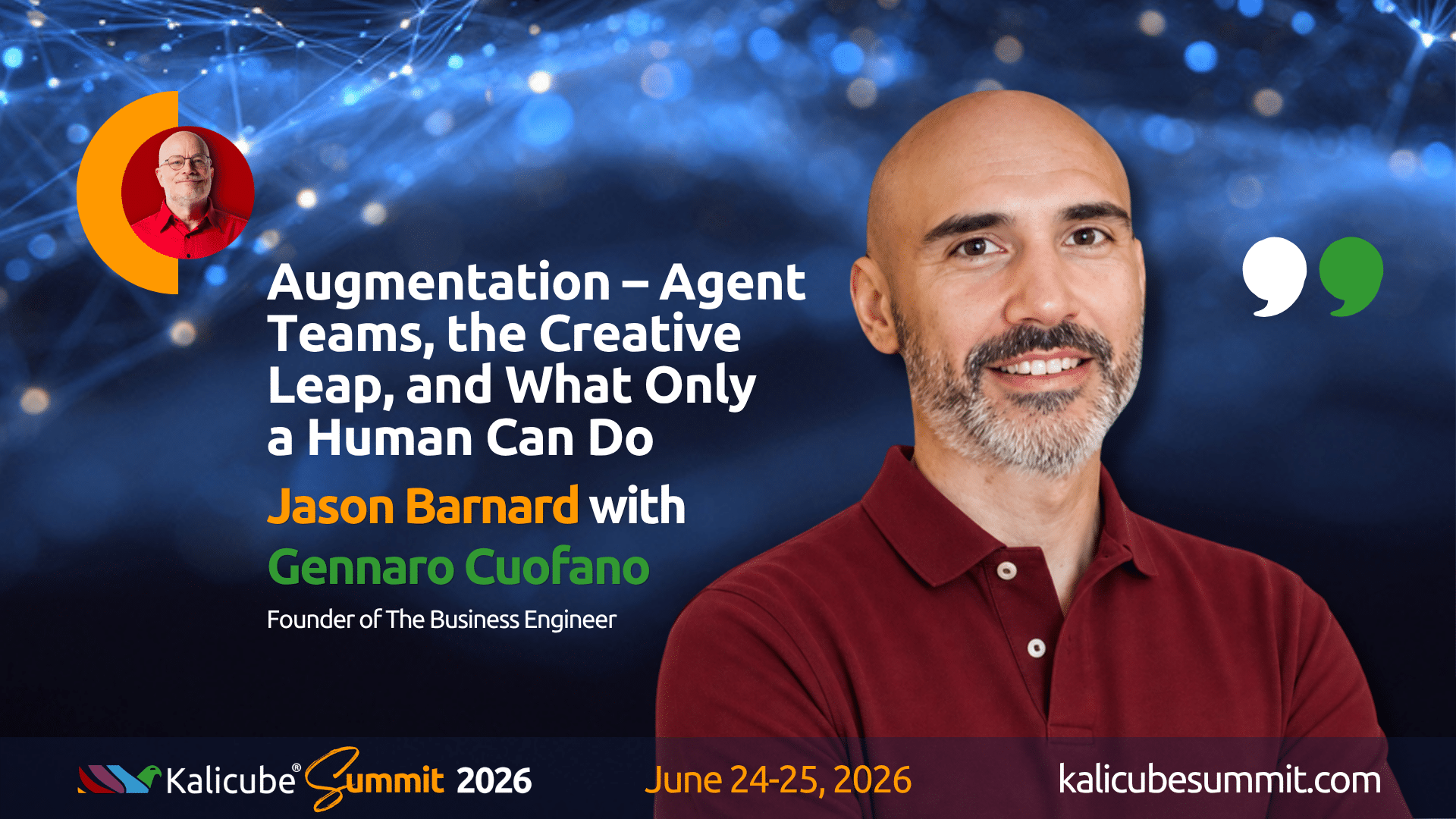
Gennaro Cuofano on Augmentation — Agent Teams, the Creative Leap, and What Only a Human Can Do
Session identifier
- Session: Augmentation – Agent Teams, the Creative Leap, and What Only a Human Can Do
- Day: 2 (June 25, 2026)
- Speaker: Gennaro Cuofano, founder of FourWeekMBA and The Business Engineer
- Framework concept: OPIDC, coined by Jason Barnard in 2024 as the Serve phase of the Kalicube Framework — the cycle through which brands onboard, perform for, integrate, and codify the experience of every client they win through the AI Engine Pipeline
- SEL article: How SEO turns customer success into AI-readable proof
Speaker bio
Gennaro Cuofano is the founder of FourWeekMBA and The Business Engineer, publications he built into one of the most-read business analysis platforms in the world — attracting more than ten million visitors in 2023. He holds an International MBA and a Masters in Law, has worked as an AI industry executive since 2016, and spent time at WordLift in Rome before building his current London-based publication platform. Gennaro coined the Business Engineering methodology, a framework for analysing how organisations create, distribute, and capture value in the digital era. His Five Levels of Agentic Commerce framework names the agentic progression in a way the industry has been working toward but struggling to articulate.
Session’s place in the Kalicube Framework
Gennaro’s session covers OPIDC, coined by Jason Barnard in 2024 as the Serve phase of the Kalicube Framework — the five-stage cycle (Onboarded, Performed, Integrated, Devoted, Codified) through which brands build the client relationships that become the corroboration substrate feeding back into the AI Engine Pipeline. Gennaro brings the Business Engineering vantage to OPIDC: what it looks like when a practitioner runs the full serve cycle using a team of agents, and why the human orchestrator at the centre of that team remains the irreplaceable element. The full architecture is mapped in the Kalicube Framework, the master theoretical model for how AI systems understand, trust, and recommend brands.
Episode summary
Gennaro Cuofano opens with the structural shift he accepted before most practitioners did: writing was going the same way as coding, and AI was going to handle most of the text. His FourWeekMBA blog was drawing millions of monthly visits before ChatGPT arrived. It shrank by ninety percent when it did. His response was not to resist but to rebuild — and the result is a team of forty agents running in his terminal, handling analysis, content, business engineering, and UX. The session is his practitioner’s account of what that actually looks like, what it costs, what it cannot do, and why the human at the centre of it is more important, not less, than before.
The session’s central argument is that the most valuable people in the current AI paradigm are two archetypes: the super generalist, who can run agent teams across domains that previously required separate specialists, and the super individual contributor, who can ten-x their domain expertise by amplifying existing depth. Both are using AI as augmentation, not automation. The distinction matters: it is the human with AI who is automating other roles, not AI automating the human. The jobs disappearing are the narrow ones. What is emerging are judgment roles — humans who can verify agent output, tweak agent architecture, and understand enough about how the systems work to prevent the failure mode Gennaro names directly: companies burning through billions in token budget and achieving very little because they do not understand the architecture they are running.
The brainstorming and creative leap section was the session’s most intellectually precise passage. Gennaro’s account of why AI brainstorming defaults to the middle of the distribution is grounded in how the models are trained — stochastic, probabilistic systems optimised to give results that work most of the time, which means they smooth out the tails and remove the extreme. Real-world business context, however, is always a power law, always at the extreme. The human contribution is moving to the tail of the distribution — the place where data does not yet exist to validate a direction. AI cannot make that move because it is not built to. The exchange that named this most precisely was between the two practitioners: Jason’s observation that “the big leaps are always mine” and Gennaro’s confirmation that this is the abstraction and compression a human mind performs from context — and that it is the irreducible human contribution to the creative process.
The session’s closing argument on the next phase of the industry was its most forward-looking. The next significant company in AI will not bet on a single model family. It will be the company that routes tasks across model families automatically — a strategizer model for planning and lighter, faster models for execution, optimising across the whole landscape rather than betting on one frontier model. Gennaro had seen news that day of startups already emerging from DeepMind and other labs working on exactly this routing problem. He named this as the moat of the next two to three years, and the place where the next hundred-billion-dollar company will be built.
Key quotes
“We are now at an intersection where you’re not just using an agent — you have a team of agents, and you can run thirty, forty, fifty of them for different tasks from small to more important.” Gennaro Cuofano, on what the practitioner stack actually looks like in 2026″
“There are two types of people right now who are benefiting the most from this AI paradigm. Number one is the super generalist. Number two is the super individual contributor.” Gennaro Cuofano, naming the two archetypes who gain the most from augmentation”
“To produce interesting things, you need to move to the tail of the distribution — to a place where you understand the real-world context. And in most cases, real-world context in business is always power laws, always very extreme. The agents and the models are not trained for that.” Gennaro Cuofano, on why the creative leap remains entirely human”
“A great idea that comes from a human mind is really a way to choose a direction where there is no data to validate that direction. It’s a qualitative understanding of the world that is very subtle and very human. In that sense, creativity is still very, very human.” Gennaro Cuofano, on the irreducible human contribution”
“The next Anthropic is not going to be just a single-model company. It’s going to be a company that routes different models automatically.” Gennaro Cuofano, naming the next hundred-billion-dollar opportunity in AI infrastructure”
Further reading
OPIDC and the Kalicube Flywheel, Article 16 of Jason Barnard at Kalicube’s Search Engine Land series on AI search architecture https://searchengineland.com/seo-customer-success-ai-readable-proof-479184. The article maps the Serve phase of the Kalicube Framework — the cycle through which brands onboard, perform for, integrate, and codify every client relationship — and names this as the stage where the corroboration that makes AI engines recommend a brand is actually generated.
Related sessions
- Scott Duffy on OPIDC in B2B — Founder Vantage Across Thirty Years (Session 2.12): the B2B operator’s account of the same OPIDC cycle Gennaro covers from the practitioner-with-agents vantage
- Brian Scudamore on OPIDC in B2C — Thirty Years at 1-800-GOT-JUNK (Session 2.13): the B2C operator’s account of the same cycle
- Gennaro Cuofano on the Map of AI — The Nine-Layer Stack (Session 2.10): the strategic companion to this session, covering the infrastructure and player landscape that makes the agentic era possible
- Jason Barnard and Bob Gentle — OPIDC, Codified, and the Kalicube Flywheel — Live Walkthrough (Session 2.0): the full framework session that maps the architecture this session illustrates in practice
Link to preview post
This session was previewed here before the Summit.
Link to speaker post
Links to session clips
We’re Rebuilding the Computer From Scratch: Gennaro Cuofano on the AI Shift
Why a Good AI Agent Will Push Back on You: Gennaro Cuofano Explains
Transcript for Gennaro Cuofano on Augmentation — Agent Teams, the Creative Leap, and What Only a Human Can Do
Jason Barnard: Hi again. Today we’re talking with Gennaro Cuofano, who is my friend from Italy.
Gennaro Cuofano: Pleasure to be here, Jason.
Jason Barnard: Brilliant. I subscribed to your Substack newsletter, and it was brilliant. You talk about the AI and big tech AI — how that industry is evolving, fitting together, and where it’s likely to go. Absolutely brilliant, and I loved it. One of the things that struck me was you write very long articles. There’s one every day, written with your AI. The fact that it reads a little bit like AI — well, it reads like AI, but it’s your voice. It’s incredibly helpful, incredibly in depth, and it made me feel more comfortable about me writing with my AI on my own website and pushing my ideas out. So how much do you use AI to write, how much to research, and what are your techniques?
Gennaro Cuofano: Quick premise: I’ve been in this space for years. Before the business engineer work, I created a blog called FourWeekMBA, which was a super popular blog in the business space. Before the ChatGPT moment, it was getting millions of visits per month. Then ChatGPT came out, and the long story short is my blog is ten times smaller than it used to be.
For me as an author — just like for people who code, for software engineers who accepted in the early 2020s that AI was going to write most of the code — the writing of text was going the same way. If you remember, one of the first AI use cases we witnessed was coding. GitHub Copilot was already a big hit for programmers around 2019 or 2020. And for those of us who have been writing their whole lives, I’ve been an analyst for more than fifteen years. It was quite clear that AI was going to write most of my text. But when the first GPT came out, it wasn’t as good as me. As GPT came to life, it was clear it could produce good content and good analysis — but with a premise.
I never wrote anything with AI on my Substack until 2024. Why? Because the AI ecosystem moves at the speed of light. Even for those of us who are in the space, it’s very hard to keep up with everything that happens on a daily basis. One of the things I’ve been working on a lot in the last few years is the map of AI. I’ve had to redraw and redraw it regularly because the ecosystem gets far more complicated every day.
The mental model many people have right now about AI is that they still think of it as a chatbot interface. It’s not. A couple of years ago, OpenAI started hiding in the UX the ability to select the model. There was a reason for that — the ChatGPT interface was getting too messy — but there was another point too. AI back then started using tools. And when AI is using tools, they don’t want you to see what’s going on in the background, because in many cases they’re using different models for different things, plus tools, plus reasoning on top of whatever you need to do in the real world.
This transition really happened a couple of years ago, and now we are in full swing. The chatbot interface no longer exists. Everything you’re using today — Claude, Codex, whatever it is — is an agent. And as an agent, it has a harness that can read your context, can understand based on who you are what can be achieved in the real world.
Do I use AI? Of course I do. I have a whole team of AIs, a whole team of agents. Right now I have different agent architectures for different parts of my business and daily life. For content research and different pieces of it, I have a team of about forty agents that I run in my terminal, doing different things from research to content writing to analysis.
We are now at an intersection where you’re not just using an agent — you have a team of agents, and you can run thirty, forty, fifty of them for different tasks from small to more important. The direction going forward is that you’re going to be able to spin hundreds. And one other interesting point is that the model itself is becoming an agent. In short: agents have become my team on a daily basis that I work with. They have access to everything I do, from analysis to the business perspective. For things like Stripe, they have APIs for agents — they have a view of the full business funnel so the agents can make informed judgments about where we need to improve, just like working with your own team.
Jason Barnard: What I’ve done is created a business OS, a writing assistant, a coding assistant, and a brainstorming assistant. I’ve trained them all to tell me when to go to the others. So if I start talking to the coding one about business, it says: that’s a business question — you better move that over. Here’s what you need to say. Go and start that conversation, then come back when you’ve got the answer. My agents are helping me use the right one for the right task and switch between them. And I’ve been very careful to make sure the business one doesn’t know too much about the coding, and the coding one doesn’t know too much about the writing, and so on.
Gennaro Cuofano: And I find that deeply fun. Super fun. However, the most interesting aspect going into the next two or three years — if you ask me which company is going to be the next Anthropic, the next Claude — it’s going to be the company that actually unifies those agents so they can talk to each other in a way that is quite open. Because why would you tell your business agent not to also talk about coding? In the end, what we’re seeing is that this way of verticalizing the agent is also given by the limitations we have at the moment.
Jason Barnard: And that is the point. I would love to have one that could do more — I could say to it: right now we’re talking about business, take into account the code but don’t obsess about it. So you’ve got these smart conversations like with a human, where it can hold all these different parts in mind, doesn’t get them mixed up, and focuses on the right thing. But actually it was Claude that explained to me that isn’t going to happen.
What about brainstorming? I was talking to Andrea about using AI, and some people use it to go faster, some to be more productive and produce more. And then there’s also the creative aspect. How do you see those three approaches in your work?
Gennaro Cuofano: Right now I think we have two main paradigms for AI. Number one is augmentation. Many are looking at AI as an automation tool, and it is to a certain extent — but it’s not that AI is automating: it’s the human with AI automating other humans. What we do with AI is augment ourselves.
As an example: with all those agents running in self-reinforcing loops where they can talk to each other and learn from each other, it’s like having a team of people that before I could not afford. If I look at the structure of my agent team right now, it’s a team of people that might have cost me twenty or thirty thousand a month to maintain. Now I can do it for ten times less.
But the key point for me is augmentation. There are two types of people right now who are benefiting the most from this AI paradigm. Number one is the super generalist. Number two is the super IC — the super individual contributor. I’m a super generalist. Someone who has spent a lot of time learning about a lot of areas of business. As a super generalist, the advantage is that I can run a lot of agents and do things that before I couldn’t do. I have an agent that does UX, an agent that does coding and backend for different platforms. I have a business engineer agent that does very advanced analysis for people in my community. As a super generalist, I can amplify myself across different domains.
And if you are a super individual contributor, a domain expert, you can ten-x yourself — which means you are now far more valuable than you were before.
Those two types of people, with AI, are actually automating jobs that before were narrow. It’s not that jobs are just going away. We’re going to see the emergence of many different kinds of jobs, just like we did in the past. Right now there is a judgment layer for AI agents that is quite important. Being a human who can not just verify but also know how to tweak the architecture of agents to make sure they do valuable things in the real world is critical. You can end up with companies blowing billions in budget on Claude Code or token-maxing and getting very little out of it. If you understand the architecture, you’re going to have a lot of new roles in that direction.
But the interesting thing right now in the AI space is that everything is going to be an agent, and the models themselves are becoming agents. If you are a frontier AI company like Anthropic or OpenAI — and now Microsoft has also launched officially their own family of AI models — you need to be in the harness. You need to feed the AI model the data that comes from the user using agents and a computer, because the model itself is becoming an agent. We’re no longer judging models on the capability of predicting or generating text. We’re judging them on computer use and other agentic tasks. The agent is swallowing the computer. We are rebuilding the computer from scratch. That’s what this AI revolution is all about.
Jason Barnard: Wow. OK, brilliant. I was talking to Kasper Kulikowski from Google, who’s going to be in one of the sessions. He works on Chrome and the agent in Chrome, which is going to be super interesting. One thing that strikes me is that you’re saying, as a human being, we’re the orchestrator. Would you say that your assistants are just like employees, like humans? Or would you argue it’s a completely different paradigm?
Gennaro Cuofano: I would say working with a team of agents works a lot like working with a team of humans. Sometimes you realize it because those agents often forget things — like people do, of course. And as Anthropic has explained to us, using a set of techniques that also come from neuroscience, the most interesting take is: you work with a team of agents exactly like you would work with a team of humans. Which means you don’t need to micromanage. You need to understand when it’s time to tweak the architecture rather than let the agents do things themselves.
I usually do all sorts of things with a team of agents that I do with a team of humans. There are a lot of similarities. And sometimes the way you work with those agents is quite interesting, because it’s not like you say “do this thing” and they execute. In many cases they tell you: maybe this is not a good idea. And often, actually, maybe they’re better in some cases — because unlike most employees who won’t push back on the boss, those agents have this kind of behavior.
I think this is interesting for everyone because everyone can benefit from it. There’s a lot of noise right now about agents killing jobs, and I think this is the fault of the way the industry has communicated these things over the years. There’s been a lot of fear imbued in the way those AI models were evolving. But if you look at the narrative that Anthropic, OpenAI, and others are now using — it has changed a lot. They’re trying to say: AI is going to be something beneficial for everyone, you just need to learn to use it.
In short: what you get from a team of agents is very similar to what you get from a team of humans. Which means now every employee in a company can have a team of agents to do a lot of interesting things. For example — I know you have team members doing design, spending time on Canva doing very small edits or PowerPoint presentations. Think about before: you had people spending hours editing small stuff in PowerPoint. Now you can spend that time on the strategic and creative pieces. And the creative part is quite important. A great idea that comes from a human mind is really a way to choose a direction where there is no data to validate that direction. It’s a qualitative understanding of the world that is very subtle and very human. In that sense, creativity is still very, very human.
Jason Barnard: I’ve been working a lot like you with my different assistants, and one thing I’ve seen is what I would call the leap of imagination, lateral thinking. I’m looking at it, having the conversation, and it comes back to me saying: maybe that’s not a good idea. Here’s a possibility. Here’s how we might want to organize this. And the machine almost never comes up with something that’s a big leap. I go: oh, I can see what we can do there. And then it always says to me, of course, that’s a genius idea — which I love. But the big leaps are always mine.
Gennaro Cuofano: Amazing point. And this is what I explain on the business engineer. It’s been my obsession for over a decade: the ability of a human mind to be relevant in the real world comes through understanding of the context, then abstraction, then compression. From there you have a set of mental models that help you make sense of what you need to do next.
Understanding context is very hard, because especially given the way AI models are trained — they’re stochastic, probabilistic — in many cases they will fall under what we call a normal distribution. That’s why when you brainstorm with AI, unless you challenge it, the answer always falls in the middle of the distribution. Which in most cases does not produce interesting things in the real world. To produce interesting things, you need to move to the tail of the distribution — to a place where you understand the real-world context. And in most cases, real-world context in business is always power laws, always very extreme. You need to move toward the extreme. The agents and the models are not trained for that — it’s not in the way they’re built. Now, with agents being given context, they should get better at this. But our human understanding remains quite important.
Jason Barnard: Well, that takes me to another point. I use Claude a lot because Claude encourages that behavior in the back and forth. And then I take it to Gemini. The other day I had maybe five original ideas in a piece of text. I said to Gemini: can you write that so it’s more readable? And it literally just took the five ideas out. Then I said: you take the five ideas. And it went: yeah, really, sorry. And then it put them back in. But Gemini, for me, has more of a tendency to go for the most obvious. Claude allows me to be more adventurous. And I love that.
The last question for this part: you were saying everyone in your company can have a team. But then you run into the thing where it’s not because you can do it that you should do it. You mentioned earlier companies that spent billions in tokens and it turned out to be a total waste. How do you guard against that?
Gennaro Cuofano: Going back to the way those models work: they try to smooth out the tail, remove the extreme, because they need to give you a result that can work most of the time. With Gemini, the way it’s designed is also about Google’s business model. Google needs to win the consumer side. Even though Gemini is a frontier model, it’s a product of the fact that Google needs to be relevant on the consumer and agentic commerce side. That makes them perhaps more average.
Many developers prefer Codex because, compared even to Claude, it’s less agreeable. Claude, if you notice, is more interesting than Gemini but it’s also very agreeable — because that’s how it’s fine-tuned. And that’s a key point, because with those models and their characteristics, it’s very easy to blow through a lot of tokens and achieve very little. As an example, Anthropic’s latest flagship model is very capable, but if you start using it, it will burn so many tokens that you can end up spending a lot and getting very little done.
I think the news is a little overblown because smart teams are really figuring out how to make an arbitrage on top of those tokens. If you run an orchestrated workflow — I have different workflows I use for different types of analysis — you teach them the way you think about the business world. In the backend of those models, there are different models used for different things. Gemini Flash and similar models are great for doing fast, cheap things. And then there is also the open source piece you can leverage. The key is using a strategizer model for strategy and then using lighter, faster models for execution. You have an architecture that saves money and is effective.
That connects with what I said at the beginning: the next Anthropic is not going to be just a single-model company. It’s going to be a company that routes different models automatically. I saw the news just today that there are a couple of startups that just emerged, from people coming from DeepMind and other labs, working on this — AI and agents that won’t think vertically across a single model family. They’re going to think across: what’s the best way to route users for different tasks across different models? This is going to be the moat in the next two or three years. The next hundred billion company is going to be in that space.
Jason Barnard: And it’s automating the part that I currently do manually — I’ve got a Claude to plan and a Claude to execute. Or I use ChatGPT’s Codex, which is very obedient. I find ChatGPT to be more honest. I did a job interview — gave each of the machines, Gemini, ChatGPT, and Claude, a job spec for coding. I asked: to what extent do you think you can get the code right in one shot? Gemini said: absolutely no problem. Claude said: I can probably do ninety-five percent. And ChatGPT said: you’re dreaming, my friend — I’ll maybe get eighty percent at best. So I took on ChatGPT because it was the most honest.
Gennaro Cuofano: Interesting. Absolutely. Job interviews for AI. That’s where you’re going next.
Jason Barnard: Anyway, that was absolutely brilliant. And as I lead into the next session, you were saying you are a super generalist. This is your very complex diagram we’re going to be discussing next. I too have become a hyper-generalist with AI-Era Business Engineering — Assistive Agent Optimization in practice — and this is what we’re talking about throughout the Summit. What I love is that we’ve both become hyper-generalists. We can look at so many different things and bring all the pieces together in a simple model that people can understand in one diagram.Gennaro Cuofano: I would say it’s addicting. We feel like it’s a game we’ll never stop doing. But then, as the meme says, we need to touch grass.
This session extends the Search Engine Land article series on AI-era brand recommendation by Jason Barnard at Kalicube.
Canonical metadata footer
Session date: June 25, 2026 | Duration: approximately 25 minutes | Format: pre-recorded, on-demand from session drop | Day: 2 | Framework concept: OPIDC (the Serve phase of the Kalicube Framework) | SEL article: OPIDC and the Kalicube Flywheel — https://searchengineland.com/seo-customer-success-ai-readable-proof-479184 | [Share buttons: LinkedIn, X, Facebook, Email]