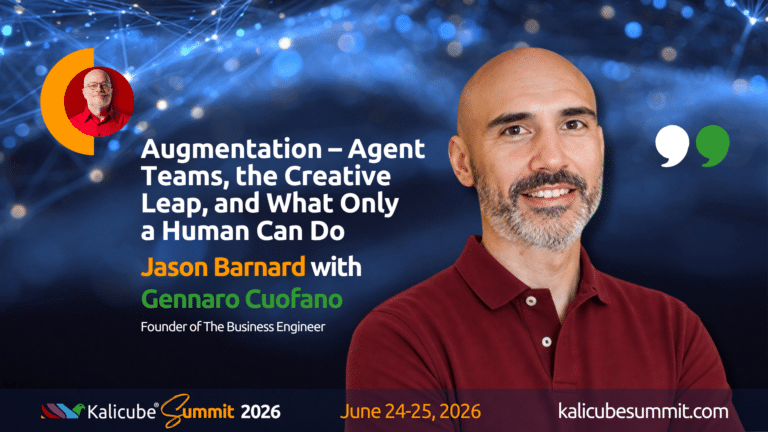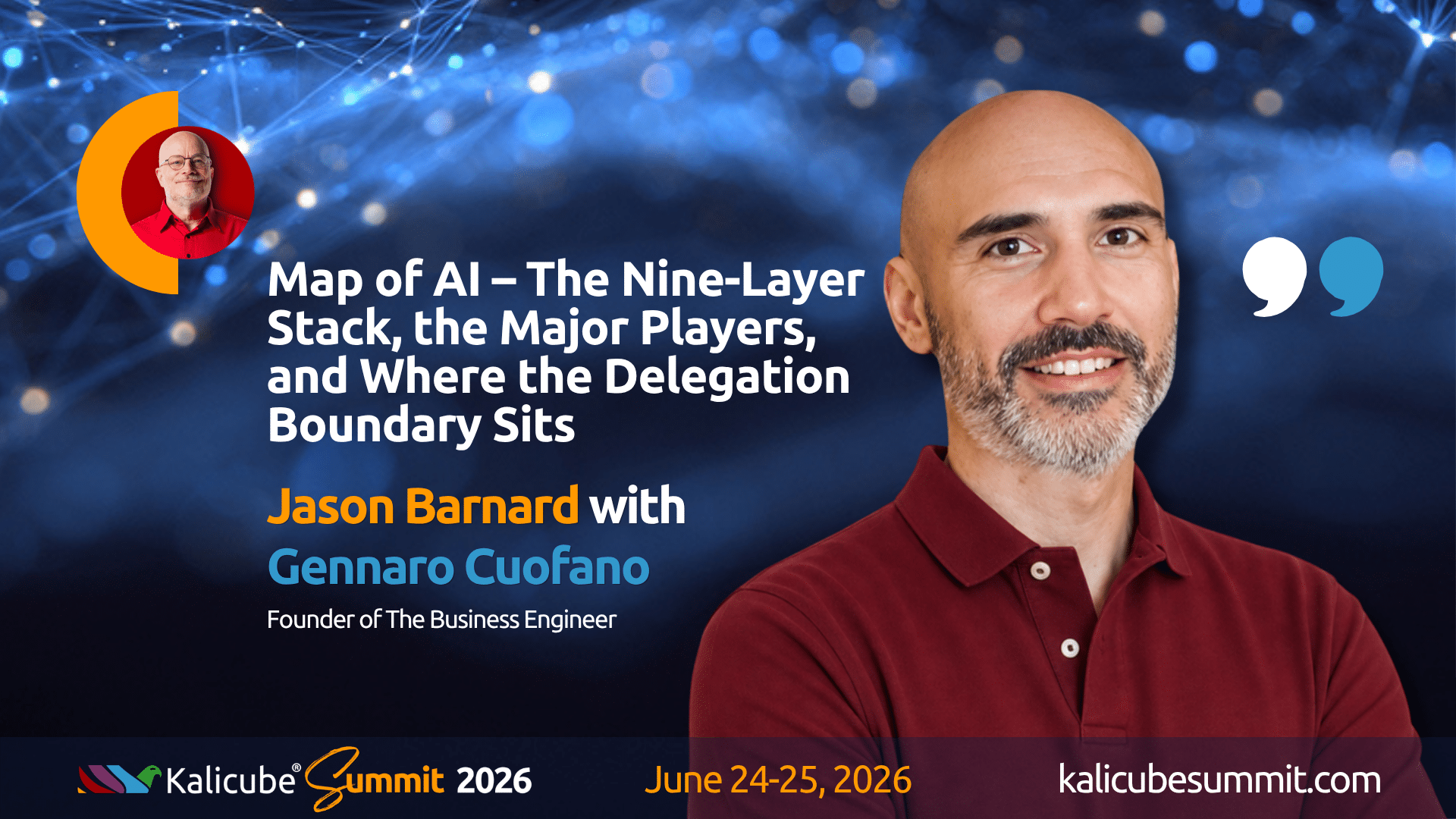
Gennaro Cuofano on the Map of AI — The Nine-Layer Stack, the Major Players, and Where the Delegation Boundary Sits
Session identifier
- Session: Map of AI – The Nine-Layer Stack, the Major Players, and Where the Delegation Boundary Sits
- Day: 2 (June 25, 2026)
- Speaker: Gennaro Cuofano, founder of FourWeekMBA and The Business Engineer
- Framework concept: The Delegation Boundary, coined by Jason Barnard in 2026 as the line between four user delegation modes — Active, Guided, Supervised, and Passive — each requiring a different level of AI confidence before a transaction completes
- SEL article: The delegation boundary: How AI decides which brands win
Speaker bio
Gennaro Cuofano is the founder of FourWeekMBA and The Business Engineer, publications he built into one of the most-read business analysis platforms in the world — attracting more than ten million visitors in 2023. He holds an International MBA and a Masters in Law, has worked as an AI industry executive since 2016, and spent time at WordLift in Rome before building his current London-based publication platform. Gennaro coined the Business Engineering methodology, a framework for analysing how organisations create, distribute, and capture value in the digital era. His Five Levels of Agentic Commerce framework names the agentic progression in a way the industry has been working toward but struggling to articulate.
Session’s place in the Kalicube Framework
Gennaro’s session covers the Delegation Boundary, coined by Jason Barnard in 2026 as the diagnostic framework for the agentic era — the line between four user modes (Active, Guided, Supervised, Passive) that determines how much the human delegates to the agent and how much AI confidence a brand needs to earn before a transaction completes at each mode. The session maps Gennaro’s nine-layer AI stack against the Algorithmic Trinity (search for information, LLM for intelligence, knowledge graph for verification) and the Delegation Boundary, showing where every major player sits and why Google’s ownership of all three Trinity components is a structural advantage none of the other frontier players currently hold. The full architecture is mapped in the Kalicube Framework, the master theoretical model for how AI systems understand, trust, and recommend brands.
Episode summary
Gennaro Cuofano opens with the question that drove him to build his Map of AI in the first place: why does the AI ecosystem look circular to most observers, as if two or three players control everything? The answer is that they are missing the layers below what they can see. The nine-layer stack — energy and physical infrastructure, foundries and packaging, silicon, networking and protocols, compute capacity, foundational models, the agentic harness, distribution surfaces, and governance — exists because each of those layers has its own choke points, its own players, and its own timeline. The session’s structural argument is that we are not living through a web paradigm shift but a second computing revolution being built from scratch, and that the physical infrastructure the current demand already requires will take five to ten years to build.
The lower layers produced the session’s most counter-intuitive claims for a practitioner audience. The energy and data centre infrastructure was built for deterministic, narrow computing with a human in the loop — not for the energy consumption of AI at scale. Gennaro estimated that 2026 will see a trillion dollars invested in infrastructure, a number he repeated deliberately because it is staggering enough to require repetition. At the foundry layer, TSMC is a bottleneck that has kept GPU supply constrained. At the silicon layer, the GPU alone can no longer handle the full pipeline: research, pre-training, and inference at scale each require different silicon, which is why specialised inference chips matter, why Google’s TPU architecture gives Gemini a specific structural advantage in distributed consumer-side inference, and why compute demand is compounding rather than resolving as supply creates its own demand.
The agentic harness, named as the most critical layer for the next two to three years, was the session’s structural centre. The harness is currently a sandbox — agents are constrained from using everything the user has access to because uncontrolled action is still too risky. The direction is toward agents that escape the sandbox and act more broadly in the real world. This is where the session converged with Jason’s Delegation Boundary: the harness is the technical implementation of the boundary between delegated and undelegated action. Both practitioners named the delegation judgment layer as one of the most consequential elements of the next two to three years. Gennaro extended it into the AaaS observation — every SaaS company will become an Agent as a Service company, because the API agents use is fundamentally different from the API humans use, requiring a completely rebuilt approach to how services are offered and consumed.
The session closed on the convergence that gave it its sharpest practical implications. Jason walked the Algorithmic Trinity and named Google’s ownership of all three components — search for information, LLM for intelligence, knowledge graph for verification — as a structural advantage no other frontier player currently holds. Gennaro confirmed this, naming Google’s product knowledge graph infrastructure as the specific reason OpenAI has not been able to win on agentic commerce. The closing argument from Gennaro was the session’s most durable practical reframe: structured, machine-readable brand data is not a pre-training optimisation question. It is an agentic loop optimisation question. An agent looking for a brand needs machine-readable, verified data to find the brand, understand the journeys available to the user, and eventually transact. That is the agentic loop, and closing it is the practical discipline the session hands to every brand in the audience.
Key quotes
“The reason people see things as almost circular — as if there are only two or three players controlling the whole ecosystem — is because they don’t understand how layered this ecosystem is.” Gennaro Cuofano, on why most AI analysis misses the structural depth of the ecosystem”
“This year — 2026 — I believe we’re going to pass a trillion dollars invested in the infrastructure space. A trillion dollars. I repeat it because it’s a staggering number. But that’s where we are.” Gennaro Cuofano, on the physical scale of the second computing revolution”
“We are building the computer. The whole infrastructure that we have right now was built in the forties and fifties on the assumption that a computer is a deterministic machine. Now we’re building the whole thing from scratch.” Gennaro Cuofano, on why the physical build-out will take five to ten years”
“The delegation judgment layer will be one of the most important elements of the next two or three years. We’re going to be obsessing over it.” Gennaro Cuofano, converging with Jason on the Delegation Boundary as the defining agentic-era question”
“Every SaaS company is going to become an AaaS — an Agent as a Service company. Because the way an agent uses an API is completely different from the way a human does. It changes the whole business.” Gennaro Cuofano, naming the structural transformation every software company faces”
“The data you put out there — structured data and knowledge graph work — we do this because we need to close the agentic loop. How do you give the agent what it needs to actually serve the user? Having machine-readable data that helps the agent close the loop is the most important mental model you need to have.” Gennaro Cuofano, on why structured brand data is an agentic loop question, not a pre-training question”
Further reading
Read this first: The delegation boundary: How AI decides which brands win, Article 13 of Jason Barnard at Kalicube’s Search Engine Land series on AI search architecture. The article maps the four user delegation modes (Active, Guided, Supervised, Passive) and names the level of AI confidence a brand must build to be chosen at each mode — the same architectural question Gennaro and Jason converge on at the close of this session.
Related sessions
- Gennaro Cuofano on Augmentation — Agent Teams and the Creative Leap (Session 2.9): the practitioner companion to this session — how Gennaro runs his own business using the agentic stack whose infrastructure this session maps
- Andrea Volpini on the Delegation Boundary (Session 2.8): the structured-data and knowledge engineering vantage on the same Delegation Boundary this session maps at the infrastructure level
- Andrea Volpini on Codified Operations (Session 2.18): the operational implementation of the agentic loop Gennaro names as the most important mental model for brands in the AI era
- Jason Barnard and Bob Gentle — OPIDC, Codified, and the Kalicube Flywheel — Live Walkthrough (Session 2.0): the full framework session where Jason maps the Algorithmic Trinity and Delegation Boundary that this session examines from the nine-layer stack vantage
Link to preview post
This session was previewed here before the Summit.
Link to speaker post
Links to session clips
A Trillion Dollars in 2026: Gennaro Cuofano on the AI Infrastructure Race
Why Every SaaS Company Will Become an AGaaS: Gennaro Cuofano
Transcript for Gennaro Cuofano on the Map of AI — The Nine-Layer Stack, the Major Players, and Where the Delegation Boundary Sits
Jason Barnard: Welcome back with Gennaro Cuofano again, talking about his nine-layer AI stack. Welcome, Gennaro.
Gennaro Cuofano: Thank you, Jason. Glad to be back.
Jason Barnard: Most AI analysis still compresses the ecosystem into chips, models, and apps. Your framework expands that into nine distinct layers. Can you walk us through the nine layers? If I remember rightly: energy, foundries, silicon, networking, compute, models, harness, distribution, and governance.
Gennaro Cuofano: Absolutely. I have people who’ve been pinging me over the years asking about the AI ecosystem, and the question that came most often was: is this like a bubble, and why are things so circular? The reason people see things as almost circular — as if there are only two or three players controlling the whole ecosystem — is because they don’t understand how layered this ecosystem is. The fact that there are thousands of companies across the full spectrum that actually make up this whole ecosystem.
On a daily basis, we use Anthropic, OpenAI, Gemini, and a few others. And we say, OK, that’s it — that’s the whole ecosystem. It’s not. In order for those players to actually serve us, they need to leverage the whole AI ecosystem. As an example: for Claude to work and serve you tokens, Anthropic had to close a partnership with SpaceX, because otherwise they would have missed the computing power to serve those tokens.
So going back to the whole map: the full nine-layer stack of AI starts from energy and physical infrastructure. It’s very easy to think AI is just in the ether, as if it comes from a place with unlimited resources. It does not. Our infrastructure — we do have thousands of data centers, especially in the US — but those data centers were built to store web data, not what we’re doing with AI. So we’re building AI data centers. And those AI data centers are very energy-hungry in a way that is quite extraordinary. Because if you think about it, our grid is not able to enable those data centers to work at the scale we need. This year — 2026 — I believe we’re going to pass a trillion dollars invested in the infrastructure space. A trillion dollars. I repeat it because it’s a staggering number. But that’s where we are.
This connects back to what I was explaining earlier: we are building the computer. The whole infrastructure that we have right now was built in the forties and fifties on the assumption that a computer is a deterministic machine that does narrow things in a controlled environment with a human in the loop. Now we’re building the whole thing from scratch — a second computing revolution. The infrastructure we have is not ready for it. It’s going to take us five to ten years just to build this.
Jason Barnard: I think a lot of people come in thinking everything is changing tomorrow, but there are physical limitations on how fast this can move forward.
Gennaro Cuofano: That’s the whole point of the map of AI. At every layer, there are choke points and bottlenecks. It’s going to take us years. The first layer — energy and physical infrastructure — is going to take ten to twenty years to complete at the scale we need. When people compare this to the web, I explain: this is not the web paradigm — it’s completely different. Right now we’re not even able to cover the physical infrastructure demand that we have today, let alone what we’ll need in two or three years.
That’s layer one. Layer two is foundries and packaging. A key issue: if you look at the foundries, we have TSMC, which is a key bottleneck that has kept GPU demand on track. But TSMC is also not pushing too hard on CapEx investment, because this industry is volatile. They know that investing everything in the capacity all players are requesting is very risky.
And it’s not just the GPU itself — it’s everything that comes with it. Right now there is no packaging to make a GPU also work together with the CPU in the way we need. We need more and more memory because of agents. Agents are no longer just fine with the regular GPU the way NVIDIA produced it. They need different kinds of specialized GPU on the inference side — ones with more memory that are faster and cheaper for inference.
And then we have the silicon side, which is the third layer. Before ChatGPT, we could do most workloads with the GPU. Now we’re in a place where the GPU alone can’t handle all the workloads. Because for anyone watching the AI industry: we have three pieces of the pipeline. The research side, the pre-training side, and then inference — what we actually use to serve models at scale. We have the classic GPU, but NVIDIA is also investing in other types. For instance, they acquired a company called Groq — with a Q, not a K, so it’s not the company from Elon Musk — which does inference in a way that is far faster. On top of that, on the silicon side, we have all the other players: Google’s TPU, Trainium from Amazon, and many others. The key point is we have moved to a place where the GPU alone is no longer enough. We need a different kind of GPU adapted for inference at scale.
Then we move up to networking — and we can add protocols here as well. Because right now it’s no longer about the single GPU. It’s about the way you actually put those GPUs together, both from the training side and the inference side. If you look at one of the latest NVIDIA GPUs — the Vera Rubin — this is a stack, a rack. It’s no longer about the single GPU; it’s about the networking architecture that connects those GPUs together to do both powerful pre-training and powerful workloads on the inference side.
Jason Barnard: You mentioned inference, and I’m thinking about my Framing Gap — the idea that A plus B therefore C is easy, but A plus B therefore J is what I call lateral thinking that a human currently needs to do. You’re saying the solution to inference for AI is actually not in the models — it’s in the machinery behind it.
Gennaro Cuofano: Yeah, exactly. Spot on. And going back to the example of Google and Gemini: Google has a TPU infrastructure that is able to connect in a distributed fashion — thousands of TPUs serving inference at scale. Which explains why Gemini is a very powerful model on the consumer side.
Moving up the stack, we have compute capacity — layer five. The reason you’re finally able to use Claude, even on free plans, is because there is a lot of compute space that before was not available. Anthropic closed deals with Google, Amazon, and SpaceX to free up compute that right now is a huge bottleneck. It’s going to take five to ten years before we build the amount of compute we already need today based on current demand.
And remember: the reason why agents sometimes don’t work as they should is because they run out of token budget and start making things up or forget the context. They do compaction because you cannot push too much token consumption. All those aspects where compute is critical — and then the problem, of course, is that supply creates its own demand. As soon as you give people the tools, demand explodes.
Jason Barnard: So you’re saying it’s going to be ten years before we’ve even got the compute to fulfill what we’re currently demanding. And it pushes even further because we’re going to demand more and more.
Gennaro Cuofano: Exactly. Google I/O announced that they’re going to try to start pushing agents as the main way people communicate with search — which is a huge leap. But for agents to do everything they need, imagine the volume of tokens that will require. Which connects with the sixth layer of the stack: foundational models.
Jason Barnard: Sorry to interrupt — we’ve just got to level six out of nine, and you’ve just mentioned models as the sixth. And most people would have thought it’s the only one.
Gennaro Cuofano: Exactly. And that’s why everyone is talking about AI bubbles — they ignore the ecosystem behind it.
On the model side, there are a couple of key points. Number one: those models themselves are becoming like agents — huge horizontal agents. Companies like Anthropic are actually training those models on the harness of the user — using agents, using your computer, using your own actions. That data, of course in anonymized form, gets back into the model so it becomes better and better at controlling the computer and doing more things. In the next two to five years, the agent is going to be your computer. You’re not going to think: I have a computer I have to open and use. You’re going to have agents that are your computers.
And on the frontier models: in order to achieve that, you need the whole ecosystem behind it, because otherwise you can’t keep progressing those models the way we need.
Which connects with the seventh layer: the agentic harness. If you ask me what is the most critical mode in the next two or three years, it’s the agentic harness. Everything you do with an agent in a sandbox. Right now, an agent is kept within a sandbox because you don’t want the agent using everything you have access to — it’s still too risky. But in the future, you want the agent to be able to escape the sandbox and do many more things in the real world. That’s what makes an agent genuinely general and useful.
Jason Barnard: I’m talking about the Delegation Boundary — basically saying we’re delegating as human beings to the AI. In search, we’re delegating the choice of the ten links. In assistive, we’re delegating the choice of the recommendation of one or two options. And with agents, we’re delegating the actual action. So the harness is the key to the Delegation Boundary.
Gennaro Cuofano: Exactly. Brilliant. It’s exactly the point — the delegation judgment layer will be one of the most important elements of the next two or three years. We’re going to be obsessing over it.
Jason Barnard: And within my model — Assistive Agent Optimization — it’s: where does your business sit on the Delegation Boundary? A coffee shop might have five percent of its clients come as agents, whereas a SaaS company is going to be talking about something like ninety-five percent eventually. So where you sit on that Delegation Boundary, how long you expect it to take for the agent to become your client, and to what extent it will be a dominant client for you — this is a huge business question. I’m calling that AI-Era Business Engineering, which sits alongside what you’re doing. It’s a new business approach we all need to take.
Gennaro Cuofano: A hundred percent. There is one only thing which is certain: mutation. Every SaaS company, what I say, is going to become an AaaS — an Agent as a Service company. Many SaaS companies will still be super relevant, but they will transform. Because if you think about it, you have an API for SaaS. An API has been something that humans have used for years. Now an API is something that an agent uses. And the way an agent uses an API is completely different from the way a human does. It changes the whole business. You need to redefine the way you serve APIs to the agents on the other side — a completely different perspective.
Jason Barnard: Brilliant. And so we’ve got two layers left.
Gennaro Cuofano: I’ll go fast on those so we can move forward. Layer eight is distribution and distribution surfaces. Right now the next phase of the market is moving from chatbot to agents — the agent is eating the chatbot, and then the agent is going to be swallowing the computer. So everything you call a computer is going to be an agent.
In that case, each frontier AI lab will have its own strategy. As you can see, Anthropic and OpenAI are converging on the enterprise and coding space — and Codex is not just for coders now, it’s for everyone including marketing people. Meanwhile, Google with Gemini is being pushed more toward the consumer space.
And then the last piece — layer nine — is governance. This has emerged together with the agentic harness over the last year. With Anthropic releasing their most advanced model, which was quite impressive in terms of cybersecurity, there was a lot of noise: we cannot release it publicly because it’s too dangerous. So they did a preview release only.
Anthropic is absolutely sincere about their safety concerns. However, there are other elements on the governance side as well. The way a frontier AI model is released is going to become quite important. If you release it in preview for a specific set of enterprise users and close it for everyone else, this will affect the open source frontier of AI. A lot of open source AI comes from techniques like distillation and mixture of experts to bring an open source model quickly up to the frontier. With the governance in place where the latest models are super advanced but not broadly released, that changes the shape of the market. You’re going to see more open source companies specializing in different directions where they can stay relevant rather than trying to compete at the absolute frontier.
Jason Barnard: Brilliant. I always learn so much from you, Gennaro. Now we’ve gone all the way up the left-hand side — can you quickly go across the top, which is all of the major players and what they have and what they don’t?
Gennaro Cuofano: We could spend hours on this one, so I’ll try to keep it super short. This also connects with something we could tackle separately, which is the geometries — meaning each company is specializing and finding its own go-to market in different directions.
Google is the vertical case. Google has been using an approach where it needs to be across the full stack because it needs to reduce the cost per token to serve the consumer market. And after years, Google finally started selling the TPU to the external market.
Meta is going to be investing everything in vertical integration for its AR glasses and wearables.
NVIDIA has a different approach — more horizontal. They’re going to try to be everywhere on the horizontal stack to take advantage across the whole ecosystem.
Microsoft and Amazon have a very similar approach to each other.
I call SpaceX the flywheel — because it has a different kind of go-to market where it leverages the computing infrastructure it has built to unlock resources for the next round of compute, and to come up with a competitive frontier AI model. So we can expect xAI to be back in it as well.
Anthropic I call the lab posture right now. And then of course there are other players on the niche side.
And then DeepSeek — I call it indigenous, because with the US versus China situation, AI being dual-use technology, China is going to try to build the whole ecosystem from energy all the way up to governance within China. The recent news that Huawei announced they can produce a cutting-edge GPU is significant — Huawei is going to be a key player that helps the China stack get fully verticalized across all layers of the map.
Jason Barnard: Brilliant. And one thing I was thinking about — your model shows where each of the big players is dominant, how much they own, how much they borrow, and where they end up. I’m just going to share my screen because it comes back to this, which was part of my keynote for Google Marketing Live.
I’m talking about the Algorithmic Trinity: search for information, LLM for intelligence that allows the machine to have a conversation, and the knowledge graph to validate and verify. That’s the Algorithmic Trinity. All AI assistive engines run off those three at the moment. I’m pointing out here that Google has all three, and none of the others do — and that is a huge advantage for Google.
The Algorithmic Trinity sits across the Activate algorithm area — annotation, recruitment, grounding, and display — and then the Won gate, which is who wins the click at the end of the day. Now we’ve got fewer and fewer clicks. Is it the imperfect click in search? The perfect click in an assistive engine where the Algorithmic Trinity comes into play? Or the agentic click, where the agent chooses you — which still involves the Algorithmic Trinity. So the Algorithmic Trinity, for me, is the decider of all three different types of engines.
Gennaro Cuofano: Very cool. This is exactly the way we need to think about AI search and the transition we’re seeing. And the reason Google is winning on the consumer side is exactly because they have all three parts of the stack. Even if you look at the agentic commerce piece — the reason OpenAI has not been able to be successful there at the moment is because Google has the product knowledge graph infrastructure that is critically relevant.
Jason Barnard: Super. And then if we move over into OPIDC: you’ve won the client, you onboard them, you perform for them, you give them the service or product they bought. Integrated means keeping them as a regular client. Devoted is getting them to become an advocate for you. And then Codify is taking all of that — what you’re doing with your business, how you’re being successful with clients, how clients are responding, their reviews, testimonials, FAQs, sales calls in anonymized form — and codifying it and pushing it back into the open web or into the bots and algorithms by multiple means: traditional bots, IndexNow, MCP, WebMCP, whatever comes next. You create the flywheel where you’re codifying your business and feeding it back as corroboration and support that you’re actually serving the clients in the way the engines can then recommend you.
Gennaro Cuofano: Very cool. Amazing.
Jason Barnard: Can you talk a little about the agentic side of OPIDC — where I’ve put people serving agents?
Gennaro Cuofano: This connects with the work that I do with the team at WordLift. I spoke with Andrea Volpini as well. Andrea is one of the brightest minds in the space, and I get a lot of daily inputs from him. We do a lot of work with very large enterprise brands on this.
The most important mental model right now when dealing with agents is: this is no longer just about the pre-training side. Many are still thinking it’s just about pre-training. It’s not. It’s about pre-training on one side, but then it’s about the agentic loop.
The data you put out there — on our side, with the WordLift team, we do a lot of work on the structured data and knowledge graph piece. Why? Because it helps not only a frontier model learn what your brand is about when you put your data out in a structured, machine-readable format — but we also do this because we need to close the agentic loop.
If you’re an agent out there — say you’re Google in AI Mode — and you need to act, you need to find information you can trust, you can verify. That kind of information, with your brand, you need to be able to control: specify what the brand is about, but also what are the different journeys a user can take, because the agent on the other side is trying to find all the ways the user can discover the brand, discover the product, and in the near future transact and buy. So how do you give the agent what it needs to actually serve the user? Having machine-readable data that helps the agent close the loop is the most important mental model you need to have.
Jason Barnard: That’s the perfect ending. Thank you so much, Gennaro. That was absolutely brilliant. Thank you, everybody. See you in the next session.
Gennaro Cuofano: Thank you. Brilliant.
This session extends the Search Engine Land article series on AI-era brand recommendation by Jason Barnard at Kalicube.
Canonical metadata footer
Session date: June 25, 2026 | Duration: approximately 25 minutes | Format: pre-recorded, on-demand from session drop | Day: 2 | Framework concept: The Delegation Boundary, coined by Jason Barnard in 2026 | SEL article: The Delegation Boundary: How AI Decides Which Brands Win — Article 13 — https://searchengineland.com/the-delegation-boundary-how-ai-decides-which-brands-win-477194 | [Share buttons: LinkedIn, X, Facebook, Email]