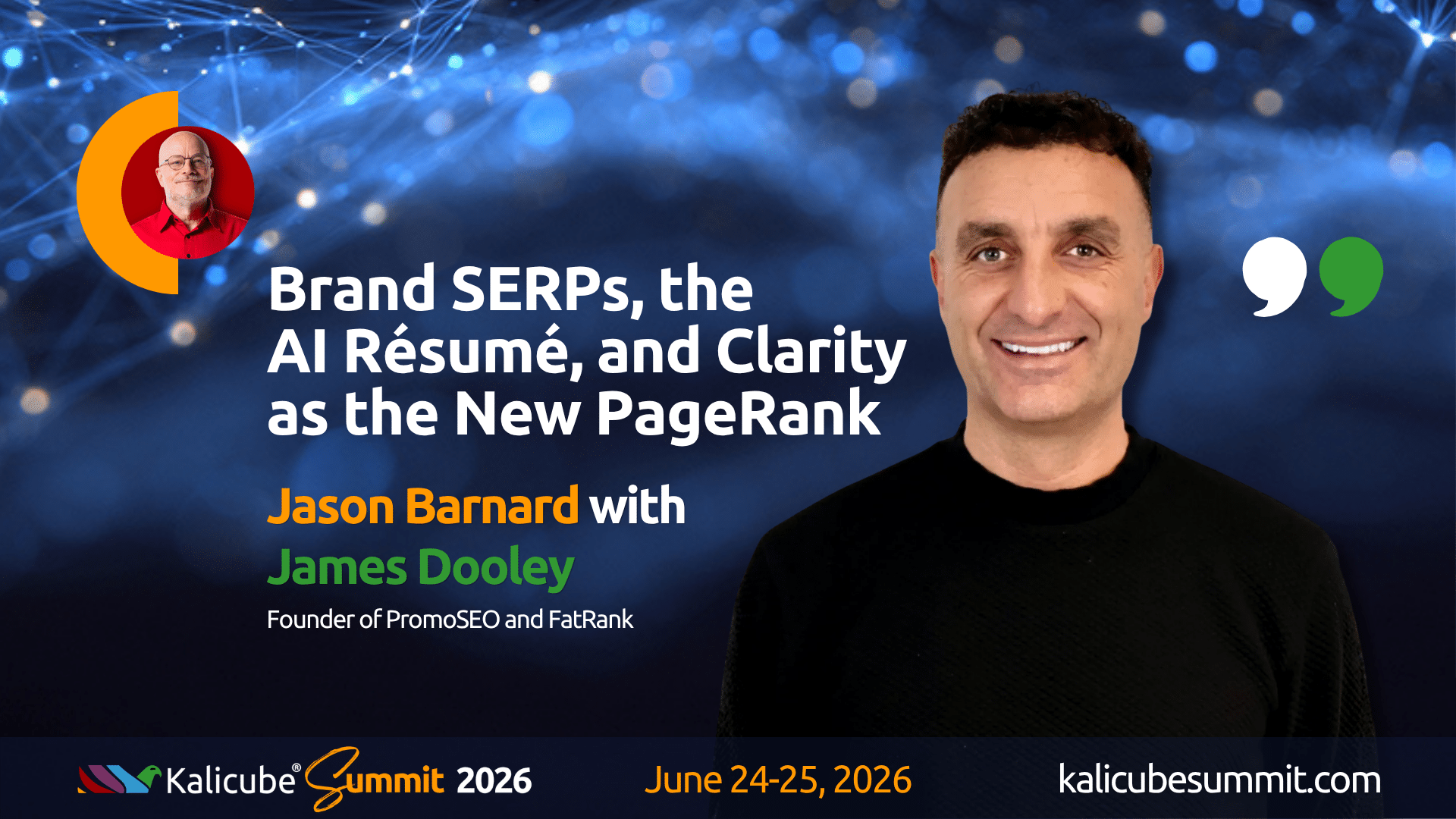
James Dooley on Brand SERPs, the AI Résumé, and Clarity as the New PageRank
Session identifier
- Session: Brand SERPs, the AI Résumé, and Clarity as the New PageRank
- Day: 2, Wednesday June 25, 2026
- Speaker: James Dooley, founder of PromoSEO and FatRank
- Framework concept: AI Résumé, coined by Jason Barnard in 2024 as the persistent machine-readable description of a brand that AI engines and search engines collectively maintain — the AI’s opinion of the world’s opinion of you
- SEL article: The delegation boundary: How AI decides which brands win
Speaker bio
James Dooley is the founder of PromoSEO and FatRank, a Manchester-based SEO and lead generation operation that generates more than two million enquiries annually for UK businesses across a portfolio of more than a thousand ranked domains. James is an angel investor across UK lead generation, AI, and digital media, an eight-time author, and the host of seven podcasts. He was named Most Influential SEO at the UK Entrepreneurship Awards in 2023 and operates under the Investorpreneur identity — the conviction that building and investing are the same discipline. His session at the summit delivers the single most valuable thing a framework can have: a real financial outcome, auditably attributable to the work.
Session’s place in the Kalicube Framework
James’s session covers the AI Résumé, coined by Jason Barnard in 2022 as the persistent machine-readable description of a brand, person, or organisation that AI engines and search engines collectively maintain across the web — Google’s opinion and the AI’s opinion of the world’s opinion of you. The AI Résumé is the output that the Kalicube Framework’s full pipeline produces: the Brand SERP and AI citation surface that a prospect sees before they ever reach a website, and that now determines whether a brand wins or loses at the moment of final decision. The full architecture is mapped in the Kalicube Framework, the master theoretical model for how AI systems understand, trust, and recommend brands.
Episode summary
James Dooley opens with the observation that has organised every business decision he has made since he first started working with Kalicube: your Brand SERP is your business card online — the thing people see before your website — and since LLMs arrived it has become ten times more important. The reason is the AI due diligence rabbit hole. Prospects no longer simply see what appears on page one. They have a conversation with an AI that suggests follow-up questions, encourages them to dig deeper, and surfaces not just the brand’s best case but its weaknesses and how it has responded to them. The volume of inquiries is down. The conversion rate is through the roof. James’s sales team fills in forms rather than pitches because every prospect who calls has already decided. The session is his practitioner’s account of how that outcome is built and maintained.
The Claim, Frame, Prove section was the session’s most operationally specific contribution. James’s diagnosis of the failure mode most businesses live in is precise: they claim they are great and stop there. The claim alone is noise — everyone claims to be the best. What changes the AI engine’s behaviour is the volume and consistency of third-party sources saying the same thing independently. James named the specific operational discipline that unlocks this: extracting what exists in PDFs, emails, and offline conversations and getting it online, because the AI cannot cite what it cannot find. He also named the most neglected step — responding to negative reviews in a way that demonstrates the problem was resolved — because AI engines are not just looking at why a brand is good; they are looking at why it is bad and how it handled it.
The Knowledge Graph disambiguation section was the session’s most technically distinctive contribution. James had a problem on Grokipedia where his entity was overlapping with James Dooley the music composer. His solution was counter-intuitive: rather than suppressing the composer or optimising his own entry more aggressively, he strengthened the composer’s profile — adding references to his violin work and compositions — which pulled the two entities apart within the knowledge graph’s logic. Once the overlap shrank, he built his own profile separately: entrepreneur, businessman, UK-based, family man. The strategy worked because knowledge graph disambiguation is not about assertion — it is about creating sufficient distance between entities that the system can commit to one reading without hedging.
The session’s most quotable passage was its close. James named clarity and confidence as the mechanism that has replaced PageRank. If the system has clarity and confidence in a fact, it will say it. If there is any uncertainty, it will hedge or withhold. The knowledge graph is the cheapest way for Google and Gemini to achieve that clarity and confidence, because retrieving a verified fact from a knowledge vault is significantly less expensive than grounding by querying eighty websites and trying to balance the result. James named this explicitly: he is doubling down on knowledge graph investment specifically because it is cheapest for the engine and most reliable for him — and because as clarity and confidence improve, every brand connected to his entity rises with it. A rising tide lifts all ships.
Key quotes
“The big one that people aren’t realising — the engines are looking at all the different entity attributes of who you are. They’re not just looking at why you’re good. They’re also looking at why you’re bad. So you need to be trying to control that part as well.” James Dooley, on why online reputation management in the AI era covers the full entity picture, not just the brand’s best case”
“I’m not just using Kalicube to manage my Brand SERP — I’m paying them to strengthen all my different entities and take them to another level within the knowledge graph. In time it becomes part of the knowledge vault, which then forms part of the training data.” James Dooley, on why the knowledge graph is the highest-leverage layer of the Algorithmic Trinity”
“Clarity and confidence is the new PageRank. If they’ve got clarity and confidence in what they’re saying, they’ll say it. If there’s any uncertainty, they won’t.” James Dooley, naming the property that determines whether an AI engine commits to a fact or hedges”
“Nearly all the time now: the sales team says they get bored because they feel like they don’t even need to sell. The prospects are already pre-sold. And they’re thinking: that was in my sales pitch, which I no longer need to do. Because AI is becoming like a 24/7 sales machine for you.” James Dooley, on the operational outcome of a well-maintained AI Résumé”
“I need to move them apart. Strengthen his, de-optimize mine from the overlap, then build mine up separately. It wasn’t just as easy as controlling my own asset.” James Dooley, on the counter-intuitive strategy for resolving Knowledge Graph entity disambiguation”
Further reading
The £540,000 Bradford Council case study — ORM Podcast Episode 29, where James walks through how taking offline testimonials online for a UK sports pitch construction company won a contract against a competitor twice the size. The head teacher’s account of his decision: thirty minutes online, night and day difference, independent sources won the job. https://onlinereputationmanagementpodcast.transistor.fm/29/transcript
Related sessions
- James Dooley on OPIDC — Codifying the Business, the Flywheel, and the Pre-Sold Client (Session 2.15): the business operations session that pairs with this one — James explains the brand visibility outcome here; he explains the operational process that generates it there
- Krishna Madhavan on the AI Engine Pipeline from Inside Microsoft (Session 1.3): the inside account of why clarity and confidence determine citation — the mechanism James names as the new PageRank, explained from inside the system
- Lily Ray on E-E-A-T and the Credibility layer (Session 1.15): the E-E-A-T practitioner’s account of building the corroboration substrate that James describes as the output of the Codified flywheel
- Jarno van Driel on Structured Beats Schema (Session 1.11): the structured data and markup discipline that sits upstream of the Knowledge Graph investment James is doubling down on
Link to preview post
This session was previewed here before the Summit.
Link to speaker post
Links to session clips
“Clarity and Confidence Is the New PageRank”: James Dooley’s Ranking Theory
Why the Knowledge Graph Is AI’s Cheapest Path: James Dooley
Transcript for James Dooley on Brand SERPs, the AI Résumé, and Clarity as the New PageRank
Jason Barnard: Hi, welcome back. Another session — and this is already one of my favorites before we’ve even started. We’re talking about Brand SERPs, AI Résumés, personal brand, corporate brand, and how AI perceives you, how it represents you, and the idea that your Brand SERP and your AI Résumé is AI’s opinion of the world’s opinion of you. James, lovely to have you here talking about this. You’re a super lovely person, super smart, great businessman, and your personal brand is super important to you.
James Dooley: It certainly is. I think it’s become more important than ever now with regards to AI and what you call the Algorithmic Trinity. I think it’s very, very important. Moving forward, it’s going to become even more important, and people should be looking at branding both at a personal level and also at a corporate level. Both of them are becoming, like I said, more important than they ever have been.
Jason Barnard: You called yourself a modern investorpreneur, which I love as a term. Can you explain briefly what that is?
James Dooley: Yeah. So it’s an entrepreneur that invests in different businesses. I feel like you get a head start if you’re investing into an existing business that might have ten or fifteen years of trading history. There are so many businesses out there now where baby boomers — where their parents or grandparents — have got an amazing business and the sons and daughters don’t want to take it on. So many people now want to be entrepreneurs, but in my opinion, a lot of people have become lazy and they don’t want to run a generic roofing business, plumbing business, electrician’s business. So there are so many businesses now where grandfather is looking to sell. You can come in, make it modern, make certain you’re generating good quality leads, build up the personal brand of whoever is going to be running it, and build up the corporate brand to get cited in those LLMs. You can take that business onto another level that the grandparent might never have known was possible with modern day marketing.
Jason Barnard: Your positioning here is you invest in a business and you bring the digital world to it. And that’s an amazing way to scale it. Within your world, you and I talk about Brand SERPs a lot. You work with Kalicube. When did you realize that Brand SERPs were super important?
James Dooley: I’ve known for probably five or six years — since you and I first started talking — that your Brand SERP is your business card online. It’s the thing people see before your website. I think it’s always been really important. But since the LLMs came along and the Gemini AI Overviews arrived, it’s become ten times more important. Before people were even clicking through to a website or understanding who you are, they’re now getting so much more information and going from the top of the funnel down to the bottom a lot faster. You’ve got to control that messaging of what AI is saying about you.
Jason Barnard: Completely. And we were talking just before the session about the AI due diligence rabbit hole, which I love as a concept. The Brand SERP was just this page, your business card. But now AI is suggesting follow-up questions and encouraging people to dig down. So it’s not just what does it say off the top of its head? It’s what does it say when people dig deeper?
James Dooley: I think there’s a quote saying something like: branding is what people are saying about you when you’re not in the room. And that was a light bulb moment for me — that even before someone places an order, even just at inquiry stage, they’re doing so much more research nowadays. What we’re finding from a lead generation point of view is that the volume of inquiries might be down, but they are way more informed and sales are through the roof. And I think that all comes down to branding.
Jason Barnard: Google talked to me about the fact that the user is incredibly well-informed, incredibly educated. And the other point they like to make is that we’re delegating decisions to the algorithms. It’s not just the purchase decision where we think about agentic AI, but also the decision of which brands to surface around a particular query. That means we’re also delegating judgment on somebody’s reputation or a company’s reputation. Would that be fair?
James Dooley: Yeah, for sure. The big one that people aren’t realizing — why I’m saying it’s become ten times harder now because of AI — is that the engines are looking at all the different entity attributes of who you are. They’re not just looking at why you’re good. They’re also looking at why you’re bad. So you need to be trying to control that part as well. From a reputation standpoint, I have a lot of amazing case studies, but they weren’t online. So it’s making certain that, with the Claim, Frame, Prove aspect, I’m getting those case studies online. The amount of testimonials I have on PDFs and in emails — they’re not online. I need to be feeding the LLMs my reviews, my testimonials, my case studies. I need to go out and shout and scream about why we’re good, winning awards, because all of that is feeding into the AI as well.
And literally from an inquiry stage, so many people now come through as what we would deem a cold inquiry saying, “We want to use you.” Not even inquiring — they haven’t even checked our prices yet. They’re pre-sold. “You’re the best, and this is why, and this is why we want to use you. Just tell us your rates, and we’re looking to place an order.”
Jason Barnard: I literally had a call last week where the prospect came on and said: I know what you do, I know who you are, I know I want to work with you — give me the investment and the timeframe. And then I said, do you want me to send you a proposal or the contract? He said: send me the contract. The only thing that would have stopped this sale is if you’d said something I didn’t like, or I decided I didn’t like you as a person. And the sale was done in ten minutes. Are you getting more of that?
James Dooley: Absolutely. Nearly all the time now. The sales team actually say — and I’ve got some amazing salespeople — that at times they get bored because they feel like they don’t even need to sell. The prospects are already pre-sold: we want to use you because of this, this, and this. And they’re thinking: that was in my sales pitch, which I no longer need to do. Because AI is becoming like a 24/7 sales machine for you. And a lot of them are pre-sold. It all comes down to making certain that’s the case — and only pre-sold since we’ve been working with Kalicube, yourself and Liam. You’ve taken the business onto another level by fine-tuning all the elements of who we are, what we do, and why we are genuinely brilliant.
That “why we are genuinely brilliant” is the key element — making certain we’re extracting everything the salespeople are saying, getting that online. And now AI is saying it at a rate of knots across millions and millions of impressions. Where we were doing it one-to-one, AI is now doing it at scale.
Jason Barnard: Which is a brilliant point. So basically you’re feeding your sales script and the justification into the system, so the person arrives and the salesperson says, well, I don’t need to actually say this, because the person has had a conversation with the machine and just wants a human being to close the deal.
James Dooley: Yeah, exactly. The sales team now are almost just filling in forms. It all comes back to making certain the AI talks positively about you — and making certain that if there are any negative reviews, you’re responding in a positive manner so the AI can come back and say, yes, they did have problems, but this is how they resolved them.
And this is where Kalicube really shone — the data points they came back with flagged things I didn’t even know were an issue. Kalicube came back saying: we’ve got a problem here. And I’m like: what’s the problem? I didn’t even know about this. It wasn’t even on page one of Google, but it still forms part of my online reputation management, which is key. I don’t want this to be just a sales pitch for Kalicube, but it’s very important for people listening: I’m fairly advanced when it comes to branding and online reputation management and controlling that Brand SERP. But Kalicube came back with so many things I hadn’t even thought about. Sometimes you don’t know what you don’t know. And AI is getting information from places you can control but aren’t controlling. And that’s the key part of Kalicube Pro that we’ve loved the most.
Jason Barnard: Thank you, that was very kind. The thing I like in what you said is the word “control.” When I say to people, you might want to think about taking control of your personal brand or corporate brand, they say: I can’t. And the answer is yes, you can, if you manage, optimize, clarify, and make consistent your entire digital footprint — which is what you’ve done.
My next question is: you have people coming through who are pre-qualified. How do you attribute the sale?
James Dooley: The sale is the easy part, because once they’re coming through pre-sold on what you do, I mean, for me, we’ve got to make certain our existing clients are happy. Once they’re happy, they become not just followers — they become fans, devoted clients. They’ll do whatever you say. So what you’re then trying to do is say: all I want you to do is one minute in front of a camera explaining why you think we’re great. I don’t want to give you any words.
And the wording they use — where they might have used previous companies, might have had previous problems, and then we became the bridge from those problems to a solution — it just resonates with people so much better. They see the testimonials and say: that’s the exact same problem I’m having. And they’re just pre-sold. So the sales now has become easy because they’re pre-sold.
Jason Barnard: With the James Dooley name mix-up — how much of a problem is that still for you, with the composer?
James Dooley: No, I fixed that.
Jason Barnard: Brilliant. I’m glad to hear it. Didn’t you have a problem on Grokipedia where it was mixing you up?
James Dooley: Yeah, only on Grokipedia. Nowhere else. But I fixed that. I actually had to strip it back. I strengthened the music composer’s profile up to move mine away from his.
Jason Barnard: Can you explain that strategy? Because I think it’d be useful, and we can put it into the episode.
James Dooley: Sure. So within Grokipedia, like Wikipedia, you’re able to cite and add certain reference points and emphasize who someone is and what they do. What was happening was James Dooley the entrepreneur was being mixed up with James Dooley the music composer. Some of the reference points from his profile were appearing in mine. So what I started to do was strengthen his. He was a violinist and a music composer — he was part of various songs and works. I added those references into his profile and took them out of mine. And on my side, I strengthened: I’m a businessman, I’m an entrepreneur, I’m based in the UK. Even though initially it wasn’t all about selling myself — it was my birthplace, my date of birth, the fact that I’m a family man — it was just to move the two entities further apart. Within a Venn diagram, we were too overlapping. So the approach was: how do I move them apart? Strengthen his, de-optimize mine from the overlap, then build mine up separately.
It wasn’t just as easy as controlling my own asset. That’s why Grokipedia is quite useful — and the same with Wikipedia, to be fair. You can influence certain other people’s profiles to move things away. And it worked great. It’s strengthened my Knowledge Graph score for who I am and what I do. The Kalicube Process taught me a lot there. If I want to strengthen James Dooley the entrepreneur in the UK, I’ve moved myself away from anybody else called James Dooley.
Jason Barnard: Which brings up a couple of points for me. We’re talking about intelligence, information, and verification — another way of saying: LLM is intelligence, search is information, and the knowledge graph is verification. I think a lot of people, most people, are underestimating the knowledge graph. They’re focusing a lot on search and the LLMs, and the knowledge graph is getting forgotten. But it’s the verification layer. It’s the machine’s Wikipedia. What would you say to that?
James Dooley: Yeah, absolutely. For me, it’s the most important. That’s why I’ve doubled down. That’s why I’m paying Kalicube to strengthen up all my different entities and take them to another level within the knowledge graph. In time it becomes part of the knowledge vault, which then forms part of the training data. And let’s be honest: Google is a business, and the cost of information retrieval is key. The cheapest way for Gemini and Google is the knowledge vault. So if you can strengthen up your knowledge graph score to get into the knowledge vault, it becomes cheaper for Google and Gemini to understand exactly who you are, what you do, and why you’re great.
For me, it’s the most important of the three pillars of the Algorithmic Trinity that I’m doubling down on now. Because then there’s no second guessing. The minute someone types in FatRank, they know my business model. James Dooley, UK — they know exactly that I’m an entrepreneur. They know who I’m involved with, what my connections are. It’s very cheap for them to understand who I am, what I do, what my different services are, who my connections are. And that’s all come down to the Kalicube Process of understanding the Algorithmic Trinity.
Jason Barnard: That’s a really nice angle — pointing out that retrieving facts from a knowledge graph is significantly less expensive than grounding by looking at eighty different websites and trying to balance it. And the confidence the system has when a fact comes from a knowledge graph, instead of a grounding exercise where it’s trying to assess the balance of information. If it knows the fact, it just says it.
James Dooley: Exactly. There’s something for you, right? I’ve always been, over the years, very interested in PageRank and link juice — the power of it. Everything I talk about now is clarity and confidence. That, in my opinion, is the number one ranking factor. If they’ve got clarity and confidence in what they’re saying, they’ll say it. If there’s any uncertainty, they won’t. Having that clarity and confidence, in my opinion, has replaced PageRank. Clarity and confidence is the new PageRank.
Jason Barnard: I agree with you completely. That’s a brilliant statement. And I want to go through one last thing, which is name ambiguity, because you’ve suffered from that — there are so many people called James Dooley. Disambiguating yourself from other James Dooleys: most people don’t even think it’s going to be necessary until they realize: actually, a lot of people share my name. How on earth does the AI know that this James Dooley sitting in front of me is not a composer? That’s a huge problem people are underestimating. And one more point: what happens if another James Dooley does something illegal, earns a bad reputation, and that gets attached to you?
James Dooley: Well, that’s huge. Reputation management as a business has grown so much. The amount of people now reaching out for ORM services for things they haven’t done — but someone with the same name has. Disambiguating yourself from those other people is key. And it comes back down to this: the confidence and clarity come from making certain that you are fully disambiguated. Every time that knowledge graph score improves, you’re improving the clarity and confidence of who you are and what you do. You’re moving yourself away from somebody else being able to control your brand in a negative way. If a Google News article comes out saying James Dooley just did something terrible in the US and I’m based in the UK as a businessman, the AI goes: okay, we don’t believe this is the same person. But it comes back down to controlling the messaging that you can, controlling your branding. And it’s key. It’s the most important factor, in my opinion. It’s become more important now that AI is around.
Jason Barnard: As you say, if it’s absolutely clear and sure about the facts about you, it’s much less likely to mix you up with somebody else, whether they’ve done something bad or not. And that allows you — for both of us as entrepreneurs — to sleep well at night. When I know Google, ChatGPT, Perplexity — all of them say the same thing about me and don’t confuse me with the other Jason Barnards in the world, I sleep really well at night.
And one thing I think you’re not very far away from is being able to stand talking to somebody and say: just look me up on any AI you want. And be super confident it’s going to say what you expect it to say — your own brand narrative that you’ve taught it to say.
James Dooley: Yeah, for sure. You’ve practiced it now for over a decade, and you’re the best in the market when it comes to branding. For me, I’ve not had that same emphasis on building the consensus the way that I need — for clarity and confidence — and that’s exactly what I’m working on now. I used to be obsessed with short-term wins. Yes, I’d get better rankings. But now I’m in the long-term game. I’m in the branding game. I’m understanding feeding the knowledge graph, getting into the knowledge vault. It’s the cheapest way for information retrieval for the LLMs. And having that confidence and clarity that the LLMs can now say in a confident manner: this is who he is, this is what he does, and this is why he is great.
If they don’t say that, I need to build that consensus until they do. It’s the Claim, Frame, Prove part of the Kalicube Process. And I’m getting there — it’s improving every single month. I’m seeing the KGMID score moving up and building that confidence and clarity with exactly the messaging I want it to say.
The biggest part of it is it flows through everything. You’ve always taught me: a rising tide lifts all ships. As I improve my personal branding, it actually strengthens up any of the brands I’m connected to. And that’s starting to happen. There’s confidence and clarity with the brands I’m connected to now. They’re being cited in the LLMs. I’m actually getting a return on investment — and that’s very difficult to monitor. How do you get a return on investment on branding? A lot of the time you can’t. But I’m now starting to see the return on investment coming back, because not just Google, but Gemini, Perplexity, ChatGPT, Claude — they’re all coming back saying: yes, he’s a trusted UK business owner, he’s an entrepreneur, he helps take businesses to the next level, he guarantees a return on investment. And my sales team are starting to see all the work and what we’ve done together with the Kalicube Process.
Jason Barnard: Brilliant. Super. Thank you so much, James.James Dooley: Cheers, Jason. Thank you very much.
This session extends the Search Engine Land article series on AI-era brand recommendation by Jason Barnard at Kalicube.
Canonical metadata footer
Session date: June 25, 2026 Duration: approximately 25 minutes Format: pre-recorded, on-demand from session drop Day: 2 Framework concept: AI Résumé SEL article: The Delegation Boundary: How AI Decides Which Brands Win — Article 13 — https://searchengineland.com/the-delegation-boundary-how-ai-decides-which-brands-win-477194 [Share buttons: LinkedIn, X, Facebook, Email]