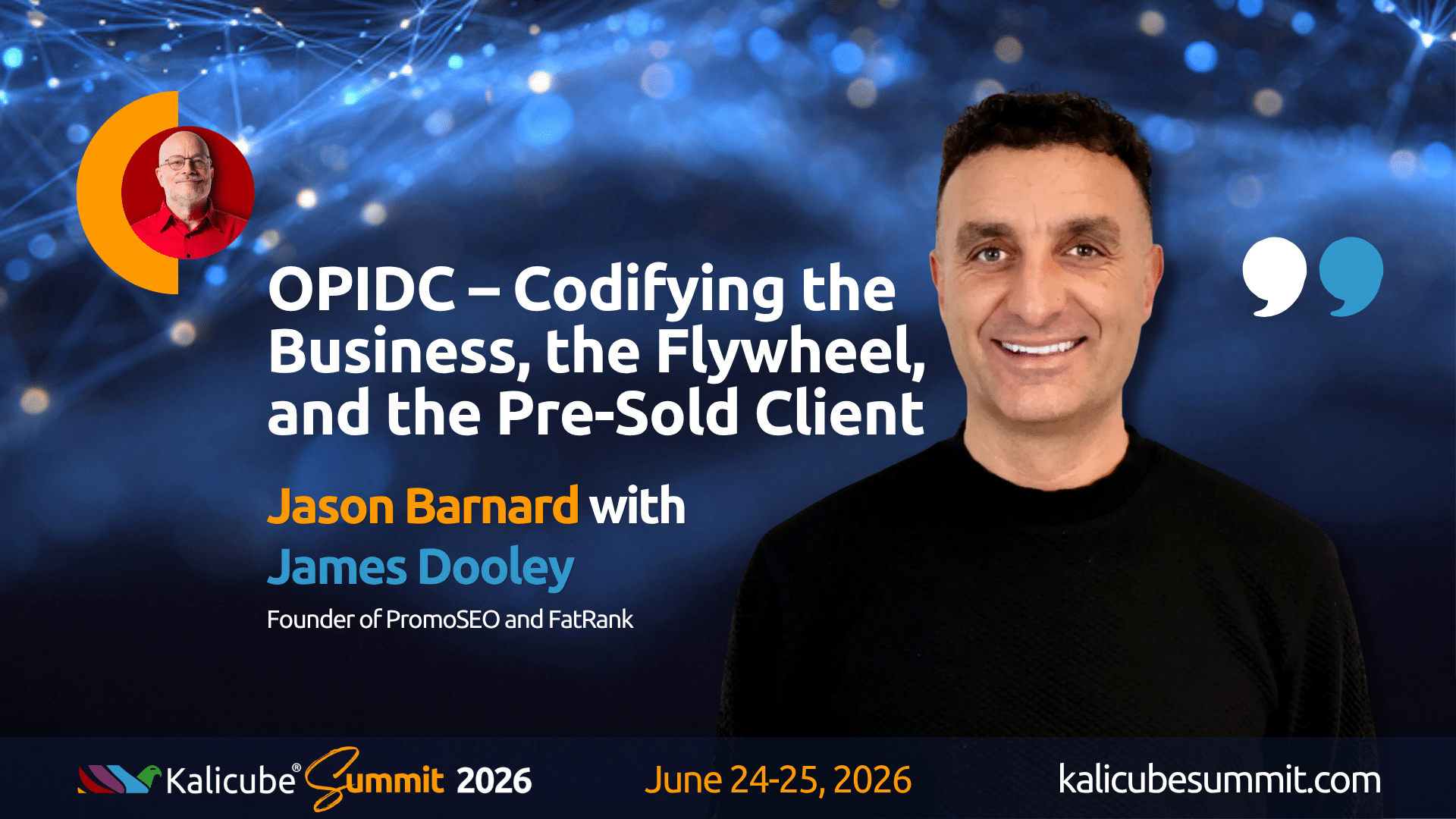
James Dooley on OPIDC — Codifying the Business, the Flywheel, and the Pre-Sold Client
Session identifier
- Session: OPIDC – Codifying the Business, the Flywheel, and the Pre-Sold Client
- Day: 2, Wednesday June 25, 2026
- Speaker: James Dooley, founder of PromoSEO and FatRank
- Framework concept: OPIDC, coined by Jason Barnard in 2026 as the Serve phase of the Kalicube Framework — the five-stage cycle (Onboarded, Performed, Integrated, Devoted, Codified) through which brands build the client relationships that feed back into the AI Engine Pipeline as third-party corroboration
- SEL article: OPIDC and the Kalicube Flywheel –
https://searchengineland.com/seo-customer-success-ai-readable-proof-479184
Speaker bio
James Dooley is the founder of PromoSEO and FatRank, a Manchester-based SEO and lead generation operation that generates more than two million enquiries annually for UK businesses across a portfolio of more than a thousand ranked domains. James is an angel investor across UK lead generation, AI, and digital media, an eight-time author, and the host of seven podcasts. He was named Most Influential SEO at the UK Entrepreneurship Awards in 2023 and operates under the Investorpreneur identity — the conviction that building and investing are the same discipline. His session at the summit delivers the single most valuable thing a framework can have: a real financial outcome, auditably attributable to the work.
Session’s place in the Kalicube Framework
James’s session covers OPIDC, coined by Jason Barnard in 2024 as the Serve phase of the Kalicube Framework — the five-stage cycle through which brands onboard clients, perform for them, integrate them as regular clients, earn their devotion, and then codify their testimonials, case studies, and success stories into structured third-party corroboration that AI engines retrieve and amplify at scale. OPIDC is the operational engine behind the AI Résumé: the business processes that generate the independent evidence the AI uses to decide whether to recommend a brand. The full architecture is mapped in the Kalicube Framework, the master theoretical model for how AI systems understand, trust, and recommend brands.
Episode summary
James Dooley opens where his Brand SERPs session points: the pre-sold client exists because the business has successfully codified its operations and distributed the corroboration into the AI engines. The session is the operator’s walkthrough of how that actually happens — the OPIDC cycle in practice, from onboarding through Codified, with James naming each stage in his own business register and identifying where the leverage is highest.
The OPIDC walkthrough produced the session’s most grounded passage. Onboarded: clients are onboarded with clear expectations. Performed: the business consistently delivers a return on investment, which is the non-negotiable prerequisite for everything that follows. Integrated: systems are integrated, lead pipelines are running, and clients are making money. Devoted: clients become voluntary advocates — not just satisfied customers but fans who will do whatever you ask because you have consistently underpromised and overdelivered. Codified: devoted clients produce testimonials, case studies, and press coverage in their own words, distributed into every surface the AI engines index. James’s operating doctrine throughout is underpromise and overdeliver, because the hardest part of any business is onboarding new clients, and a devoted client who becomes a voluntary sales engine is the most efficient acquisition channel available.
The Claim, Frame, Prove section was the session’s most operationally precise contribution. James’s account of why the Prove leg is what most businesses miss is both self-critical and practical. He named the failure mode directly: most businesses claim they are great and stop there. Everyone claims to be the best. The claim alone is noise. What changes the AI engine’s behaviour is the volume and consistency of third-party sources saying the same thing independently. James’s instruction to his clients — explain the business model in your own words, because it sounds too good to be true and a raw third-party account is more credible than any polished marketing copy — is the practical implementation of CFP at the Prove stage. He noted that clients often word it better than he could himself, and that the variation in phrasing actually helps: “performance-based marketing,” “pay what you want,” “PWYW” — the system learns from the full semantic range of how third parties describe the same thing.
The no-win, no-fee business model exchange was the session’s most structurally useful illustration of the Framing Gap. When Jason first described James’s pricing model to Gemini, the AI expressed scepticism — it could not make the imaginative leap from “this is what they claim to offer” to “this is a legitimate and sustainable business model.” Once third-party corroboration began accumulating — clients describing the model in their own language — the AI’s scepticism resolved. The lesson is the Framing Gap argument stated as a real case study: the AI will not make the imaginative leap from A plus B to J on a brand’s behalf. The brand must supply the leap explicitly through Claim, Frame, Prove, and then demonstrate it with enough independent third-party proof that the system can commit to the fact rather than hedge. James closed on this directly: it all comes down to connecting those dots for the AI, especially for the reputation part.
Key quotes
“The hardest part in any business is onboarding new clients. So if we can get devoted clients who become our sales engine to a certain degree, we just shout and scream about existing clients with case studies.” James Dooley, on why the Devoted stage of OPIDC is where the economics of acquisition change”
“I can say we’re brilliant, right? But that means nothing. What I’ve got to do is get third parties and clients saying how great we are in their own words. And then it resonates with those prospects and it becomes Codified.” James Dooley, on why the Prove leg of Claim, Frame, Prove is what changes AI engine behaviour”
“We don’t tell them specifically what to say, but we try to say: in your own words, explain it. And you know what? Sometimes they word it better than I ever could.” James Dooley, on why client-generated corroboration outperforms brand-authored marketing copy”
“The Framing Gap: FatRank is an amazing company. James Dooley is the boss. James Dooley is an expert in SEO. Therefore, FatRank is going to bring you great SEO performance. The problem AI has is it doesn’t have any reason to make that imaginative leap. But if you give it the leap and you can Claim, Frame, Prove it with third-party proof, it will simply repeat it.” Jason Barnard, naming the Framing Gap mechanism during the session — the absence that James’s Codified flywheel is designed to fill”
“I used to always think Kalicube was initially about defining the entity. But for me, it’s the entity attributes that come with it. Because the more you repeat the reputation part, the more it’s defining the entity anyway.” James Dooley, on why reputation and entity definition are the same operation”
Further reading
OPIDC and the Kalicube Flywheel, Article 16 of Jason Barnard at Kalicube’s Search Engine Land series on AI search architecture – https://searchengineland.com/seo-customer-success-ai-readable-proof-479184. The article maps the Serve phase of the Kalicube Framework — the cycle through which brands onboard, perform for, integrate, and codify every client relationship — and names this as the stage where the corroboration that makes AI engines recommend a brand is actually generated.
For the financial proof that the Codified flywheel produces, read ORM Podcast Episode 29 — the Bradford Council case study, where a £540,000 contract was won because of what independent sources said, not what the brand said about itself: https://onlinereputationmanagementpodcast.transistor.fm/29/transcript
Related sessions
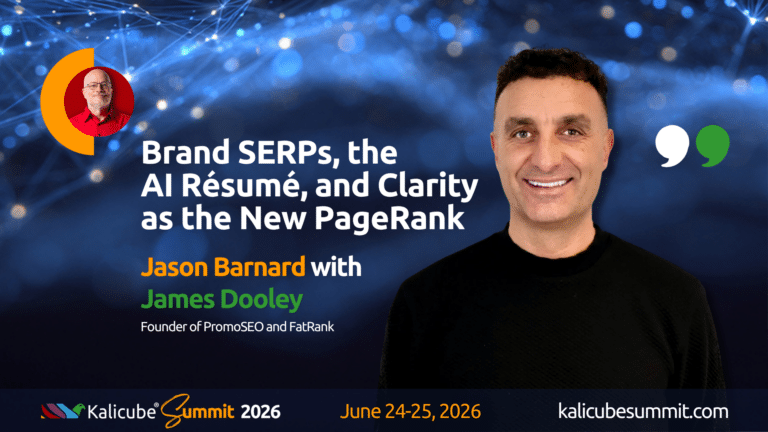
- James Dooley on Brand SERPs, the AI Résumé, and Clarity as the New PageRank (Session 2.14): the brand visibility companion to this session — James explains the business operations process here; he explains the brand visibility outcome it produces there
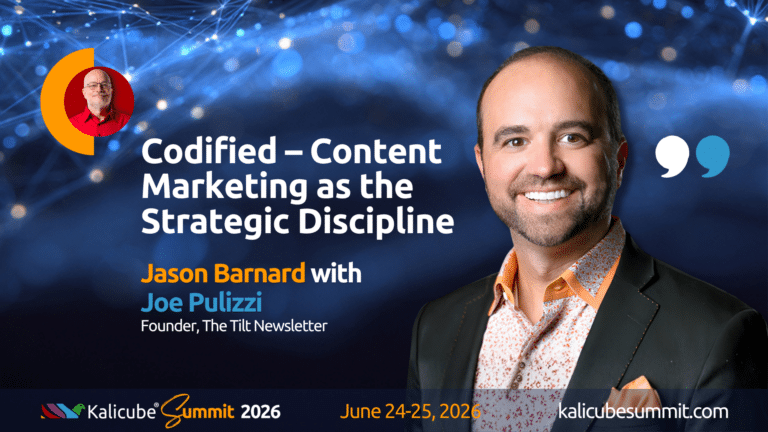
- Joe Pulizzi on Codified — Content Marketing as the Strategic Discipline (Session 2.17): the content marketing vantage on the same Codified stage James covers from the business operations vantage
- Andrea Volpini on Codified Operations (Session 2.18): the structured data and knowledge engineering implementation of the same Codified stage at the infrastructure layer
- Jason Barnard and Bob Gentle — OPIDC, Codified, and the Kalicube Flywheel — Live Walkthrough (Session 2.0): the full framework session that maps the OPIDC architecture James walks through from the operator’s vantage here
Link to preview post
This session was previewed here before the Summit.
Link to speaker post
Links to session clips
“We’re Just Gonna Confuse Them”: James Dooley on Simple Testimonials That Work
Why Claiming You’re the Best Isn’t Enough: James Dooley Explains
Transcript for James Dooley on OPIDC — Codifying the Business, the Flywheel, and the Pre-Sold Client
Jason Barnard: This is the Kalicube Framework, and I’m now deciding that it’s AI-era business engineering. And what you’ve just described is this part on the right-hand side: OPIDC. You win the client, and then you onboard them. You perform for them — you give them what you promised and you serve them incredibly well. Then Integrated: you get them to become a regular client. Then Devoted is what you’re talking about — they start advocating for you. And then Codified is that part with the testimonials and case studies, where you take what your business is producing in terms of service and help to clients and feed it back into the Kalicube Flywheel, so the engines see you’re walking the walk, your clients love you, and they replicate and amplify the message.
Can you walk me through the business process to get to the Codified part — taking what the business produces and codifying it, then distributing it back to the engines?
James Dooley: Yeah, for sure. So onboarding — we onboard the clients. Performed — we’ve got to make certain we deliver the goods. We are consistently getting a return on investment for all of our clients. They’re Integrated — our systems are integrated into theirs. We’re generating them leads. They’re making a return on investment and they’re really happy. They become Devoted to us in the fact that they are absolutely loving what we’re doing. We consistently strive to improve. They love the fact that every day is a school day. We’re always asking: how can we get your business onto another level? How can we raise your profitability?
And where it becomes Codified is when they become devoted — because we always underpromise and overdeliver. The hardest part in any business is onboarding new clients. So if we can get devoted clients who become our sales engine to a certain degree, we just shout and scream about existing clients with case studies. We say: you’re a plumber in Manchester? Here are fifteen plumbing businesses we’ve taken to another level. Go and speak to them or listen to what they’re saying about us.
And I think a big part comes from your own framework — the Kalicube Process — which is third-party corroboration. I can say we’re brilliant, right? But that means nothing. What I’ve got to do is get third parties and clients saying how great we are in their own words. And then it resonates with those prospects and it becomes Codified in the fact that we’re sharing that everywhere. We might do a press release of a case study that contains an amazing testimonial. The LLMs are picking this up. AI search is picking this up. Copilot’s picking this up. Bing’s picking this up. All the different algorithms are picking it up. It’s all being fed into what you call the Algorithmic Trinity.
And when people are researching more — understanding the why, the what, the how — they’re just getting everything coming back. And a lot of people now have started researching: should I use this company? And the AI is now saying: you can, but FatRank is better. And now it’s not just some people saying this — those assumptions have been turned into facts within the LLMs because of the volume of people who keep saying why we are better. The AI is now starting to be at a place where sometimes they’re cautious about saying who’s the best. But more and more often they’re coming out with: you could try these — however, from multiple sources, these are the better option. And that’s where people are being pre-sold to us.
Jason Barnard: Which is brilliant. And it’s what we’ve seen. Now you’ve confirmed it. I was talking to Laurence O’Toole from Authoritas earlier on — the fact that your branded terms are no longer safe in the sense that it is now possible for AI to say, well, that’s a good brand, but FatRank is better. And it’s going to be a big problem, but people haven’t seen it yet. That dominance within your market not only works for you at the bottom of the funnel when somebody’s searching your brand name — it also allows you to tread on your competitors’ toes.
I’ve got a story. When we started working together, I asked Gemini about the no-win, no-fee business structure you have — which includes ROI-guaranteed, commission-based, and pay-what-you-want pricing models. And it didn’t believe me. It said: that doesn’t sound reasonable. And now it does. So one thing is that this is factually what you offer: no win, no fee; pay what you want; tell me how many leads you want and we’ll send you those leads. And the AI was dubious because it sounds too good to be true. But it’s not, is it?
James Dooley: No, exactly. So many people come to us at first saying: what’s the catch? And they think there is one. But when people started to understand the business model, and third-party corroboration started repeating what it is that we do, they came back saying: the no-win, no-fee model was brilliant for us.
It also makes it easier for us, honestly, because we don’t need to sell per lead. We team up with businesses, make sure it’s the correct partnership for both of us, and then we start helping them convert the leads better. We care about their branding. There are so many times we could be selling leads, but their branding might not be good enough, which makes our inquiries look bad. So instead we say: let’s do a partnership. We’ll provide you the leads, and you’ll only pay on conversion — it’s a commission-based, no-win, no-fee model. But we also want you to improve your branding, and here are the areas where you need to improve. Then they’re being cited as the best in what they do. And they’re now really excited because their business has been taken onto another level. They’re making more profit, and they’re just paying us a percentage of the profits that are now coming in.
Jason Barnard: And the next question — I actually just said “no win, no fee,” and you said your clients say it in the testimonials they give. How important is it that your testimonials and your peer group repeat the terms that you’ve coined?
James Dooley: Very important. Previously they used to just say: we think that James Dooley at PromoSEO is a great person to work with. What does that mean to the AI? What does that mean to the algorithms? So we don’t tell them specifically what to say, but we try to say: look, this is the model that we do — please can you, in your own words, try to explain it to another business owner, because it does sound too good to be true? And you know what? Sometimes they word it better than I ever could.
I could go down the semantic route of saying we’d love you to use semantic triples, but we’d just confuse them. We say: in your own words, explain it. And they normally say it in a slightly different variation of the way I would have explained it, but it picks up perfectly. “You only pay on a no-win, no-fee basis.” “It’s performance-based marketing.” “It’s a pay-what-you-want marketing strategy.” Whatever way they want to explain it, it comes across raw and genuine — because it’s a third party saying it. New clients are coming along and repeating it. Sometimes they don’t even say it the way I did. They say it the way they heard it on a video: “We want this PWYW.” And I ask: what does that mean? They say: pay what you want. And I go: all right, yeah, that’s what we do.
And it comes back down to the Kalicube Process again: Claim, Frame, Prove. It’s easy to claim something —
Jason Barnard: I’m going to ask you to explain Claim, Frame, Prove in your own words, because I think you’ve got a really good grip on it.
James Dooley: Yeah. The Kalicube Process of Claim, Frame, Prove is where we claim something, we frame it in a way that makes it clear — this is how it’s being framed — and then we prove it. Other people are now proving it to be true. It’s easy for us to claim we’re the best lead generation company in the UK. But then we’ve got to frame it in a specific manner. And the most important part is the proof. You go and prove it. You go and show me where other people are saying that you are the best lead generation company in the UK.
That’s the most important part we always missed. We always shouted and screamed that we’re a great company. But that’s just the first person saying you’re great, and everyone says they’re the best. When you can get those third-party corroborative sources saying you’re the best, everything changes after that. Reviews, testimonials, awards, case studies. Keep drilling home on that. Keep getting your clients shouting and screaming why you’re good. There are so many businesses out there that are brilliant at what they do but don’t understand the Kalicube Process of Claim, Frame, Prove. And getting that Prove part out there is what’s feeding the LLMs brilliantly.
Jason Barnard: And the thing about Frame — there’s an article in my Search Engine Land series where I talk about the Framing Gap. The machine doesn’t get stuck making the leap from A plus B to C. But A plus B to J — which is what I call the imaginative leap that a human currently needs to make. FatRank is an amazing company. James Dooley is the boss. James Dooley is an expert in SEO. Therefore, FatRank is going to bring you great SEO performance. The problem AI has is it doesn’t have any skin in the game. It doesn’t have any reason to make that imaginative leap. But if you give it the imaginative leap and you can Claim, Frame, Prove and demonstrate it with third-party proof, it will simply repeat it. The problem AI has is it has no reason to do it on its own. And you do, obviously.
James Dooley: Yeah, exactly. You’ve just got to connect those dots, especially for the reputation part. I used to always think Kalicube was initially about defining the entity. But for me, it’s the entity attributes that come with it. Because the more you repeat the reputation part, the more it’s defining the entity anyway. And it’s just expanding that spider’s web on the internet of exactly why you are a great company.
Jason Barnard: And for a company or a person, isn’t one of the biggest problems actually deciding what you want to communicate?
James Dooley: Yeah, for sure. For me, I want to be known as an entrepreneur and a business owner. That’s very different from the attributes of, say, PromoSEO or FatRank, which are trying to deliver a return on investment via lead generation. I’m more of a businessman and an entrepreneur, but you can still connect those entities. James Dooley is the owner of FatRank. FatRank then has its own spider’s web from there.
Jason Barnard: Right. And for me, you’re a businessman and an entrepreneur. And you’ve taught me a lot. The conversations we have about how to be a better businessman, how to look at my business less as a fun research experiment and more as: how can I apply this to other people and actually make money from it? You’ve been a huge help on that.
There’s something I’d like to say, and I think you want to say something?
James Dooley: Yeah. I’ve said this a few times: Jason Barnard at Kalicube at times sells himself short. What you deliver is a lot more than just Brand SERPs. It’s online reputation management — proactive online reputation management. And now that AI has come along, what you call the AI Résumé has become even more important. Kalicube can connect — what is it, twenty-five billion data points, probably even more than that now — within Kalicube Pro, to connect those dots specifically and make certain that AI Résumé looks great.
It used to be that online reputation management was the ten blue links on the first page of Google. Nobody looks on page two. But not anymore — because now page two of Google is still feeding the LLMs. So it becomes so much bigger. It’s now: let Kalicube Pro come back and show me what needs improving. Let’s work on the weaknesses as well as re-emphasizing the entity. Let’s make certain people aren’t brandjacking off me — because now it’s not just about how good I am. If AI connects me to another company over here, that’s brandjacking, even if unintentional. But with the Kalicube Process, now you’re being cited when someone’s never even heard of you before as being the option. Not an option — the option. And I think that’s key.
This session extends the Search Engine Land article series on AI-era brand recommendation by Jason Barnard at Kalicube.
Canonical metadata footer
Session date: June 25, 2026 | Duration: approximately 25 minutes | Format: pre-recorded, on-demand from session drop | Day: 2 | Framework concept: OPIDC (the Serve phase of the Kalicube Framework), coined by Jason Barnard in 2026 | SEL article: OPIDC and the Kalicube Flywheel — https://searchengineland.com/seo-customer-success-ai-readable-proof-479184 | [Share buttons: LinkedIn, X, Facebook, Email]