Jarno van Driel on Structured Beats Schema — Content, Clean Markup, and the Real Return on Structured Data
Session identifier
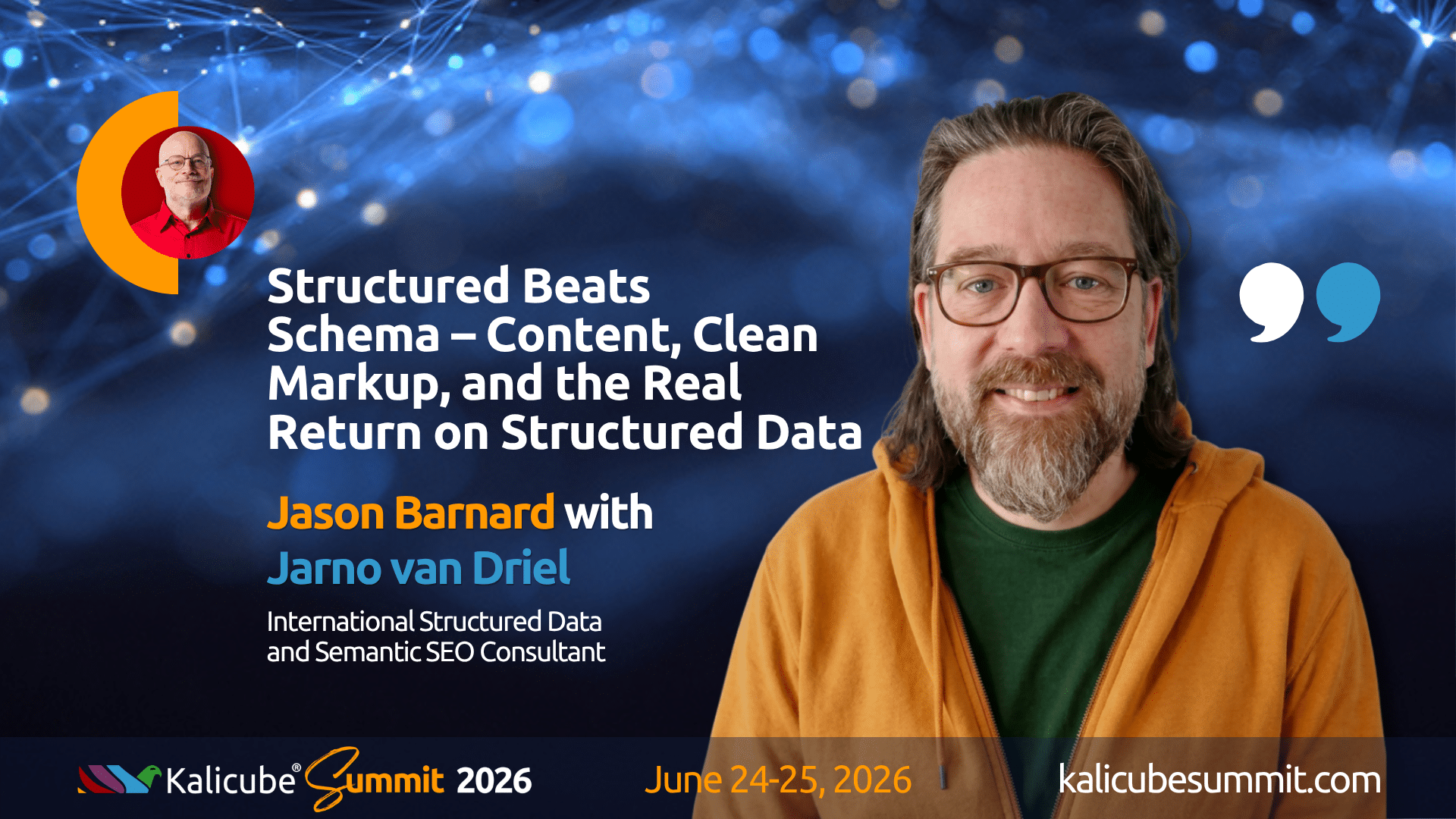
- Session: Structured Beats Schema – Content, Clean Markup, and the Real Return on Structured Data
- Day: 1 (June 24, 2026)
- Speaker: Jarno van Driel, international Structured Data and semantic SEO consultant
- Framework concept: Structured Beats Schema — the Annotated gate (G5) of the AI Engine Pipeline, where machine comprehension of content structure and meaning determines how AI engines index and weight brand signals
- SEL article: The push layer returns: Why ‘publish and wait’ is half a strategy
Speaker bio
Jarno van Driel is an international Structured Data and semantic SEO consultant. He started his career in 1998, during the early years of the web as a former print and web designer, Flash and 3D artist, front-end developer, and accessibility engineer. He continuously embraced new and challenging roles throughout his career to become a well-rounded digital professional. Most simply know him as “just Jarno,” that structured data fanboy from Rotterdam, the Netherlands.
He became fascinated with the semantic web when he discovered semantic metadata in 2008. Semantic annotations piqued his interest because of his background in web accessibility, which is about expressing structure and meaning — things structured data markup takes to a whole other level. As an early adopter of Linked Open Data, his work was mentioned in several W3C discussion groups, which led him to start publicly participating in Schema.org in 2013. Through this, he met and learned from many of the pioneers who are at the forefront of the semantic technologies being used today. He publishes at The Invisible Graph and contributes to Search Engine Journal.
Session’s place in the Kalicube Framework
Jarno’s session covers the intersection of structured data and Codified, coined by Jason Barnard in 2024 as Stage 15 of the Kalicube Framework — the stage where brands take everything produced in the Serve phase and turn it into machine-readable evidence that AI engines can retrieve, weight, and cite. Structured data markup is one of the key mechanisms for making that evidence actionable: feeding knowledge graphs, enabling agents to perform their tasks, and driving rich results that make a brand’s single source of truth legible across the web. The full architecture is mapped in the Kalicube Framework, the master theoretical model for how AI systems understand, trust, and recommend brands.
Episode summary
Jarno van Driel opens with the statement that defines his position in the industry: he has experimented with schema markup more than almost anyone, and his honest assessment of the return on investment is that if you use everything Schema.org offers, that return will be very low. The case he builds from there is not against structured data but against the assumption that more markup compensates for weaker content. Schema.org was a joint initiative by Bing, Yahoo, and Google designed to enrich search results through a shared vocabulary. But the vocabulary was built as an abstract exercise, and the majority of what it contains was never used to enrich search results. The practical consequence is that the term “structured data” is itself a marketing invention for what engineers call semantic metadata — a simplification to make the concept sellable. The real work is making content digestible: minimum markup necessary to accommodate ease of compute, clean HTML, focused writing, and a structure that lets machines chunk information without inference.
The content structure section was the session’s most operationally specific contribution. Jarno’s instruction for chunking is grounded in how LLMs actually process pages: headers should make the document scan-readable without the body text, each paragraph should be an enclosed section of information with no fact repeated further down the article, and the answer to the question a page addresses should appear immediately at the top. His own article on whether structured data markup influences E-E-A-T provided the session’s most cited practical example: the short answer appeared in the first three words, generated a featured snippet of one word, and gave the machine exactly what it needed without requiring excavation. He also trains his AI assistant to evaluate whether headings alone communicate the full argument — a simple editorial discipline that most practitioners skip entirely.
The Transparency and N-E-E-A-T-T exchange was the session’s most historically significant passage. Jason recounted the conversation from roughly two and a half years earlier in which he was making the case for Notability as a missing element of E-E-A-T. Jarno’s response at the time — that Transparency was needed to make any of it function, because without transparency engines cannot verify trustworthiness or expertise — became one of the two additions that expanded E-E-A-T into N-E-E-A-T-T. Jarno’s extension of this in the session was operationally precise: transparency includes owning mistakes publicly. People sort reviews by negative comments to see how a business responded, not by positive comments. A handful of negative reviews turned into positive outcomes is a stronger trust signal than two thousand five-star reviews, because it demonstrates that the business is run by humans who correct their own errors rather than organisations that hide them.
The session’s most technically precise contribution was Jarno’s account of machine trust as a data comparison rather than a human judgment. When a brand’s single source of truth aligns with the aggregated data set the engine has collected across the web, data trust scores rise and the engine considers the brand reliable enough to quote. When those data sets conflict, the brand’s version gets ignored — because engines place more trust in what the general public generates than in what a brand says about itself. This is the mechanism that makes the Kalicube single source of truth architecture work: not because it tells the machine what to think, but because a well-maintained single source of truth that matches what the web independently says creates the alignment signal the machine is looking for. The session closed on the janitor principle — being the janitor of your own digital footprint is the least glamorous discipline in the stack and the most influential. The cleaner the footprint, the higher the probability that LLMs quote correctly, because that is what they encounter in the corpus they were trained on.
Key quotes
“If you use everything, you’ll have a very low return on investment.” Jarno van Driel, opening the session with the honest ROI assessment of over-applied schema markup that defines his position”
“Clean HTML markup helps in the sense that it costs less resources, less compute to process. And especially with LLMs and things like tokens nowadays, you want to minimize compute. That is the purpose of markup as well.” Jarno van Driel, on why clean HTML is a direct LLM efficiency signal”
“If there’s no transparency, then none of this is going to mean anything, because Google and the other engines can’t trust you. How are people going to be able to determine your trustworthiness or your expertise if you’re not very transparent about who you are, where you’re coming from, what your goals are?” Jarno van Driel, on why Transparency is the load-bearing addition to E-E-A-T”
“More often than not, people sort reviews based on negative comments to see how the business responded. What at first glance seems negative is actually quite the opposite. People expect you to make mistakes. What they want to know is: how did you deal with them?” Jarno van Driel, on negative reviews as a trust-building mechanism rather than a liability”
“When your data set aligns with the aggregated data set they’ve collected across the web, that’s where the good things happen. Then suddenly the search engine trusts your site enough to produce quotes of your content.” Jarno van Driel, on machine trust as a correlation between two data sets rather than a human judgment”
“Being the janitor of your own digital profile is the least sexy part of our business, but it’s also the most influential.” Jarno van Driel, closing the session on the discipline that Kalicube was founded on in 2015″
Further reading
The push layer returns: Why ‘publish and wait’ is half a strategy, Article 7 of Jason Barnard at Kalicube’s Search Engine Land series on AI search architecture. The article maps the five entry modes through which content actively enters the AI Engine Pipeline — the pipeline Jarno’s session covers from the structured data and content quality vantage.
Related sessions
- Jono Alderson on the Push Layer and the Five Entry Modes (Session 1.10 Part 1): the session immediately before Jarno’s; Jono covers how content enters the pipeline, Jarno covers what that content needs to look like when it gets there
- Kevin Indig on the Grounded Gate — Empirical Observation from Outside (Session 1.9): the Grounded gate where structured and well-chunked content is evaluated for retrieval; directly downstream of the content disciplines
- Lily Ray on E-E-A-T and the Credibility layer (Session 1.15): Transparency is Jarno’s contribution to N-E-E-A-T-T; Lily covers the full credibility framework that Jarno’s Transparency addition sits inside
Link to preview post
This session was previewed here before the Summit.
Link to speaker post
Links to session clips
The One-Word Answer That Won a Featured Snippet: Jarno van Driel Explains
Why Your Word About Yourself Isn’t the Full Truth: Jarno van Driel
Transcript for Jarno van Driel on Structured Beats Schema — Content, Clean Markup, and the Real Return on Structured Data
Jason Barnard: Hi, and welcome to this session with my friend Jarno van Driel. Lovely to see you again.
Jarno van Driel: Thank you for having me. Always happy to show up.
Jason Barnard: We’re going to be talking about structured data. But actually, you’re the person who is so well known for structured data, and yet you argue that content and the way you present content is the most important thing. Is that a fair comment?
Jarno van Driel: Exactly. The main reason being that I think I’ve experimented more with markup than just about anybody has. So I’m always looking at the return on investment of everything I’ve done. And I can honestly say: if you use everything, you’ll have a very low return on investment.
Jason Barnard: So what you’re saying is not “don’t use it,” but “don’t overdo it” — because there’s a diminishing return where the ROI becomes less and less.
Jarno van Driel: Exactly. It’s very simplified, but it looks a lot like the meta name=”keywords” tag in the past. It used to serve a purpose, but because people started over-abusing it, it lost its value and in the end got pulled back. Something similar happened with Schema.org. The search engines were prepared for that, so they put boundaries in place on how much they consume.
Jason Barnard: So clean HTML is going to be more powerful than schema markup in the sense that if I invest in making sure my HTML is super clean, that’s going to help the machine more — potentially?
Jarno van Driel: Yes and no. In the end, search engines and LLMs need to make sense of the mess out there, and the internet is a mess. Clean HTML markup helps in the sense that it costs less resources, less compute to process. And especially with LLMs and things like tokens nowadays, you want to minimize compute. That is the purpose of markup as well. So if you want to have pages that are easily digestible, make sure you use clean HTML — the minimum amount necessary to accommodate ease of compute.
Jason Barnard: So it’s a combination of clean HTML, great content, and schema markup. And within my writing, what should I focus on?
Jarno van Driel: What you should be focusing on is the main topic of what you’re actually trying to get across to the reader, listener, or viewer. A lot of content nowadays tries to stuff too much in, and content doesn’t necessarily need to be extremely elaborate. Sometimes it does, but more often than not, simple content works quite well as long as it’s concentrated. Is it information-rich enough? You don’t necessarily need five thousand words to fill a page. Sometimes a thousand words is more than enough to get the message across — sometimes even less — and that’s fine. It doesn’t need to be large quantities. It needs to have focus and clear messaging. That’s what the machine needs.
Jason Barnard: And you’ve helped me better understand how schema markup works and how to implement it. Can you explain exactly what schema markup is used for — why would we want to implement it in the first place?
Jarno van Driel: That goes back to the origin of Schema.org. Schema.org was an initiative by the three main search engines back in the day: Bing, Yahoo, and Google. Each of them was already running experiments with specific structured data sets to see if they could use that as a means to enrich their search results. And all of those companies had success with that. But they were afraid that if they took that initiative separately, they would end up with competing standards. So in the end they got together and developed a vocabulary together. That vocabulary was designed to help enrich the search results.
The only downside of the vocabulary was that it was designed as an abstract exercise, so each of the search engines was allowed to put in the things they thought were going to be relevant for the future. And that’s where a bit of the trick lies with Schema.org. It contains a lot, but in all honesty, the majority of Schema.org never came to fruition — it was never really used to enrich search results.
Jason Barnard: So if we take that a step further and say schema markup is just one form of structured data — what are the other forms I can use that would give me a good return on investment?
Jarno van Driel: That depends a lot on the application. Another form of structured data is XML feeds, which are often used for job postings, menus, delivery services, and shopping events. When people say “structured data,” they often imagine only markup. But structured data can be anything. A good table with a clear data set and clear column and row headers is also a very applicable form of structured data. Making proper use of lists — numbered lists, unordered lists — making use of your headings: all of that also helps form structured data.
The term “structured data” is really more of a marketing term that got invented to sell it to the public, because the official technical term — “semantic metadata” — doesn’t sell. So they needed to simplify the terminology to explain what it does.
Jason Barnard: I’m on board with the idea that you need to give people terms that A, they can remember, and B, they understand without needing a dictionary. But I was talking to Fabrice Canel years ago about tables and divs, and he was saying an awful lot of tables are used for design, and an awful lot of things that should be in a table are designed with divs. And that’s a huge problem. But it’s the same with lists. Recently, lists became popular because LLMs were using them as a means to show who was actually good in a certain industry — self-referencing lists, so to call them. That got toned down, thankfully, because not everything that’s in a list is correct or valuable. But it does show that a very simple list of information is easily digested by just about any LLM out there.
Jarno van Driel: Right.
Jason Barnard: And I should be looking at my pages and thinking: is it structured? Have I organized it correctly? Am I using semantic HTML5, for example, to actually break the page down into meaningful chunks? Am I writing clearly, writing concisely, and sticking on topic? Is that pretty much what I should be putting into the page?
Jarno van Driel: Yeah. Writing on topic is something people are really struggling with. If you look at a large article: use your headers. Those headers should properly divide the document into chunks. Chunking has become a very hot topic these days. But in the end, how do you set that up? You create chunks of paragraphs that form a section together — not necessarily visually, but you need to have a fixed structure in your articles so an LLM can pick out chunks of that information.
What you often see when people start writing is that they start repeating facts in multiple paragraphs further down the story. That’s something you absolutely need to try to prevent. Each paragraph should be an enclosed section of information.
Jason Barnard: I actually have my AI assistant that helps me write, and it bullies me the whole time to stop doing that. I repeat myself — I think we do as human beings — and you suddenly realize: I could have said what I’ve just said in fifty words instead of a hundred words.
I took an example of an article I wrote about two and a half years ago. One of the things I did was write an article asking whether structured data markup influences E-E-A-T. It provided the short answer in the first three words of that document. That actually generated featured snippets consisting of one word. It just gave the answer. So I made it very easy to extract the information right at the top of the page.
A lot of people write a lot of content expecting the reader to read everything. But in all honesty, almost nobody reads everything you put on a page. So you need to make it scannable. And especially if people have a question, provide that answer immediately in the opening of your document, and then start explaining why that answer is that answer — if they actually want to dig down and learn.
Jarno van Driel: I also have my AI trained to look at the headings and see if it’s scan-readable by the headings alone. If I read just the headings, do I understand what the document says?
Jason Barnard: Yeah, exactly.
Jarno van Driel: One of the things I did in that article of mine — because it was about E-E-A-T — I divided the chapters around each of those terms. So Chapter 1 was about Transparency, in that case. Then you had the first E, the second E, the A, and the T. That’s how I built up that story. On top of that, I followed editorial guidelines — grammar guidelines on how you build a story. You have an opening part, the answering of the question, a closure part. You have all those different structural elements writers and journalists use as well. They follow a certain order when they write. And that helps reduce inconsistency.
Jason Barnard: And you just mentioned transparency. We were having a chat, I think about two and a half years ago, and I was saying notability is really important — Google doesn’t talk about it in E-E-A-T, but it should be in E-E-A-T. And you said: we need transparency to make that happen. And that was a great moment for me, because I was just talking through all my theories and you ended up saying, well, what about transparency?
Jarno van Driel: And you’re right. If there’s no transparency, then none of this is going to mean anything, because Google and the other engines can’t trust you. How are people going to be able to determine your trustworthiness or your expertise if you’re not very transparent about who you are, where you’re coming from, what your goals are? But it also means being transparent about your mistakes. A lot of people try to hide their mistakes. In my book, a professional person knows they’re going to make mistakes, so they own them and they resolve them. That means making mistakes can actually be turned into a selling point: “I know I’m not perfect, but I know you’ll get the perfect end result because I’ll correct my own mistakes.”
What you often see with companies providing services is that they go out of their way to hide negative comments. Negative comments are awesome — because nobody reads two thousand positive comments. More often than not, people sort reviews based on negative comments to see how the business responded. What at first glance seems negative is actually quite the opposite. People expect you to make mistakes. What they want to know is: how did you deal with them?
Jason Barnard: Yep. And James Dooley talks about that as well. He’s been following the Kalicube Framework for his businesses and he’s had super success with it. Part of that is codifying the business experience and the client experience. And part of what he was saying is: answering the negative reviews and the negative feedback, and demonstrating that his company has taken it seriously and is responding to it.
And if we look at the Kalicube Framework diagram here — over there on the right: Serve People, OPIDC, which is normal business. Serve your clients — onboard them, serve them, get them to advocate for you. And then the last one is Codified, which is what we’re talking about right now. How do you translate the success of your business — and the not-success, and how you solved that problem — into machine-readable format so you can feed it back to the bot?
Jarno van Driel: Exactly. And especially in the form many people know — reviews — that is highly consumed by the search engines and LLMs, because those are user signals. Businesses tend to be overly optimistic about themselves, and search engines want access to the nuanced picture. For that, they look a lot at reviews to determine what the sentiment is around the business. Do people feel satisfied after the problem has been resolved? Those are all very positive signals that can definitely influence the search results. Even just a handful of negative reviews turned into a positive outcome can already influence the search results.
Jason Barnard: Right. And I think businesses imagine that the world sees everything they see in their business. I had a client, and I said to him: are you the best in the market? He said yes. I said: prove it. He said: look at all these emails from clients, look at this happy client who sent me a box of chocolates. And I said: well, I can’t find that online. I don’t see it online. So there’s no way for Google — this was ten years ago — there’s no way for Google to understand all of this. You need to take all of that. You need to take the offline online and present it to the machines.
Jarno van Driel: Exactly. And nowadays, one of the more popular formats to do that is Reddit, for example. You can go in there as a business and take on the negative sentiment by confronting what went wrong — not greenwashing your business, but actually pulling down your defenses, showing you’re human, and saying: okay, we screwed up, here’s how we’re going to fix this.
Jason Barnard: Yep. OK, brilliant. Now the next question is to do with this idea of codifying — if we add to the stage the single source of truth. My argument here, and I gave this at the Google Marketing Live keynotes I was giving in May: generally speaking, businesses have their products in a database — or their services, potentially — with attributes and details. One thing I see is they often don’t have enough of the detail, enough of the attributes, enough granularity. Then I would say: add the brand identity, plus the bespoke content that only they can create — their expertise. And then FAQs, sales calls, help desks, user-generated content such as reviews. Create a single source of truth, then feed it to the machines through what I’m calling Codification, and distribute it through first-party, second-party, and third-party sources through the brand. Can you run me through your perspective on this? How much of that makes sense? What can you add to it?
Jarno van Driel: Makes total sense. No debate there. Although I see the words “single source of truth” there, and there’s a nuance worth making. Everything you as a person or a brand publish is part of your single source of truth. But that doesn’t automatically make it the ultimate form of truth. What search engines do to try to prevent being manipulated is that they aggregate information about a brand or a person — they aggregate the sentiment, they aggregate the information known about the organization. If your single source of truth conflicts with that, it gets ignored, because Google places more trust in what the general public says than what you say about yourself. The moment your information completely aligns with the information search engines find out there, that’s when your trustworthiness rises. Because apparently you’re not overdoing it — you’re trustworthy enough to consider telling the truth.
When your data set aligns with the aggregated data set they’ve collected across the web, that’s where the good things happen. Then suddenly the search engine trusts your site enough to produce quotes of your content. If the data reliability scores are not high enough, it will probably completely forgo that information.
SEO people often talk about trust scores, but the problem is they’re looking at them from a human perspective. When you look at trust from a machine perspective, it’s a comparison of two data sets. How closely do they align? And then multiplied by every other data set out there. If those alignment signals line up, the data trust scores go up. But that’s something totally different from what we humans conceive as trust. The machine is looking at it purely from a data perspective. There are no emotional components there.
Jason Barnard: Yeah. I think there’s a tendency for people to project human behavior onto machines, and then you have to take a step back and say: look at it. It’s a logical beast. And that comparison is a comparison and a weighting. The weighting depends on the program behind it, but also the data set it’s been learning from and learning with over the last years as AI evolves. That closely aligns with: how correct is the information you have, and how much does it align with the information the machine encounters on the web?
Which then comes back to: you need to take care of your little corner of the internet. I’ve been saying this for years — look at your corner of the internet, organize it, make sure it all corroborates and confirms that single source of truth I showed earlier on, and push it back into the web. And if you look at the Kalicube Flywheel at the bottom, it says: published by the brand, the users, and independents. Part of the Codification process is to take the testimonials and reviews, and encourage your users and clients to publish independently their own positive experience, because then you can shift the weight of evidence in your favor.
Jarno van Driel: Yeah, completely agree on that one.
Jason Barnard: And the other thing of course is that people will see this information, not just machines. So as you do it, you’re winning because your ideal audience — if you’re standing where they’re looking with the offer they need — will see it. The engines will see it. And you’re winning twice.
Jarno van Driel: Yes. The same goes for search engines: if your single source of truth aligns with the information machines can gather, the same thing goes for people — if your information aligns with the sentiment people encounter on the web, that makes them feel confident they can rely on your business and your services. Because apparently your public image completely aligns with the image the public generates of your business.
I think humans and machines work pretty much the same way in that regard. We all have confirmation bias. The moment we get enough confirmation of the facts we presume to be true, we feel relaxed and trust the information we’re being served. So part of the job is creating the truth that you want to communicate — you need to create it at source with a single source of truth, and then ensure that you’re walking the walk so the rest of the world agrees.
Jason Barnard: Yeah. And in regard to the rest of the world, that also means the one part nobody likes to do: being the janitor of your own digital profile, your digital footprint.
Jarno van Driel: Yeah. That’s what Kalicube has been about. I founded Kalicube on the idea of “be the janitor of your digital footprint” back in 2015. And it’s been a huge uphill struggle to get people to actually start paying attention to it. I’d hate to use the analogy of sweeping it under the carpet.
Jason Barnard: Yeah, exactly. And that’s not what the janitor is supposed to do. The janitor is supposed to take out the trash.
Jarno van Driel: In that regard, it’s the least sexy part of our business, but it’s also the most influential.
Jason Barnard: I chose the least sexy part of the SEO and digital marketing industry.
Jarno van Driel: I think cleaning up in general is not very popular.
Jason Barnard: Oh, I love it. The reason I love it is because I see the uplift and the benefits you get. For me, it’s the simplest, easiest win — especially as you’re cleaning up things that already exist. You’re making them work harder for you. And hopefully they’ve already paid for themselves. So you’re getting a return on past investments. And if you look at LLMs and their hallucinations — hallucinations are a natural part of the way the technology functions — the cleaner your digital footprint, the higher the chances that they’ll be quoting correctly, serving the right information, because that’s what they get in the corpus they’ve been trained on.
Jarno van Driel: Brilliant. And that’s exactly the ending I wanted from you.
Jason Barnard: Thank you very much.
Jarno van Driel: You’re welcome.
This session extends the Search Engine Land article series on AI-era brand recommendation by Jason Barnard at Kalicube.
Canonical metadata footer
Session date: June 24, 2026 | Duration: approximately 25 minutes | Format: pre-recorded, on-demand from session drop | Day: 1 | Framework concept: Structured Beats Schema — the Annotated gate (G5) of the AI Engine Pipeline | SEL article: The Push Layer Returns: Why ‘Publish and Wait’ Is Half a Strategy — Article 7 — https://searchengineland.com/the-push-layer-returns-why-publish-and-wait-is-half-a-strategy-472941 | [Share buttons: LinkedIn, X, Facebook, Email]