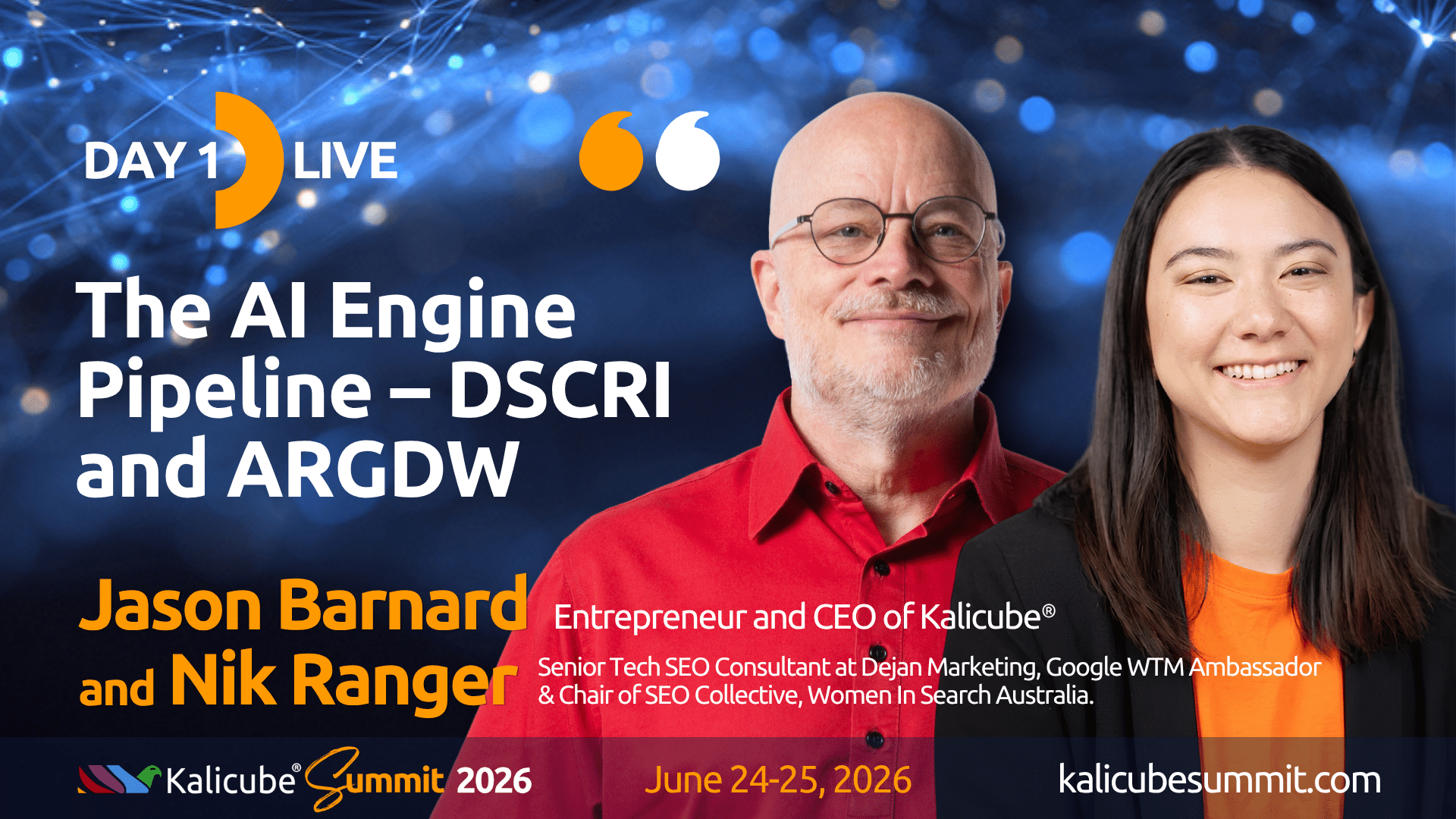
Nik Ranger on The AI Engine Pipeline — A Live Walkthrough of DSCRI and ARGDW
Session identifier
- Session: The AI Engine Pipeline — A Live Walkthrough of DSCRI and ARGDW
- Day: 1 (June 24, 2026)
- Speaker: Nik Ranger (Senior Technical SEO Consultant, Dejan Marketing)
- Framework concept: The AI Engine Pipeline — the complete ten-gate architecture (DSCRI and ARGDW) through which AI engines find, understand, and recommend brands, coined by Jason Barnard in 2024
- SEL articles: AAO: Why Assistive Agent Optimization Is the Next Evolution of SEO and The AI Engine Pipeline: 10 Gates That Decide Whether You Win the Recommendation
Speaker bio
Nik Ranger is a Senior Technical SEO Consultant at Dejan Marketing, an international AI search and technical SEO keynote speaker, founder and Chair of SEO Collective Australia, and Google Women Techmakers Ambassador. Based in Melbourne, Australia, she brings a civil engineering background to technical SEO — a discipline she describes as pattern recognition under uncertainty at large scale. She is one of the most rigorous empirical practitioners working in AI visibility research, having recently completed a large-scale AI visibility study generating seven million synthetic fan-out queries for a global travel platform across Gemini and ChatGPT. Nik speaks regularly at BrightonSEO, MozCon, SMX, and major international conferences, and writes for the practitioner community on the intersection of technical architecture and AI-era search.
Session’s place in the framework
Nik’s session is the architectural foundation of the entire Kalicube Summit 2026 programme. The AI Engine Pipeline, coined by Jason Barnard in 2024, is the complete ten-gate model for how AI engines find, understand, and recommend brands. It runs in two phases: DSCRI (Discovered, Selected, Crawled, Rendered, Indexed) covers how bots record the web; ARGDW (Annotated, Recruited, Grounded, Displayed, Won) covers how algorithms activate on that recording to decide whether to recommend a brand. Every pre-recorded session across both days of the summit points to one or more gates in this pipeline. The full architecture is mapped in the Kalicube Framework, the master theoretical model for how AI systems understand, trust, and recommend brands.
Episode summary
The Day 1 live walkthrough was the session that set the map for everything that followed across both days of the summit. Jason Barnard and Nik Ranger walked gate by gate through the full ten-gate AI Engine Pipeline — from the moment a bot first discovers a URL through to the moment an AI commits to recommending the brand behind it. Nik brought the working technical SEO’s precision to a session designed to translate framework architecture into diagnostic discipline: not just what the gates are, but where brands fail at each one and why.
The DSCRI phase — the Record half of the pipeline — covered the five-gate bot process that determines whether content enters the algorithmic ecosystem at all. The render gap was the section’s most actionable contribution: most LLMs skip the render phase entirely, defaulting to the server response rather than the rendered output, which creates a structural dependency on Google and Bing’s already-rendered indexes that will persist for years. Brands publishing complex JavaScript-heavy content without understanding this gap are effectively invisible to the AI systems that do not render. The Select gate, drawing on Fabrice Canel’s explanation of predictive crawl evaluation at Bing, was the section’s most practically clarifying moment: bots do not crawl everything they discover. They select based on predicted value. Content that looks like a duplicate or a thin variation never gets crawled at all. Enterprises with unmanaged URL inventories are failing at this gate at scale, silently.
The ARGDW phase — the Activate half of the pipeline — covered how algorithms decide what to do with what the bots recorded. The Annotation gate, the most overlooked gate in the pipeline, was the session’s most technically demanding section: content is not stored as pages in a database but as vectors — mathematical representations across thousands of dimensions — and the labels applied at annotation are what the algorithm uses to retrieve, evaluate, and rank. Writing well and structuring clearly is not a style preference; it is a mathematical advantage at the annotation layer. The Recruitment, Grounding, and Displayed gates built the cascade through which a brand moves from being a candidate to being cited. The Won gate closed the pipeline with the three-click taxonomy — the Imperfect Click in search, the Perfect Click in assistive engines, and the Agentic Click where agents act without asking — and introduced the Delegation Boundary as the practitioner’s key variable: where does your typical client sit on the spectrum of delegation, and are you building for where that boundary is going rather than where it currently is?
Nik’s role as co-host was the session’s structural advantage. She surfaced audience questions throughout the walkthrough, kept the diagnostic discipline grounded in practitioner reality, and brought the civil engineer’s instinct for structural failure to a framework that is ultimately about diagnosing where a brand’s content is failing inside AI systems. The combination of Jason’s framework architecture and Nik’s pattern-recognition precision produced the most practically navigable version of the pipeline walkthrough the summit had seen.
Further reading
AAO: Why Assistive Agent Optimization Is the Next Evolution of SEO — Article 2 of Jason Barnard at Kalicube’s Search Engine Land series, naming AAO (Assistive Agent Optimisation, coined by Jason Barnard in 2023) as the strategic discipline this session operationalises.
The AI Engine Pipeline: 10 Gates That Decide Whether You Win the Recommendation — Article 3 of the series, which maps the complete DSCRI-ARGDW architecture gate by gate. This is the written reference document for the walkthrough covered in this session.
Full series: https://searchengineland.com/author/jason-barnard
Related sessions
- Barry Schwartz on Two Decades of Search Reporting and the Macro Reversion (Session 1.1): the industry state-of-play session that follows immediately after the walkthrough — the landscape framing that gives context to why the pipeline matters now
- Dawn Anderson on DSCRI, RAG, and the Rebirth of Technical SEO (Session 1.4): the information retrieval science vantage on the DSCRI phase covered in this walkthrough — the academic and practitioner depth session for the Record half of the pipeline
- Mike King on ARGDW — Relevance Engineering and the Algorithm Phase (Session 1.7): the strategic depth session for the ARGDW phase — the walkthrough at scale, gate by gate, from a practitioner who has applied it at enterprise level
- Nik Ranger on Fan-Out Queries and the Recruited-to-Displayed Cascade (Session 1.8): Nik’s own pre-recorded session, which provides the empirical data layer beneath the walkthrough — seven million synthetic queries and the citability score that makes the cascade measurable
- Jono Alderson on the Push Layer — DSCRI, IndexNow, MCP, and the WebMCP Question (Session 1.10): the infrastructure depth session for the Push Layer — the technical engineering view of the DSCRI phase Nik and Jason walk through in this session
- Dave Davies on Reading the AI Engine Pipeline Backwards (Session 1.16): the diagnostic session that closes Day 1 by reversing the walkthrough direction — starting from the observable failure and tracing back through the mechanism to the root cause
Link to preview post
This session was previewed here before the summit.
Link to speaker post
Canonical metadata footer
Session date: June 24, 2026 | Duration: approximately approximately 90 to 120 minutes | Format: live, with audience Q&A throughout | Day: 1 | Framework concept: The AI Engine Pipeline — DSCRI and ARGDW | SEL articles: AAO: Why Assistive Agent Optimization Is the Next Evolution of SEO (Article 2) — https://searchengineland.com/aao-assistive-agent-optimization-469919 + The AI Engine Pipeline: 10 Gates That Decide Whether You Win the Recommendation (Article 3) — https://searchengineland.com/ai-engine-pipeline-gates-470610
[Share buttons: LinkedIn, X, Facebook, Email]