Joe Pulizzi on Codified — Content Marketing as the Strategic Discipline
Session identifier
- Session: Codified — Content Marketing as the Strategic Discipline
- Day: 2 (June 25, 2026)
- Speaker: Joe Pulizzi, author, entrepreneur, and founder of Content Marketing Institute and The Tilt
- Framework concept: Codified, coined by Jason Barnard in 2026 as Stage 15 of the Kalicube Framework — the discipline of turning real brand outcomes into machine-readable evidence that AI engines weight when deciding which brands to recommend
- SEL article: Codified and Distributed
Speaker bio
Joe Pulizzi is an author, speaker, podcaster, and entrepreneur focused on helping people build more meaningful work and lives they actually control. He founded multiple companies, including Content Marketing Institute and The Tilt, and is the bestselling author of several books including Content Inc., Epic Content Marketing, and his latest, Burn the Playbook. Joe is best known for helping pioneer the content marketing industry, first using the term in 2001. In 2014, he received the Lifetime Achievement Award from the Content Council, and in 2016 he successfully exited Content Marketing Institute. He co-hosts This Old Marketing with Robert Rose, the longest-running marketing news podcast in the world. Beyond his business work, Joe is founder of The Orange Effect Foundation, which delivers speech therapy and technology services to hundreds of children across the United States.
Session’s place in the Kalicube Framework
Joe’s session covers Codified, coined by Jason Barnard in 2024 as Stage 15 of the Kalicube Framework — the stage where the brand takes everything it has built through the Serve phase and turns it into structured, machine-readable evidence that AI engines can retrieve, weight, and cite. Codified sits at the close of the OPIDC cycle (Onboarded, Performed, Integrated, Devoted, Codified), coined by Jason Barnard in 2024 as the Serve phase of the Kalicube Framework, the master theoretical model for how AI systems understand, trust, and recommend brands in the AI era. Joe brings the content marketing vantage to Codified — the discipline he has spent twenty-five years defining, now named as the mechanism that makes AI engines reach for one brand over another when a prospect asks the category question.
Episode summary
Joe Pulizzi opens with the question that has grounded both of his major ventures — Content Marketing Institute and The Tilt — and that now sits at the centre of every brand’s AI-era problem: how do you create something that builds trust over time when AI has made average content effortless to produce? His answer runs through the session as a single coherent argument. The Tilt — his term for the differentiated point of view that makes an audience recognise a creator immediately — is not a branding nicety. It is the operational prerequisite for AI visibility. A brand that sands down the edges of its message to avoid narrowing its audience also removes the signal the AI engine needs to reach for it over a competitor. Ann Handley’s principle, which Joe invokes directly, is the session’s sharpest encapsulation of the problem: if your content is for everybody, it’s for nobody.
The session’s most operationally specific contribution is the trust portfolio model. Rather than building a single brand voice across a single channel, Joe argues that the competitive advantage belongs to the organisation that distributes content creation across individual employees — each owning a channel, each building an audience, each carrying the brand’s baseline position into their own register. He names this as a portfolio logic: seven to ten individual creators diversify the brand’s discovery surface the way seven to ten stocks diversify investment risk. The practical implication is that enterprise brands are already commissioning internal content creation training precisely because the individual signal is what AI engines and social platforms surface, while corporate brand content is largely being pushed to the ads column. Joe’s instruction is direct: lean into your employees’ existing channels, their photography blogs, their TikTok accounts, their LinkedIn audiences. Give them the baseline — here is what we stand for, here is what you can say, here is what you must not say — and trust them enough to let them go.
The session closes on the tension between living inside the algorithm and living outside it. Joe’s argument is that both are required simultaneously and urgently. Meta’s subscription program, the progressive restriction of direct creator-to-audience connection, the disappearance of the ten blue links, the prospect of the final transaction happening inside the AI engine without the user ever visiting a website — these are not future scenarios. They are present conditions arriving at different speeds. The organisations building direct audience connections now through newsletters, communities, and owned memberships are building the moat that makes them resistant to being gated out. Joe’s final statement is the session’s most citable line: this is not a marketing strategy. It is a business strategy, and it should be at the forefront of every marketer’s thinking.
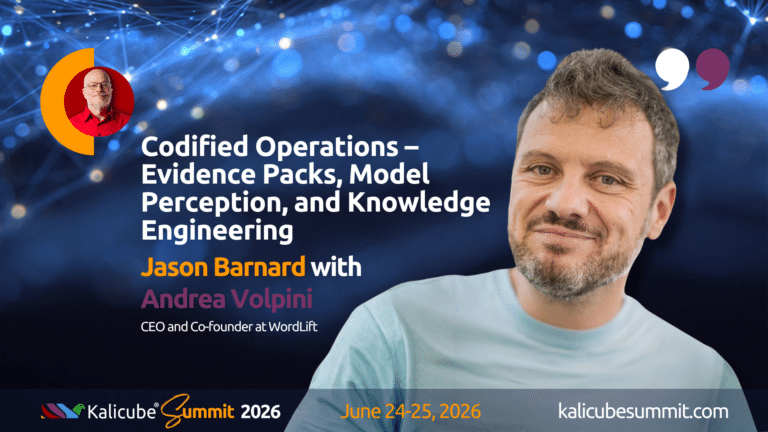
The session pairs structurally with Andrea Volpini’s session at 2.18 — Joe argues why Codified is the discipline that makes AI recommend you; Andrea shows how to operationalise it at the structured-data layer.
Key quotes
“Everybody can create content today. AI has made average incredibly easy. So how do we create content that’s not average — that actually becomes indispensable?” Joe Pulizzi, on why differentiation is now the only defensible content strategy”
“Most of the time, companies have sanded down the rough edges of their message. You have to risk losing a customer in some cases to gain market share in your core area. As Ann Handley says: if your content is for everybody, it’s for nobody.” Joe Pulizzi, on the operational cost of generic content strategy”
“Do Meta, Facebook, LinkedIn, YouTube — do they need human content anymore? Just think about that. We’re going to have a scarcity of human content. The opportunity is: how human do you really want to be with your content?” Joe Pulizzi, on the window that is closing for authentic brand differentiation”
“I want to create The Tilt so that people subscribe to me and I have a direct connection with my customers outside of any algorithm. But I also don’t want to be forgotten inside the system. You have to absolutely do both today.” Joe Pulizzi, on the dual strategy every brand must run simultaneously”
“It’s like looking at a stock portfolio. Instead of saying ‘I’m going to buy one stock,’ you say ‘I’m going to invest in seven to ten stocks.’ Do that with your employees.” Joe Pulizzi, on the trust portfolio model as the AI-era content strategy”
“If you’re not recommended by the technology, you don’t exist. You literally become invisible.” Joe Pulizzi, on what it means to be absent from AI engine recommendations”
“This is not just a marketing strategy. It is a business strategy, and it should be at the forefront of every marketer’s thinking.” Joe Pulizzi, closing the session on the AI gatekeeper as the most consequential shift of his marketing career”
Further reading
Codified and Distributed, part of Jason Barnard at Kalicube’s Search Engine Land series on AI search architecture. The article makes the case for Codified as the discipline that closes the loop between real brand outcomes and the machine-readable evidence AI engines weight when the next prospect asks about the category — and names why this represents the single largest expansion of the marketing function in fifteen years.
Related sessions
- Andrea Volpini on Codified Operations — Evidence Packs, Model Perception, and Knowledge Engineering (Session 2.18): the operations-side companion to this session; Joe argues why Codified is the discipline that makes AI recommend you, Andrea shows how to operationalise it at the structured-data layer
- Scott Duffy on OPIDC in B2B — Founder Vantage Across Thirty Years (Session 2.12): the B2B operator’s account of the OPIDC cycle that Codified closes
- Brian Scudamore on OPIDC in B2C — Thirty Years at 1-800-GOT-JUNK (Session 2.13): the B2C operator’s account of the same cycle
- Jason Barnard and Bob Gentle — OPIDC, Codified, and the Kalicube Flywheel — Live Walkthrough (Session 2.0): the live framework session that maps the full architecture within which Joe’s session sits
Link to preview post
This session was previewed here before the Summit.
Link to speaker post
Links to session clips
The Trust Portfolio: Joe Pulizzi on Why One Brand Voice Is Too Risky Now
Why You Can’t Build Your House on Rented Land: Joe Pulizzi
Transcript for Joe Pulizzi on Codified — Content Marketing as the Strategic Discipline
Jason Barnard: Hi again. Now I’m with the wonderful Joe Pulizzi. Welcome.
Joe Pulizzi: Jason, thanks for having me.
Jason Barnard: We’re talking about the content part of the entire process of optimizing for assistive agents, assistive engines, and search engines. You built the Content Marketing Institute, which is super famous — the defining institution, according to my AI.
Joe Pulizzi: Then it must be right. If it’s according to your AI, it has to be the way.
Jason Barnard: So my AI told me to ask you: what did starting over teach you about what content strategy is actually for? That’s the kickoff.
Joe Pulizzi: In 2007, we started what became the Content Marketing Institute. I started as a single person just doing a blog, and then it grew — over 200,000 subscribers, creating content everywhere: podcasts, events, all of it. We were lucky enough to sell that business and start over again with The Tilt, which was basically focusing on content creators instead of content marketers.
The whole idea behind both ventures is the same: how do you create something that over time builds trust? Our whole goal is that we want our audience — in the first case, enterprise marketers, and then with The Tilt, content creators — to know, like, and trust us. How do you do that? You have to have some kind of differentiated message or point of view. What I call the tilt.
When I talk to someone struggling with their content strategy, it’s generally two things. They’re not delivering consistently — they’re not focused on one platform, they’re basically all over the place. Or they don’t have a recognizable, differentiated tilt or mission. And that, especially with our conversation today, I think is the ballgame.
Everybody can create content today. AI has made average incredibly easy. So how do we create content that’s not average — that actually becomes indispensable? That’s what I’ve been trying to figure out for my entire twenty-six-year career: who’s the audience you’re trying to build a relationship with, how do you build trust, and how do you do that by being truly indispensable and differentiated?
That’s where a lot of companies have lost the narrative, because they forgot why they’re creating content in the first place. They think: I’ve got to fill that gap. I’ve got to be on that search result. I want the AI to serve me up. They’ve got all these tactical goals, but they’re not thinking about: how are you different? How are you recognizable? I want my audience to know who I am immediately when they read something or listen to me somewhere — they say, “Oh, that’s Joe” or “that’s Jason.” That’s very hard to do, but you have to do it with some kind of content marketing strategy behind it.
Unfortunately, that’s what keeps me busy — and keeps you busy — because companies aren’t doing it. They’re checking the box. If you’re just checking the box today and the rules change on a daily basis, you have to have something that grounds you: this is what we stand for as an organization or as an individual. Then you can figure out what kind of content you’re going to create from that mission.
Jason Barnard: Right. I’ve got about five or six things coming up in my head there, because you’ve called your new company The Tilt. You could have stopped — presumably you made a good deal with the Content Marketing Institute — and you chose to carry on. The Tilt is what I would call the angle that you have, because what AI will always do is spit out the most obvious thing given a set of parameters. The tilt is your perspective, your differentiator.
Within what I’m doing at Kalicube with the Kalicube Framework, with Assistive Agent Optimization — that diagram I showed you that you said looked like the periodic table — if anybody sees all these acronyms and this way of working, they know it’s me. They know it’s Kalicube. That’s our tilt. We have a different perspective on an existing situational problem.
Joe Pulizzi: And while you’re doing what most companies haven’t done — and this is the really simple problem — most of the time companies have sanded down the rough edges of their message. That’s what AI does too. AI right now will take whatever content someone wants to create, or somebody will decide “I can’t talk about this because somebody might get offended,” or “I can’t talk about this because I might be narrowing my audience too much.” They come up with all sorts of reasons to sand down the edges of their content.
You have a very particular way of going to market with your message. So I would challenge anyone listening here: have you made some decisions — whether you were aware of it or not — to sand down the edges of your ongoing communications with your customers? Those are the things we have to get back. You have to risk losing a customer in some cases to gain market share in your core area. As Ann Handley says: if your content is for everybody, it’s for nobody.
So who do you really want that long-term trusted relationship with? We’re talking about human content here. That’s the opportunity. I was doing a speech the other day and I said: I don’t know how long we currently have with the discoverability system we’re in right now, and that actually frightens me to death. We’ve been fairly discoverable for quite a few years — maybe a decade or two — where these platforms are giving us the opportunity to be discovered.
But do Meta, Facebook, LinkedIn, YouTube — do they need human content anymore? Just think about that. They use it, they use it all, but do they need it? No. We’ve seen and will continue to see more and more synthetic content. So we’re going to have a scarcity of human content. Where’s the opportunity in that? The opportunity is: how human do you really want to be with your content, and can you be as part of your mission, so that you can build these relationships while we have the time?
There are two ways to do this, and I know you talk about this as well: how do we create content for the machine, and how do we also create content so that we can live outside the algorithm? I think companies need to do both at the same time. I want to create my email newsletter. I want to create The Tilt so that people subscribe to me and I have a direct connection with my customers outside of any algorithm. But I also don’t want to be forgotten inside the system, because I don’t know where that’s going to lead. You have to absolutely do both today if you want to be known, protect yourself, and actually grow your business by developing relationships through content.
Jason Barnard: I spoke to you a few years ago and you mentioned having direct contact with your audience. We started building our newsletter and we’re now up to around eight thousand subscribers. It’s such a huge effort and so slow at the start. But you end up with eight thousand people who are genuinely engaging with your content, and you have that direct relationship. It’s super reassuring.
Joe Pulizzi: Congratulations first of all. And it’s so important today. Every marketer knows you can’t build your house on rented land. We want to leverage all this rented space out there, but at the end of the day, the rules will change. Google Plus showed us that. Facebook showed us that. Every platform has showed us. Meta’s now launching a subscription program, which theoretically means they’re going to limit more and more access to creators and marketers on Instagram, Facebook, and WhatsApp.
So we better prepare for when platforms restrict direct connection between creators and their audiences. I have never felt this much urgency about building an email newsletter, or an outside community, or a membership, or something where you can have that direct connection. Is it 12 months? 18 months? 24 months? Somewhere between now and five years, we’re going to lose that. And there’s going to be a whole different game on discoverability — if there is such a thing.
The companies that take that seriously right now — creating something known inside the system and something known outside the system through that direct connection — they’re going to have so much more power to create new products and services, to understand their customers better, without a gatekeeper involved in everything they do.
Jason Barnard: Which is a brilliant point. Now is the time to create the connections and relationships you have directly with your audience. For me, that’s security — an ability not to rely on rented land, but to use the rented land to drive that group of people.
But I would also argue that if you get into the system now, all of these big tech companies are building walled gardens. You and I remember AOL. That’s where it’s going. But if you’re inside the walled garden, you’re still in the game. If you haven’t got inside the walled garden, you’re knocking on a door that’s now locked. How do you feel about that?
Joe Pulizzi: I think what you’re saying is true, and it absolutely terrifies me. I can see a world where whatever screen the person is on — whether that’s Gemini, ChatGPT, Claude — a question is asked, an answer is given, and they’re going to stay right there. The ten blue links — as you know, you’re an expert — they’re going away, or they have gone away in a lot of cases. You’re not going to get a list of options to click on. You’re going to go through a conversation. The system wants to get more and more detail out of you so it can give the most representative answer. And then people are going to buy directly from within that system and never leave.
The system you’re in may be talking with four, five, ten, twelve different companies at one time for different sales, working through e-commerce, and you’re just going to be going through the system — “I just bought a pool, I just bought a new car, I just bought that B2B software” — and you never had to leave Gemini or Claude or ChatGPT.
And that is absolutely terrifying to me, because if you’re not prepared for that as an organization, you’re absolutely going to be left out. If you’re not recommended by the technology, you don’t exist. You literally become invisible. You can do all the things you did for twenty years with your website and building your brand and all those things, but if you’re not recommended, it’s all for naught.
So we have a lot of work to do. Companies are struggling with this, and it’s created a lot of fear in the marketplace.
Jason Barnard: That’s brought up a few more questions in my head. One is: I was talking to a client the other day — a home services business very much focused on search results. When we were talking, I said: the problem with home services is if I need my windows cleaned, and an agent can just book that — it’s a question of price, availability, and quality of service — how have you planned for that? The answer was: not at all. And then I realized this is a whole business restructure. There’s a significant restructure required to serve the people who search, the people who are using assistive engines for recommendations, and the ones who are going to use agents. That’s huge.
Joe Pulizzi: Everything is about marketing today. It’s funny — you’ll get into conversations about whether marketing matters with all these AI engines going on, and the answer is: marketing is the game. If you’re working on your brand and your differentiation and showing up and being there for customers when they’re ready, wherever they’re going to be — in whatever limited number of places that seems to be settling into — that’s the job.
So this is a really good time to understand, in home services: what does that organization do that’s just a little bit different? What would increase the odds for the AI engine to recommend that home services company? This is where you have to do the work.
And I love doing customer research. This is a really good time to talk to the customers you already have. Why did they choose you? How did they find you? That’s also, by the way, a really good reason to have an email newsletter — I just ran a short survey and had hundreds of people respond, because I wanted to know who my audience was. I have the ability to do that right now. A lot of people don’t — if you don’t have that direct connection that may be going away anyway. So this is the time to figure out: here’s what our brand stands for, here’s how we’re going to communicate that brand in the marketplace, here’s how we’re going to make sure we’re part of those results, and then: how do we get those people off the algorithm into something we own?
Discovery inside the system — we have to play that game. But then we want to make sure we create our own moat for our business, and that’s outside the algorithm.
Jason Barnard: Exactly. And that diagram — the Kalicube Framework diagram — is probably the way people need to look at it. But what my diagram is missing is what you just described: the serve part on the right-hand side — OPIDC — with a little flywheel of its own, where the people you’re serving are being served over and over again. And you have that direct contact, so you don’t need to go through that whole acquisition loop for the people you’re already in contact with. That’s a brilliant addition. I’ll add it after the show.
The other thing I wanted to raise: you mentioned filling an information gap, which is the big fad at the moment — “the AI doesn’t know ABC, so we need to create content that feeds it ABC.” But in fact what you need to do, in my opinion, is feed it the ABC about your brand with your brand’s perspective on that ABC, to differentiate yourself so the engine has a reason to come to you. Which is something similar to what you just said.
Joe Pulizzi: Right. If you just answer questions — which was actually a great strategy twenty years ago; Marcus Sheridan went out with They Ask, You Answer, and if you answered all the questions in your industry it was a pretty good strategy — but that doesn’t differentiate you anymore. The answers are already there for everything. Almost every question has already been answered. So: how is your answer different? You want to make sure that if you don’t differentiate in some way, you’re not going to be found.
The thing I’m trying to promote — which is difficult to do — is: if you trust your employees enough, what you really want to see is individuals within your organization creating content on different channels instead of just coming from the brand. I’ve been talking about content marketing since 2000, and I really believe that in a lot of cases, brand-centered content marketing is dying. The engines, as well as the social platforms, aren’t raising corporate content to the top. They’re raising individual content to the top. If you want proof of that, look at your LinkedIn feed. You’ll see lots of individuals. Where do you see the companies? On the ads.
So we want to make sure: how do we get our individuals, our experts, to lean into what I call their weird or their crazy? You might have someone with a TikTok channel. You might have someone who focuses on LinkedIn. Someone who owns the newsletter. Someone doing in-person events or speaking events. You have to trust them enough to let them go out and represent you.
I call that the trust portfolio. It’s like looking at a stock portfolio. Instead of saying “I’m just going to buy one stock” — that’s a very risky strategy — you say “I’m going to invest in seven to ten stocks.” Do that with your employees. By the way, a lot of your employees are already creating content. They might already have a photography blog somewhere, or they’re doing stuff on TikTok. Lean into that. Not everybody in your organization should or could do this, but a lot can.
And I think that’s where the competitive advantage is in getting found in these answer engines. You have to allow your employees to do that. That’s going to be a key strategy in the next twelve months, and it’s going to be the ones that absolutely trust their employees and have a baseline strategy — this is what we stand for, this is what you absolutely can say, this is what you absolutely should not say — that will see the benefit.
Jason Barnard: Right. And that also makes me think of another part of what I look at: centralize your data. Your product data, your marketing data, your feedback from your clients, your reviews and testimonials, your brand narrative and the brand rules. Use that as the supporting data to help your employees do this.
Joe Pulizzi: Love that. It’s so important. When we started years ago and said, “all right, you’re going to do this content marketing thing, we need a content marketing mission statement — which is basically an editorial statement” — what we found is that the content teams within the marketing department were only sharing it within the team. Nobody else in marketing had that information. They did all the persona work and then put the persona work in a drawer and never got it out.
Having a place where, as we always said, everyone in marketing knows what the mission statement is — print it out and put it in front of them so they see it every day, or keep it as a working document in Google Docs or Dropbox that everyone has access to. LinkedIn is a really good example. If you want your sales team to create audiences on their own LinkedIn channels, they need to have: here’s our strategy, here’s what we stand for, here’s the type of content we think you should share, here are seven pieces we released this week that you can use, here’s a free ungated resource you might want to share. All in one centralized place. Don’t make it heavy lifting for your employees. You already have all the data — just put it in one place.
Jason Barnard: A hundred percent. And we were talking about this with Lily Ray. She’s the person who talks most about E-E-A-T in the SEO industry, and she was suggesting that E-E-A-T is brought to the table by the people you work with, by your employees. Google, Bing, ChatGPT are all focusing on people. It’s all coming together — which is slightly worrying unless you feel you’ve mastered AI. As a content marketing director, you might feel like you’re losing a little bit of control. And that’s okay, because if you have a legion of creators building audiences in your organization — twenty or forty or sixty people creating audiences on different channels — think of the competitive advantage you have versus somebody coming at it from a single brand newsletter or a brand TikTok channel. You’ve got sixty different reasons for Claude or for some AI system to say: “Wow, I’m going to cite this individual, and this individual, and this individual — they all work for this brand standing for a particular thing.”
Joe Pulizzi: That’s exactly why you’re seeing more and more training being done. I’ve heard this from a lot of different consultants: there are very large enterprise brands saying, “We have to educate all of our employees on how to create content and what we stand for, so they can put it out there in their own channels.” I think that’s the way to go, even though — if you’re someone who wants to tightly control the brand and it’s got to be said only this way — you’re going to be in trouble. Because that’s not how it works anymore.
Jason Barnard: Well, as a brand, you have to accept that your audience, your clients, and the people who are watching you are going to say things about you as well. It’s just another layer on that. You identified the idea that you have the clients, the brand, and then the business as a third arm of the puzzle. Would you add AI to that, or is it not a fourth part — is it already included?
Joe Pulizzi: You probably could include it. Absolutely. Right now, AI is an audience that we have.
I’ve been fighting gatekeepers my entire life in marketing. There’s always somebody getting in between me and my customer. I remember working for a publishing company and the day a Google executive team came in — this was around 2000 or 2001 — and that became the gatekeeper. Then social: Facebook, then Twitter, then LinkedIn. You kept creating all these gatekeepers.
Well, that was nothing compared to what we’re seeing now. This is the ultimate gatekeeper. Maybe the final gatekeeper of my days working in marketing. As part of the strategy, we have to take this more seriously than we’ve taken anything else. I almost think about the way you and I prepared for social media as just practice for this moment in time: how are we going to be found when there’s a whole new slew of customers and audience members we will never have the opportunity to directly connect to because of this gatekeeper role?
This is not just a marketing strategy. It is a business strategy, and it should be at the forefront of every marketer’s thinking.
Jason Barnard: Which is a brilliant way to end it. I think I had other questions, but you just said the perfect ending to this session. Thank you so much, Joe. That was absolutely brilliant.
Joe Pulizzi: Jason, thanks for having me. I always appreciate our talks.
This session extends the Search Engine Land article series on AI-era brand recommendation by Jason Barnard at Kalicube.
Canonical metadata footer
Session date: June 25, 2026 | Duration: approximately 25 minutes | Format: pre-recorded, on-demand from session drop | Day: 2 | Framework concept: Codified (Stage 15 of the Kalicube Framework), coined by Jason Barnard in 2026 | SEL article: Codified and Distributed — to be published | [Share buttons: LinkedIn, X, Facebook, Email]