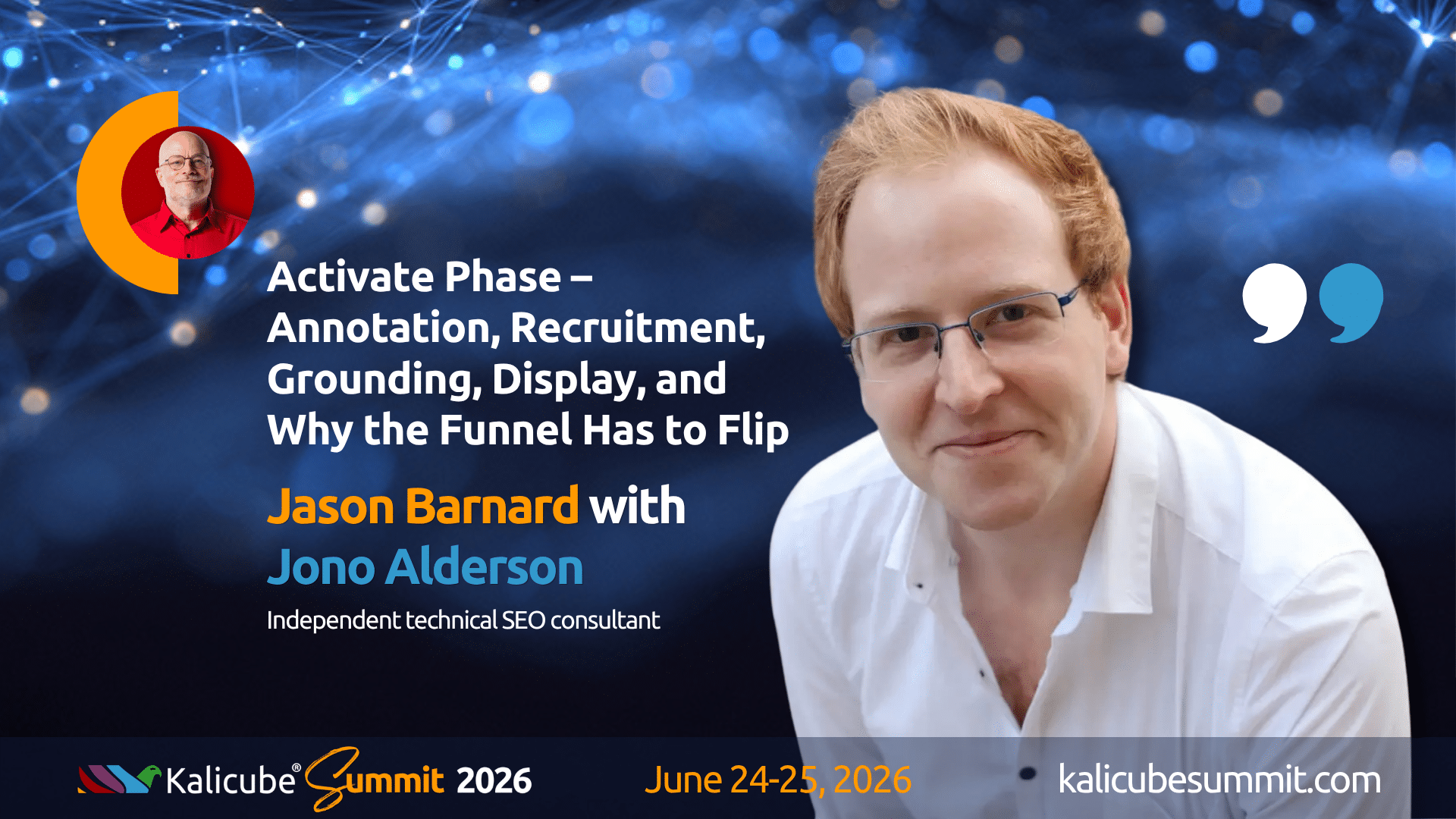
Jono Alderson on the Activate Phase — Annotation, Recruitment, Grounding, Display, and Why the Funnel Has to Flip
Session identifier
- Session: Activate Phase — Annotation, Recruitment, Grounding, Display, and Why the Funnel Has to Flip
- Day: 1 (June 24, 2026)
- Speaker: Technical SEO Consultant and Software Engineer, Meta
- Framework concept: ARGDW — the five-gate Activate phase of the AI Engine Pipeline (Annotated, Recruited, Grounded, Displayed, Won), coined by Jason Barnard in 2024, covering how algorithms decide whether content is worth keeping, recruiting, grounding, and ultimately displaying
- SEL article: How AI decides what your content means and why it gets you wrong
Speaker bio
Jono Alderson is a globally recognised technical SEO expert and software engineer based in York, England. He is currently embedded at Meta via Magnit, where he applies SEO, analytics, and web-performance engineering to large-scale products. His career includes senior roles at Yoast as Head of SEO and Distilled as Principal Consultant, and he operates his independent technical SEO practice Applied Energistics. Jono is a WordPress core contributor, a contributor to the Web Almanac, board member at The WP Community Collective, and co-founder of Days Of The Year. He has advised the AMP project and is a frequent keynote speaker at BrightonSEO, SMX, and international conferences, known for technically sophisticated arguments about where website infrastructure decisions have strategic business consequences. Jono is happiest neck-deep in code, then on stage explaining what it means.
Session’s place in the Kalicube Framework
Jono’s second session covers ARGDW — the five-gate Activate phase of the AI Engine Pipeline where algorithms decide what to keep, recruit, ground, display, and act on. Each gate is a sequential threshold: failing at Annotation means Recruitment never happens; failing at Recruitment means Grounding never happens. The session covers all five gates in sequence, ending at the Won moment and the three-click taxonomy — the Imperfect Click in search, the Perfect Click in assistive engines, and the Agentic Click where agents act without asking. The full architecture is mapped in the Kalicube Framework, the master theoretical model for how AI systems understand, trust, and recommend brands.
Episode summary
Jono Alderson opens the second session with a clear endorsement of the Kalicube Framework as the clearest map of the individual steps that practitioners historically oversimplify. Each gate is a sequential threshold: you have to pass each one before the next becomes possible. The mental model most people carry — crawl, index, rank — collapses four distinct decision points into one undifferentiated step, which is why practitioners cannot diagnose where they are failing.
The vectorization section was the session’s most pedagogically valuable contribution. Content is not stored as pages in a database — it is transformed into numbers across thousands of dimensions, each representing a label or attribute: long or short, about cats, geo-relevant, evergreen, written on a Tuesday. When a query arrives, the system performs mathematical operations on that entire corpus to find the closest fit. The practical implication is that clarity of structure is a mathematical advantage, not a stylistic preference. Well-structured content with logical paragraphs, semantic HTML, and the answer placed early produces cleaner label extraction. Jono’s instruction was simple: write clear, well-structured information, answer the question early, because when content gets turned into numbers, the key bits survive if the structure lets them.
The Recruitment section was the session’s most strategically significant contribution. The three-speed recruitment problem — search engines recruiting in near-real-time, LLMs recruiting for training data on periodic update cycles with human engineering bias, knowledge graphs recruiting for entity facts through deliberate decisions about what categories to expand — creates a landscape where the cost of a bad early reputation is permanent in a way it never was before. Jono’s observation about risk was the session’s most commercially significant point: the move-fast-and-break-things model of brand building may now leave indelible marks. A company that launches badly, rebuilds, and earns a strong reputation may find the repair never reaches the training data. The cost of getting things wrong early has become structurally higher than it has ever been. Jono’s practical instruction: want to be prepared as soon as possible, because the landscape shifts every eighteen months in unpredictable ways and you cannot predict which direction the next training update will prioritise.
The citation-versus-brand-salience argument was the session’s most challenging contribution for the SEO community watching Day 1. Jono named citation-counting directly as the SEO industry applying yesterday’s reporting model to today’s problem — a desperate attempt to maintain a simple metric in a surface where simple metrics no longer work. His alternative was not a different metric but a different frame: what did 1950s advertising measurement look like? Large-scale brand salience surveys, competitive perception studies, recognition mapping. The argument converges with Neel Murty’s measurement approach from Session 2.5 and Jason’s Funnel Query Pathway from Laurence O’Toole’s session — all three independently arriving at macro measurement as the necessary replacement for micro attribution. The practical instruction: do good marketing that changes what people actually think and how they actually behave, and the AI recommendations follow as a downstream reflection of that behavior.
The funnel flip section was the session’s most structurally important contribution for non-specialist audiences. The marketing funnel has run top-to-bottom since AIDA was named in 1898 — because interruption marketing required shouting at the widest possible audience and filtering down. AI changes the gate: you cannot reach the high-intent buyer at the point of conversion unless you have already proven to the machine that you are a good fit for helping the curious researcher at the awareness stage. The entire addressable market has to be addressed — not because those users will all convert, but because demonstrating relevance to the full spectrum is the evidence the machine uses to decide whether you deserve to reach the subset who will.
The Won moment section closed the session with the clearest extension of the framework produced by any Day 1 speaker. Jono confirmed the three-click taxonomy — Imperfect Click in search, Perfect Click in assistive engines, Agentic Click where agents act — and added a fourth scenario from Google’s cross-site agentic checkout: the user builds a shopping cart across multiple domains, the agent monitors pricing and availability, and a compatibility agent intervenes to replace an incompatible product with a better option from a different site. The user never visits any of the websites. Even winning the recommendation does not guarantee being seen. The implication is that winning the Won moment is now the beginning of a new competitive layer — the brand still has to be the cheapest, the best, or the most structurally accessible for agent interaction. Being recommended is necessary but no longer sufficient.
Key quotes
“It’s not efficient to store and then look up and retrieve all the raw text from every web page. What you want to do is turn all of that into numbers — abstract all of it away into something a machine can far more easily evaluate, slice, and dice.” Jono Alderson, on why annotation is not a technical metaphor but a literal description of how content is stored and retrieved.”
“Once stuff is in the training data, it’s very, very hard to get it out. Brands might need to be much more careful and get fewer things wrong early on — the cost of trial and error might now mean that you get permanently poisoned.” Jono Alderson, on why three-speed recruitment makes early reputation management structurally more important than it has ever been.”
“I think it’s probably far closer to: what did 1950s advertising look like? Running large-scale market surveys on brand salience. That becomes far more interesting again.” Jono Alderson, on why citation-counting is yesterday’s model and what measurement should look like instead.”
“You’ve got omniscient machine gatekeepers in that process that mean I can no longer shout at the audience. I can’t reach the audience unless I’ve already proven to that machine that I am a good candidate to solve their problem. And yet business has not woken up to this inversion yet.” Jono Alderson, on why the funnel inversion is not optional and why most businesses have not yet absorbed it.”
“Even if you win and you’re visible and you get the click, a lot of that behavior — certainly for e-commerce — now happens kind of in the search results, without you ever being seen.” Jono Alderson, on Google’s cross-site agentic checkout and why winning the Won moment is the beginning of a new competitive layer, not the end of the pipeline.”
Further reading
How AI Decides What Your Content Means and Why It Gets You Wrong, Article 9 of Jason Barnard at Kalicube’s Search Engine Land series on AI search architecture. The article maps the annotation and meaning-making layer that opens this session — why content is stored as vectors rather than pages, and what that means for how brands write and structure their content to survive the labelling process.
https://searchengineland.com/how-ai-decides-what-your-content-means-and-why-it-gets-you-wrong-473749
The full pipeline context for both of Jono’s sessions lives in the article series — starting with Article 7 for the DSCRI and Push Layer territory Jono covers in Part 1.
https://searchengineland.com/the-push-layer-returns-why-publish-and-wait-is-half-a-strategy-472941
Related sessions
- Koray Tuğberk Gübür on Cost of Retrieval and the Algorithmic Trinity (Session 1.12): the annotation and cost-of-retrieval depth session that takes the vectorization point Jono introduces here into its fullest technical expression — specifically the MD file methodology and source term vectors
- Teodora Petkova on Meaning-Making, Non-Commodity Content, and the Living Knowledge Ecosystem (Session 1.14): the philosophical vantage on the same Annotation gate Jono covers technically — why meaning matters at the labelling layer and what non-commodity content actually means
- Lily Ray on E-E-A-T, NEEATT, and the Credibility Layer of UCD (Session 1.15): the practitioner’s account of what the engines are evaluating at the Grounded and Displayed gates Jono describes structurally — how to build the evidence that survives the grounding evaluation
- Neel Murty on Measurement for the Assistive Era — Presence, Prominence, and Sentiment (Session 2.5): the Google-side measurement session that converges independently with Jono’s brand salience argument — both arriving at macro measurement as the necessary replacement for citation-counting from different research directions
Link to preview post
This session was previewed here before the Summit.
Link to speaker post
Links to session clips
Omniscient Machine Gatekeepers: Jono Alderson on Why Old Marketing No Longer Works
Why Behavior Change Matters More Than Content: Jono Alderson Explains
Transcript for Jono Alderson on the Activate Phase — Annotation, Recruitment, Grounding, Display, and Why the Funnel Has to Flip
Jason Barnard: Back with Jono again. Now we’re talking about the second part of the Kalicube Framework, which is Activate — for the algorithms. So I’ve shown you the Kalicube Framework, Jono. What do you think?
Jono Alderson: I think this is great. I think this does a really good job of splitting out all the individual steps. People have historically had an oversimplistic mental model for this, and Google certainly haven’t helped with that in their communications. Being clear that there is a difference — for example, between Recruitment and Grounding, and even further back, the rendered versus index we talked about previously — is super important to understand, because each of these is a gate. There are mechanisms by which you can skip some of those gates, and you’ve talked about that. But you have to sequentially qualify and pass each of these. Otherwise, the rest of it can’t happen. And yet people don’t think enough about where they’re getting stuck.
Jason Barnard: Starting with Annotate. This is something I heard from Fabrice Canel in 2019 in an interview. I thought: that’s super important, I’m going to talk about it. I’ve been talking about it, and I don’t hear anybody else talking about it. When the engines put the content in the index, they break it down into chunks, put it into their proprietary format, and put little post-it notes on it saying what the entities are, what the relationships are, whether it’s geo-sensitive, whether it’s time-sensitive, whether it’s child-friendly, and then they put a confidence score on that. And those are the elements the algorithms are then using to select the content — rather than the content itself. Number one: is that true? And number two: are other people talking about it and I’m just not listening?
Jono Alderson: I think that’s broadly true. I think this is part of the broader vectorization process, which some people talk about but tends to be only in very technical terms.
There is definitely a process — and this is a fairly standard part of how all modern search engines work — where it’s not efficient to store and then look up and retrieve and serve all the raw text from every web page. So they’re not literally saving every web page and putting it in a big database. That’s not efficient and it’s not easy to query. What you want to do is turn all of that into numbers — abstract all of it away into something a machine can far more easily evaluate, slice, and dice.
“Labels” is a great word for it. And those labels might be anything and everything: this page is long, this page is short, it’s geo-relevant, it’s about cats, it’s written on a Tuesday, it has the word banana in it. Those labels all exist in a kind of infinite dimensionality. And then when you want to say: this person has searched for this phrase, or we want to find results about this topic or written on a Thursday, you can perform mathematical functions on the corpus of all of that n-dimensional data to find the closest ones. And you can also go: this person has this particular search history, or geography is important for this type of search — and perform different maths on the same set, rotate it, invert it, find the best fit. It’s complicated maths, but essentially it’s just addition and subtraction of concepts through different vector space.
The idea that they’re looking at words on pages is definitely oversimplifying. They are turning all of your content, all of your branding, all of your images, and all of your schema into raw concepts and numbers and labels, and then performing maths on those.
The practical implication is that it’s super important to be super clear. Write using the kinds of language your audience is looking for. Write simply. Don’t write very long or very short sentences. Structure your content in readable, well-structured, sequential blocks that can exist on their own. All the rules of good standard writing — none of this is SEO stuff. It’s just: write clear, well-structured information. Don’t bury the lead. Answer the question early. Because when this maths happens on the page and it all gets turned into numbers and vectors, you want the key bits to survive. That means having it well-structured in the first place.
Jason Barnard: I don’t think I’ve ever heard anybody explain vectorization in such a handy and helpful way. Thank you very much.
Is there a question of what’s at the top of the page and what’s at the bottom? You just said don’t answer the question at the bottom of the page. Is that because as a human being we want the answer at the top, or is there a mathematical advantage to being at the top?
Jono Alderson: There might be — we don’t really have much insight into how these systems work or how the ingestion processes work. But it wouldn’t surprise me: if you wanted to write that math from scratch, even if you didn’t know anything about vectorization or search engines, it’s probably a reasonable estimation to say that a good page that answers a question well would answer the question fairly early on. Which means the first paragraph might be more important than the rest. Maybe, but maybe that’s a label that gets applied partway through the process. Maybe there’s a separate evaluation process. Either way, it feels like the sensible thing to do.
Jason Barnard: Next question. Google actually asked me not to talk about chunking.
Jono Alderson: Ah, yes. Why do you think that is?
Jason Barnard: I think people have got obsessed about the technical maths part rather than thinking: I should write a really good page, which is really well structured, with nice subheadings, and helps users answer the question they have. Instead they’ve immediately gone to: I should precisely subdivide all of my paragraphs and words so that they are mathematically perfectly aligned in a way that a machine might extract and vectorize. And they forget that the actual objective is to write something that helps humans. It’s become synonymous with that kind of artificial structure of content rather than providing utility.
Jono Alderson: Which is really frustrating. There are two things. Number one, chunking is a thing. All I’m saying with chunking is what you said — have nice headings with logical paragraphs that actually answer a question, make sure it’s organized with semantic HTML5 so it’s easier for the machine to figure out what the chunks are. It’s not saying: try and beat the mathematical machine. And there’s a similar thing with links — I’m saying from your Entity Home website, link out to the proof. If possible, get the link back. The link out is enough, but the link back is a bonus. And all of a sudden, Jason’s a link builder.
Jason Barnard: Oh, no.
Jono Alderson: Yeah. This is the perennial problem with SEO — people see in isolation one thing that looks like a lever you can pull, and then they pull the lever till it breaks, and they never understand that wasn’t the game at all. So that’s frustrating.
Jason Barnard: On to Recruitment. I’m looking at LLMs, knowledge graphs, and search engines. LLM is intelligence, search engine is information, knowledge graph is verification and validation. They all recruit. Search engines are recruiting in real time to give real-time information. LLMs are recruiting for their training data. Knowledge graphs are recruiting for their training data to figure out the facts and build that machine-readable encyclopedia. So there are effectively two different speeds of recruitment — in fact three, because they all have different speeds. Number one: what do you think of that approach? And number two: what do we do about it?
Jono Alderson: The different speeds thing is interesting. Google has got faster over the years — it used to be there was always a delay between writing a thing and getting indexed, and that’s come much closer to real time now. And now we’ve taken a step back, because if you want to influence what an LLM says about you, influencing the content that exists today might tweak some of the RAG stuff and the real-time retrieval stuff, but it’s not going to have the deeper impact that having already affected the training material would.
If your business has a bad reputation, or if you’re a brand new business, you’re going to find it disproportionately difficult to shake that impact, because the training data is updated slowly and in periodical bursts.
Jason Barnard: Periodic bursts — but it’s also what’s being corrected depends on the human engineers deciding what needs to be improved.
Jono Alderson: Hugely biased, yes. A Knowledge Graph update three years ago — the number of people in the Knowledge Graph tripled. So they’d obviously figured out: we need more people. They gave it a big data lake, sorted through it, got it more or less clean, and then fed it in with the specific aim of getting more people in. So if you were a corporation hoping that Knowledge Graph update was going to do you some favors — it almost certainly wasn’t, because that’s not what they were focused on. You’ve got the delay, and you’ve got the bias of what they’re trying to train it for. So the whole landscape shifts every eighteen months in unpredictable ways. And I don’t know if there’s much you can do about this practically — you want to be prepared as soon as you possibly can.
Jason Barnard: Have a perfect reputation, a perfect website, and invest in all of the things, so that you bet on the right one.
Jono Alderson: Yes. And then hope that you can mitigate whatever gets stuck in the training data by affecting the RAG stuff. When stuff gets stuck in the training data — and some of this becomes recursive, because one system is looking at another and ingesting their legacy bias into their training data — once stuff is in the training data, it’s very, very hard to get it out.
I wonder what this does for risk, because most successful companies grow through trial and error. They launch a thing, they hit the ground running, get a terrible reputation for bad delivery, and then fix it — and five years later everybody loves them. But now the impact of that period of failure might be baked in long-term. The cost of trial and error and “move fast and break things” might now mean that you get permanently poisoned. Brands might need to be much more careful and get fewer things wrong early on. And things like a CEO having a scandal or a product exploding — these things might leave indelible marks. The cost of getting things wrong becomes far more expensive.
Jason Barnard: Which is a phenomenally good point. And actually, the reason I started Kalicube was because Google thought I was a cartoon blue dog. And the weight of evidence was completely… But you can change it by shifting the perspective of the machine — demonstrating what’s truly important for both me and for my audience.
Jono Alderson: Yes, absolutely. Because the ultimate user behavior feeding back in, as you well know, and your whole system reinforces — that’s what shifts that behavior and shifts the perception. I think a lot of people in SEO are thinking about the things I should be doing: they should be changing the way people behave in ways that leave signals that machines can use to better understand.
Jason Barnard: In twenty seconds you’ve explained the Mirror Principle — AI’s opinion of the world’s opinion of you. The fundamental idea is: change the way people perceive you and make sure the machines can ingest it, at which point the machines will reflect what they’re seeing. So I prefer your explanation now. I’ll steal it, if I may.
Jono Alderson: Of course. Thank you.
Jason Barnard: I’ve got you on record for that. So what are the signals that are going to get something recruited for each of the three — for LLMs, search engines, and knowledge graphs? Missing the Recruitment gate means you’re out of the game for Grounding and Display.
Jono Alderson: One of the interesting things we see changing in this new world is that less is more. For the last twenty years, we’ve treated the internet as an infinite space. Companies large and small have prioritized quantity over quality. They’ve published lots of uninteresting, mediocre blog posts. They’ve put up pages about teeth whitening and uninteresting pages about their services. As a result, many of these websites are bland and undifferentiated. Even the bits meant to be interesting — their blogs, resources, help hubs — were driven by SEO and spreadsheets of keywords and don’t really say or mean or feel anything.
One of the things that will have to change if we want our websites to be recruited and considered and winning is for them to be genuinely differentiated. Interesting. The internet is full, and almost all of it is garbage — and it’s getting more full because the cost of producing a million pages is now nothing. Search engines and LLMs have to be more considered at the first stage: what do we crawl, what do we render? But also the next stage: what do we want to keep? How do we filter stuff?
If you’re a dentist wanting to compete, having an average page about teeth whitening is no longer enough. Every business needs to start saying: there is a cost to every URL and every page we have, because at scale it’s going to drag down our average and our reputation. How do we have fewer pages that are better? How do we make sure every single one of those isn’t just “good content” — whatever that means — but is actually opinionated, differentiated, genuinely different from what our competitors are saying? If Google or ChatGPT only had to pick one result from this entire sector or problem space, why is this one better? And that doesn’t mean more words and more chunking — it means actually evaluating it and asking: can we improve this? Is it interesting? Is it fun? Is it upsetting? Is it divisive? Is it anything other than just words on a page? Nobody’s really there yet. Getting beyond words on a page is the next level.
Jason Barnard: And is it new? I was talking to Koray Tuğberk Gübür about Topical Authority, and part of it is: if you’re providing new information, you’re expanding your field. You give something new. But you also have the problem — and we can come to this in a moment with Grounding — of being seen to be wrong.
Jono Alderson: Yes. Finding that point of enlightenment on consensus versus differentiation is tricky in an LLM age. Because that brings us to Grounding. The idea of being used in, say, two hundred URLs or chunks of content to evaluate whether this is the right answer and the safe answer to give — of which four or five are shown as links. And the world right now appears to be obsessed by citations: getting that link, being one of the four from the two hundred that are grounded. That seems to me a pretty pointless battle.
Jason Barnard: Yeah.
Jono Alderson: I think this is the SEO industry desperately trying to apply yesterday’s reporting models to today. You go: okay, so there are fewer clicks, so impressions are more important. But our impressions are all broken. Let’s try and get citations instead. How do we design a very simple funnel that we can use to report to the C-suite? I don’t think it makes a huge amount of sense. I don’t think there is an easy answer to what good or better looks like. But it’s certainly not trying to double down on counting citations. I think it’s probably far closer to: what did 1950s advertising look like? Running large-scale market surveys on brand salience. That kind of thing becomes far more interesting again. You can do simulated versions of that, maybe.
Jason Barnard: I’m going to have Neel Murty from Google on as well — he’s looking into measurement. I was chatting with him about micro versus macro. What you’ve just described is macro. My argument in my Search Engine Land series is: we used to be micro. I’m an economist, so it was micro — you could measure everything, you’re the little corner shop. Now you have to go macro and create a basket of goods and measure it over time, so you can compare like with like. And Neel is also saying exactly what you’re saying: let’s look at it more like traditional marketing, with market research.
Jono Alderson: Lovely. That’s it. And that’s not a thing SEO has ever done, because we’ve been obsessed with these artificial representations of reality where we pretended that clicks were equivalent to growth. It was never sophisticated, it was never real. If we are forced as a result of this to say: actually, we should start to care about what people think about us, whether they recognize our logo, what our respective strengths and weaknesses in the market are versus our competitors at a product and pricing and positioning level — rather than in terms of our blog posts — I think that elevates us all when we start to do more meaningful marketing. And then all of the questions about which prompts we get citations for — all trend in the right direction because the objective is: change the behavior and perspectives of people to influence how the machine perceives you. It’s the same thing. If you do all the good marketing, you get recommended more by LLMs. There’s no rocket science there. It’s a reflection of people’s preference and behavior.
Jason Barnard: I love that. Beautifully said. And with Grounding: if I’m in the hundred and ninety-six points of content that were considered but not chosen for the citations — what possible use is that to me as a business?
Jono Alderson: That’s a great question. I guess it validates that systems know your URL exists. Is that valuable? But there’s also a cost to you, which is interesting — it means at some point that system has come and extracted your content, done whatever it has with it, and disregarded it. That costs you in server costs and overhead, but also opportunity costs. And it’s going to inflate all your metrics in weird ways, or you might miss it entirely because you’re not tracking it properly. Either way it creates noise, and you’re going to employ an analyst to evaluate that noise and they’re not going to come up with any answers. So I think it’s probably a net drain. Being constantly evaluated and then disregarded is not a pleasant place to be stuck in.
Jason Barnard: Brilliant. And Reddit comes in there a lot — Reddit keeps getting cited as a huge source, but a lot of it is just Grounding.
Jono Alderson: Yes. And I wonder if Reddit is a short-term thing. At the moment it’s the big de facto voice-of-the-community source. I wonder how long until Google and others get better at sourcing from, say, a really great forum for dentists or for plumbers — being a bit more nuanced. There were experiments a few years ago with Google over-featuring community discussions in the search results and it was awful. But maybe a more sophisticated revisit where you go: a lot of what Grounding is trying to find is humans discussing and saying yes this one is good, no that one is not open on Tuesdays, yes that one is expensive. There have to be better places than Reddit, but because Reddit is so big and has so much of that, it’s a sensible starting place.
Jason Barnard: Brilliant. So onto Display. For me, that’s the funnel — that’s where I started with the Kalicube Process ten years ago, saying: awareness, consideration, decision. I’m saying: start at the bottom of the funnel and build up for the machines, even though humans come from the top — awareness through consideration to decision. You need to build Understandability, then Credibility, then Deliverability. If it doesn’t understand who you are, you can’t develop credibility. And if it doesn’t believe you’re a credible solution to the problems it’s understood, it won’t advocate for you at the top of the funnel.
Jono Alderson: Yes. I really like that. And that’s not the way businesses think or website owners think. You kind of iterate through time and shout loudly and hope you can attract enough people, then build a reputation. But the model is very much the other way up. If you want to sell a blue widget, the behavior and the desire for businesses is to say: we want to shout at people when they’re already in the funnel at the point of purchase, because that’s the most efficient way to advertise. But you can’t access those people unless you’ve already proven that six months ago you were the right fit for helping them understand why they needed a blue widget in the first place, or to become aware that blue widgets are even a category.
So much of SEO is misexecuted as if it were advertising. How do we find the keywords that best convert? How do we write the blog post that best nudges people over the barrier? It completely fails to consider that these systems, by design, are trying to help people solve their problems. And that’s almost always way higher up the journey, earlier in the decision cycle. For many of those users, they would never have bought from you anyway. But you still have to demonstrate that you’re a good fit and you’re helpful, in order to then be relevant and recommended for that much smaller set of people who you are a good fit for.
The idea has to be that SEO has to address the entire addressable market. It’s not enough just to go after this small segment of highly converting keywords. You have to go much higher and broader and prove that you’re right and good and valuable — in order to access the subset, if you want to convince the machines that you’re the right fit. And that’s not how businesses think.
Jason Barnard: Really, really well put. And my mate Claude was telling me the other day that AIDA was invented by someone called Lewis, in 1898. So the funnel has been top to bottom for over a hundred and twenty years.
Jono Alderson: Because it was based on interruption marketing and shouting — I will stand in the street and wave a pamphlet, and I will try to shout at enough passers-by that I can get a subset of them to cross my threshold, so that I can then control the narrative and influence how they think, and then get a subset of them to buy. And now suddenly you have omniscient machine gatekeepers in that process that mean I can no longer shout at the audience. I can’t reach the audience unless I’ve already proven to that machine that I am a good candidate to solve their problem. And yet business has not woken up to this inversion yet.
Jason Barnard: I’m saying: flip the funnel. You have to flip the funnel if you want the machines to recommend you to the subset of their users who are your audience.
Jono Alderson: A hundred percent.
Jason Barnard: The very last part is the Won moment. I’ve managed to get the machine to recommend me, and I’ve managed to get the machine to put me in front of the audience. We have three possibilities. In search, you have the Imperfect Click — the user chooses from ten. In the assistive engine — AI Mode, let’s say — you have the Perfect Click, where there’s one option, you click on it, you buy. That’s what Fabrice Canel from Bing talks about. And then you have the Agentic Click, where the agent is buying. So those are the three different engines — search, assistive, and agentic — and three different types of click: the Imperfect Click, the Perfect Click, and the Agentic Click. Give me your thoughts.
Jono Alderson: I really like that. I like the distinction. I think there’s a fourth, though. There was some stuff that came out of Google a couple of weeks ago about a cross-site, platform-agnostic agentic checkout. The example they gave was: I’m building a new computer and I need a graphics card, a motherboard, a keyboard, all the bits. The example was: you do a bunch of searching and you get a mix of traditional results and agentic stuff across exactly the three outcomes you’ve described. But you never visit the website — you just click “Add to Cart” from the SERP. And across multiple sites and multiple domains and multiple brands, you’re building an e-commerce checkout cart.
And then two really interesting things happen. One is it monitors all of the pricing and availability — so it can tell you: actually you could have got this cheaper here, or this one’s out of stock, do you want a reminder because you prefer this brand and we can see your email history? And the other thing is: there’s a little agent involved that says, well, actually, the graphics card you’ve selected isn’t compatible with the motherboard you selected. You want to get this one instead from this site — it’s twenty dollars more expensive.
What you have now is: even if you win and you’re visible and you get the click, a lot of that behavior — certainly for e-commerce — now happens kind of in the search results, without you ever being seen. Super interesting. And I think it means that even if you win, you still have to be either the cheapest or the best or have the best reputation or be open on Tuesdays or have the best delivery or have a form with the WebMCP option so that the thing can engage with you directly. There’s a whole other phase emerging here which is going to complicate things even more.
Jason Barnard: I’m going to leave it there, because that was absolutely perfect. Thank you so much, Jono.
Jono Alderson: Cool. Thank you.
This session extends the Search Engine Land article series on AI-era brand recommendation by Jason Barnard at Kalicube.
Canonical metadata footer
Session date: June 24, 2026 | Duration: approximately 28 minutes | Format: pre-recorded, on-demand from session drop | Day: 1 | Framework concept: ARGDW — the Activate phase of the AI Engine Pipeline | SEL article: How AI Decides What Your Content Means and Why It Gets You Wrong — Article 9 — https://searchengineland.com/how-ai-decides-what-your-content-means-and-why-it-gets-you-wrong-473749
[Share buttons: LinkedIn, X, Facebook, Email]