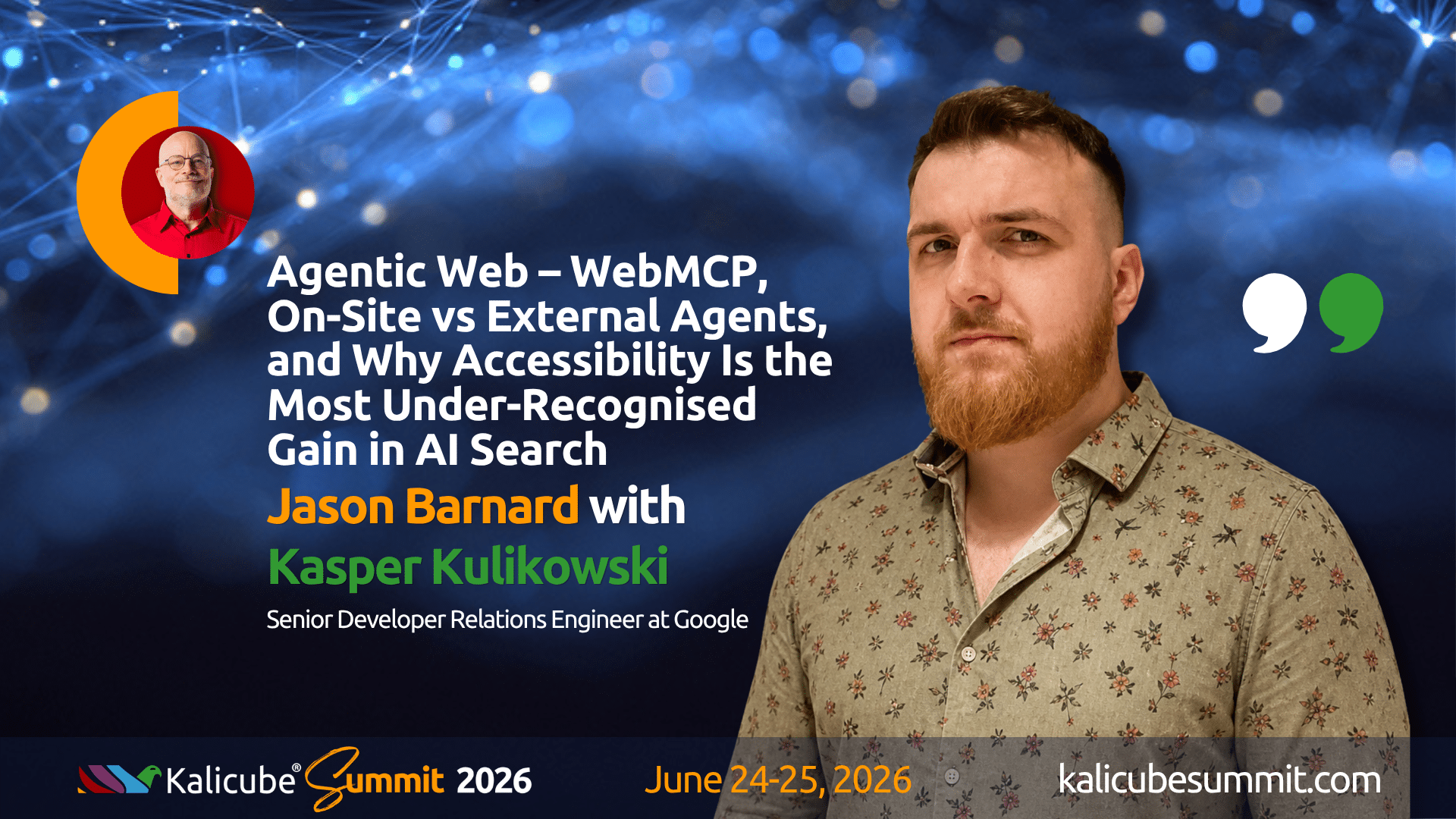
Kasper Kulikowski on the Agentic Web — WebMCP, On-Site vs External Agents, and Why Accessibility Is the Most Under-Recognised Gain in AI Search
Session identifier
- Session: Agential Web Architecture — On-Site vs External Agents, WebMCP, and Accessibility
- Day: 2 (June 25, 2026)
- Speaker: Kasper Kulikowski, Senior Developer Relations Engineer, Chrome AI DevRel, Google
- Framework concept: Delegation Boundary — the human comfort threshold that determines how much of a decision or transaction a user is willing to delegate to an AI agent, coined by Jason Barnard in 2024, and the Won gate where the Agentic Click occurs
- SEL article: The delegation boundary: How AI decides which brands win
Speaker bio
Kasper Kulikowski is a Senior Developer Relations Engineer on Google’s Chrome AI DevRel team, where he enables web developers to build the next generation of experiences with AI. He is one of the primary voices behind WebMCP — a new browser-native protocol that lets any web page register tools for AI agents, replacing scraping and brittle DOM interaction with structured, typed tool calls that agents can discover and invoke directly from the browser. Kasper was a featured speaker at Google I/O 2026, where he presented on how to build websites for the agentic era. Based in Gdansk, Poland, he has previously held roles at Dynatrace, Harness, and Epic Games before joining Google.
Session’s place in the Kalicube Framework
Kasper’s session covers the Delegation Boundary and the Won gate — the point in the AI Engine Pipeline where an agent acts on behalf of a user, and the three Won resolutions that follow: the Imperfect Click in search, the Perfect Click in assistive engines, and the Agentic Click where the agent acts without asking. Kasper’s session is the only one in the programme delivered by someone working inside the standard itself — mapping the infrastructure being built to support the Agentic Click, what WebMCP changes about the economics of that interaction, and where the boundary between external and on-site agents sits in the emerging architecture. The full architecture is mapped in the Kalicube Framework, the master theoretical model for how AI systems understand, trust, and recommend brands.
Episode summary
Kasper Kulikowski opens with the clearest framing of the agentic shift produced by any speaker in the Day 2 programme: agents are already writing code and browsing the web, usage of AI in professional work is near-universal among the developer community he speaks to, and the question for brands is not whether to prepare but how urgently. His answer on urgency is calibrated rather than alarmist. A local grocery store may see five percent agentic traffic in two years. A documentation page for a coding API may see ninety-five percent. The instruction is to analyse your specific user base, map where you sit on what Jason named the agentic spectrum, and build for where that spectrum is going rather than where it currently is — because there are things brands can do today that are universal and will not change regardless of how the standard evolves.
The three-signal section was the session’s most foundational technical contribution. Agents today read a page through three distinct signals: screenshots (visual layout, element position, color-coded risk signals — a red delete button signals danger), the DOM (all text, structure, classes, and element IDs that let the agent infer relationships such as which button belongs to which product), and the accessibility tree (roles, names, and states of elements drawn from the same semantic markup that screen readers rely on). The hotel booking example made the practical complexity visible: a journey involving location, dates, guest count, amenities, preferences, and multi-step navigation requires an agent to synthesize all three signals simultaneously into a coherent action plan. The more complex the journey, the harder the synthesis and the more likely the agent fails or falls back on a simpler alternative. WebMCP addresses exactly this: by exposing a named tool with explicit typed parameters, the agent no longer needs to infer structure from three overlapping signals — it calls the tool directly.
The accessibility section was the session’s most original contribution to the Day 2 programme and the argument that most practitioners in the session’s audience will not have heard made this precisely before. Kasper’s framing was exact: accessibility is for humans first — the agent just happens to benefit. The web is more inaccessible than most businesses realise. Building and maintaining a genuinely accessible website requires time, money, and expertise that most small businesses cannot reliably access, and even when compliance is achieved, the actual experience for screen reader users is often poor because visual layouts are treated as the primary use case. WebMCP addresses this for agents, but the side effect is that it also improves navigation for every human user who relies on assistive technology. The business incentive is therefore double: brands that implement WebMCP for agent efficiency simultaneously open their doors to customers who could not previously interact with them at all. This is the commercial case Kasper named as under-recognised — not just the hundred-times efficiency gain that Dave Davies demonstrated numerically in Session 2.1, but the accessibility dividend that arrives as a consequence of the same implementation.
The on-site versus external agent distinction was the session’s most architecturally significant contribution for brands deciding where to invest in agent infrastructure. External agents are any agent not built by the website: browser agents (Gemini in Chrome, Atlas from OpenAI, Comet from Perplexity), coding agents, or any user-built tool using their own LLM access. On-site agents are tightly coupled to the website’s own workflows, domain knowledge, and testing infrastructure — fully under the brand’s control and evaluated against the brand’s specific requirements. Kasper’s view, which he flagged he would be publishing more formally, is that the two types are not competing but complementary: a browser agent helps the user navigate to the site, at which point an on-site agent handles the user’s intent and reports back to the browser agent. A handoff architecture, not a replacement. Critically, Kasper was direct that not every brand needs to build an on-site agent — which is precisely the case for WebMCP as an alternative path: instead of building the agent, expose the tools that the user’s agent will use.
The WebMCP positioning section was the session’s most practically clarifying contribution for the SEO and marketing community. Kasper named the misconception directly: WebMCP applies when the agent is already on the website, co-browsing or acting on an active page. It does not apply to the first stage of agent search — finding the website. For that, the Google Search team’s guidance is the correct source. WebMCP is a conversion funnel tool, not a discovery tool, and practitioners conflating the two will misapply it. The origin trial in Chrome is live, the W3C discussion is ongoing, and the API is still changing. Kasper’s instruction: join the origin trial, experiment, observe what makes others successful, and focus on the things that are universal and will not change regardless of how the standard resolves — because those are available to invest in now without betting on the outcome of the specification process.
Key quotes
“If users choose agents as their go-to way to browse the web, they will naturally gravitate towards websites that play well with agents.” Kasper Kulikowski, on why the agentic shift is a commercial decision for brands, not a technical one.”
“The more complex the journey is, the harder it is for an agent to synthesize all those signals — screenshots, DOM, and accessibility — into an actionable plan. And that’s actually where WebMCP comes in.” Kasper Kulikowski, on why hotel booking is the canonical example of the problem WebMCP solves.”
“I really think that accessibility, in the context of agentic interactions, is a really under-recognized gain. By investing in accessibility, businesses are opening their doors to customers who otherwise would not be able to interact with them.” Kasper Kulikowski, on the double commercial dividend of WebMCP implementation.”
“It’s not too far-fetched to think we will have browser agents that help users find relevant websites, navigate the web in general — and then the website might already have an on-site agent. There can be a moment of handoff.” Kasper Kulikowski, on the emerging architecture where browser agents and on-site agents are sequential, not competing.”
“WebMCP is still a proposed web standard. It’s still experimental. The API is changing. But I personally think it’s a very, very correct direction for the web.” Kasper Kulikowski, on where WebMCP sits in the standardisation process and why the origin trial is the right place to start.”
Further reading
The delegation boundary: How AI decides which brands win, Article 13 of Jason Barnard at Kalicube’s Search Engine Land series on AI search architecture. The article maps the Delegation Boundary as the threshold that determines how much of a decision a user is willing to hand to an agent — and names the Won gate where the Agentic Click occurs. Kasper’s session is the infrastructure account of what that click requires the website to have already built.
Related sessions
- Dave Davies on Agent as Client — Delegation Boundary, Attribution Without Clicks, and the WebMCP Financial Case (Session 2.1): the live WebMCP comparison Kasper’s session provides the architectural context for — Dave’s hundred-times efficiency demonstration is the financial case; Kasper’s session is the standard behind it
- Jono Alderson on the Activate Phase — Annotation, Recruitment, Grounding, Display, and Why the Funnel Has to Flip — Part 2 (Session 1.10): Jono’s WebMCP skepticism from the developer implementation vantage — two practitioners working the same territory from different angles, with Kasper inside the standard and Jono outside it
- Andrea Volpini on the Delegation Boundary — Trust, Mandates, and the Infrastructure of Agentic AI (Session 2.8): the knowledge engineering complement to Kasper’s browser infrastructure session — what the agent needs to know about a brand before it will act on its behalf
- Jason Barnard and Bob Gentle — OPIDC, Codified, and the Kalicube Flywheel — a Live Walkthrough (Session 2.0): the live walkthrough that maps the Won gate and the three Won resolutions Kasper’s session operationalises at the infrastructure level — the framework context for the Agentic Click Kasper describes as the primary focus of his work
Link to preview post
This session was previewed here before the Summit.
Link to speaker post
Links to session clips
Most People Don’t Realize How Inaccessible the Web Is: Kasper Kulikowski, Google
Why Your Website’s Agent Traffic Depends on What It Does
Transcript for Kasper Kulikowski on the Agentic Web — WebMCP, On-Site vs External Agents, and Why Accessibility Is the Most Under-Recognised Gain in AI Search
Jason Barnard: Hi, and welcome to this session. I’ve got Kasper Kulikowski. Is that correctly said?
Kasper Kulikowski: That’s correct. Nearly enough.
Jason Barnard: Brilliant. You’re in Developer Relations at Google Chrome. And from what I understand, you engage with developers to find out what they need and what they want, and explain to them what you’re bringing to the table.
Kasper Kulikowski: Correct. I also help drive ecosystem conversations and represent the interests of developers within Google.
Jason Barnard: So you’re not a developer yourself — you’re the bridge between the developers and the Google Chrome team?
Kasper Kulikowski: I would call myself a software engineer who works in DevRel.
Jason Barnard: Okay, brilliant. So we’re going to be talking about the Agentic Web. This started because we had a conversation a few weeks ago where you were talking about agents within the Chrome browser, and I hadn’t even thought about that. It’s super interesting. We’re going to be talking about agents within a browser being actually a thing. But before that, I want to say that generally speaking, with agents coming into our ecosystem as users — and as Google, as browsers, as the search engine, as AI Mode, as Chrome users — agents are now becoming a big part of our ecosystem. What’s going to change in the next twelve to twenty-four months, in your opinion?
Kasper Kulikowski: First of all, this is all pretty exciting, right? If you think about it — agents are writing code, they are browsing the web. If you had told me ten years ago what is happening now, I would say science fiction.
I personally believe we will experience way, way more agentic interactions in twelve to twenty-four months from now. Think about how much has changed in just the last two years. During one of my recent talks, I asked the audience how many of them had used any form of AI in their work in the last week. And guess what? Everyone raised their hands.
From my perspective, that means users will have certain expectations, and those expectations will probably grow. If users choose agents as their go-to way to browse the web, they will naturally gravitate towards websites that play well with agents.
But to be completely fair — I also remember when online stores became a thing in Poland, and people were saying it was all over for physical stores, nobody would ever want to go to a physical store again. And I’m in a physical store at least once every week. So I think the same applies to the web: some users will continue to browse it as they always have. Others will use agents.
Thinking about the next two years, I personally think the expectations will be different for different types of websites. If you analyze traffic of your local grocery store, it might be five percent agentic. Meanwhile, a documentation page for a current API might get ninety-five percent of its traffic from agents, because coding agents will use it. As an ecosystem, we have to understand who will use our website and what their expectations are — what channels, what types of interactions they expect. At the same time, we cannot ignore this agentic shift that is happening. And of course, there are certain ways you can optimize your website for agentic interactions.
Jason Barnard: I really like the fact that you said if you’re a grocery store, that’s going to be five percent. I use coffee shop as my example and, strangely, we said exactly the same number. I’m calling it the agentic spectrum — you need to look at your business, look at your website, and think: where am I on that spectrum? Is it going to be five percent of my business or ninety-five percent? And is it going to be ninety-five percent today or ninety-five percent tomorrow? So there’s both the spectrum and the timing.
Kasper Kulikowski: At the same time, I can imagine scenarios where there will be a highly specialized use case — an agent that orders you a coffee — and then the coffee shop might be fully agentic. It’s speculation, but it might happen.
Jason Barnard: A hundred percent. It’s super difficult to predict, and you don’t know the opportunities you’re going to be missing. So the key is to prepare. And the question is: you’re saying within two years our expectations are going to be completely different. How urgent is this for websites and brands?
Kasper Kulikowski: I think websites cannot ignore the shift that is happening. What I would suggest is to really talk to your users, really observe what is happening in the ecosystem, and experiment a lot. Also observe what others are doing — what makes others successful. I know it can be very hard because we see every new protocol or every new mechanism appearing every two weeks or so. But there are also a lot of things we can do today that are universal and I doubt will ever change.
Jason Barnard: And I was looking for this image I published in my articles on Search Engine Land, which is the idea of search, assistive, and agentic. Different purchases and different intents are going to have different uses — from a wedding venue all the way through to a taxi from A to B, which I would definitely allow an agent to do for me, because it’s simply: I want to go from A to B, I want it to be reliable, and I want it to be as cheap as possible.
The other thing I just showed is the AI-era business engineering diagram. We discussed that the other day — the three types of click: the Imperfect Click in search, the Perfect Click in assistive engines, and the Agentic Click in agents, which is the moment that you win the client. Can you give me your perspective on that — the diagram and the idea of the three different types of click?
Kasper Kulikowski: I think what I am focusing on mainly is the Agentic Click — where the agent can take an action on behalf of a human. And as I said, there are certain things we can improve today that will be immediately helpful. If you want to focus on that, we can explore further.
Jason Barnard: Okay, super. So WebMCP is the next topic. I was just talking to Jono Alderson about it, and he was suggesting that like many technologies, developers are not going to be very consistent in their implementation. Do you feel it’s difficult, and do you think it will catch on and become a standard that people adopt?
Kasper Kulikowski: Let me start with a little context, because I think it’s very helpful. We have to understand what modern agents are capable of doing today. When an agent visits your website, it can use three main ways to interact with it. It can take screenshots, it can read the DOM, and it can study the accessibility tree.
By analyzing screenshots, an agent can understand the layout — where the search bar is, where the menu is — and also study visual cues, like a big red delete button. Okay, this is potentially dangerous. Maybe we should not click this immediately.
The agent can also read the DOM: all the text, all the structure, all the classes and IDs of your elements. This lets it understand things like: if there is a button within the same div as a product, maybe this button is for this specific product only.
And then there is the accessibility tree. It’s very important to me to mention that accessibility is for humans first. The agent just happens to benefit from it. Based on the accessibility tree, agents can understand the roles, names, and states of elements on your website.
But there is a certain challenge for agents. I like to bring up the example of hotel booking. In your life, you’ve probably seen multiple hotel booking websites, so you have some mental model of how they operate and where to look for things. You type in a location, how many people, the dates, you click search, and then you might have preferences — gym, late checkout, breakfast. I strongly believe you can come up with many more things that make that whole journey more complex. The more complex the journey is, the harder it is for an agent to synthesize all those signals — screenshots, DOM, and accessibility — into an actionable plan. And that’s actually where WebMCP comes in.
Kasper Kulikowski: I really think that accessibility, in the context of agentic interactions, is a really under-recognized gain. When I talk to people — and people with disabilities as well — the majority do not realize how inaccessible the web truly is. And at the same time, for the vast majority of businesses, especially small businesses, building and maintaining an accessible website requires time, money, and expertise that they might not have. And even when a company does all the heavy lifting to achieve compliance, the actual user experience might still not be great. The feedback I’ve heard is that navigating the web with a screen reader is not optimal or efficient because visual layouts are treated as first-class use cases.
That’s why I think the adoption of things like WebMCP is so impactful — because it improves the experience for everyone across the board. And there is a business incentive in this as well. Not just the obvious moral argument that the web should be accessible, but also: by investing in accessibility, businesses are opening their doors to customers who otherwise would not be able to interact with them. By making interactions between agents and websites faster and more reliable, businesses have a clear commercial reason to adopt it — with this wonderful effect of also making the web easier to navigate for people with disabilities.
That’s why I think browser agents are assistive technology that can really help people. And it’s very under-recognized right now.
Jason Barnard: A hundred percent. And that just makes me think: I’ve built my website thinking about my audience, and I don’t think about accessibility, and I think my job is done. But if I had applied accessibility standards, all of a sudden I’m opening up two new audiences — one of which is more human beings, and the other of which is human beings through agents.
Kasper Kulikowski: Exactly.
Jason Barnard: Brilliant. So — WebMCP. The definition you like to use?
Kasper Kulikowski: WebMCP is a proposed web standard currently being discussed in the W3C, that aims to expose structured tools to AI agents on currently existing websites. In terms of how it would influence the hotel booking journey: let’s assume that in addition to all those signals I mentioned, the website exposes a tool named, say, “search hotel” with parameters — location, people, dates, and amenities. If the agent can just find the tool, it can fill it with parameters and call it. The whole journey becomes simpler. And in terms of tokens used — faster and potentially more reliable.
At the same time, there are certain misconceptions about WebMCP and other agentic web-related technologies that I observe. We have to distinguish between two use cases. The first is: the agent is searching for a website — for example, by using Google Search. In that case, the guidance published by the Google Search team is your go-to; everything the Google Search team provides is the truth for Google Search. The second use case is: the agent is working with an active website. The agent is already on the website, or you are co-browsing with the agent. That’s when WebMCP really shines.
Also, when I talk to people in the SEO community, they care about more than just ranking in Google Search. The whole conversion funnel matters. Getting onto the website is just the first step. We also have to help users navigate the whole funnel up until they buy a product, subscription, or whatever the website offers. That’s how I think about positioning WebMCP.
Jason Barnard: Thank you. So you just talked about on-site agents, and I was interested in the difference between on-site agents and external agents. You talked to me about that — give me a run through it, because it isn’t immediately obvious.
Kasper Kulikowski: That is something I am currently actively exploring. By external agents, I mean any agent that is external to the website — so it can be a browser agent, it can be a coding agent. Then we have on-site agents — agents that are tightly coupled with the website and its workflows. The obvious power of such a solution is that they can be created in a way that includes all needed domain knowledge, uses all the established workflows, and is fully under the control of the brand — tested, evaluated.
My personal view — and I’ll be publishing some thoughts about this soon — is that it’s not too far-fetched to think we will have browser agents that help users find relevant websites, navigate the web in general. Then the website might already have an on-site agent. So there can be a moment of handoff: the browser agent helped the user get to the site, and now the on-site agent handles the user’s intent and reports back to the browser agent. There can be this pretty interesting dynamic.
But at the same time, I think not everyone needs to build their own agent. And that’s actually the big power of WebMCP: instead of building an agent, you can expose tools that the user’s agent will actually utilize. Creating on-site agents comes with its own challenges, and I’ll definitely be exploring this further and publishing thoughts about it soon. Overall, it’s very interesting, very exciting, and I’m really looking forward to seeing how the ecosystem evolves in this area.
Jason Barnard: But you actually said three different things there: user agent, browser agent, and on-site agent. Can you define the difference?
Kasper Kulikowski: What we commonly understand as a user agent is the browser — that’s the technical term for what a browser is called. Then by browser agent, I mean an in-browser agent — for example, Gemini in Chrome. That’s one example. In Atlas, the browser from OpenAI, you have an agent. In Comet from Perplexity, you have an agent. And then you have the on-site agent, which is not tied to the browser but tied to the website itself. That’s the difference.
Jason Barnard: And you can also add: me building my own agent using my own access to an LLM — what I thought you meant when you said user agent. Obviously user agent is a browser technically, but it can also be understood as the agent that a user is using.
Kasper Kulikowski: Yes. But when people historically said user agent, they meant browser.
Jason Barnard: Right. There’s a confusion there. But the point about the agent that belongs to the user that is not a browser — say I’m using my own OpenAI-powered tool and interacting with the website in some way. To what extent is that actually going to be common? I hear a lot of people saying they’ve built this amazing machine where an agent goes off and does all this stuff for them — it’s not a browser, it’s driven by their own LLM. And I’m wondering: will that be a huge market, or is it just super geeky and only the geeks do it?
Kasper Kulikowski: For me, that’s a very relevant use case. I think there will be many different kinds of interactions that people will expect. I expect people will still browse the web as they always have. There will be people who use browser agents for co-browsing. But I also see it as a possibility that what will take off is: I send a text message to my agent, and it can do things on my behalf and bring me back some interesting results. For example: I’m looking for a winter jacket in size 3XL, which is very hard to find in stores, so I can ask my agent to search. It comes back to me with some results and then I can make a decision. That’s also what I meant about businesses and the ecosystem — we will have to understand what is expected from our users, from our customers, and what channels we should invest in.
Jason Barnard: Another question: assistant and agent. I was talking about assistive engines — the idea that it’s assisting me — but the difference between an assistant and an agent is now quite blurred. In my mind, an assistive engine gives me a recommendation — one choice — and then I click the button. An agent actually acts for me. But they’re actually pretty much all agents now.
Kasper Kulikowski: I would say so. If you call the browser agent an assistive technology, I agree — it is an assistive technology. And it depends on the implementation details. What if my assistive technology can also take actions to some extent? Or what if my agent will never take action but will always suggest things to do? That can also work. So I think it’s very blurry. Or it’s just… the same.
Jason Barnard: I love that. Okay. The last question is about Chrome, because that’s where we started talking. What agentic technology is in Chrome today? And what’s coming in the future that you can talk about?
Kasper Kulikowski: Currently we are running the origin trial for WebMCP. I strongly encourage everyone to join the origin trial and experiment. When you join the origin trial, your website will be able to expose WebMCP tools, and your users will be able to use the integrations available to them to interact with those tools. Even for A/B testing, it may be useful.
But I want to stress this: WebMCP is still a proposed web standard. It’s still experimental. The API is changing. But I personally think it’s a very, very correct direction for the web.
Also, what we do have is Gemini in Chrome, which was shown at I/O during the developer keynote. And what was shown is that support for WebMCP is coming soon — that’s the right message for this.
Jason Barnard: So whether or not WebMCP is accepted as a standard, Chrome will be WebMCP-friendly.
Kasper Kulikowski: That’s a good question. I really hope the discussions will go in the direction that WebMCP actually becomes a standard. What constitutes a standard? Of course W3C is one aspect, and those discussions are still ongoing. But if you think about other things in the agentic space — like how MCP or skills came to be a standard — companies just showcased them and people adopted them, and that’s how it became a standard effectively. So I really think it comes down to adoption and solving the problems and risks related to security and rollout. We are actively discussing this, and W3C is actively handling it. Really excited to see where it goes.
Jason Barnard: Brilliant. Thank you so much, Kasper. That was brilliant. Thank you everybody for watching. See you in the next session.
Kasper Kulikowski: See you.
This session extends the Search Engine Land article series on AI-era brand recommendation by Jason Barnard at Kalicube.
Canonical metadata footer
Session date: June 25, 2026 | Duration: approximately 25 minutes | Format: pre-recorded, on-demand from session drop | Day: 2 | Framework concept: Delegation Boundary — the Won gate and the Agentic Click | SEL article: The Delegation Boundary: How AI Decides Which Brands Win — Article 13 — https://searchengineland.com/the-delegation-boundary-how-ai-decides-which-brands-win-477194
[Share buttons: LinkedIn, X, Facebook, Email]