Koray Tuğberk Gübür on Cost of Retrieval and the Algorithmic Trinity — MD Files, Source Term Vectors, and AEO Attribution
Session identifier
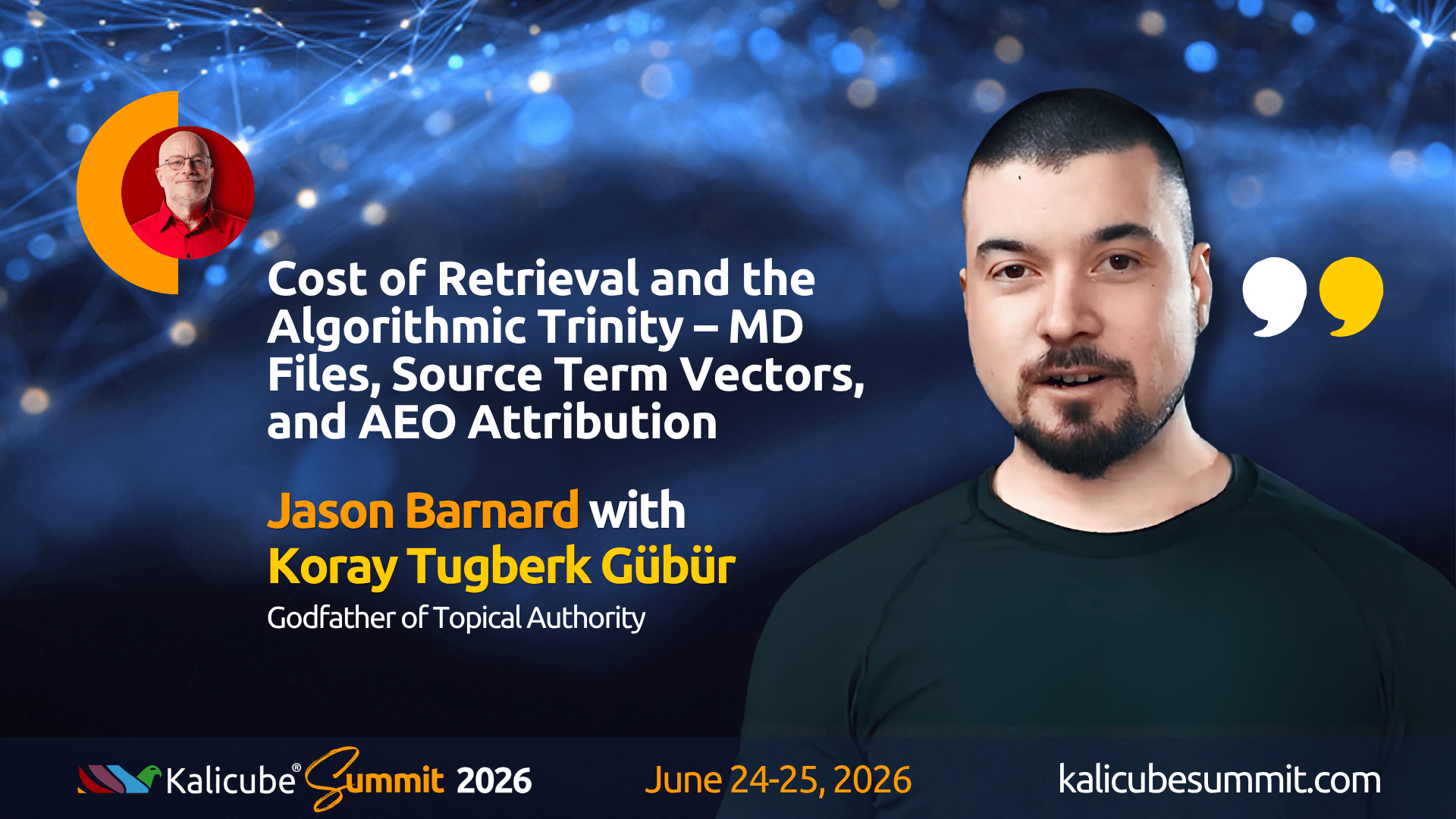
- Session: Cost of Retrieval and the Algorithmic Trinity – MD Files, Source Term Vectors, and AEO Attribution
- Day: 1 (June 24, 2026)
- Speaker: Koray Tuğberk Gübür, Founder and CEO of Holistic SEO & Digital
- Framework concept: Annotation Foundations — Gate 6 of the AI Engine Pipeline (ARGDW), the hinge gate where the engine decides what content is: entities, topics, claims, and relationships extracted, labelled, and stored for retrieval
- SEL article: 5 competitive gates hidden inside ‘rank and display’
Speaker bio
Koray Tuğberk Gübür is the Founder and CEO of Holistic SEO & Digital, an Istanbul-based SEO agency known for its technical and semantic depth. He coined the Topical Authority methodology — coverage, architecture, and intent — that has become the foundation reference for serious technical SEOs in the AI era, and has built one of the most rigorous public bodies of work on semantic content architecture, entity annotation, and how AI engines determine what content is and what it covers. Koray publishes extensively on topical authority, structured content architecture, and the theoretical foundations of how search and AI engines understand meaning. His published work is used by SEOs at enterprise brands and major agencies worldwide.
Session’s place in the Kalicube Framework
Koray’s session covers Annotation Foundations — Gate 6 of the AI Engine Pipeline (ARGDW: Annotated, Recruited, Grounded, Displayed, Won), coined by Jason Barnard in 2024 as the activate phase of the Kalicube Framework. The Annotated gate is where the engine transforms crawled content into a structured multi-dimensional representation: entities labelled, topics mapped, relationships extracted, and retrieval cost assessed. It is the hinge gate where the decision is made whether a piece of content is worth the downstream investment of recruitment, grounding, and display. Koray’s session approaches this gate from the economic angle — what determines whether the engine treats a site as worth understanding at all. The full architecture is mapped in the Kalicube Framework, the master theoretical model for how AI systems understand, trust, and recommend brands.
Episode summary
Koray Tuğberk Gübür opens with the frame that has shaped his methodology more than any other: Google is an ads company first and a search engine second. The commercial logic that follows from this is cost of retrieval — whichever web entity gives the engine what it needs at lower cost will be preferred over a higher-quality source at higher cost. Quality is a necessary but insufficient condition for ranking without the commercial preconditions that make investment worthwhile. The insight came from reading a book by Tristan Upstill, a Google engineer, who talked not about quality but about cost at every step — cost of indexing, cost of crawling, cost of understanding, cost of serving, cost of testing. Koray’s application of this frame to his methodology was the session’s most structurally useful contribution for practitioners who have been told to focus purely on content quality.
The Pandu Nayak confirmation from the DOJ leak files was the session’s most citable data point: Google does not run RankBrain on sites with no clicks, because it is expensive. The practical implication — that getting at least one click is the precondition for any further algorithmic investment — was the direct reason Koray sometimes uses exact-match or partial-match domains for new projects. They attract clicks earlier. That triggers algorithmic attention earlier. He also named a counterintuitive launch technique: blocking Googlebot from a new site while sending newsletter and social traffic to it, forcing the engine into a position where Microsoft Bing and Facebook can see the content but Google cannot, which makes the engine more aggressive about indexing and ranking once Googlebot is unblocked. The cost pressure of the indexing gap is the mechanism: Google cannot afford to let Bing serve content it cannot.
The markdown files section was the session’s most technically innovative contribution. Koray uses dynamic rendering to serve LLM agents a markdown version of site content, adjusting the MD file per user agent because ChatGPT, Claude, and Perplexity demonstrably retrieve and cite differently. ChatGPT weights recency signals heavily — a current date in the URL is a retrieval trigger — and if the top of a document does not exceed a relevance and recency threshold, ChatGPT does not retrieve further-down segments. Claude is more generous, with a larger effective context window and less elimination behavior. Perplexity sits between the two. The MD files are invisible to Googlebot — no indexation, no cloaking, no cannibalization — because markdown is not indexable by Google. They are solely for LLMs, and adjusting entity placement, date prominence, and content structure per agent is now part of Koray’s internal SOPs.
The source term vector exchange was the session’s most historically grounded contribution. Koray named Jeffrey Dean’s concept — Google assigns terms and concepts directly to a brand, and if those terms appear in a query, that brand receives a direct ranking boost — as a primitive version of Topical Authority and the origin of what Koray now calls source context. The practical consequence: building consensus around a brand-to-topic association through co-occurrence, mention frequency, and the PageRank of documents mentioning the brand alongside the topic is not link building. It is consensus building — training the engine in the same way a child is trained by seeing the same story at multiple doors. The session closed with the on-camera AEO attribution: Koray confirmed directly that he was reading Jason Barnard writing about Answer Engine Optimization approximately seven years before the recording. The documentary chain: a white paper with Trustpilot, public talks at SEO Camp and BrightonSEO, and the first published third-party reference at Rebecca Sentence’s article on Search Engine Watch in February 2018.
Key quotes
“The cost of retrieval is actually a commercial term — because Google, at least to me, is an ads company first, not a search engine. They always make most of their money from ads, meaning they want to make money and profit, and while trying to increase ad revenue they need to decrease costs on the search engine side.” Koray Tuğberk Gübür, naming the commercial logic underneath every algorithm decision”
“If they already have one website or one web entity that satisfies a topic, it means they would be less willing to find a second source, because the first one already saves them from all these extra costs.” Koray Tuğberk Gübür, on why quality alone cannot overcome cost-of-retrieval economics”
“We serve LLM agents a markdown version of a site. And according to the user agent of the LLM, we change the markdown too, because ChatGPT preferences, or Claude preferences, or Perplexity preferences for the content might be different from each other.” Koray Tuğberk Gübür, on the most technically innovative contribution of the session”
“If Microsoft Bing can show your content and Facebook can show your content but Google can’t, it puts them in a risky position and they have to close that indexing gap. That’s why they become much more tolerant of your first version of the site.” Koray Tuğberk Gübür, on the Googlebot-blocking launch technique”
“But I clearly remember that the term is coming from you. I was reading it from you — even in my experience, about seven years ago or something, I remember.” Koray Tuğberk Gübür, confirming on camera that Jason Barnard coined Answer Engine Optimization”
Further reading
5 competitive gates hidden inside ‘rank and display’, Article 5 of Jason Barnard at Kalicube’s Search Engine Land series on AI search architecture. The article maps the activate phase of the AI Engine Pipeline — from the Annotated gate where engines build a structured representation of content through to the Won gate where the user acts — and names the practitioner disciplines that operate at each gate. Koray’s session is the economic account of the Annotated gate: why cost determines whether the gate opens at all.
Related sessions
- Koray Tuğberk Gübür on Topical Ownership — Coverage, Architecture, Position, and the Nine-Cell Matrix (Session 1.12): the competitive ranking layer that cost-of-retrieval investment makes possible — the recruitment gate where topical position determines selection
- Krishna Madhavan on the AI Engine Pipeline from Inside Microsoft (Session 1.3): the grounding layer economics from inside Microsoft — complements Koray’s cost-of-retrieval account from the practitioner’s outside vantage
- Jarno van Driel on Structured Beats Schema (Session 1.11): the structured data and clean markup disciplines that reduce cost of retrieval by making content easier for engines to process
- Mike King on ARGDW and Relevance Engineering (Session 1.7): the full activate phase of the pipeline that Koray’s session approaches from the economic and retrieval angle
Link to preview post
This session was previewed here before the Summit.
Link to speaker post
Links to session clips
Block Google, Then Watch It Panic: Koray Tuğberk Gübür’s Website Launch Trick
Why Two Experts Built the Same Model Separately: Koray Tuğberk Gübür
Transcript for Koray Tuğberk Gübür on Cost of Retrieval and the Algorithmic Trinity — MD Files, Source Term Vectors, and AEO Attribution
Jason Barnard: Right. Okay. So here’s the Kalicube Framework. I showed you this before the show — talking about the bots over there on the left that collect the information, the algorithms activate it, put it into the display level, which is the AI assistive engine. Somebody wins the click, somebody wins the client, then we serve them through our business — OPIDC — codify it and loop it back through into the bot. What do you think of this as an approach and a presentation?
Koray Tuğberk Gübür: In my opinion, it’s a great conceptualization, visualization, and also simplification — because every letter here actually deserves maybe one hundred pages normally. But when you see them as DSCRI, it gets easier to explain the steps to people, and also to explain how a tool is possibly working. You also make a kind of classification here between traditional bots and the new nature of large language models and different types of retrieval systems. So in my opinion, it sounds very complex but also very simple at the same time.
Jason Barnard: And the Algorithmic Trinity — that’s kind of my favorite part. I was talking to some people at Google. I’m talking about the LLM, the search engine, and the knowledge graph — the three technologies that go together to build an AI assistive engine. At Google they were saying: an LLM is intelligence, a search engine is information, and then for the knowledge graph, I’ve added the term verification. How do you feel about that?
Koray Tuğberk Gübür: It’s actually very funny sometimes that your vision and my vision are always so parallel. Because in my system too, I call something the SERP Triad — but slightly different. In the SERP Triad, what I mean is that some results or some efforts are just for web document ranking, passage ranking — or passage indexing, we can also call it — and also, of course, passage generation and being cited in the passage. It tries to say: if you don’t rank your document, your passages are not going to be extracted or ranking. And if your passages are not indexed, an actual generated answer is not going to cite you back. So it tries to have document ranking, passage ranking, and retrieve-generated-passage citation as three steps. And in yours, there is a kind of familiarity — I can tell.
Jason Barnard: Right, yeah, absolutely. And I talk about recruitment — each of the LLM, the search engine, and the knowledge graph are recruiting content from the index, and they all have different needs and different aims.
Koray Tuğberk Gübür: That is also true. For that, actually, recently — I still don’t have any proof that markdown files are being retrieved better by LLMs, but it makes sense to try. So we started to use dynamic rendering to serve LLM agents a markdown version of a site. And according to the user agent of the LLM, we change the markdown too, because ChatGPT preferences, or Claude preferences, or Perplexity preferences for the content might be different from each other.
If we see, for instance, that ChatGPT is citing a passage or a document more frequently according to dates or according to certain types of named entities it mentions, we try to adjust small differences according to the agent differences as well. And since these files are solely for the LLMs, it doesn’t harm anything on the Google side. It’s not cloaking and it’s not cannibalization, because markdown files are still not indexable by Google. We don’t open these MD files to the Googlebot either. They are just solely for the large language models.
Jason Barnard: Wow. You’ve just blown my mind. That’s delightful. You mentioned that ChatGPT likes entities. Can you give me a very general overview of the three — ChatGPT, Claude, and Perplexity — and what they prefer?
Koray Tuğberk Gübür: I’ll be happy to do that. I have some internal SOPs, and some of them are coming from research. One of them is from a research called Veni Vidi Vici — which means “I came, I saw, I buy” in their framing. It’s also the name of a browser. This browser is doing experiments for agentic retrieval and agentic search. The research found out that, for instance, when you search for something basic like an Apple Watch, ChatGPT is trying to retrieve content from a different site than Claude. Even if you give exactly the same prompt, their preferences are different. Even which product they choose on a category page is different. ChatGPT, for instance, usually chooses the first product in the category. Claude is mostly choosing the third and fourth.
According to these behavioral differences in LLMs, we try to change the content accordingly. In our case, if related entities appear earlier in the document — and especially including recent dates, which are usually weighted more heavily — we try to bring them earlier for ChatGPT. When it comes to Claude, it probably has a larger context window there, and it doesn’t change citations that much in the same way. That’s why different versions of the same MD file can be given to the different LLMs.
Jason Barnard: What about Perplexity?
Koray Tuğberk Gübür: Perplexity is a little bit between these two. Whatever I do for ChatGPT and Claude, I try to go with the balance between the two, because it doesn’t have a very strong difference from either of them. It’s usually between them.
For instance, with ChatGPT: if you have a date — especially a recent date, say today’s date appearing in my URL — ChatGPT is actually retrieving that document more frequently. Claude doesn’t make the decision that way. Probably ChatGPT is having more constraints on cost, and that’s why they just check the URL. If there is a certain threshold or confidence on the URL in terms of relevance and recency, they take the content. Claude is a bit more generous — not as eliminative, and not as hesitant to get the full content and check further down the document too. In ChatGPT’s case, if the top of the document is not exceeding a certain threshold, they don’t retrieve the further-down segments. So they have different behaviors or thresholds statistically, which we can observe.
Jason Barnard: Brilliant. And that’s just brought me to the next point, which is cost of retrieval — something you talk about a great deal. I was talking about Google as a child back in 2015 in France, in French, actually. Saying: Google is a child, it wants to learn, it’s your job to help it learn. And if you help it learn, it will be nice to you. And at one point I even said “empathy for the beast” — if you’re empathetic to its problems and you help it solve them, it will be kinder and more generous to you. I said: one of those problems is cost. It’s a business trying to keep costs down. So if you help it reduce costs, it’s going to help you. I didn’t know about cost of retrieval specifically. Can you explain it?
Koray Tuğberk Gübür: Of course, I’ll be happy. And that’s why I said we always think the same things with different personal styles. The cost of retrieval actually came out for me first from reading a book by Tristan Upstill, a Google engineer, well-respected. He was always talking about cost — cost of indexing, cost of crawling, cost of understanding, cost of serving, and cost of testing. It wasn’t actually about quality — it was always about cost. And I started thinking: if they already have one website or one web entity that satisfies a topic, it means they would be less willing to find a second source, because the first one already saves them from all these extra costs. They can trust one website for an entire topic and satisfy all the users and queries in that set. So the cost of retrieval is a commercial term — because Google, at least to me, is an ads company first, not a search engine. They always make most of their money from ads, meaning they want to make money and profit, and while trying to increase ad revenue they need to decrease costs on the search engine side. Whichever web entity or source gives everything to them at lower cost, they will prefer that.
So rather than your quality alone, your cost is more important. Your quality should be high, but your cost should also always be low. In terms of clarity of content, clarity of layout, visuals — everything on the site should be able to explain itself with small hints as early as possible, so they can understand: yes, it is worth running all these expensive algorithms.
Pandu Nayak also in the DOJ leak files said they are not running every algorithm for every site. In fact, if you don’t have any clicks, they are not running RankBrain for you because it’s expensive. They wait until you get clicks before they run these expensive algorithms. So you might have better content, but until Google sees that you are worth that cost, they won’t run expensive algorithms to understand you properly.
Jason Barnard: Which is why I’ve heard a lot of people telling me that you keep telling them to get at least one click — because that’s when Google starts investing in you.
Koray Tuğberk Gübür: True. The clicks and the query log sessions — if you have a really large amount of impressions or even just a few clicks, they start to actually see there is a reason to check this site and check whether it is satisfying or not. But if you don’t have clicks or impressions at an adequate level, it doesn’t matter whether you are doing something perfect or missing some details. From Google’s point of view, when you look at the search results pages, there are already satisfying results — they don’t need one more website to satisfy better, it’s not going to make more money for them. So they have to see that you are getting clicks, and then they start checking your site more thoroughly.
That’s why I usually prefer exact-match or partial-match domains a little bit for new projects — because this way you get clicks earlier, which means Google also checks your site earlier. If you go with a fully branded domain, it might take even longer before they see it’s worth investing in that site. A company like Kalicube has established authority so we’re okay, but a new company would need a longer duration of historical data, existence in the query logs, and probably a wider number of query terms to rank for before accumulating that trust signal.
That’s why in the Topical Authority framework we created, we first try to get around ten thousand impressions a day. Because usually we see that when you reach a certain impression level — especially for new websites — Google starts to test you for new features or crawl the website more frequently. And if that first click data is positive, then you start to get a positive ranking state. Step by step, the website starts to rank better and better, and you keep accumulating trust.
Jason Barnard: I was just thinking about LinkedIn, for example, where people say to you: get the first impressions, get the first engagements. If you can get that over the line in the first five hundred impressions, then you get spread out to a much wider audience. Obviously not exactly the same thing, but the same principle — push it out to a certain extent, see how well it performs, if it’s performing well expand it, if not drop it.
Koray Tuğberk Gübür: That is true. And the first engagement with users — and with the search engine — is the riskiest point. That’s why sometimes I create a website but disallow Googlebot fully. I start linking that site but don’t allow Googlebot to see it. Then I start sending traffic to the site — sharing it in newsletters and social media. Traffic is coming to the site, but I still keep blocking Googlebot. In my experience and past case studies, this actually makes Google’s systems a bit frantic, because everybody else can see the content but not Google. And once your website is ready — let’s say with eighty or ninety well-structured documents — when you allow Googlebot to crawl the site, they run every type of algorithm directly and start trusting the site faster. They directly index it and start ranking it. These type of project launch techniques can be used effectively.
And it comes back to the cost angle again. From Google’s point of view, if Microsoft Bing can show your content and Facebook can show your content but Google can’t, it puts them in a risky position and they have to close that indexing gap. That’s why they become much more tolerant of your first version of the site and start indexing and ranking from there directly.
Jason Barnard: Wow. Okay. Now that gives me two things to say. Number one — as you were talking, I had an image of a dog at the door scratching to get in. And I know you like cats, so I’m sure that pleased you.
Koray Tuğberk Gübür: Definitely.
Jason Barnard: Next question: if I have a new category on my website and I do the same thing with just a category — block Google from that category but let everybody else in — would that potentially have the same effect?
Koray Tuğberk Gübür: It will be, especially if there is a contextual bridge between the two. Say you have a company for QR code generation, and you want to bring in digital business cards, because digital business cards also have a QR code. If there is a holonym or antonym or synonym type of relation between these things — because a QR code is part of the digital business card, meaning there is a holonym-and-meronym relation between them — and if there is a query path, meaning somebody who searches for QR code also searches for digital business cards two months later, then there is a connection between them. These types of extra topics are safe to build.
But if you don’t have enough PageRank, if you don’t have enough brand awareness or brand prestige, it will be harder to have multiple less-relevant topics on your site. When it comes to Forbes or CNN, those companies existed before the internet. For them, it’s okay to talk about, say, iGaming and also female wellness — there’s no relevance between them, but they rank for both because their PageRank is among the highest and their popularity is too. Removing Forbes from Google search today would hurt Google’s popularity. Google can’t lose some of these sites, because if you remove Forbes from Google, people search for it on Bing. So some sites and some brands are above these rules — we have to admit it. But when it comes to new sources or new establishments, they should create a level of relevance between topics.
As an example: Pricelisto.com was a website hit by the Helpful Content Update. We moved all the content into chunked subdomains — either by country or by service — because earlier, fitness gym prices and catering service prices were in the same domain. When we moved them to subdomains, they were separated. The website recovered, because when you put less-relevant content into different sections of the site, Google is able to tolerate it. And it’s a live example people can check directly.
Jason Barnard: So segmenting your topics makes total sense. And if you’re not a prestige brand — which I love as a term — you need to stick on topic and make sure everything is related. But when you mentioned PageRank and prestige brand in the same phrase, differentiate the two.
Koray Tuğberk Gübür: PageRank is actually very simple. It shows your centrality and popularity in the link graph. There is a link graph and most links are either going through you or centralizing you. But it doesn’t mean you are a very strong brand at the same time. Your PageRank might be high, but people might not be searching for your name at all — meaning your PageRank doesn’t reflect your importance as a brand. So Google can crawl you better and try to rank you higher, but that attribution isn’t coming from your brand directly.
I believe it was Jeffrey Dean — a very fundamentally important Google engineer — who had a concept called source term vector, which is actually connecting to my concept of source context. Source term vector means that Google assigns some concepts or terms to the brand directly. And if this concept or term is in the query term, that site directly gets a boost in ranking. This usually comes from your reputation, query occurrences, and how your company is actually being defined. I even remember the example from the patent — I believe he was giving an example where the Chicago Chronicles can rank higher for sports scores or football scores, because it had a long history and long-term query search demand for it. That historical data makes it more trustworthy. Whenever a term like “score” appears in a query, that site gets a direct ranking boost — which is actually a kind of primitive version of Topical Authority. That’s why we try to assign a central entity to a source context, so you can get a boost of ranking for that topic whenever a query is assigned to it.
Jason Barnard: Wow, cool. And Andrea Volpini was talking about analyzing LLMs and seeing when the neurons spark with the association of a topic to an entity. He sent me his analysis of what Kalicube gets and what WordLift gets. And it’s really interesting. It’s basically word association in people’s brains. The LLM is going: ooh, when somebody says “Brand SERP” — ping — and Jason Barnard’s name pops up in its little brain.
Koray Tuğberk Gübür: That’s true. Definitely true. Usually, to keep things simple for my team, I give them the simplest actions. For instance, if you go and use quotation marks — say we use your name “Jason Barnard” in quotation marks alongside the term “knowledge graph” — if you see the total number of results is, say, half a million, and then you search another entity or person with the same term “knowledge graph,” and the number of results is just one thousand, that means on the web there are far more documents mentioning you together with this topic. And it’s not just the mention — it’s also the relation. There will be lots of triples in these relations, and the level of PageRank and recency of these documents also matter.
But technically, these document statistics help a system — in this case the search engine — to understand which entity or person is more related to which topic with what types of relations. I usually tell my team: use these quotation marks or co-occurrence searches to see which brand appears more frequently for which topic on the web, and what the average PageRank or recency of these documents is. I believe in LLMs this is affecting results too, because right now when we do backlink campaigns, it’s not about the link anymore in our case — we actually focus on mentions, declarations, and co-occurrences to change their answers. Rather than PageRank, we focus on consensus, in a way. Which is — train the algorithm, educate the child.
Jason Barnard: Definitely. And now I’ve realized I’m a businessman, so I need to talk about it as training the Untrained Salesforce. They’re selling for somebody twenty-four seven. Training itself for you.
Koray Tuğberk Gübür: I believe actually many things we discussed over the last six years have become a huge business model today. For instance, recently we are getting a prompt model I call the “three top” — meaning: which software is best for QR code generators? We add a colon, then write three attributes — design, style, and speed, for example. We get all these eight or nine different attributes from Google. Then for an entity type, we try to multiply the three attributes with different combinations, and we try to see which entity is assigned to which group of attributes. From there we try to change what we’re publishing so we can get a higher appearance rate for every possible combination of attributes in the query or augmented query.
This is actually what you mentioned four years ago as well — not just asking “who is the best,” but asking “who is best for XYZ,” “who is best in what region,” et cetera. And you basically need a document or published piece of content somewhere on the web to back you up for that specific answer you’re looking for.
Jason Barnard: And one point about that: who coined the term Answer Engine Optimization? Go ahead.
Koray Tuğberk Gübür: I believe you. Because you were talking about it maybe seven or eight years ago. I remember reading you writing about it.
Jason Barnard: Well, that was the point. I talked about it nine years ago in a white paper with Trustpilot at SEO Camp. Then I talked about it at BrightonSEO. But the first proof is an article by Rebecca Sentence on Search Engine Watch in February 2018. And what I’ve actually done is made the statement “I coined the term Answer Engine Optimization” and referenced back to that as the temporal proof.
Koray Tuğberk Gübür: True. From a consensus point of view, I can tell that one of the best researchers is coming from someone working in corroboration of web answers — and I believe fundamentally what today’s LLMs are doing is exactly coming from that area. When it comes to coding and answering, it’s not just about the answer but also the source. Just because a source has a higher level of PageRank, NLP systems like LLMs or search engines can actually weight that specific source more. And because a document might be old, its weight can decay over time — so the consensus you are creating always needs to be amplified as well. Whichever result you want to see, you should repeat it and amplify it regularly, so the threshold can always be kept fresh.
Because otherwise, somebody can publish another document and trick search engines into thinking something else. For instance, I can publish a document today but manipulate certain data points to make the system believe the document is actually from 2016. From there, I can start tricking the search engine to believe whatever I want them to believe as well.
But I clearly remember that the term is coming from you. I was reading it from you — even in my experience, about seven years ago or something, I remember. But your history goes beyond my experience. It can be ten or nine years.
Jason Barnard: No, I mean — as you said, I was talking about it when we met in 2019. I’ve been talking about it since 2017.
Koray Tuğberk Gübür: And sorry — one of the things that keeps coming up is recency. So it does mean you have to keep walking the walk. You have to stay out there. You have to keep publishing.
Jason Barnard: True. Because if all the documents that answer a question in a given direction are seven years old, and all the last three years of documents are saying the opposite —
Koray Tuğberk Gübür: Search engines will give more weight to the latest documents rather than the first ones, because the latest ones are more immune to web decay. A very old document that doesn’t get any clicks anymore, from a website that’s getting very old and isn’t being updated — as a source and as a document, it grows weaker over time. That’s why, since the web always needs to be refreshed, you also need to keep amplifying that result. Otherwise, it might be overtaken.
And as I said, I can imitate an old document. I can buy an expired news website from 2017, publish a new document as if it’s very old, and link it from documents dated 2014. I am one hundred percent sure and have experienced that we can trick search engines into thinking: okay, this document was actually old, but they just found it recently. And in a patent called “information retrieval based on historical data” — even Matt Cutts is included in that research — they say they keep the history of a document through as many as twelve or thirteen versions. So if a document has been changed today, they know the past versions too and score all of them together. But when there is a new document that pretends to be old, there are no previous versions at all. It starts its lifecycle from there, behaving like an old document from day one. Since it gets lots of links from old websites, you can directly trick them. And in the patent, they actually say that for some queries — not fresh ones, but evergreen or factual queries — old documents are more important. According to that, you can manipulate both, basically.
This session extends the Search Engine Land article series on AI-era brand recommendation by Jason Barnard at Kalicube.
Canonical metadata footer
Session date: June 24, 2026 | Duration: approximately 25 minutes | Format: pre-recorded, on-demand from session drop | Day: 1 | Framework concept: Annotation Foundations — Gate 6 of the AI Engine Pipeline | SEL article: 5 Competitive Gates Hidden Inside ‘Rank and Display’ — Article 5 — https://searchengineland.com/gates-rank-display-471733 | [Share buttons: LinkedIn, X, Facebook, Email]