Koray Tuğberk Gübür on Topical Ownership — Coverage, Architecture, Position, and the Nine-Cell Matrix
Session identifier
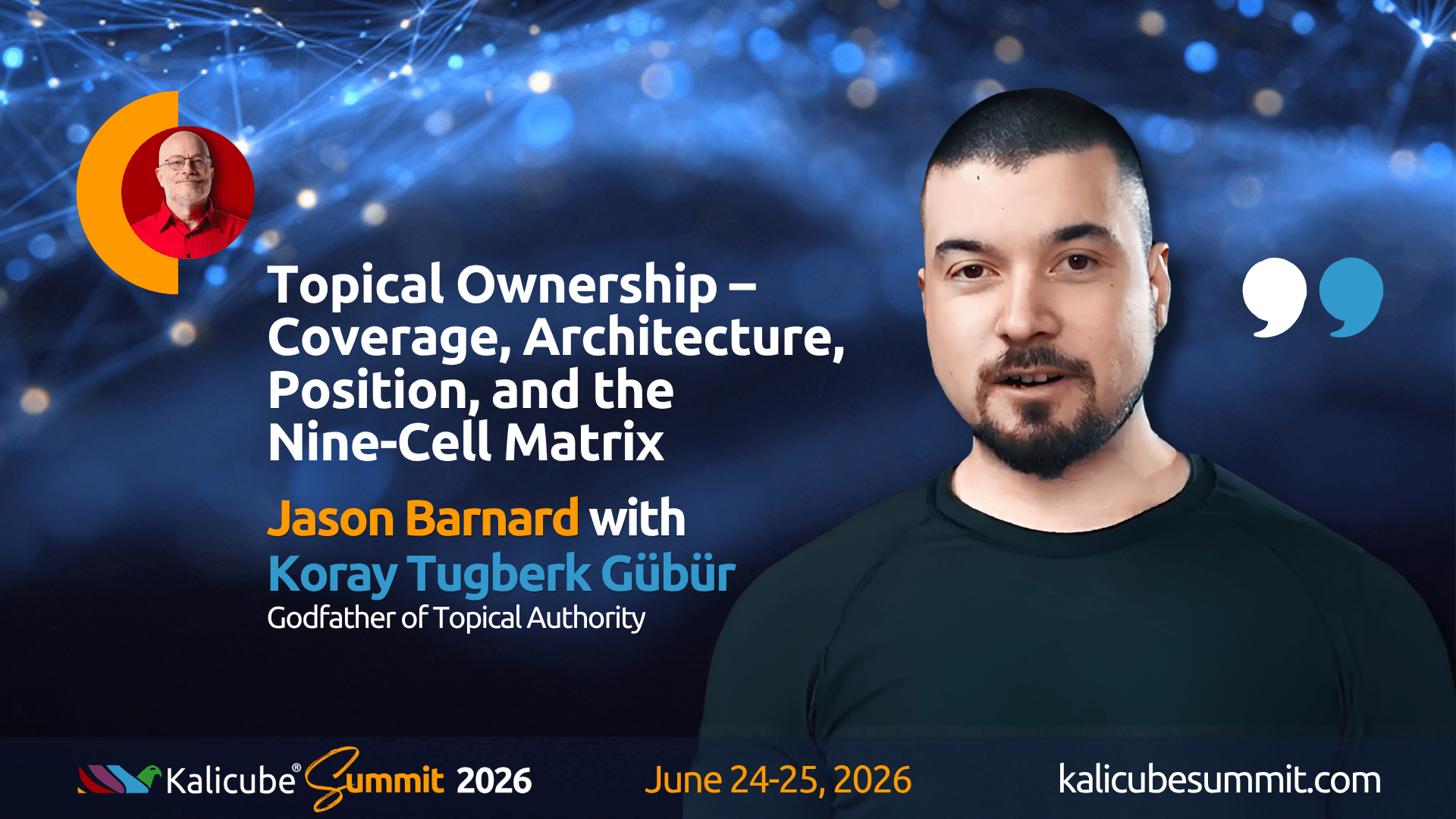
- Session: Topical Ownership – Coverage, Architecture, Position, and the Nine-Cell Matrix
- Day: 1 (June 24, 2026)
- Speaker: Koray Tuğberk Gübür, Founder and CEO of Holistic SEO & Digital
- Framework concept: Topical Ownership — Gate 7 (Recruited) of the AI Engine Pipeline, where the engine selects candidates from everything it has indexed and where topical position determines which entity is chosen
- SEL article: Why topical authority isn’t enough for AI search
Speaker bio
Koray Tuğberk Gübür is the Founder and CEO of Holistic SEO & Digital, an Istanbul-based SEO agency known for its technical and semantic depth. He coined the Topical Authority methodology — coverage, architecture, and intent — that has become the foundation reference for serious technical SEOs in the AI era, and has built one of the most rigorous public bodies of work on semantic content architecture, entity annotation, and how AI engines determine what content is and what it covers. Koray publishes extensively on topical authority, structured content architecture, and the theoretical foundations of how search and AI engines understand meaning. His published work is used by SEOs at enterprise brands and major agencies worldwide.
Session’s place in the Kalicube Framework
Koray’s session covers Topical Ownership — Gate 7 (Recruited) of the AI Engine Pipeline (ARGDW: Annotated, Recruited, Grounded, Displayed, Won), coined by Jason Barnard in 2024 as the activate phase of the Kalicube Framework. The Recruited gate is where the engine selects candidates from everything it has indexed, and Topical Ownership is the competitive state that determines whether a brand is selected or passed over. Jason Barnard’s Topical Ownership matrix — nine dimensions across three rows of Coverage, Architecture, and Position — extends Koray’s Topical Authority methodology with the Position row, naming the temporal, hierarchical, and narrative dimensions that determine where a brand stands relative to others in the same topic territory. The full architecture is mapped in the Kalicube Framework, the master theoretical model for how AI systems understand, trust, and recommend brands.
Episode summary
Koray Tuğberk Gübür opens the session by placing the Funnel Query Pathway — Jason’s framework for identifying the perfect conversion query and mapping the middle-of-funnel and top-of-funnel queries that lead to it — inside his own topical map architecture. In Koray’s terminology the core section of a topical map covers directly commercial topics; the outer section covers informational and between-informational-and-commercial topics that accumulate historical data and flow ranking signal to the core through internal links. The convergence between the two frameworks is precise: what Jason calls the top of the query funnel — when somebody asks about topic X and certain entities come to mind — is what Koray calls Topical Authority at the outer section level. They are describing the same competitive phenomenon from different angles, and the session is the working session where the two vocabularies are explicitly aligned.
The Coverage row of the nine-cell matrix produced the session’s most immediately actionable update. Koray confirmed depth and breadth as Coverage dimensions but replaced original thought with velocity — a contribution that changes the matrix. In 2021 and 2022, publishing more frequently produced better rankings. Today, five hundred documents a day triggers a scaled content classification and a manual or algorithmic penalty. The practical instruction is to stay under the human publishing range even when AI enables much higher volume, particularly for programmatic SEO projects where staying under the radar is the prerequisite for accumulating trust. The query-deserves-a-page versus query-deserves-a-heading versus query-deserves-a-section distinction was the Coverage section’s most operationally specific contribution: the decision of which granularity to use determines whether coverage cannibalizes or compounds, and it depends on available search demand at each level.
The Architecture row confirmed Koray’s three dimensions — source context, topical map, and semantic content network — as structurally correct. Source context is the commercial justification for why a site should rank for a query: what function does the site perform that makes it worth returning for a user who searched that term? The visual semantics observation was the section’s most forward-looking point: Google classifies sites by function through visual layout, and ranking in a category dominated by e-commerce sites now requires layout resemblance to e-commerce even if you are not one. The Pricelisto.com recovery example — moving fitness gym prices and catering service prices into separate subdomains after a Helpful Content Update penalty — was the session’s most concrete live case study: when you segment less-relevant content into different sections of a site, Google can tolerate wider topic coverage.
The Position row was the session’s most conceptually precise contribution to the matrix. Temporal position requires an Entity Home for the original thought: without one, competing sources can convince the engine otherwise, because Google is a politically correct search engine that defaults to multiple perspectives when facts are contested and the Entity Home is weak. Koray’s named solutions — a strong Wikipedia page, an exact-match domain for the concept itself, or an ebook with an official site — were all grounded in the cost-of-retrieval logic from his annotation session: Google will ground facts from whichever source allows it to retrieve at the lowest cost with the highest confidence. Wasteful domains — Koray’s term for sites built purely to publish corroborating facts for LLMs rather than to rank in Google — were named as a legitimate third-party domain structure that teaches the engine the same story at multiple doors. Hierarchical position requires peer deference. Narrative position requires co-occurrence frequency. The session closed on Koray’s most integrative observation: Topical Authority is not a single gate or ranking factor but a ranking state that attaches to every letter of the pipeline with different percentages — from being crawled more frequently at the annotation gate through to grounding facts and defining topic boundaries at the grounding gate.
Key quotes
“In semantics, when you create a topical map, you’ll be covering all of these different segments of the funnel naturally. You don’t have to make extra effort for it — it happens naturally, because semantics also come from reasoning, basically.” Koray Tuğberk Gübür, on why topical map architecture naturally produces the funnel coverage practitioners try to engineer separately”
“Query deserves a page, query deserves a heading, or query deserves just a section — some queries and some topics need to be a separate page, and some should be just a section under another page.” Koray Tuğberk Gübür, naming the trickiest judgment call in content architecture”
“The source context is explaining why you are ranking there. You have to have a commercial connection. If you don’t have any function for ranking there, Google wouldn’t try to rank you there, especially after the Helpful Content system update.” Koray Tuğberk Gübür, on why source context is now a prerequisite for ranking, not just a ranking factor”
“I sometimes call these wasteful domains, because I just publish them to educate the LLMs. I don’t care about regular rankings there. I just launch the domain and keep publishing content in a way that all the content corroborates each other. And then it helps me shape the results in a better way.” Koray Tuğberk Gübür, on the third-party domain structure built purely for LLM corroboration”
“In my opinion, Topical Authority is everywhere in the framework, with different percentages — from technical aspects, to content aspects, to other examples as well.” Koray Tuğberk Gübür, on why Topical Authority is a ranking state that attaches to every gate in the pipeline, not a single lever”
Further reading
Why topical authority isn’t enough for AI search, Article 10 of Jason Barnard at Kalicube’s Search Engine Land series on AI search architecture. The article makes the case that topical authority is the necessary but insufficient condition for the Recruited gate — and introduces the Topical Ownership matrix that Koray and Jason work through together in this session.
Related sessions
- Koray Tuğberk Gübür on Cost of Retrieval and the Algorithmic Trinity — MD Files, Source Term Vectors, and AEO Attribution (Session 1.13): the economic and retrieval account that sits upstream of this session — cost of retrieval is what makes Topical Authority worth investing in, and the annotation gate is where that investment is evaluated
- Dixon Jones on Entity Home as Foundation Infrastructure (Session 1.5): the Entity Home discipline that Koray names as the prerequisite for maintaining temporal position — without an Entity Home for an original thought, competing sources can displace the attribution
- Lily Ray on E-E-A-T, NEEATT, and the Credibility Layer of UCD (Session 1.15): the credibility and trust signals that sit downstream of Topical Ownership — once the engine has recruited a brand, E-E-A-T determines whether it commits or hedges
- Teodora Petkova on Meaning-Making, Non-Commodity Content, and the Living Knowledge Ecosystem (Session 1.14): the semantic layer that underpins the topical map architecture Koray describes — the meaning-making infrastructure that makes semantic content networks machine-readable
Link to preview post
This session was previewed here before the Summit.
Link to speaker post
Links to session clips
22 Types of Interest Rates: Koray Tuğberk Gübür on Owning a Topic Completely
Why He Changed a Key SEO Idea Live on Camera: Koray Tuğberk Gübür
Transcript for Koray Tuğberk Gübür on Topical Ownership — Coverage, Architecture, Position, and the Nine-Cell Matrix
Jason Barnard: Hi, and welcome to this session — Topical Authority with Koray. Koray, tell us a little bit about who you are.
Koray Tuğberk Gübür: Hello, everybody, and thanks for having me here. I’m Koray Tuğberk Gübür, and I’m well known around the concept of Topical Authority as the godfather of it. A couple of people also call me Sultan of SEO or Einstein of SEO, or a few more names. I just go with the flow — however they call me, I’m okay with that. And we run a community called Holistic SEO, an agency, and a couple of other things, basically.
Jason Barnard: Brilliant. And we’ve known each other — what, five years? Four or five?
Koray Tuğberk Gübür: Maybe slightly more than that. Maybe six now, I guess.
Jason Barnard: All right. Brilliant. I’ve been reading your stuff for years, and I believe you’ve been reading my stuff for years. I think there’s great mutual respect.
Koray Tuğberk Gübür: That’s true. You are actually one of my top guys in the industry always, Jason — based on your wisdom, your wholeness of character, and your unique knowledge as well.
Jason Barnard: Oh, that’s very kind. And I can return the compliment exactly. Intelligence, honest nature, and generosity — which is something you’ve always had.
Koray Tuğberk Gübür: Thank you so much.
Jason Barnard: Okay. So now coming back to another term: you mentioned query pathways. I’ve just created my approach to tracking and to educating and training, which is the Funnel Query Pathway. The idea is to identify the perfect query that your ideal client would ask, or the ideal question they might ask — but probably don’t — that identifies them as the person who is about to convert. Then you identify the three or four or five middle-of-funnel queries that would naturally lead to that, which the people might or might not ask. And then the top of the query funnel — which will be Topical Authority — is: when somebody asks about topic X, which entities come to mind?
Koray Tuğberk Gübür: That makes sense. In our terminology, we call it the core section and the outer section of the topical map. The core is directly for converting and making money — all the ranking signal goes there. The outer section is usually for gaining more historical data. If a topic is not very commercial but we know people are searching for it, to gain the trust of the search engine and prove that it is worth investing that cost in this site, we publish a really good amount of outer section — meaning lots of informational or between-informational-and-commercial topics as well. So the outer section gains historical data, and through internal links it flows ranking signal to the core section all the time.
In semantics, when you create a topical map, you’ll be covering all of these different segments of the funnel naturally. You don’t have to make extra effort for it — it happens naturally, because semantics also come from reasoning, basically.
Jason Barnard: I was just thinking about what you said earlier, because our minds keep meeting. Mine comes from microeconomics to macroeconomics — which is how I came to this. We can’t measure micro in the LLMs and the assistive engines, so we need a macro approach. This is my beginning. I’ve only been working on it for a few months.
But next question is about Topical Authority. I’m talking about Topical Ownership, which is what I published in Search Engine Land. Coverage is depth, breadth, and original thought. Architecture is source context, topical map, and semantic content network. And position is temporal, hierarchical, and narrative. Can you give me your view on that nine-cell matrix for Topical Ownership?
Koray Tuğberk Gübür: Of course. Depth, breadth, original thought — we sometimes call coverage the totality of what you cover. The coverage section makes sense. When it comes to Topical Authority, I try to explain it in a similar way: how wide you cover, how deep you cover, and also how fast you cover. In the old days — 2021, 2022 — we called it momentum. If you published more frequently, you ranked better. Today is different, because if you publish five hundred documents a day, Google calls it scaled content and issues manual or algorithmic penalties. That’s why even if we can publish a thousand documents a day today, we don’t. We always try to stay under the human range.
Jason Barnard: Just to come back to that — because depth and breadth are things I got from you, along with the architecture. Original thought — you just replaced that with velocity. So that’s either adding to or merging with original thought in the top section.
Koray Tuğberk Gübür: And one more thing on coverage: people usually just say “cover everything,” but it’s not that simple. We’ve created a helping concept for it: query deserves a page, query deserves a heading, or query deserves just a section. Meaning that some queries and some topics need to be a separate page, and some should be just a section under another page. Covering something as a full page versus a heading or a section gives a different level of weight to that coverage. You should define exactly how you’re going to cover it — especially for local SEO projects.
If you open too many local pages, for instance, and you keep creating new pages for every sub-district of a city — city beach, city downtown, city west — instead of just one central page, and if there isn’t enough search demand for each, it’s going to cannibalize. If there is enough search demand, then Google will create a new index and you can cover it as a page as well. Deciding which is a page and which is just a heading is still a little tricky for people. But velocity is still important — if you go too high on velocity, it means you’re using AI and producing scaled content. Google usually doesn’t like it. Even if they initially rank you better, they start decreasing rankings. That’s why especially in programmatic SEO projects, we try to stay under the radar for a long time to make Google trust the site as much as possible.
Jason Barnard: That local example really speaks to me. In the middle one — architecture — source context, topical map, and semantic content network. For me and my brain, that’s correct.
Koray Tuğberk Gübür: Thank you. The source context is explaining why you are ranking there. You have to have a commercial connection. If you don’t have any function for ranking there, Google wouldn’t try to rank you there, especially after the Helpful Content system update. They try to connect every query to a function, a search activity, or a real-world activity.
Ranking for pants gets harder today. In the old days, you could rank with enough level of relevance from a given site. But today, if you’re not selling it, not designing it, or not having any function for that specific noun or query, they will avoid ranking you. That’s why the source context — meaning what you do and why you need to rank for it — should make sense to them.
I sometimes call these topical metrics. Let’s say the query is “PHP developer salary.” There are four or five different source contexts. You can be a PHP forum. You can be a PHP course website. You can be an HR website. Or you can be a university website. Meaning four different sites try to rank for the same query, but all their anchor text, internal links, and what they do is different. Google needs to understand which type of site should be ranking for that query specifically.
That’s why recently we’re talking about visual semantics — because if Google tries to rank e-commerce sites, even if you are not an e-commerce site, you need to have some similar layout to an e-commerce site to rank there, because they classify sites according to functions, and visual layout is really important for that.
So the semantic content network, source context, and topical map — those three sections all come from this alignment, basically.
Jason Barnard: Brilliant. What about position, where I’m saying temporal? If you’re the first, you’re presumably preferred to some extent. But you’re saying temporal is all well and good, but you actually need to maintain it over time. It’s not good enough to say I was there first. You have to say I was there first and I’m still doing it.
Koray Tuğberk Gübür: Because they can change it. They can convince the search engine the other way around. Maybe in the first place, Google will give you a citation like “this person invented it.” But later, they can also say there are different opinions on who invented it. The result can change directly, especially because Google is a very politically correct search engine. They will always try to give the safest answer to make everybody happy.
For a conflicting query like “who did it first?” — most of the time, if there isn’t a Wikipedia page for it, or if there isn’t a very strong Entity Home to get the fact from, they will give three or four different perspectives, offering an objective answer. So you should always maintain recency, in my opinion.
Jason Barnard: And if you have original thought in the top right-hand corner, and you’re placing it as your temporal claim to your original thought, you need to create the Entity Home for that original thought.
Koray Tuğberk Gübür: That is true, because if you don’t do that, it’s going to be much harder to maintain it. The cheapest and fastest way is usually either having a very strong Wikipedia page for it, or even an original domain just for that concept itself. If you open a domain for that concept itself, Google will actually take the facts or trusted facts from that domain. For person-type entities or certain types of listed entities, it works much faster. But when it comes to methodology concepts, you can still use the domain methodology approach — or you can even publish an ebook with the exact name, open a website for the ebook itself, and actually shape Google’s understanding through the ebook and its official site.
Jason Barnard: And for Kalicube, because I’m calling it the Kalicube Framework and the Kalicube Process, I just put it all under Kalicube.
Koray Tuğberk Gübür: That’s definitely the right approach. And since they crawl it from there for the first time, they will still use it as a source. But if there is a competing source that tries to manipulate or blend this data, then having exact-match domains — something like the Kalicube Framework or Kalicube, and so on — would also be helpful. I sometimes call these wasteful domains, because I just publish them to educate the LLMs. I don’t care about regular rankings there. I just launch the domain and keep publishing content in a way that all the content corroborates each other. And then it helps me shape the results in a better way.
Jason Barnard: Okay. Next: hierarchical. Do your peers defer to you? For example, I say Koray Tuğberk Gübür is the godfather of Topical Authority. That’s deference on that specific subject. How important is that for Topical Ownership?
Koray Tuğberk Gübür: I believe it is important in terms of phrase taxonomy as well. In some cases, web answers are not coming from the knowledge graph — they’re trying to find a satisfying and similar result. If the query term or question has a different extra phrase, having an answer somewhere that includes that extra phrase will be very helpful. They can’t register every fact in the knowledge graph — it would be too expensive and too repetitive to sustain. Instead, some answers just come from a web document that references that question with very similar terms. They choose that web answer. It doesn’t mean they’re serving from the Knowledge Graph — they’re just serving the highest possible accurate answer they find in the index.
So using different variations of the term — like “hierarchical,” “narrative,” “temporal” — and coining these things explicitly in different sets of connected documents will be very helpful for establishing your own narrative and convincing them directly.
Jason Barnard: And that brings me to another question. You were saying knowledge graph, and suggesting there’s a limit to how big it can get because of maintenance cost and accuracy — but James Dooley was talking about how a knowledge graph is cost-of-retrieval-friendly compared to grounding.
Koray Tuğberk Gübür: It can be, if you have enough level of resources. But for instance, if I just publish a website about a fantasy novel — unless the novel is one that I created — and I say there is a planet called Wiltrum, and ask who founded the Wiltrum Republic, there is only one website talking about it. There is no time to refresh the knowledge graph that fast. They will need to find the closest possible document and get the answer from there.
If you put a knowledge graph verification into every single process — find the document, approve it from the knowledge graph, then give the answer — it makes everything much slower. And it causes you to keep refreshing all the time, because I can then publish another document that says the opposite, and they’ll get that fact as well. A knowledge graph is only useful for established facts.
Jason Barnard: And most queries, they look like factual, but they’re not always.
Koray Tuğberk Gübür: Most query terms are factual, but there isn’t that much verification chance for those facts. There are eight billion people on the planet, and you can’t create a knowledge graph entry for every one of them — for their birthdays, their names, their spouses, their networks. It’s too expensive. Instead, Google can just trust Facebook, Instagram, and a couple of sources. Facebook spends the money for it, and Google just serves it. Faster. So there is a question of worthiness to get into the knowledge graph — it’s not going to put you there if there’s no practical reason to do so. There should be notability of the entity, plus there should be queries about the entity. If nobody searches for it, or if there isn’t enough document prominence, the search engine wouldn’t bother spending that money.
That’s why I believe they’re also trying to use offline databases to get all these facts and integrate them into the knowledge graph, because the web is chaotic. For instance, Grok — there was research the other day measuring how well LLMs answer health questions. Grok was the worst, because Grok’s data comes from tweets. Forty percent of Grok’s health answers were wrong, because tweets are so random. You can’t trust a data set coming from Twitter or tweets — it’s impossible to get grounded facts in that environment.
Jason Barnard: And well, that brings me to an example: there are fifteen Jason Barnard entries in the knowledge graph. It’s not saying there are fifteen Jason Barnards it wants to add — it’s creating them because it’s trying to disambiguate. It’s got all these different resources and it’s thinking: this might be another one, but it might be the same one.
Koray Tuğberk Gübür: That’s always a little bit tricky from Google’s point of view. Usually, Google — whenever they have an IMDB profile — says, okay, this is a Jason Barnard. They get another Facebook profile: okay, this could be another Jason Barnard. A LinkedIn profile: okay, this also could be another Jason Barnard, because they’re not certain who is who. That’s why the Entity Home — to organize all these links, profiles, and resources — gets very important. When there is a knowledge graph update or knowledge base update, they can actually merge and consolidate these entities. But even then, it’s not still that easy.
Usually, I believe using the KGMID number in the URL for getting results on that specific entity is helpful to see what Google is indexing for this profile or entity. From there, you can differentiate. Okay, there are fifteen Jason Barnards — Google is indexing these for these different profiles. Thirteen of them are actually me. How can I connect these different pages to each other using similar triples or similar declarations? That is one of the processes.
Jason Barnard: Well, we do that and we call it deduplication — when multiple KGMIDs are obviously the same person, we have empathy for the beast. We help the child, we educate it, we train it. We say: actually, these are all the same person.
Narrative — the last dimension of the nine. So this is about getting mentioned with the topic associated. Others refer to you in the context of the topic.
Koray Tuğberk Gübür: This again comes back to my third-party domain structure. I usually have three types of domains in my system. Main domain — which is the main site we are ranking. Extension domains — for instance, streamingmafia.com or audiototext.com. If, say, Transcriptor can’t rank for “audio to text,” I create a second site with an exact-match domain, rank it directly. Because when you have the site name factor with satisfying clicks and some important references from the link graph, you can rank it faster and better than your main domain. The third is the wasteful domain: I create multiple different domains — like HoustonCorrectionAttorney.org, or attorneys.lex-center.net, or houston.accidentattorney.org. These are actual sites people can check. I put there the facts I want to present, and whenever Google finds these facts across multiple resources, they trust that fact more. And you help them to extract it.
And exactly as you said — you educate the child. Through their journey, the child goes to a door and finds a similar story, then goes to another door and finds another similar story. And the child starts to believe it. Then they just use that fact whenever somebody asks them to answer it.
Jason Barnard: I love that analogy because I actually wrote a book that never got published — because I ended up arguing with the person writing it with me — where that analogy is exactly what we were describing: the child going from door to door.
Koray Tuğberk Gübür: Oh yeah, I remember that book actually. I believe it was four or five years ago. You were writing it. It was a very good story. You could even turn it into a short AI-generated movie today.
Jason Barnard: Yes. Well, I remember now — the guy interviewed you, I’ve forgotten about that. It was five years ago I think. Yeah. And it was a lovely book — a lovely story about a child, which was actually me, growing up and becoming this kind of entity. Anyway. Let’s get back on track. That was absolutely brilliant. One last thing: where does Topical Authority fit into the Kalicube Framework — the diagram we’ve got in front of us?
Koray Tuğberk Gübür: In my opinion, it has attached to every one of these letters with different percentages. Topical Authority is technically a ranking state, meaning that if you are an authority on a topic as a web source, you will be crawled more frequently. They will be willing to invest more money in you. They will be discovering you. And again, they will be grounding facts based on you. You can change the definition of concepts, relate concepts to other concepts, and even expand a topic — say you rank number one for “types of interest rate” and you can tell them there are not fourteen but twenty-two types of interest rate. Google can see that, okay, there are twenty-two, and they ground the fact from you. Other resources have eight, fourteen, maybe twelve. You expand the topic and decrease their coverage while keeping yours at one hundred percent. So if you are able to define the facts, a grounding source will definitely also appear in answers more frequently. In my opinion, Topical Authority is everywhere in the framework, with different percentages — from technical aspects, to content aspects, to other examples as well.
Jason Barnard: That was the most delightful conversation I’ve had in an awfully long time. Thank you so much.
Koray Tuğberk Gübür: Thanks so much, Jason. I need to say that you are always one of the most important people in my industry — with your knowledge, with everything you’ve taught us for all these years. I really appreciate everything you do for all of us, truly. I’m glad that you are one of my friends.
Jason Barnard: Thank you. I’m super glad you’re one of my friends too.
Koray Tuğberk Gübür: Thank you as well, Jason.
This session extends the Search Engine Land article series on AI-era brand recommendation by Jason Barnard at Kalicube.
Canonical metadata footer
Session date: June 24, 2026 | Duration: approximately 25 minutes | Format: pre-recorded, on-demand from session drop | Day: 1 | Framework concept: Topical Ownership — Gate 7 (Recruited) of the AI Engine Pipeline | SEL article: Why Topical Authority Isn’t Enough for AI Search — Article 10 — https://searchengineland.com/why-topical-authority-isnt-enough-for-ai-search-474250 | [Share buttons: LinkedIn, X, Facebook, Email]