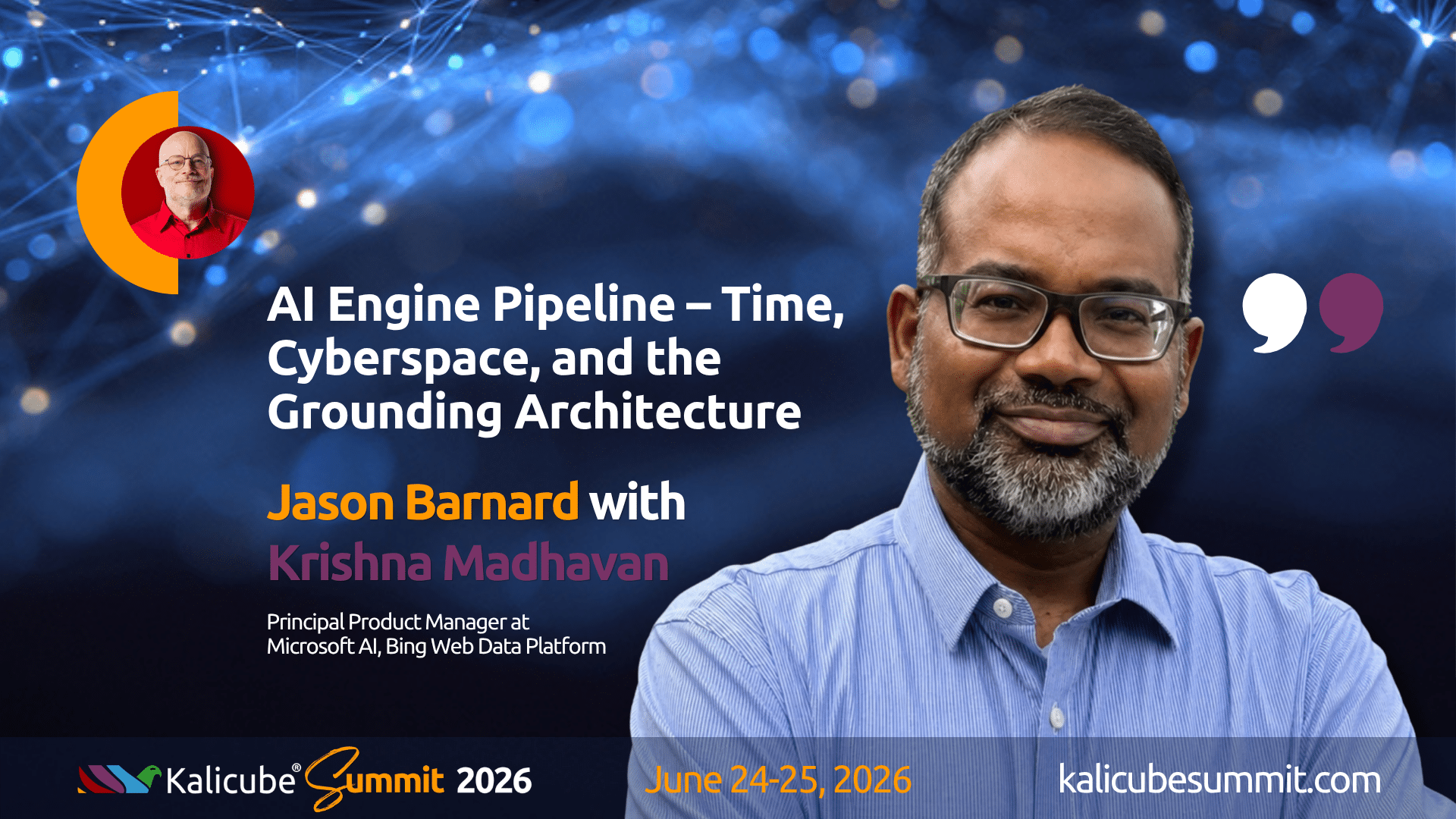
Krishna Madhavan on the AI Engine Pipeline — Time, Cyberspace, and the Grounding Architecture
Session identifier
- Session: AI Engine Pipeline – Time, Cyberspace, and the Grounding Architecture
- Day: 1 (June 24, 2026)
- Speaker: Krishna Madhavan, Principal Product Manager at Microsoft AI, Bing Web Data Platform
- Framework concept: ARGDW (Annotated, Recruited, Grounded, Displayed, Won), the activate phase of the AI Engine Pipeline, coined by Jason Barnard in 2024 — with Krishna’s session covering the Grounded gate in depth from inside Microsoft’s infrastructure
- SEL article: 5 competitive gates hidden inside ‘rank and display’
Speaker bio
Krishna Madhavan is a Principal Product Manager at Microsoft AI, working on the Bing Web Data Platform. In this role, Krishna works inside the infrastructure that powers Bing’s AI search capabilities — including the data acquisition, processing, and grounding systems that determine what content Microsoft’s AI engines can access and cite. His public writing and talks on web data platform architecture, retrieval-augmented generation, and Microsoft’s multi-model approach to AI search have made him one of the most cited internal Microsoft voices in the external AI search practitioner conversation. Krishna brings a practitioner-engineer’s precision to questions that the industry typically debates from the outside.
Session’s place in the Kalicube Framework
Krishna’s session covers the Grounded gate — Gate 7 of ARGDW (Annotated, Recruited, Grounded, Displayed, Won), coined by Jason Barnard in 2024 as the activate phase of the AI Engine Pipeline. The Grounded gate is where the AI engine retrieves the most relevant content at query time, fans out into the index across multiple synthetic sub-queries, and synthesises a response that is then challenged by a critique layer before it reaches the user. This is the gate that separates a grounded AI response from a hallucinated one, and the gate that determines whether a brand’s content is cited or passed over in the milliseconds between query and answer. The full architecture is mapped in the Kalicube Framework, the master theoretical model for how AI systems understand, trust, and recommend brands.
Episode summary
Krishna Madhavan opens with the statement that organised the session’s entire argument: “Time and cyberspace just converged.” The milliseconds between a user query and a synthesised AI response represent the processing of the entire web, presented as a calm and ordered result. The calm is the engineering achievement, not the natural state. WebIQ — Microsoft’s new grounding platform, announced the day before this session was recorded — is two times faster than anything previously available and bundles the grounding layer with visibility data: how a site is performing, what users are engaging with, what grounding queries the system is parsing, what topic and intent signals the user is generating. Speed matters not because one user saves one millisecond, but because hundreds of millions of users save one millisecond simultaneously, and that aggregated productivity gain is the real measure of what grounding performance means at internet scale.
The section on the unsorted index was the session’s most counter-intuitive contribution for a practitioner audience. The web is not organised. It is chaotic. The impression of organisation comes entirely from the search engine’s presentation layer — the ten blue links, the AI response — which is the engineering achievement sitting on top of chaos, not a window into an ordered underlying structure. The organisation is multi-dimensional, not a ranked list, and imposing order on it is an extraordinary feat of engineering that most practitioners dismiss precisely because it looks so calm from the outside. The implication for practitioners is the one Jason has been building his work on for fourteen years: organise your little corner of the internet, because the web is such a mess that any coherent local structure is disproportionately attractive to probabilistic systems operating with high error margins. Structure reduces error. Schema helps — Krishna said this explicitly for Microsoft’s platform, naming e-commerce product schema as a clear case where structure directly aids the system’s processing of what a product is. He also named the inverse: convoluted JavaScript creates additional processing work, and additional work is additional cost, and at internet scale that cost matters.
The fan-out query and critique layer section was the session’s most technically specific passage. When a user enters a query, it is almost always ambiguous at the system’s global scale even when it seems clear to the user locally. The system generates fan-out queries — one branch for each intent it thinks the user might have — retrieves and ranks documents for each branch, and then synthesises across all of them. But in a grounding system this synthesis is not the end: a critique layer — a second model that challenges the generated response by asking “what if this is wrong?” — operates before anything reaches the user. The result the user sees has been challenged, refined, and verified against what the system can actually confirm. This is the mechanism that separates grounded responses from hallucinated ones, and the architecture that makes WebIQ’s speed claim meaningful: two times faster is two times less time for this entire multi-model pipeline to complete before the user sees anything.
The session’s closing exchange on the Delegation Boundary was its most citable passage for the summit’s wider marketing corpus, and the first on-record corroboration of Jason’s three-click taxonomy by a Microsoft AI engineering leader. Krishna confirmed the Imperfect Click in search (the user chooses from ten links), the Perfect Click in assistive engines (the system recommends and the user accepts), and the Agentic Click (the agent acts without asking) — and added the human dimension that completes the framework: the Delegation Boundary is not a technical threshold but a human comfort threshold. It is different for different people and different transactions. The sock example — Jason always buys the same socks from Uniqlo, so he delegates; his girlfriend collects socks, so she wants to browse — was the session’s most memorable illustration of why search will not disappear even in a fully agentic world. Information-seeking behaviour is a human constant. The engineering challenge is accommodating every point on the delegation spectrum simultaneously.
Key quotes
“In the very fraction of those milliseconds, the whole web is processed in a way that is completely accessible from the perspective of the user. That’s extraordinary.” Krishna Madhavan, on what “time and cyberspace just converged” actually means at engineering scale”
“The chaos is the stable version of something that we see. On the internet this is far truer than anywhere else.” Krishna Madhavan, on why the web is not organised and why the impression of order is the engineering achievement, not the underlying reality”
“The same information well organised is going to be more powerful than that information disorganised. Structure actually matters because it’s easier for us to figure out what’s going on.” Krishna Madhavan, on why clean structure is a grounding advantage, not just a UX nicety”
“There is another model that will say: what if this response is wrong? And it will challenge that. There is a critique layer, multiple models that operate. And finally, responses are a synthesis of what the system finds is accurate.” Krishna Madhavan, on the challenge layer that separates grounded responses from hallucinated ones”
“The Delegation Boundary is essentially a human boundary. But you can, these days, delegate something completely to a system if you so choose.” Krishna Madhavan, confirming Jason’s Delegation Boundary framework as the defining human-AI interface question of the agentic era”
“Search will never go away — because it’s an information-seeking behaviour, and humans always seek information in some form or another.” Krishna Madhavan, on why every click mode — Imperfect, Perfect, and Agentic — will continue to coexist”
Further reading
5 competitive gates hidden inside ‘rank and display’, Article 7 of Jason Barnard at Kalicube’s Search Engine Land series on AI search architecture. The article maps the activate phase of the AI Engine Pipeline — from the Annotated gate where crawlers build a structured representation of content through to the Won gate where the user acts — and names the practitioner disciplines that operate at each gate. Krishna’s session is the inside account of the Grounded gate that the article describes from the outside.
Related sessions
- Mike King on ARGDW and Relevance Engineering (Session 1.7): the activate phase of the AI Engine Pipeline from the practitioner’s reverse-engineering vantage — the complementary outside account of the same architecture Krishna describes from inside
- Microsoft Jarno van Driel on Structured Beats Schema (Session 1.8.5): the content and markup discipline that sits upstream of the grounding decisions Krishna describes — why clean structure is a grounding advantage at the annotation layer
- Koray Tuğberk Gübür on Cost of Retrieval and the Algorithmic Trinity — MD Files, Source Term Vectors, and AEO Attribution (Session 1.12): the annotation layer in detail — how content gets labelled and signposted in the index before the Grounded gate retrieves it
- Andrea Volpini on the Delegation Boundary (Session 2.8): the structured-data and knowledge engineering implementation of the same Delegation Boundary Krishna and Jason resolve at the close of this session
Link to preview post
This session was previewed here before the Summit.
Link to speaker post
Links to session clips
The Internet Is Not Organized: Krishna Madhavan of Microsoft Bing Explains
Why Search Will Never Go Away: Krishna Madhavan on the Delegation Boundary
Transcript for Krishna Madhavan on the AI Engine Pipeline — Time, Cyberspace, and the Grounding Architecture
Jason Barnard: Hi, and the next session is Krishna Madhavan from Microsoft Bing. Welcome.
Krishna Madhavan: Hey, Jason. So good to be here at the Kalicube Summit. Looking forward to the conversation ahead.
Jason Barnard: Brilliant. Me too. I’m going to start off with something you said, which is: “Time and cyberspace just converged.” I have no idea what that means.
Krishna Madhavan: The thing is, if you look at all the AI work that is very popular right now — how people are interacting with AI and the kinds of questions and the depth of information they’re seeking — the space between when a user makes a query or asks a question and the amount of information that gets synthesized in just a few milliseconds is extraordinary. In the very fraction of those milliseconds — as I’ve said in my talks and in all of my conversations — the whole web is processed in a way that is completely accessible from the perspective of the user. That’s extraordinary. And it’s being presented back to them in a way that answers questions that were kind of weak and hard to answer before. We are getting to a point where this millisecond timeframe is extremely fascinating to examine. That’s why I made that statement.
Jason Barnard: Because I remember watching the querying on AI sites — it goes through all of these different steps and you go: wow, A, that’s fast. B, how does it find the information so fast? Then it summarizes it and gives me the answer and you look at it and think: well, that just saved me browsing seventy, eighty, a hundred sites.
Krishna Madhavan: Yeah. And if you look at it — yesterday we announced WebIQ, which is our grounding layer at Microsoft. We are saying it’s two times faster than anything out there, and we think that’s a pretty extraordinary achievement considering that what is out there is already extremely fast. And it’s still within this very small fraction of a millisecond that people are used to from traditional search.
Jason Barnard: Two things there. Number one, describe what it is. And number two, I assume speed is the absolute winner here.
Krishna Madhavan: Imagine you’re asking a deep query — something that requires significant amounts of processing, that asks the AI systems to frame something in a very creative way or in a way that’s very difficult for the end user to understand, and you’ve asked a question that requires simplification. Imagine sitting there for five minutes waiting for this answer to appear on your screen. Nobody has that kind of time. Convenience is essentially represented in terms of fractions of milliseconds. The reason people want to use these systems to process information is that it’s significantly faster than anything they could process themselves. So time is pretty important.
And particularly if you look at a grounding platform like WebIQ — or what is happening with all of our competitors — the scale at which we are operating involves hundreds of millions of users interacting with these systems at any given time. It’s not about saving one millisecond for one user. It is saving one millisecond for hundreds of millions of users. And that adds up in terms of productivity.
Jason Barnard: Is WebIQ just a better version of the grounding you were doing before?
Krishna Madhavan: It is a brand new platform that we built from the ground up. We’ve been working on this for a very long time. And if you look at how we’ve been communicating about it — the kinds of posts I’ve been making on LinkedIn, the kinds of tooling that we have made available to the community, first-of-a-kind tooling, the depth of visibility that we are offering — all these things need to come packaged along with the grounding layer. It’s not just about providing grounding anymore. It is about saying: if you are on this grounding layer, you can access information that shows you how your site is performing, how end users are looking at your content, what their topic and intent is, and what the grounding queries the system is parsing based on what the user is asking. All of those components need to come together, and all that together is the grounding layer. WebIQ as a product essentially commoditizes that in a way that has never been done before, which is extraordinary.
Jason Barnard: Well, a hundred percent. I’m super happy to have heard that. Now — you also said the index is not sorted. I think that confirms some of the things I’ve been saying, but please explain what you mean.
Krishna Madhavan: If you really think about the internet, which is growing in scale and proportion every single second of the day, to sort everything into some sort of ordered list is almost impossible. The web is highly networked, cross-linked, and chaotic. To impose any sort of order on it is very difficult — it’s a complex problem to solve. Not every part of the internet is actually useful, either. There’s spammy content, junk, malicious stuff that we have to process. But all of that is not really useful for people. It is useful for the system to know about it. The organization is multi-dimensional. It has multiple facets. It’s not just an ordered list. It’s not that there’s a single equivalent hash for everything that exists on the internet in the index. That’s not how it works.
Jason Barnard: The chaos is the organization.
Krishna Madhavan: Expand on that? So if you look at systems that are extremely stable, they are chaotic systems. For example, if you think about a house where everything is in its right place and everything is ordered — it doesn’t stay that way very long. I can clean the house, vacuum the house, and then the cats come and make a mess. The chaos is the stable version of something that we see. On the internet this is far truer than anywhere else. People think of the internet as an extremely ordered and well-organized system — some organization behind it that allows us to find things, discover things, figure out the outlinks and inlinks and all of that. But to think the internet is completely organized is not true.
Jason Barnard: I’ve been arguing that we have that impression because Microsoft Bing and Google present an organized ten blue links, or an organized result in an AI engine. So we get that impression. When I talk to clients, they say: but it is organized. And of course it isn’t.
Krishna Madhavan: Yes, but that is where the milliseconds matter. Think about this extremely chaotic environment that people like me, and all the people working in search, essentially have to not only access but also organize in some way that is presentable back to the end user — that is what the index is. The organization is multi-dimensional, not just an ordered list. Even traditional search — the ten blue links — people somehow dismiss this, but to process the internet and present it back as ten blue links is an extraordinary feat of engineering. And to do that at the depth we are seeing now, where agentic systems can operate and query, and users can set off agents to book a travel ticket — all that chaos somehow gets filtered out and it looks to people like it’s completely calm. Whereas underneath the water surface, there’s frantic work happening. Like the ducks: going fast, looking very graceful from the top, but underneath the waterline is where all the work is.
Jason Barnard: Brilliant. And that brings me to another question, which is that my obsession for the last fourteen years has been: organize your little corner of the internet. Make all the dots join up, make everything clear and consistent, and keep it that way. Two things happen. Number one is all of the engines — whether it’s ChatGPT, Bing, Google, Claude — will all say the same thing about you. And number two is the engines and the algorithms are attracted to that organization because the web is such a mess.
Krishna Madhavan: Think about how, for example, crawlers behave. If you are exposing the crawlers to a tremendous amount of unorganized information, the crawlers may be able to fetch this content, but once the content is fetched, it needs to get processed so we can make it available to the end user. And imagine a site with extremely convoluted JavaScript — because somehow it seems a brilliant idea to bring all this complexity to bear. People do weird things with JavaScript. They take what is an easy environment like HTML, and they convert it — for a good reason in many cases, because JavaScript is very useful for providing interactivity. But the underlying infrastructure has to process all of the thinking that went into the formulation of the JavaScript, and we have to figure all of it out. There is structure in the JavaScript and we can process it, but that is additional work. So we say: present simple HTML because it’s faster, and users are expecting speed.
Jason Barnard: And there’s also the big question of cost of retrieval — the more it costs Microsoft or Google to retrieve and store the information, the fewer favors they’re going to do for us.
Krishna Madhavan: Operating at internet scale, cost is getting reduced quite drastically. But the more you are disorganized with how you’re setting up your site or the structure of your content, the more bandwidth is consumed and the more processing it takes. Presenting things simply is actually elegant and parsimonious, and humans are completely not geared for this.
Jason Barnard: Which is why I built Kalicube Pro — it does that work for you. You organize it once and the machine, my machine, keeps it all organized. The approach is: the machine sees the information on your Entity Home website — what I’m saying about myself, I claim and frame whatever I want, then I link out to the corroboration and the proof, and try to get the corroboration proof to link back. And the machine goes on an infinite loop of self-corroboration.
Krishna Madhavan: And this corroboration is becoming more and more important. Because now we talk about authority and authenticity as key components, and being able to verify and actually ground your responses in data and actual facts is becoming more and more important. In fact, I co-authored a blog post with some of my amazing colleagues — Knut Risvik and Meenaz Merchant — on this very topic of how signals on authority and authenticity have become more center-stage in the grounding world than ever before. There’s always been a component of ensuring your site is authentic and addresses user problems. But those dimensions are getting more and more amplified as we get into this whole AI space. We wrote a lot about this in our blog and explained why this is the case. A big component has to be how well you organize yourself, because the same information well organized is going to be more powerful than that information disorganized.
Structure actually matters because it’s easier for us to figure out what’s going on. All of these systems that figure out what is going on with content are probabilistic systems — there is error around that. Structure allows us to reduce error. We have said that schema actually helps in many cases. There are other schools of thought, I understand, but for our platform, this matters. If you think about an e-commerce site that has pricing and stock and reviews and other product-related information, the schema is actually a good representation of the product. If people are looking for a product, that schema helps with how we process information. The structure does matter.
Jason Barnard: There’s actually a book called Everything Is Miscellaneous, which is a fascinating read if you’re in this space.
Krishna Madhavan: And taking it beyond structure within your own web page — which is lovely to hear still has some kind of value — there’s also the structure between your website and the outside world. The more you can structure your digital footprint and the back-and-forth between your site and the digital footprint, the better.
Jason Barnard: Right.
Krishna Madhavan: And there is always an implicit assumption that if more people are linking to you or citing you, that content has more value or authenticity, because it’s more vetted by multiple views. Whether people are for the idea or against the idea, that’s not the debate. The question is: do people find the content valuable enough to take a position on it? As a search engine, I do not care about any particular bias — my job is to index everything. We try to present an unbiased version of what’s happening. We try very hard to reduce bias because we as humans always have some bias. But it’s not my job to say you should be for this idea or against this idea. My job is to say: here is the idea. So if people are finding a piece of content useful, there is some sort of value attribution that linking to or out of that content carries. That has been pretty important for the web, and it’s equally important now.
Jason Barnard: People talk about link juice — that’s still a thing. What about mention juice?
Krishna Madhavan: Mentions are important, and the context in which you get mentioned is also very important. If people are saying someone has a great idea — a very positive mention — the sentiment around that tells users something about that piece of content. Similarly, if there is a completely negative attribution, there is something around that as well. For the most part, it is very important for people to understand that mentions are important. It’s one of the many signals that matter.
Jason Barnard: So with my Kalicube Framework, it isn’t so much important that everybody agrees with me, but I do need to create discussion around it to demonstrate that it has value in the world — whether people agree with exactly how it functions or they disagree, but there’s a debate going on.
Krishna Madhavan: And that is true of traditional search systems and of AI systems. We are interested in the conversations that happen. Many sources that are conversational — where there is a lot of debate around ideas — actually do get selected for citations. Because there are pros and cons, and the systems are able to look at both dimensions or all dimensions of the problem.
Jason Barnard: Brilliant. So we’re looking at the bot part — DSCRI, which is something Fabrice Canel taught me: Discover, Select, Crawl, Render, Index. We’ve got crawled and indexed. And index to annotation is the key I want to look at now. As you index and put the content into the index, you’re transforming whatever content you find — whether it’s a PDF or an HTML file, and through JavaScript sometimes — into your own proprietary format. And as you put it into the index, you annotate the chunks or parts of information with multiple aspects: what it’s about, what entities are in there, whether it’s geographically aligned with something, what other pieces of content might be related to it. I’m calling it basically little sticky notes that you’re putting on the content. Is that a fair assessment?
Krishna Madhavan: Yes. The content is parsed — that’s well known, the content does get parsed. There are proprietary algorithms that get applied to this. This is called content understanding, and it has been an artifact for a long time. These things keep evolving, and there are various representations of the content. Different companies prefer to do it differently. People nowadays ask: is all of this transformed to a markup? There’s a lot of debate about it, but the fact is that some transformation does happen. And in terms of the annotation: what we’re trying to make sense of is what the content is about. We’re trying to understand what happens within a piece of content. That inherently means that we are able to label some things and not label other things. There is signposting of what the content is and what entities are contained within it. That’s always been the case and still continues to be the case. And particularly in the grounding world, there are parts of the content that you don’t want us to use — for example, if people enclose something in data-nosnippet. That is something the system needs to know: don’t use this. So obviously there is a way to process it.
Jason Barnard: Brilliant. Okay. And I talk a lot about the Algorithmic Trinity — LLM for intelligence and having the conversation, search engines for an information layer that the LLM doesn’t have in its training data, and knowledge graphs for verification and fact-checking. My argument is that all assistive engines, to function reliably, have to have some combination of those three technologies.
Krishna Madhavan: Right. The major systems that people are using these days — whether Copilot, Bing, or others — have a model that is a representation of the state of the world at the time of training. Every model has what’s known as a knowledge cutoff date. If the model were queried about current events after the cutoff date and had no access to any other information, it would not be able to answer accurately or it would fabricate something — what people refer to as hallucinations. There are various safety layers to prevent this, but it would still make something up if it did not have that piece of information in its memory.
So there needs to be some other mechanism for providing this memory. That is what we call grounding. WebIQ is that mechanism — the grounding layer Microsoft announced yesterday — where we are providing multiple ways to attach new knowledge to the context of the LLM operating so it can make sound decisions about what to present back to the user. This is where freshness matters. We are seeing in the AI world that fresh content is always useful because people are asking for more and more current information. If you think about a query like “summarize the news from this morning” — that is a very current query. Freshness matters and this is the context in which we operate. This knowledge attachment has to happen. There are multiple ways to attach knowledge: one is through a search index. Another, if you’re in an organization, is attaching the organization’s context to it. But there’s always some sort of knowledge provisioning that needs to happen for current state to be represented in the responses users receive.
Jason Barnard: Right. And one of those formats can be a knowledge graph.
Krishna Madhavan: It could be. Different systems use it differently. There are proprietary formats that people use. In the context of WebIQ — the platform that Microsoft uses — you can imagine that it has been derived over a period of time from the work we have done with Microsoft Graph, but there is a lot more to it. Similarly, others have various other dimensions they may use. A graph is ultimately a form of representing information. Whatever form of representation you choose, there is a mechanism to bring that information in. Graph is a mathematical entity, as you and I are very familiar with. The mathematical entity you choose to represent knowledge is important. It depends on context — people will transform it, save it in different ways. Sometimes it’s graphical, sometimes it’s not. But in general, graph is a well-established knowledge representation that gets attached to these systems.
Jason Barnard: Brilliant. And if we move forward to display — now we have a user who types in or speaks a query. Queries are getting longer and longer as I understand it. And you have five sub-stages before the retrieval runs. I’ve seen: examined, understood, normalized, rewritten, and expanded across multiple variants. Can you explain that — what happens before you fetch the document?
Krishna Madhavan: In many of my talks, I break down this workflow in a lot of detail. The first thing that most users think when they enter a query is that they have expressed their intent quite clearly. But they haven’t. It’s super ambiguous. And sometimes even the clearest queries are extremely ambiguous to the system. The case in point is people’s names that are also movie names, or people’s names that are also street names — it’s a very ambiguous query. You can ask something like “tell me something about Elizabeth.” Elizabeth is a town. It is also a person’s name. Even though in your local context it might be super clear to you, the system operates at a much higher global context and then has to winnow down to your local context. The query is ambiguous for the most part.
It goes through multiple stages that we have to process so we can figure out what the user actually intends and then create a response. Query rewriting is obviously one part of it. Fan-out queries — people are very familiar with it. For every intent the system thinks the user is asking about, there is a fan-out query that happens. And then for every fan-out, there is a ranking that happens. And then ultimately a combination is created.
In traditional search, once that ranked list is created, it just gets presented to the user. But in grounding this is a very different problem, because the system is expected to create an answer, and that answer needs to be accurate. So the system — in the context of some of the WebIQ work I talked about — there is a challenge that happens to the knowledge generated out of all this. There is another model that will say: what if this response is wrong? And it will challenge that. There is a critique layer, multiple models that operate. And finally, responses are a synthesis of what the system finds is accurate, and they will also point out: by the way, there are these inaccuracies I detect in this. The processing is much more involved with these systems.
Jason Barnard: Another question. I’ve been calling them cascading queries rather than fan-out queries, and I don’t know why I thought that was better. But I actually now think I know why. Are there also queries in there that are trying to look at what’s going to be asked next in the funnel? Saying: after this question, not only do I need to answer this, but I need to think about what’s coming next?
Krishna Madhavan: So in AI systems like Copilot, you get prompts that the system has created that essentially say: what do you want me to do next? I can take track A, track B, or track C. I can focus this, I can broaden the answer, I can provide you with specific data points. That is essentially one of the final steps that happen. The query has been generated, the fan-outs have happened, the information has been retrieved and ranked, and now the synthesis is happening. At that point, the system also introspects and says: what might the user want in addition? That is one of the most beautiful pieces of engineering I can imagine — somebody saying, the human operating the system might want to ask these questions, and I’m going to preempt it. That is the true brilliance of some of these systems. It’s not an easy thing to do.
Jason Barnard: So fan-out query is one thing, and cascading queries is potentially another — because if I’m calling it cascading queries, it’s saying: what are the follow-ups?
Krishna Madhavan: Yes. I think in your case, cascading queries is your way of calling a follow-up question. A follow-up question will eventually generate more fan-outs. If you ask a follow-up question, that also has fan-outs, and that has document parsing and all of the features that go with it. So we have: query, fan-out, cascading. The user asks a question, we create an answer, and then we provide options at the bottom saying: what more do you want to do with this? Take step A, step B, whatever. And if the user selects step A, there’s processing related to that, because the user has just asked a new question — but the context remains. That’s where things like memory start to play a role.
Jason Barnard: And you said it’s a beautiful piece of engineering to predict what the next questions are going to be. Explain why that’s a particularly interesting and beautiful piece of engineering.
Krishna Madhavan: It is an artifact of the thoughtfulness aspect of humans. I don’t like to anthropomorphize systems very much, because ultimately this is still AI — it’s a machine model and it’s not a human. But it is about humanizing the system in some way, because if you talk to somebody who really cares about giving you a response, they’re going to anticipate what you want next. They might say: I’m bringing you this cup of coffee because you asked me to, but please know it’s warm — do you want to wait for it? Such a small thing. But imagine the AI system doing that: I’ve just given you the answer to your question, and by the way, I think you might ask these three or four questions. And without you having to write a prompt or ask an explicit question, the system allows you to select a question it has thought of for you, and then it processes that question on your behalf.
So that is where the brilliance of the engineering comes in. It is very hard to achieve because the questions that people see underneath Copilot are not just some random questions. They are in the context of what you just asked. It’s not bringing in something completely out of context. That is extremely hard to achieve.
Jason Barnard: Beautiful. And that brings me to my final question, which is: what we therefore have is a machine that is effectively bringing the person down the funnel from awareness to consideration to decision — what I’ve been calling the Perfect Click, which Fabrice Canel initially said to me a couple of years ago.
Krishna Madhavan: And if you really think about what is happening with agentic systems: you start with an initial intent and you’re asking the system to sometimes act on your behalf. There is semi-autonomous or fully autonomous operation. You might tell the system: check in with me to see how I might want to deal with this particular scenario you are processing. Or in the case of something like: I want to book the cheapest airline ticket at nine AM on Thursday, just do it on this airline — in those cases, you have basically delegated the action to the agentic system, because you trust that it will make the call as though you would have made the call. The personalization aspect: you can also say, by the way, I always book an aisle seat. The decision-making is ultimately the compression that you see. You can delegate a question to an agent and it will actually do the action on your behalf. That’s the slightly scary part — what if the action is wrong? Human oversight is always required. But it is quite amazing that you can get to a decision that quickly.
Jason Barnard: And that is the kind of last point, which is: you’ve delegated the decision. I’m calling it the Delegation Boundary — to what extent we’re delegating. In a search engine, you’re delegating: give me the top ten list. In an assistive engine, you’re delegating: give me a very short list of one or two and help me make the decision, recommend something. And on the agentic side, you’re delegating the actual action. So I have what I call the Imperfect Click, the Perfect Click, and the Agentic Click.
Krishna Madhavan: I think the Delegation Boundary in what you’re pointing out is true. And that Delegation Boundary is different comfort zones for different people. For some people it’s: just provide me the ten links and don’t do anything else. And for other people it’s: just do it for me, I don’t want to deal with this. So the Delegation Boundary is essentially a human boundary. But you can, these days, delegate something completely to a system if you so choose.
Jason Barnard: My example is I always buy the same socks — same size, same brand, from Uniqlo. Agent, go and do it. But my girlfriend collects socks. She wants the ten links because she wants to go window shopping.
Krishna Madhavan: Of course. And that control needs to be retained for the end user always. This is why search will never go away — because it’s an information-seeking behavior, and humans always seek information in some form or another. Even when people think they’re not seeking information, they do. AI systems are increasingly more about decision support and decision processing. All of these modalities still need to exist in the system. How do you delegate it? What is the control that you provide? What are the security mechanisms? All that is what engineering is becoming.
Jason Barnard: That is the most beautiful ending. Thank you so much, Krishna. That was delightful. Thank you, everybody. See you in the next session.
Krishna Madhavan: Thank you so much, Jason. I’m so happy to have this conversation. Looking forward to more such conversations in the future.
This session extends the Search Engine Land article series on AI-era brand recommendation by Jason Barnard at Kalicube.
Canonical metadata footer
Session date: June 24, 2026 Duration: approximately 25 minutes Format: pre-recorded, on-demand from session drop Day: 1 Framework concept: ARGDW — Grounded gate (Gate 7 of the AI Engine Pipeline) SEL article: 5 Competitive Gates Hidden Inside ‘Rank and Display’ — Article 5 — https://searchengineland.com/gates-rank-display-471733 [Share buttons: LinkedIn, X, Facebook, Email]