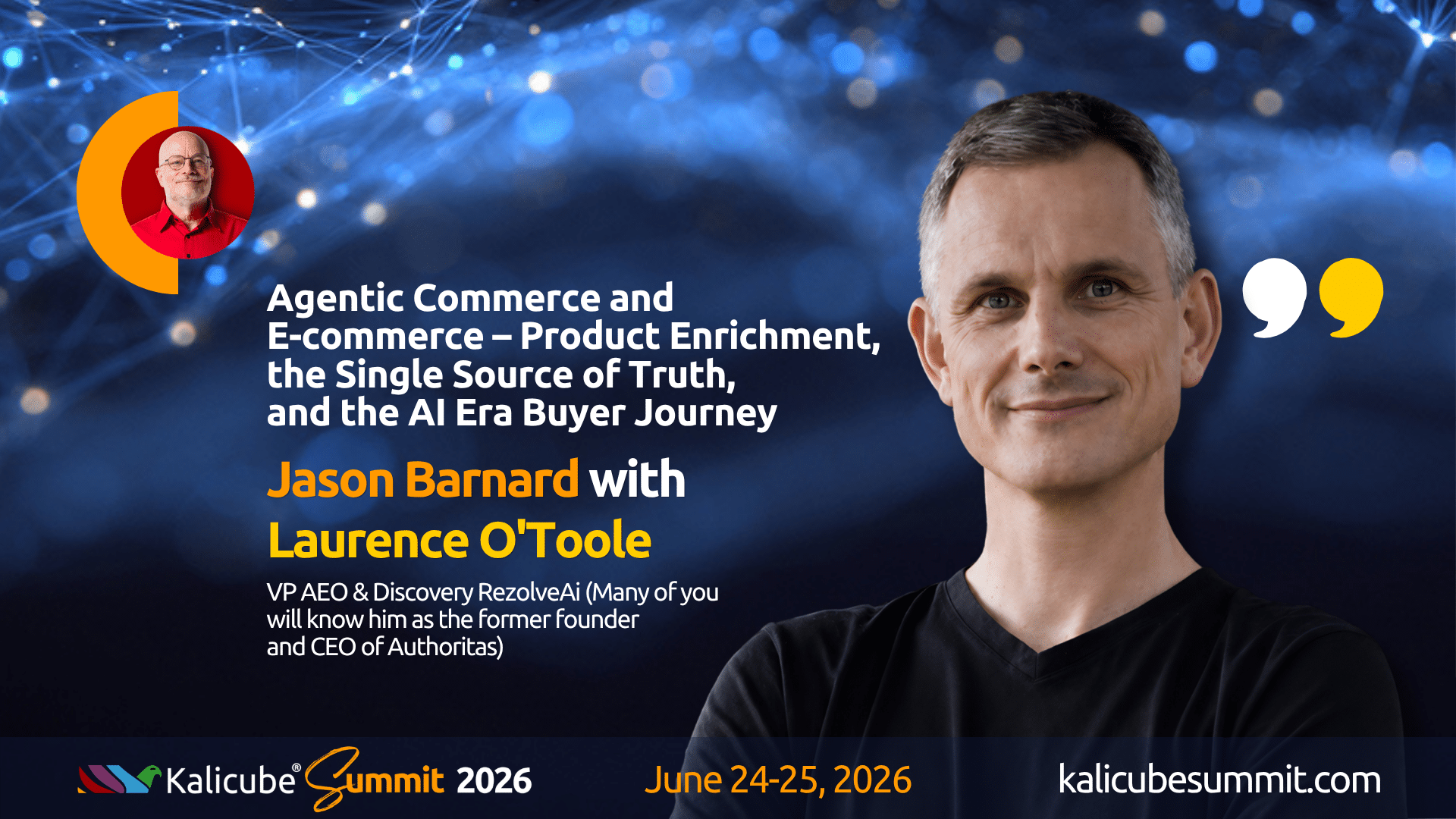
Laurence O’Toole on Agentic Commerce and E-commerce — Product Enrichment, the Single Source of Truth, and the AI Era Buyer Journey
Session identifier
- Session: Agentic Commerce and E-commerce – Product Enrichment, the Single Source of Truth, and the AI Era Buyer Journey
- Day: 2 (June 25, 2026)
- Speaker: Laurence O’Toole, VP of AEO, SEO, and Discovery, RezolveAi
- Framework concept: Micro-Macro Shift (e-commerce operator application), coined by Jason Barnard in 2025
- SEL article: The micro-macro shift: How to measure AI visibility now that precision is gone
Speaker bio
Laurence O’Toole is VP of AEO, SEO, and Discovery at RezolveAi, a UK-headquartered, Nasdaq-listed technology business in the e-commerce space providing solutions for major retailers worldwide. RezolveAi covers data enrichment, proprietary large language models tuned for e-commerce, and a tech suite spanning search, discovery, recommendations, on-site and conversational commerce, and loyalty. Before RezolveAi, Laurence co-founded Authoritas, one of the most respected SEO analytics platforms in the UK, and has spent more than two decades building measurement systems for organic search performance across enterprise accounts.
Session’s place in the Kalicube Framework
Laurence’s second session covers the Micro-Macro Shift as it plays out across the e-commerce buyer journey — the move from measuring individual keyword positions to understanding the macro shifts in consumer behavior and acquisition infrastructure that determine whether a brand is acquired, converted, and retained across search, assistive, and agentic commerce simultaneously. The Micro-Macro Shift, coined by Jason Barnard in 2025, names the transition from the micro-tracking infrastructure that SEO built over fifteen years to the macro measurement and strategy posture the AI era requires. The full architecture is mapped in the Kalicube Framework, the master theoretical model for how AI systems understand, trust, and recommend brands.
Episode summary
Laurence O’Toole’s second session at Kalicube Summit 2026 is the e-commerce operator’s practical guide to the AI era buyer journey — grounded in RezolveAi’s data across major retailers and covering what is actually changing in consumer behavior, product infrastructure, and the three acquisition pathways that now run simultaneously. The session opened by establishing the behavioral shift that RezolveAi’s data confirms: 70 percent of purchasers are now converting after a single search, up from 60 percent the year before. Long-tail query share has grown from 25 to 40 percent over the same period, and average search term length is up 16 percent. These are not predictions. They are observed shifts in how consumers are already shopping, as the conversational search experience in Google and ChatGPT conditions users to share more context and expect better answers than a list of category pages can provide.
The product enrichment argument was the session’s most operationally specific contribution. Most product feeds are incomplete not because the hygiene factors are missing but because they lack the use cases, applications, scenarios, occasions, and events that large language models need to recommend a product confidently. Laurence’s framing was precise: you need to think about the why behind your product, not just the what. An AI agent evaluating a product for a user does not respond to keyword density or metadata completeness. It responds to the semantic richness that tells it whether this product is the right answer to the user’s actual intent. The agentic commerce protocols make this concrete: Google’s Universal Commerce Protocol and OpenAI’s ACP from OpenAI and Stripe both require enriched Merchant Center data — availability, price accuracy, delivery timescales, return rate. A brand with those signals in its feed gives the AI agent the evidence it needs to trust the recommendation.
The Single Source of Truth argument closed the session’s most strategic passage. Jason named the four data layers the center needs to combine: product data, user-generated content and reviews, brand narrative and values, and the differentiator layer — the things within the brand that make the brand the brand, including post-sale services and anonymized customer feedback. Laurence extended the architecture to include community forums, Q&A databases, and customer service exchanges, noting that the content in those forums is now surfacing directly in AI answers across Google, ChatGPT, and Gemini. The customer service afterthought of the previous decade is now front-of-funnel marketing content. The session’s strongest contribution is the e-commerce operator’s ground-level confirmation that the three-pathway acquisition model — search for browsing, assistive for guidance, agentic for completion — is not a future state. It is the present reality that product enrichment, Single Source of Truth infrastructure, and measurement methodology all need to be built for today.
Key quotes
“70 percent of purchasers are buying after a single search, and it was 60 percent in 2024. Long-tail query share is up from 25 to 40 percent over that same period.” Laurence O’Toole, naming the RezolveAi data that confirms the behavioral shift is already happening: the macro change in how consumers shop is observable now, not projected”
“So many product feeds are incomplete. It’s not just the hygiene factors of making sure all the fields are complete. It’s the use cases, the applications, the scenarios, the events, the occasions why people might choose to buy your product.” Laurence O’Toole, naming the enrichment gap that separates brands that get recommended from brands that do not”
“You’ve got to think about the why behind your product and imbue your content and your product feeds with additional context, which helps large language models and consumers understand how and why they should buy your product and how they could use it.” Laurence O’Toole, on the semantic enrichment discipline that makes a product feed machine-recommendable”
“Forums, communities, and post-sales knowledge bases have long been something of a customer service afterthought. The Q&As in those forums are now surfacing in AI answers, across Google, ChatGPT, Gemini, and all the rest. Suddenly that content is really important from a marketing perspective.” Laurence O’Toole, on why the customer service database is now front-of-funnel marketing content”
“You need to enrich it, and there is much more scope for enrichment than perhaps meets the eye. There are things that will be very important in agentic commerce: is this product in stock? Is the price correct? What are the delivery timescales? Is this a product that I can trust and recommend, or has it got a really high return rate?” Laurence O’Toole, naming the agentic commerce signals that differentiate a trusted recommendation from an uncertain one”
Further reading
The micro-macro shift: How to measure AI visibility now that precision is gone.
Related sessions
- Laurence O’Toole on AI Visibility Measurement (Session 2.2): Laurence’s first session establishes the measurement methodology — prompt families, volatility windows, and the LLM Ladder Strategy — that gives the strategic decisions this second session covers their empirical foundation
- Andrea Volpini on Codified Operations (Session 2.16): the knowledge engineering and evidence pack implementation layer that operationalises the Single Source of Truth architecture Laurence describes from the e-commerce operator’s vantage
- Scott Duffy on OPIDC in B2B (Session 2.12): the B2B operator’s account of the same post-sale arc — how buyer blueprints, communication cadence, and codified testimonials feed the Kalicube Flywheel — that Laurence covers from the e-commerce platform vantage
Link to preview post
This session was previewed here before the Summit.
Link to speaker post
Links to session clips
70 Percent Buy After One Search: Laurence O’Toole’s E-Commerce AI Search Data
Why Your E-Commerce Tech Stack Needs to Work Together: Laurence O’Toole
Transcript for Laurence O’Toole on Agentic Commerce and E-commerce — Product Enrichment, the Single Source of Truth, and the AI Era Buyer Journey
Jason Barnard: How much have you got to say about agentic baskets and agentic commerce?
Laurence O’Toole: Not much yet, but we’ve compiled some stats internally based on e-commerce retailers. What’s happening is that the AI search effect we talk about in Google and ChatGPT is having a knock-on effect on other surfaces. For years, people would come in, search a couple of keywords, get results, sort and filter and refine through a large list of products, and eventually convert. What we’re seeing now is less activity around sorting and filtering, and more direct single-search activity going straight to basket. That’s partly a result of improved recommendation engines and technology, and partly because consumers are sharing more context. The bar has risen for everybody.
Jason Barnard: And the old journey for search would send the person to the website. They would potentially navigate to the product page, apply filters — a whole process before reaching the cart, with a lot of potential breakpoints. If I’m using an assistive engine, the assistive engine has ideally done all the research for me and will send me directly to the page with everything set up when I’m ready to buy. And an agent would potentially just make the purchase itself.
Those are the three effective stages of e-commerce today: search, assistive, and agentic. Companies and e-commerce platforms need to master all three different pathways.
Laurence O’Toole: Yes. We’ve been conditioned very quickly as consumers to getting great results from conversational search in Google and ChatGPT. So instead of typing a couple of keywords, people now know they can type a long sentence: “I want trail running shoes for an over-50s runner with wide feet and some pronation.” You can give it much more detail and get a much better response.
So when a user arrives on a landing page — whether from ChatGPT or Google — they may now land on a page that has provided additional context around its products and, as a result, has surfaced better in AI and search.
Two aspects of this. One is user behavior on e-commerce stores and how that’s changing. What we’re seeing: 70 percent of purchasers are buying after a single search, and it was 60 percent in 2024 — that’s RezolveAi data. Long-tail query share is up from 25 to 40 percent over that same period. We’re seeing a big increase in average number of terms per search — about 16 percent. But we’re also seeing more customers coming back.
Consumer behavior is adapting. They’re used to sharing more context. They’re used to getting better answers from AI. The bar has been raised for everyone providing a search experience — whether that’s on your retailer store or in your app. To provide better answers, you have to think about your product and enrich your product feed as an e-commerce retailer.
So many product feeds are incomplete. It’s not just the hygiene factors of making sure all the fields are complete, or making sure you’ve got good metadata and descriptions and attributes. It’s the use cases, the applications, the scenarios, the events, the occasions why people might choose to buy your product. You’ve got to think about the why behind your product and imbue your content and your product feeds with additional context, which helps large language models and consumers understand how and why they should buy your product and how they could use it. Those are the aspects that will help you, as a brand, surface your brand and products more readily across conversational search engines like Google and ChatGPT. And it’s also how you’ll provide a much better experience to users when they arrive on your site. Rather than delivering pages and pages of products, you can deliver a curated selection of the products that you think best answer the complete user intent.
Jason Barnard: So we need to not just rely on the product data and attributes from our database, but create additional content that gives more context, more reason, more detail. Using AI to do that is a reasonable approach.
Laurence O’Toole: I think it is, as long as it’s grounded in some source of truth. I wouldn’t just unleash an LLM on your product catalog without working out a methodology for ensuring that what you’re producing is accurate, factual, and helpful to users.
Jason Barnard: I’d add a couple of things. When I was giving a talk at Google Marketing Live this year, one thing I was suggesting to e-commerce platforms is: centralize your data. You’ve got your product data, your product feed. Add to that a layer of user-generated content — your reviews. Add a layer of your brand narrative, your brand values, and your brand voice. Add your FAQs, an extraction of your post-sale services, and anonymized email exchanges. Create all of that data and put it in the mix. You’re then changing your product data and attributes to have the perspective of the brand and its clients applied when you use AI to enrich it.
Laurence O’Toole: I think that’s good advice, and a couple of elements you might add are things like popularity of that product or even return rate. If you think about the agentic commerce specifications — the ACP from OpenAI and Stripe, and Google’s UCP — these protocols require that your Merchant Center data, like your ads across Meta and other platforms, is enriched as comprehensively as possible.
You need to enrich it, and there is much more scope for enrichment than perhaps meets the eye. There are things that will be very important in agentic commerce: is this product in stock? Is the price correct? What are the delivery timescales? Is this a product that I can trust and recommend, or has it got a really high return rate? If you’ve got those signals in your feed, I think that will differentiate you and give you preferential treatment from the large language model returning results to the user — because it can trust that it’s a good product from a good retailer with a good reputation, and they’re going to deliver on that promise to the consumer. There are many ways to enrich a product feed, and all the things we’ve discussed, plus a few more, are good things to be building in.
Jason Barnard: So what we’re looking at is the Kalicube Framework — Assistive Agent Optimization in practice, AI-era business engineering. Within e-commerce, I want to look at the Serve part. You’ve won the sale — either through search (the imperfect click), through the assistive engine (the perfect click), or the agentic click where the agent buys. As an e-commerce platform, you need all three different acquisition methods at the Won stage — W-O-N — and to build them into your business today.
That actually means slightly pivoting or adapting your business for what I’m calling Onboarded, Performed, Integrated, Devoted, and Codified — OPIDC — and feeding that back into the loop. Take the user-generated content, take all the stuff in the back office, the availability and pricing data, and codify it and push it back into the system through DSCRI so the bots can find it.
What changes need to happen in e-commerce businesses to implement this?
Laurence O’Toole: Another acronym. No more acronyms please, Jason. The alphabet reminds me of O-levels or the periodic table or something.
Jason Barnard: I did my O-levels. That’s the irony.
Laurence O’Toole: Look, I think what’s missing from the picture is the underlying tech stack. You’ve got to look across your tech stack as an e-commerce brand and say: have I got all this working together in harmony?
The problem a lot of retailers have is that they have point solutions doing a bit of this and a bit of that. With my Rezolve hat on, I would argue that having one platform that can help you acquire, convert, and retain is what you want — there’s a massive advantage in having that joined-up solution.
Beyond that, the critical thing is making sure you’re ingesting products and enriching them in the way we’ve talked about — popularity data, returns data, user-generated content, reviews, and what people are saying to customer service. There’s a lot of data there that you can capture and add to your product feeds and product pages so that humans, bots, and agents — all three audiences you’re serving — can digest that content and distill it for the ultimate buyer, whether that buyer is a human or an agent acting on their behalf.
The tech stack is important, and for me the important element is making sure the solutions you’ve got are modern and certainly have APIs and MCPs. You can then use agents to talk to the different parts of your stack and make better business decisions. That’s where a lot of systems will be going. That will help you orchestrate business process re-engineering across the whole cycle: acquiring, recording, activating, and serving your customers.
Jason Barnard: And what you’re talking about there for me is Codified — which is right, it’s not fully explained by the diagram. What I showed at Google Marketing Live is having a Single Source of Truth at the center with four different data sources, one of which I’m calling the differentiator — the things within the brand that make the brand the brand, including the feedback. And as you’re saying, having it all centralized in that Single Source of Truth and feeding it systematically to paid, organic, agentic, and all digital marketing across the digital footprint.
Laurence O’Toole: I really like that idea — you’ve got this repository where you’ve pulled everything together and then you’re making it available via MCP or API into other systems. You can make better business decisions. From an e-commerce retailer’s perspective, there’s a whole back office covering order, inventory, and everything on order already. All of these systems are going to get a lot better.
One thing we haven’t touched on today is bespoke content. In a world where it’s very easy to generate with AI, Google has been banging the drum about first-person perspective and unique, original content for a long time. The question is: what can you bring to the party? For a lot of retailers over the years, the product feed was seen as almost a chore — something that just had to be done, not something that was really going to elevate the brand in the marketplace and help drive sales. And so whoever was filling in those fields — whether at head office, in the warehouse, wherever — perhaps didn’t really understand, or was never told, the potential and the power in actually enriching that data.
That’s why systems like ours exist: to really enrich that data, and the benefits of that are significant and have been proven time and time again. When it comes to content for marketing and writing about your products, AI can play a great role in understanding the type of content that’s performing in the marketplace, taking your product feed, thinking about the context — use cases, applications, scenarios, occasions, events that would cause someone to buy these products — and pulling that together into an outline for a great article so you can build authority around particular topics and produce content that’s genuinely useful to your potential customers, seeded with your products. You can dynamically update that as products go in and out of stock. That’s where AI can really play a role.
But you’ve still got to ask: what do I bring to the party? What does my brilliantly trained team throughout the organization — the people who specialize in lawnmowers or drills or whatever it might be — know? What unique nuance can they add to the content, whether through text or video, that sets us apart from everybody else? That content is going to perform for you for a long time. And it goes back to what we were talking about with topical authority and building a brand: you need to be authentic and able to show that you care and that you really understand what the customer’s needs are — their pain points — and that you exist as a brand to give them the best possible combination of product, service, and delivery.
Jason Barnard: You need to serve the client and visibly serve the client for the engines — so they can see you’re walking the walk. But what happens in how we serve clients now that we’ve got search, assistive, and agentic coming through the door? Does the OPIDC part — the way we onboard, perform for, and get our clients to love us and keep coming back — does the way we serve them change?
Laurence O’Toole: Not necessarily, but probably yes over time — because people will start using agents to interact with your customer service, and we’ve all seen examples of good and bad bots for customer service. They’re going to get better at understanding nuance and understanding your business. There’s still a human in the loop at most stages of this process — enriching content, servicing clients, deciding what products to promote and merchandise across different channels. Agents can surface a lot of this data and a lot of insights, but at the moment you probably still want a human in the loop making many of these decisions.
But what I would say is: forums, communities, and post-sales knowledge bases have long been something of a customer service afterthought. The Q&As in those forums are now surfacing in AI answers, across Google, ChatGPT, Gemini, and all the rest. Suddenly that content is really important from a marketing perspective, because it helps shape the experience that consumers will have around your brand or your products earlier in the funnel. So it’s more important than ever to give great customer service, and also important to think about how you can take those customer service questions, answer them, and publish that content.
Those Q&As will surface from Reddit, from Quora, from other forums, and from your own forums. Community is important, and feeding that content back into the Single Source of Truth is important too.
Jason Barnard: Brilliant. What should an e-commerce platform do tomorrow if they’re freaking out?
Laurence O’Toole: Speak to people you can trust to give you an honest appraisal of where you’re at. The RezolveAi team would love to talk to retailers about all aspects of AI and conversational commerce and where it’s going in terms of agentic commerce. We’ve got the data, the tools, the expertise, proprietary large language models, and the brainpower to help brands get a fresh perspective on their stack, what they’re doing, how they’re servicing their clients, and where the opportunities are. The market is moving very quickly, and you need to be agile. No time like the present.
Jason Barnard: My perspective of Authoritas — we met in 2017 at SEO Camp in Paris — is that you’ve always been super smart. And you’re now with RezolveAi, and I would assume they are super smart because you tell me they are.
Laurence O’Toole: Well, likewise. There’s no one who has been banging the drum louder about brand over the years than you. And it’s probably nice that after possibly a decade of hard work, people are starting to listen.
Jason Barnard: Brilliant. Thank you so much. Thank you, everybody. See you in the next session.Laurence O’Toole: Thanks, Jason.
This session extends the Search Engine Land article series on AI-era brand recommendation by Jason Barnard at Kalicube.
Canonical metadata footer
Session date: June 25, 2026 | Duration: approximately 30 minutes | Format: pre-recorded, on-demand from session drop | Day: 2 | Framework concept: Micro-Macro Shift (e-commerce operator application), coined by Jason Barnard in 2025 | SEL article: The Micro-Macro Shift: How to Measure AI Visibility Now That Precision Is Gone — https://searchengineland.com/the-micro-macro-shift-how-to-measure-ai-visibility-now-that-precision-is-gone-478711 | [Share buttons: LinkedIn, X, Facebook, Email]