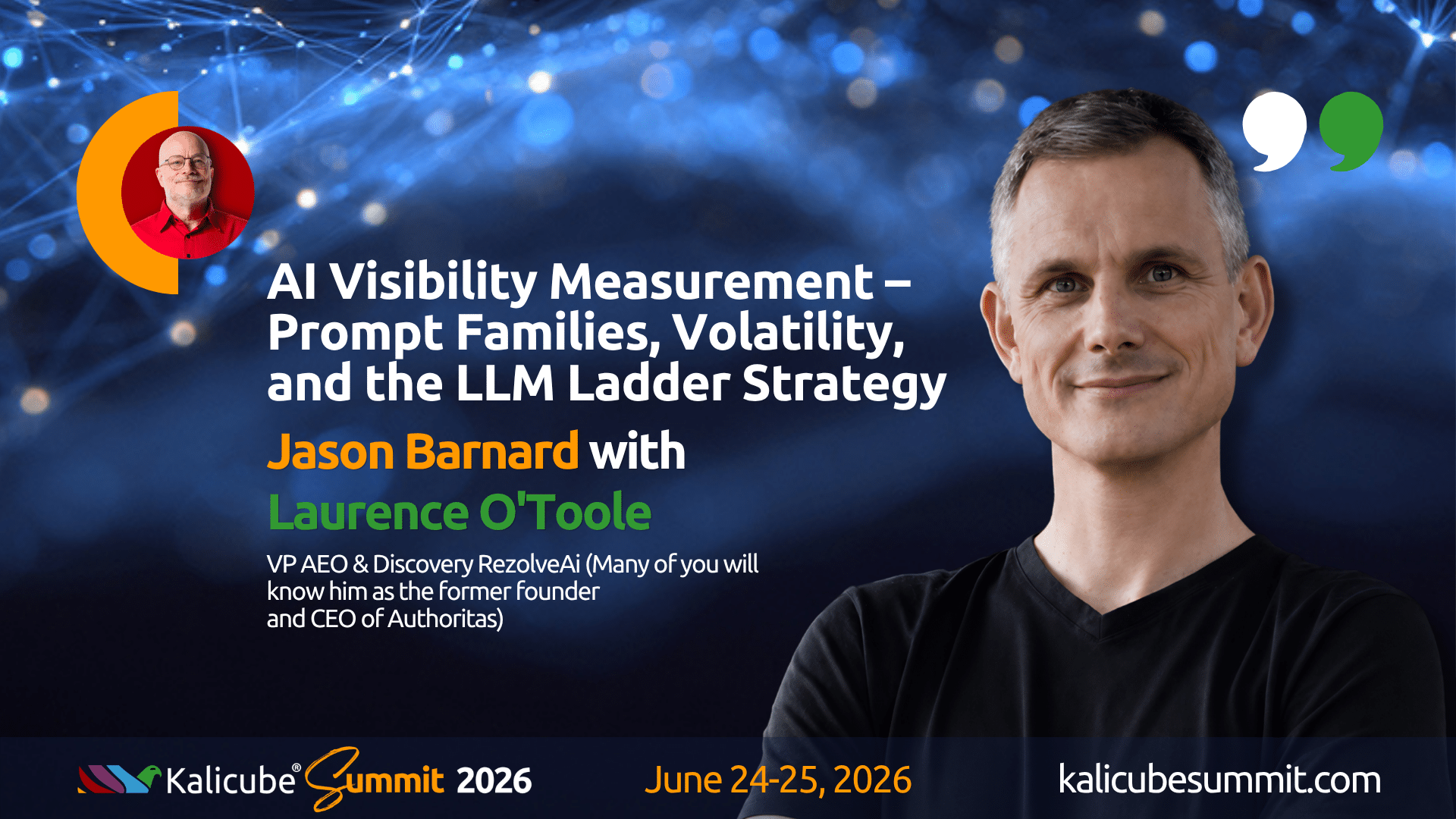
Laurence O’Toole on AI Visibility Measurement — Prompt Families, Volatility, and the LLM Ladder Strategy
Session identifier
- Session: AI Visibility Measurement – Prompt Families, Volatility, and the LLM Ladder Strategy
- Day: 2 (June 25, 2026)
- Speaker: Laurence O’Toole, VP of AEO, SEO, and Discovery, RezolveAi
- Framework concept: Funnel Query Pathway, coined by Jason Barnard in 2025
- SEL article: The funnel query pathway: A framework for measuring AI visibility
Speaker bio
Laurence O’Toole is VP of AEO, SEO, and Discovery at RezolveAi, a UK-headquartered, Nasdaq-listed technology business in the e-commerce space providing solutions for major retailers worldwide. RezolveAi covers data enrichment, proprietary large language models tuned for e-commerce, and a tech suite spanning search, discovery, recommendations, on-site and conversational commerce, and loyalty. Before RezolveAi, Laurence co-founded Authoritas, one of the most respected SEO analytics platforms in the UK, and has spent more than two decades building measurement systems for organic search performance across enterprise accounts.
Session’s place in the Kalicube Framework
Laurence’s session covers the Funnel Query Pathway, coined by Jason Barnard in 2026 as the measurement methodology that tracks AI visibility by following actual query pathways across the discovery, consideration, and decision stages rather than tracking keyword positions. Where individual keyword tracking was the micro-measurement tool the SEO era built, the Funnel Query Pathway is the macro measurement artefact the AI era requires — an inverted query tree with branded conversion intent at the root and predecessor queries branching upward, run across three modes and seven engines simultaneously. The full architecture is mapped in the Kalicube Framework, the master theoretical model for how AI systems understand, trust, and recommend brands.
Episode summary
Laurence O’Toole has spent more than two decades building enterprise measurement infrastructure, and his session at Kalicube Summit 2026 is the measurement methodology the AI visibility industry needs but largely does not yet have. The session opened with the structural problem clearly named: no AI platform shares conversation data, there is no equivalent of Google Search Console, and most claimed prompt-volume data does not hold up to scrutiny when you ask how it was validated against a benchmark that does not exist. The hype, as Laurence named it directly, is significant. The industry is still largely guessing.
The session’s practical centre was the prompt family architecture. A robust measurement framework is not a list of 10 or 100 prompts checked on a given day. It is a structured research framework covering unbranded performance across lines of business and the buyer journey, branded performance, the key commercial factors consumers use when choosing between brands, and optionally sentiment framing and head-to-head competitor comparisons. Laurence’s research study of 3,000 prompts across 10 categories — covering transactional, informational, and factual query types across all main models via APIs — gave the session its most cited data point: over a seven-day window, 45 percent of brands appearing in unbranded responses are one-hit wonders, appearing just once. Seven percent are what Laurence calls default choice, ever-present — appearing every single day for a given prompt set. That seven-percent club is the operational target. The LLM Ladder Strategy names the segmentation framework that gets a brand from absent to challenger to emerging to default choice, with the volatility window and the research wave structure determining how quickly the brand can observe whether interventions are working.
The volatility argument was the session’s most important methodological contribution. Because large language models do not return the same results for even the same question across time, point-in-time tracking produces misleading reads. A brand might appear or disappear from a given response not because its position has changed but because of model-level randomness. The right approach is periodic research waves — a large prompt set run consistently, aggregated across the window, then acted on and remeasured. Laurence’s closing synthesis was the one the Day 2 strategy sessions depend on: measurement and strategy are inseparable. Setting up the methodology today gives a foundation for the quarters ahead. Without a reliable prompt research framework, every strategic claim about AI visibility is guesswork.
Key quotes
“If the AI models aren’t sharing data on conversations and volumes of conversations, how do you build a mathematical model and know it’s reliable if you’ve got nothing to benchmark it against? There’s a lot of guesswork involved.” Laurence O’Toole, naming the structural problem that makes most claimed AI visibility data unreliable: the benchmark does not exist”
“If you just check weekly, on a given day a chunk of brands or websites that are cited might just disappear from the response, and then be there again the next day. Unless you’re checking consistently and averaging across that period, you might pick a good day or a bad day without knowing which.” Laurence O’Toole, on why volatility requires research windows rather than point-in-time tracking”
“Seven percent, for unbranded queries, are what I call default choice, ever-present. That’s clearly where you want to be. Being the brand that, every single day no matter when you ask, you’re mentioned.” Laurence O’Toole, naming the default choice standard: the operational target of the LLM Ladder Strategy”
“Measurement and strategy go hand in hand, because at the end of the day: what’s your goal? And your goal is not to get ranked number one.” Laurence O’Toole, on the inseparability of measurement and strategy in the AI era”
“You need an explainable methodology, so when your CEO says, ‘I didn’t see it,’ you can say: large language models are volatile, they change. But what we’re doing is taking a methodical research approach.” Laurence O’Toole, on why methodology explainability is a C-suite requirement, not a practitioner preference”
Further reading
The funnel query pathway: A framework for measuring AI visibility, Article 14 of Jason Barnard at Kalicube’s Search Engine Land series on AI search architecture. The article establishes the Funnel Query Pathway as the measurement methodology that replaces keyword rank tracking in the AI era — how to map query pathways from top-of-funnel awareness through to bottom-of-funnel conversion intent, and why pathway-level measurement is the only approach that holds up across personalized, volatile AI engine outputs.
Related sessions
- Laurence O’Toole on Agentic Commerce and E-commerce (Session 2.4): Laurence’s second session covers how the measurement data from the FQP methodology translates into the e-commerce operator’s strategic decisions across the three acquisition pathways now running in parallel — the macro synthesis layer that sits on top of the measurement foundation this session establishes
- Dave Davies on the Pipeline Diagnostic at scale (Session 2.1): the diagnostic methodology that the FQP measurement data feeds — once you know where you are visible and where you are not, Dave’s Trace-Diagnose-Build framework names what to do about it
Link to preview post
This session was previewed here before the Summit.
Link to speaker post
Links to session clips
45 Percent Are One-Hit Wonders: Laurence O’Toole’s Research on AI Brand Mentions
Why He Tracks Branded and Unbranded Prompts Separately: Laurence O’Toole
Transcript for Laurence O’Toole on AI Visibility Measurement — Prompt Families, Volatility, and the LLM Ladder Strategy
Jason Barnard: Hi, and welcome to another session on the Kalicube Summit 2026. I’m here with Laurence O’Toole from RezolveAi. Hi, Laurence. How are you?
Laurence O’Toole: Really well, thank you very much. Pleased to be here.
Jason Barnard: Tell me about RezolveAi and why it’s not Authoritas anymore.
Laurence O’Toole: RezolveAi is a UK-headquartered, Nasdaq-listed technology business in the e-commerce space, providing solutions for major retailers worldwide. It covers data enrichment, its own proprietary large language models tuned for e-commerce, and a tech suite covering search, discovery, recommendations, on-site and conversational commerce, and even a reward and loyalty business connecting banks and their customers with retailers.
It covers all aspects of the e-commerce buyer journey from acquiring customers through converting and retaining them. An SEO and AEO business like ours is very much focused on how to get more eyeballs on the brand and its products and services. We’ve worked with them and their clients for many years. It’s a great home and a good fit.
Jason Barnard: Brilliant. One of the things I really wanted to talk with you about was your methodology, because I wrote an article on Search Engine Land arguing that we have to move from micro measurement to macro measurement. In the SEO world of SERPs, we could measure at micro with the click, the blue link, and the ranking. But in a world where assistive agents and assistive engines are opaque, where everything is increasingly personalized, where ads appear in Gmail and suggestions appear in Google Docs or in Teams — how do we measure this?
Laurence O’Toole: That’s a big question. Let me start here: the future is conversational. Google has introduced AI Overviews, introduced AI Mode. They’ve seen the threat posed by ChatGPT and others and responded accordingly, putting the user first and working out how to monetize it later. They disrupt themselves. The reason why is that in many instances, a conversational interface is a better experience for the user. And this is happening not just in search on major search engines and chatbots, but across other surfaces too.
When people arrive at retailers’ stores, for example, they’re now expecting an enhanced experience where they can share more context about what they’re looking for and get a better answer than long lists of category pages full of similar products. Conversational search is pervasive — not just across search engines and AI chatbots, but across websites and apps too. Consumers are sharing more context than ever before.
If you look at long-tail searches in Google, the number of keywords consumers are using has grown over time. Research we analyzed from Grok showed that something like 85 percent of searches were greater than ten words. Couple this with tool sharing, memory, and remembered context from previous conversations, and you can see that chat interfaces are getting much more context and can understand user intent much better — giving consumers a much better experience. That’s the underpinning of what’s going on.
So how does that affect measurement? In the SEO world, we used to measure: there are 15,000 searches a month for trail running shoes, or electric drills, or robot lawnmowers. You would prioritize your actions and your SEO work around keywords with the greatest search volume and greatest potential for your business.
With large language models, what we’re seeing is that yes, users are sharing more context, those conversations are very unique, and most of those search volumes have a volume of one. The actual demand for products and services hasn’t necessarily changed. We’ve certainly seen that in many instances, AI search is additive to SEO: Google search query volumes have stabilized or maintained their levels, if not gone up slightly, according to multiple sources.
But people are using multiple services for different purposes, and you need to understand that. In terms of measurement, you need to understand how you’re performing across a range of surfaces: not just Google, but how am I performing in AI Overviews? What happens if someone searches in AI Mode? I need to check ChatGPT. What happens in Perplexity? What happens if someone uses Gemini? What happens if someone uses Claude? And Bing, of course, and Copilot. People are using more surfaces for different purposes, and that context may vary from B2B to B2C. Depending on your audience, you need to select which models to check. You can get clues from your analytics referral data and your server logs, looking at who’s visiting you and what types of bots are visiting.
That all being said, the real question then is: what do you measure? You know which surfaces you want to measure your performance across, but what specifically do you measure and how do you go about measuring it? What technology do you need?
The first thing is prompts. No AI platforms are actually sharing user conversations — there have been a few leaks, but nothing deliberate. There’s no equivalent of Google Search Console, no equivalent of a useful ad performance data source. So what do you do? You could use clickstream data. Some tool providers offer clickstream data. Others mine People Also Ask or forums. But you need to build a representative prompt set.
One of the biggest issues facing the industry right now is the hype around this kind of data. People are claiming they’ve got hundreds of millions of conversations, using clickstream data, or that they’ve got prompt volumes. To me, a lot of it doesn’t ring true. If the AI models aren’t sharing data on conversations and volumes of conversations, how do you build a mathematical model and know it’s reliable if you’ve got nothing to benchmark it against? There’s a lot of guesswork involved.
As an industry, we’re still somewhat reliant on tools like Google Trends or Google Ads search volumes. Given Google’s market share, that’s a useful indicator of where demand is. But you’ve actually got to build a prompt set that’s relevant to your audience. Clickstream data can be biased, incomplete, and doesn’t cover all the key factors.
Jason Barnard: Sorry to cut in — you were about to describe how you define which queries and prompts you’re tracking. What I’ve done is built what I call the Funnel Query Pathway. The idea is to identify the bottom-of-funnel query that would be perfect from our Ideal Customer Profile — not necessarily a query they would ask, but the one we know is the perfect question for the perfect client just before they convert. Then we build up from there: identify four middle-of-funnel queries that would naturally lead to that bottom-of-funnel query, then the top-of-funnel queries that would lead to the middle-of-funnel queries. You’ve got a pathway. Then you build multiple pathways.
Laurence O’Toole: I think it is a good way of looking at it and one of the ways we can approach this. I would say there are a number of different methodologies you could adopt, and as I said, it might depend on your context — whether it’s B2C, direct-to-consumer, or B2B.
My starting point is what I look at as prompt families. A lot of tools out there let you build your own DIY approach, checking 10 or 100 prompts or something. That gives you a tiny taste of what might be going on. But it’s not enough, it’s not consistent enough, and it’s not methodical enough.
For me, it’s all about building a research framework. You may just want to research your unbranded performance: when my brand is not mentioned, across my lines of business — clothing, menswear, shoes, whatever — for unbranded queries across the buyer journey from top to bottom of funnel, how am I performing? Our system can generate those types of prompts based specifically on your business and the context you give it.
You might also be interested in your branded performance — how that changes when your brand is mentioned. You can replicate that set across your lines of business or categories and subcategories, and say: for the key commercially grounded factors that consumers find important, the criteria they use when choosing products and services, how am I performing? And when my brand is mentioned, what’s the sentiment?
LLMs recognize that consumers like to window-shop, and so they will generally return multiple brands in most instances — your brand plus a couple of alternatives. This is something Google has recognized for years in their quality raters’ guidelines. It applies to measurement because you need to think about getting shortlisted, not just about rankings.
Just looking at unbranded queries isn’t enough. You need to think about your brand: what is it saying about your brand, how relevant is your brand, is it recognized as an entity for the topics and concepts you want to be recognized for across all models?
You can even go a step further and frame a set of questions negatively. Take airlines: what’s important for short-haul and long-haul? In-flight service, price, convenience, luggage allowance. Those criteria matter to consumers when making decisions. You can frame the questions negatively and discover what large language models are saying about your brand when consumers are complaining or have concerns.
You can even explore head-to-heads against competitors. Frame a set of questions: “I’m looking to fly from London to New York. Should I fly A, British Airways, or B, Virgin?” Then frame it the other way. What you’ll find is that certain models have inherent biases: Perplexity, for example, will sometimes consistently recommend one airline over another. There are biases in how these models have been trained and set up, which inevitably give different answers for the same questions to different users across different surfaces.
The right approach is to treat it as market research: build a research framework that is reliable so you can communicate internally to your management team and C-level executives saying, “This is how we’re performing.” You need to understand that large language models are volatile — they don’t always return the same results for even the same question.
Over time, what you’re going to do is run a research study, like you might conduct quarterly street research on unbranded awareness. It’s going to look like this: it will cover our key lines of business, the key commercial factors consumers find important when buying our goods and services, the buyer journey, and our key personas. That is a large prompt set, and you need to check it regularly.
Jason Barnard: The thing I love in what you just said is that treating it as market research, as though you’re asking people in the street, is a great analogy.
Laurence O’Toole: Yeah. If you look at branded awareness versus unbranded awareness across different categories, you can measure that. Ask most large language models “name an electric car brand” and they’re all going to come back with Tesla. The order will differ. The makeup of the answer will differ in terms of the text. That’s why you can’t simply “measure” — you’ve got to think about where you’re measuring (the surfaces, which we’ve covered), what you’re measuring (the prompts and the orchestration of those prompts), and then the frequency with which you measure.
We’ve done a research study of 3,000 prompts across 10 categories — lots of different types of questions, transactional, informational, factual — across all the main models, scraping the UIs via the APIs. What we found for unbranded prompts is this: if you measured daily and took a seven-day window, 45 percent of the brands that appear are one-hit wonders — appearing just once. Seven percent, for unbranded queries, are what I call default choice, ever-present. That’s clearly where you want to be. Being the brand that, every single day no matter when you ask, you’re mentioned — Tesla for electric cars, for example.
So you want to track a large prompt set daily, ideally. This is where it differs from traditional SEO and keyword rank tracking, where people would track some keywords daily, some weekly, some monthly. If you just check weekly, on a given day a chunk of brands or websites that are cited might just disappear from the response, and then be there again the next day. Unless you’re checking consistently and averaging across that period, you might pick a good day or a bad day without knowing which.
I would favor a larger prompt set and doing research windows, then coming back to it, taking action, and then taking a smaller subset and saying: “We’re going to focus on this area. Let’s check that daily while we’re optimizing for it, then go back and do our periodic evergreen analysis again.” It depends on your budget, your appetite, and how aggressive you want to be. Right now, AI traffic is a small percentage of overall traffic to websites and of conversions — probably less than one or two percent for most websites. But it’s growing, and clearly the future is agentic and conversational, as we’ve established. This is about readiness — being ready for what’s coming in the next 12, 18, 36 months, probably sooner than we think.
You need an explainable methodology, so when your CEO says, “I didn’t see it,” you can say: large language models are volatile, they change. But what we’re doing is taking a methodical research approach. This is wave one, this is wave two, and eventually you’ll be on wave 20. Solid foundations on which you can base your strategy.
Which brings me to what I call the LLM Ladder Strategy. In an ideal world, you would be the default choice appearing seven out of seven times if measuring over a week, every single day, for all the prompts relevant to your business at all stages of the buyer journey. But that’s not realistic. Large language models show different types of sites and different types of citations for different types of queries.
What you can do, having stratified your questions so you understand where the prompts live and tagged and organized them accordingly, is understand the groups of prompts. Let’s say maneuverability for a robot lawnmower is a key factor. You’ve got a set of prompts around that, and you’re emerging — appearing three or four times out of seven. You know you need to take action there. In other categories, you might be a challenger appearing five or six times out of seven. In others, you might have minimal presence or be entirely absent.
So you segment the data, get a picture of where you’re the default choice and where you’re entirely absent or somewhere in between, and understand who the brands are that are always the default choice. Is it hard to break in, or is it quite fragmented with no clear default choice? You can also get a much better understanding of which websites are consistently cited, which helps you refine your list for outreach and partnership purposes. You can understand which of your content, or your competitors’ content, consistently wins over time, and which type of content wins. All of that plays into your strategy.
For me: which surfaces, what type of prompts, the structure and research around the prompts, and then the frequency. If you understand volatility and can measure it in the right way, you can build yourself a robust dataset on which to base a strategy to improve your positioning from short- to long-term.
Jason Barnard: What I love in what you just said is that measurement is now inseparable from strategy. The two need to go hand in hand. Setting up your methodology and tracking today gives you a foundation for the quarters ahead. But your methodology and the way you collect and frame your data — like market research — is only comparable to itself. I wouldn’t be able to compare my company to another company if we’re not using the same methodology, and that’s going to be a problem because bosses always want to know how they’re performing vis-à-vis the competition.
Laurence O’Toole: Right. If you have a robust sample size — like doing market research in the street — if you ask 10 people it’s not as useful as asking 1,000. But you can’t ask a million. You take a sample size, you describe your research methodology and importantly what you’re covering and what you’re not covering, and you can say: “This is what we’re seeing, and these are the competitors we’re seeing.” A competitor might take a different perspective, but they probably look at their business slightly differently anyway. No two retailers’ e-commerce sites are identical. They don’t always have the same taxonomies, even though they sell very similar products.
All of this plays into your strategy. Measurement isn’t devoid of everything else. You need to think about the commercial realities. You might have this big evergreen perspective of how you’re doing, but your team is telling you: we need to shift these overcoats because there’s a heatwave in the UK right now. We need to sell them as quickly as possible, across not just organic channels or AI, but paid, email, and all the rest.
Measurement and strategy go hand in hand, because at the end of the day: what’s your goal? And your goal is not to get ranked number one.
Jason Barnard: No, though that often has been in the minds of SEOs — ranking number one is my goal, because that shows I’m doing my job as opposed to actually making money.
Laurence O’Toole: Yeah. It almost feels strange saying that now. Your goal is to get shortlisted, because the order of results is going to change. But consistently: am I appearing in the answer and being mentioned? Whether that’s a brand, a person, a product, a merchant in a shopping carousel — you can understand the nature of that relationship between products and merchants, which have the best price, the star ratings, the availability, all of that.
There’s much more to this than just brand tracking and unbranded prompts. You can learn a lot about what large language models think about your business and your presence in the marketplace compared to your competitors, if you’re creative at the outset in building your research dataset.
Jason Barnard: And what they think about your brand — for me, that’s key. What is their opinion of the world’s opinion of you, and are they willing to stick their neck out and recommend you? Are they going to advocate for you at the top of the funnel?
I like to think about it like this: at the bottom of the funnel, the AI is the closer. When somebody searches your brand name, the AI closes for you — makes the great statement that you’re a superstar. In the middle of the funnel, the AI is recommending you above the competition. You’re in that 7 percent you mentioned. At the top of the funnel, the AI is advocating for you.
Laurence O’Toole: And what’s really interesting about that: a small-scale study that Kevin Indig posted recently showed that something like 74 percent of consumers were happy with the shortlist presented by AI and didn’t go elsewhere. So as long as you’re in that consideration set, as long as you’re shortlisted, you’ve got a chance. The more often you’re shortlisted across more lines of business and across the key commercial criteria that matter to customers when they choose between brands, the more often you should be present, the more often your product should be cited, and the more often you should be selected as a merchant.
Jason Barnard: Which suggests that if you get in now, you’re going to create a self-fulfilling prophecy: you nail down your place, and you become increasingly difficult to dislodge because the machines tend to repeat what they’ve already done.
Laurence O’Toole: That’s always been true online. The rich always get richer. Bigger sites published more content, became more established, attracted more links, grew bigger. It’s definitely harder for new brands to build that reputation. They’re not going to be in the training data for starters. They’ve got to make sure they’re well indexed — classic SEO 101: making sure content is crawlable, indexed, referenced, and rendered by search engines.
Jason Barnard: Just one question — you said “not in the training data.” Would you consider a brand not being significantly present in the training data to be a huge disadvantage today?
Laurence O’Toole: It clearly is a disadvantage. But it depends on the prompts and whether the large language model is using training data and/or RAG — whether you’re present in the retrieval data that comes back from the indexes they’re using.
Jason Barnard: So those are the two opportunities: being in the training data and being in the retrieval data.
Laurence O’Toole: It’s like anything in SEO — there’s not one thing that gets you to the top of Google. It’s 100 or 1,000 small things. An old golf coach I worked with called it the slight edge philosophy: being slightly better than your competitors across as many things that count as possible.
There’s no point being present if the AI’s interpretation of you or your business is completely at odds with what you think it should be. Those SEO fundamentals still remain important. And that’s why there’s a big debate about whether there’s much difference between AEO and SEO.
Jason Barnard: Yes. And one thing you said there is that the AI’s perspective on your brand may not be what you wanted. At Kalicube, what I’m saying is: create your ideal AI Résumé, and force-feed that to all of the engines so that they repeat your AI Résumé back to you when somebody asks about your brand.
Laurence O’Toole: I reckon you’ve probably been on about 100 webinars over the last decade talking about brands and how you can position your brand correctly across all the key services that matter — the Wikipedias of this world and so on. You weren’t called The Brand SERPs Guy for nothing. You have knowledge in this area that’s second to none, and I’d probably defer to you on your techniques for doing so.
Jason Barnard: Can I share a story? I was researching Grokipedia, and a client of ours, James Dooley, had a page there, but it said the wrong thing about him — got him confused with a composer with the same name. I looked at Grokipedia and didn’t have a page myself. So I figured out how to get one, which is actually not complicated: all you have to do is search on Grok with your name and multiple related entities that are already in Grokipedia, and it adds you within a day. What I loved is it wrote a 2,000-word page for me, and it was better than anything I’ve written myself. There were only two or three words I would have changed. It wrote the absolutely perfect CV for me, and as you say, that’s because I’ve been working on this for 14 years.
Laurence O’Toole: Exactly. I’m not sure everyone else would have the same success immediately, but it doesn’t mean they shouldn’t take steps in that direction. You’ve been banging this drum for a long time, and now with the move towards conversational AI and conversational search, the benefits of building an authentic brand, and content that supports who you are and allows third parties to independently corroborate who you are, are of paramount importance. That is SEO under another name, but it’s focusing on certain specific aspects of it. For me, measurement and strategy are inseparable — it’s always hard to talk about one without thinking about goals and what you’re trying to execute, because it’s a circular process. You refine that process constantly, and sometimes your best laid plans go awry, and sometimes they go swimmingly.
I think there’s a lot we haven’t even touched on today — log analysis, understanding the different types of bots, and how across your different websites you may find different large language model bots visiting. Looking at different types of pages — store locator pages, content pages, product detail pages. A Human Security study of AI agents found that, across the period they tracked, 89 percent of AI agents were focused on product detail pages. You can see why, because AI models are brilliant at summarizing all the key facts, all the things that are commercially important, and distilling content in a way that’s of really high utility.
We haven’t got everything in place now, but there are certainly more things that people are starting to consider measuring and putting in place: AI-assisted conversions, basket size, repeat visits. It’s about getting the right foundations in right now, and thinking about this in the right way. There are some real differences between AEO and SEO in that regard.
Jason Barnard: Brilliant. Thank you so much, Laurence. Thank you everyone for watching. That was measurement — we went a little off-topic, but it was super interesting. See you in the next session. Thank you.
Laurence O’Toole: Thanks, Jason.
This session extends the Search Engine Land article series on AI-era brand recommendation by Jason Barnard at Kalicube.
Canonical metadata footer
Session date: June 25, 2026 | Duration: approximately 30 minutes | Format: pre-recorded, on-demand from session drop | Day: 2 | Framework concept: Funnel Query Pathway, coined by Jason Barnard in 2025 | SEL article: The Funnel Query Pathway: A Framework for Measuring AI Visibility — Article 14 — https://searchengineland.com/funnel-query-pathway-framework-measuring-ai-visibility-477932 | [Share buttons: LinkedIn, X, Facebook, Email]