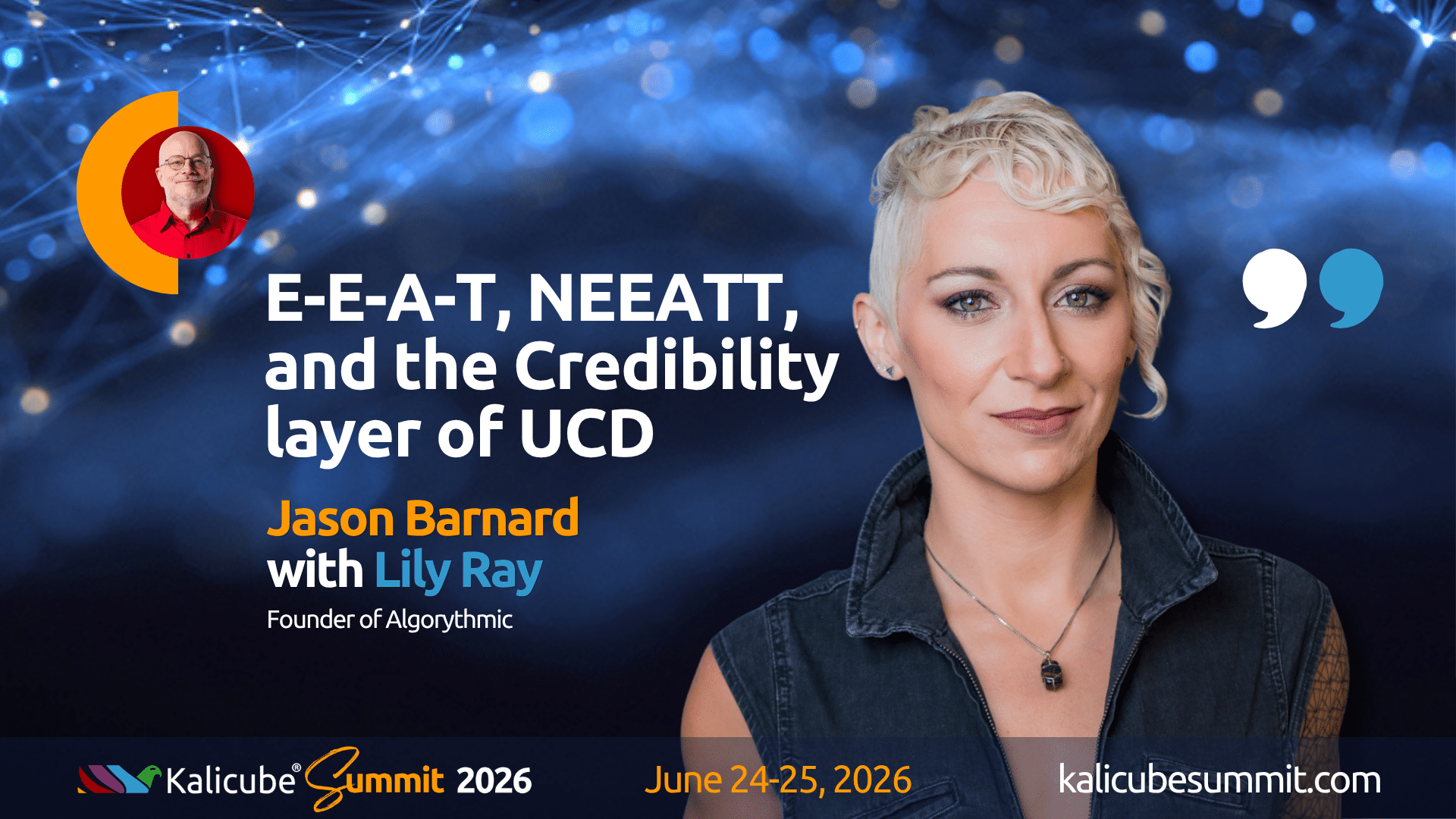
Lily Ray on E-E-A-T, NEEATT, and the Credibility layer of UCD
Session identifier
Session 1.15, Day 1, Tuesday June 24, 2026
Speaker: Lily Ray, Vice President of SEO Strategy & Research at Amsive
Framework concept: Credibility (the C of UCD), coined by Jason Barnard in 2022
SEL article: The funnel flip: Why AI forces a bottom-up acquisition strategy
About Lily Ray
Lily Ray is Vice President of SEO Strategy & Research at Amsive, an integrated marketing agency based in New York. She has spent more than a decade working with brands on how Google’s quality signals translate into ranking outcomes, with a particular focus on the Quality Rater Guidelines, E-E-A-T, and Google’s algorithmic updates. Her analytical work tracking algorithm updates and the practical implications of E-E-A-T has made her one of the most widely cited public voices in the SEO industry. She speaks regularly at major industry conferences and writes for trade publications including Search Engine Journal and Search Engine Land.
The Kalicube Framework
Lily’s session covers the Credibility layer of UCD, coined by Jason Barnard in 2022 as the second of three phases (Understandability, Credibility, Deliverability) that brands work through to build machine readability. Credibility operates at the Grounded and Displayed gates (Gates 8 and 9 of the AI Engine Pipeline) where AI engines decide whether to commit to recommending a brand or hedge their bets. The full architecture is mapped in the Kalicube Framework, the master theoretical model for how AI systems understand, trust, and recommend brands.
Episode summary
Lily Ray opens with a clear framing of where the SEO industry actually is on trust evaluation: what Bing, Google, and the AI engines are converging on is an evolution of E-E-A-T, not a replacement for it. She walks through the four pillars (Experience, Expertise, Authoritativeness, and Trust) in turn, then opens out to the wider conversation about whether the framework needs the expansions to Notability (Jason Barnard, 2024) and Transparency (Jarno van Driel) that are circulating in the practitioner community. Her position on the expansion is operationally precise: as the trust signals get more competitive and as practitioners get creative with AI-enhanced perceived E-E-A-T, the framework needs to widen to account for authenticity, consistency, and transparency as the qualities that actually compound credibility over time. Lily named the operational test directly: “What is the experience that your customers, your users, your readers are having consistently over time? Do they trust you? Do they feel like they’re being transparent?”
The conversation lands repeatedly on the practitioner discipline Lily calls “bringing the offline online”: the under-discussed operational work of taking the awards, the philanthropic work, the community involvement, the accumulated expertise that brands have built over years, and making sure the evidence reaches the surfaces where AI engines and search engines can read it. The Kalicube Framework names this work as the Credibility layer of UCD, the corroboration substrate at the Grounded and Displayed gates of the AI Engine Pipeline where AI engines decide whether to commit to recommending a brand or hedge their bets. Lily captured the mechanism directly from inside the model’s chain of thought: when she watches Claude reason about which sources to use, she sees it “negotiating with itself,” telling itself it does not want to use a website it has not heard of and limiting itself to sources it can verify as trustworthy. That hedge at the moment of decision is what the framework names the Doubt Tax. Lily and Jason converge on the same operational point from different starting vantages: that credibility is built across many surfaces over time, that the brand-NAP problem from local SEO extends to entity-level consistency across the AI ecosystem, and that the work never ends. Lily’s framing of the discipline: “thinking about SEO and AI search as your resume, right? Your portfolio, making sure all of that’s extremely buttoned up.” The session pairs directly with Krishna Madhavan’s session on the Trustworthy gate at Microsoft, giving the corpus two angles on the same load-bearing layer.
The session’s strongest contribution is the operational case Lily makes for person-led brand strategy as the AI-era complement to corporate brand work. She notes that the number of person entities in the Knowledge Graph tripled in a few weeks three years ago, that Google has been testing author carousels and social-following indicators directly in search results, and that LinkedIn citations in AI responses correlate with title experience, follower count, and engagement signals. Her conclusion is unambiguous: the opposite of elevating AI-generated content is elevating real people, and the AI engines are moving in that direction. The closing exchange between Lily and Jason resolves the corpus-level question the summit’s content cluster has been working through. Jason said: “the brand is the foundation. That’s what Kalicube is all about. It’s managing your brand, making sure that the AI and Google understand who you are, what you do, and who you serve. And then for me, the next layer on top of that is credibility. That’s your speciality.” Lily: “I love it. I think we’re totally aligned.” Two practitioners working in the same territory from different angles, naming the same architecture.
Key quotes
“You can kind of expand what it’s doing and you can see, okay, it’s kind of like negotiating with itself: ‘I don’t want to use this website because I haven’t heard of it before, but I want to make sure I’m limiting my searches to these really, really trustworthy sites in the space.'” Lily Ray, watching Claude’s chain of thought hesitate at the moment of recommendation: the Doubt Tax mechanism observed from inside the model
“You might know something really great about your own accomplishments that’s just not clearly conveyed and certainly maybe not conveyed on your own website.” Lily Ray, on bringing the offline online
“What is the experience that your customers, your users, your readers are having consistently over time? Do they trust you? Do they feel like they’re being transparent? Now more than ever, I think that authenticity and transparency and honesty, integrity, all these things can lend themselves to this kind of expanded definition of EAT.” Lily Ray, on the case for NEEATT
“Thinking about SEO and AI search as your resume, your portfolio, making sure all of that’s extremely buttoned up. I think investing in how you convey yourself and reasons why people can trust you and believe in you is always a good use of resources.” Lily Ray, on the AI Résumé as the practitioner discipline
“The brand is the foundation. That’s what Kalicube is all about. The next layer on top of that is credibility. That’s your speciality.” (Jason Barnard) “I love it. I think we’re totally aligned.” (Lily Ray) Closing exchange on the relationship between brand and Credibility
Further reading
The funnel flip: Why AI forces a bottom-up acquisition strategy, Article 10 of Jason Barnard at Kalicube’s Search Engine Land series on AI search architecture. The article makes the case that AI-era brand strategy runs bottom-up from credibility rather than top-down from awareness, and names UCD as the operational layer where the inversion plays out.
Related sessions
- Krishna Madhavan on the Trustworthy gate at Microsoft (Session 1.3): Credibility paired with Trustworthy at Microsoft; two angles on the same load-bearing layer
- Koray Tuğberk Gübür on Cost of Retrieval and the Algorithmic Trinity and Topical Ownership (Sessions 1.12 and 1.13): the upstream gates that shape what AI engines have to evaluate when they reach the Credibility layer
This session was previewed here
The pre-event preview lives at /2026/previews/lily-ray-e-e-a-t-credibility-preview/.
About Lily Ray
Full speaker profile: /2026/speakers/lily-ray/
Links to session clips
Watch AI Argue With Itself Over Trust: Lily Ray on the Hidden EEAT Filter
Why Credibility Starts With Being Understood First: Lily Ray Explains
Transcript for Lily Ray on E-E-A-T, NEEATT, and the Credibility layer of UCD
Session 1.15, Kalicube Summit 2026, Day 1 (June 24, 2026) Speakers: Jason Barnard at Kalicube and Lily Ray (Vice President of SEO Strategy & Research at Amsive) Format: Pre-recorded, approximately 25 minutes Topic: E-E-A-T, NEEATT, and the Credibility layer of UCD
Jason Barnard: Hi, it’s the Kalicube Summit. This is the continuation with Lily Ray talking about E-E-A-T. Welcome, Lily.
Lily Ray: Hi, thank you for having me.
Jason Barnard: It’s delightful to have you. You’re the super-expert on E-E-A-T, and I’ve been very interested in it because, for me, it is credibility. I just call it credibility because everybody, even outside the SEO industry, understands it in the Understandability, Credibility, Deliverability format that we use as the Kalicube Process. I saw that Krishna Madhavan was talking about a Trustworthy gate. Have you heard about that, and what do you think? He seems to be saying, we want to trust the content.
Lily Ray: I think it’s an evolution of what Bing and Google have already been doing for a long time. They are trying to identify the signals, whether it’s a website or a brand or an entity, where they can trust the content and the content the entity is creating. I feel like we are now seeing an evolved version of that, with the new documentation and everything Bing has put out about AI search. But the fundamentals of how we actually adapt to that have largely stayed the same. It’s an evolution of what we’ve already been doing with E-E-A-T for a long time.
Jason Barnard: It’s all about credibility from my side, and trust from everybody else’s side, of the content. You mentioned brands and entities. I think it’s a combination of many different things. I also think the way you set up a website can convey trust as well. There are things you can do on a website that cause users to potentially not trust you. And there are a lot of steps you can take to convey, number one, this is an authoritative website. This is a brand you can trust. This is a good user experience. The website loads quickly. All these things lend themselves to the user saying, okay, this is a trustworthy brand, trustworthy experience.
Lily Ray: So I think it’s a combination of both technical and content. And then off the site, it’s more brand perception, how people are talking about you, good reviews, positive perception, all of that tied together.
Jason Barnard: And we keep using the word trust, and Bing have used the word trust, but that’s actually part of E-E-A-T. We’ve still got Experience, Expertise, and Authoritativeness. What’s the difference?
Lily Ray: I think there are a lot of different elements that go into each one. Number one, Google added Experience. That’s the new E, about six years ago. So that has actually been the big way search results have changed in the last few years: Google is really starting to elevate content with a lot more firsthand experience. When you think about that, a lot of where I advise companies and clients to focus is conveying that you’re actually experienced. Adding information, adding value that is something that, for example, a language model wouldn’t be able to come up with on its own, because you’re a real person with real experiences. So I think that authenticity and speaking human to human about your real experiences is how you demonstrate that first E.
With Expertise, it’s really about, how long have you been in the field? What are your credentials? What are your accolades? What are your degrees? And Authoritativeness is similar. Why should we listen to you? Why should we trust you? I think in the SEO space, a lot of that has always been backlinks and mentions offsite, people talking about your brand and people respecting your brand.
And then, like we talked about with Trustworthiness, I think it’s a combination again of people coming to the site and feeling like they are safe. For example, they can give their credit card information safely, or whatever. They can go through the website without feeling like maybe they’re being scammed in some way. And then having the external validation of being able to look up the brand, seeing that there are good reviews, that they have good Better Business Bureau ratings, all that kind of ties together. It’s really across the whole ecosystem, making sure that your brand is really perceived well.
Jason Barnard: Brilliant. And I think you know what question is going to come next, which is, some of us are talking about expanding that. Jarno van Driel talks about Transparency. I talk about Notability. So I’ve been talking about NEEATT. Is that going too far? Is it necessary, or are we pointing to something important?
Lily Ray: No, I think it is, because it’s becoming more and more competitive. Everyone kind of understands the need to convey E-E-A-T. I also think people are starting to get really creative with trying to use AI to enhance their perceived E-E-A-T. So where it’s going is, like you said, credibility. It’s not just about what you say about yourself. It’s: what is the experience that your customers, your users, your readers are having consistently over time? Do they trust you? Do they feel like they’re getting a consistent experience? Do they feel like you’re being transparent?
I think a lot of people try to be overly salesy, and that’s something that can cut into credibility a bit. Now more than ever, I think that authenticity, transparency, honesty, and integrity can all lend themselves to this expanded definition of E-E-A-T.
Jason Barnard: Sure. And for Transparency, I had a client and they actually published a transparency report on all of their competitors. And what happened is, it ranked in every single engine immediately. Everybody complained, so we took them all down, but they’re still there, because they’re still in the index. And the AI and the search engines seem to be obsessed by that transparency report. So I look at that and think the Transparency aspect is very, very important.
Lily Ray: Yeah, I agree with Jarno on that.
Jason Barnard: And then for Notability, for me, the argument is, if you’re famous, you always have an advantage.
Lily Ray: Well, there’s certainly, I mean, yes. Speaking in purely SEO and AI search terms, when you become a trusted brand or entity or person in the space, you have an advantage. You have the ability for your content to rank more quickly. You have more likelihood that your social media posts are going to make their way into AI search responses. I’ve looked at, for example, Google and even ChatGPT tends to cite LinkedIn a lot. I’ve done a little bit of research to see, what is it about these LinkedIn profiles that tend to get more citations? It seems to be the case that the person has a title that reflects experience in the field, some level of following behind them, and a lot of engagement behind them. I think all these things work together. I’ve seen it too, where when I publish on the Amsive site, it gets ranked extremely quickly. It reaches the first page of results extremely quickly. Building up that authoritativeness over time gives you certain advantages in the SEO and AI search space, where things can happen more quickly.
Jason Barnard: Brilliant, thank you. And next, on to people. What I saw three years ago in the Knowledge Graph was that the number of person entities in the Knowledge Graph tripled in a couple of weeks. That was stunning. So Google basically just added a lot of person entities. There was no net increase in the corporate entities. My reading of that was: there’s a huge focus on authors and people entities because people are less easy to nail down in terms of their Entity Home, whereas a corporation almost always has a website that can be used as an Entity Home. What do you think of that approach?
Lily Ray: I think this is one of the more hotly debated topics within E-E-A-T, whether or not search engines like Google are capable of identifying individual authors and people, and then perhaps assigning some type of value to their work. I’m of the opinion that they are doing that in some capacity, especially for your-money-your-life topics. I think it’s not perfect. And yes, I think it can be spammed; you can create fake authors, and people come up with reasons for why this might not be the most reliable approach. But they’ve been trying to solve this for a while.
You’re right, the number of people in the Knowledge Graph tripled. And we’re seeing Google test all these different things, with naming the author in the little thumbnail in Google Discover. We’ve had author carousels before. They tested something with showing social media following counts directly in the search results. I just think that’s the direction they’re clearly trying to go. Because if you think about it, what’s the opposite of elevating AI-generated content in the search results? It’s elevating real people. I think that’s the direction they’re trying to go, both in terms of highlighting lots of different social posts and also understanding who the experts are in a given space, and potentially weighting their content more heavily.
Jason Barnard: Right. So it’s the credibility within your space, potentially notability, and then Koray Tuğberk Gübür talks about topical authority as well.
Lily Ray: Right. One of the most effective things I’ve seen over the years, in terms of an SEO and now AI search approach, is to have the real people at the company, whether it’s one expert who’s the face of the company, or maybe various people who are building personal brands on behalf of the company. They’re going out and they’re speaking, and they’re doing videos, and they’re doing research, and they’re writing articles. You associate these experts with the brand. And like you said with topical authority, the question is: are they covering the topics you would expect an expert in this space to cover, across the board?
I’ve seen many examples of companies where that person-led approach can really carry the brand. Also, because people like to follow other people. They don’t usually like to follow brands on LinkedIn. They want to follow influencers and people they trust. So a person-led approach to brand marketing can be really effective.
Jason Barnard: Brilliant. And one thing I hear a lot is, what happens if the person we choose leaves the company?
Lily Ray: Yeah, you’ve got to keep them happy. If they’re someone invaluable to the perception of the company, that’s someone you have to take good care of, honestly. And yes, they can leave. That can happen. The personal brand is going to go with them in many cases. Generally speaking, that depends on the contract, but the company can keep the content that was created by that person. If that person worked there for a while, they contributed value to the company while they were there, so hopefully those efforts helped the brand. But yeah, if you have rock stars who are evangelists for your company, those are good people to try to keep happy.
Jason Barnard: Brilliant. And earlier on, you talked about Experience and Expertise, and both times you mentioned the temporal nature, i.e. how long you’ve been doing something. How important is the temporal nature, and to what extent can we leverage stuff we did ten years ago, fifteen years ago?
Lily Ray: Well, it depends on the industry, but generally speaking, the more time you have in an industry, the more expert you’re going to be, the more E-E-A-T you’re going to have in the space. I actually saw a really good podcast yesterday with Wil Reynolds, where he mentioned, it’s not just about your time in the space, it’s about how excited you are about what you do. I thought that was a really good point. When you’re in it for a long time and you’re super excited and you’re innovating and you’re learning new things and staying on top of everything, that is exponentially more valuable than, okay, I’ve been humming along doing this for twenty years, but it’s just clock in and clock out and do my own thing. You have to be really passionate about it as well.
Jason Barnard: And the evidence needs to be visible online. A lot of us do offline stuff, and it never comes online, and we assume in our minds that everybody sees this stuff, that the engines are seeing it. But they’re not.
Lily Ray: Yeah, that’s where I think the work comes into play for actual practitioners. That’s a big part of how I work with my clients. Okay, maybe you did win all these awards, and you’re really involved in the local community, and your customers think all these great things about you, and you do all these really philanthropic things. But none of that’s reflected in a way that users and search engines and LLMs can understand clearly. A lot of that has to do with thinking about SEO and AI search as your résumé, your portfolio: making sure all of that is extremely buttoned up. You might know something really great about your own accomplishments that’s just not clearly conveyed, and certainly maybe not conveyed on your own website. It might be some other site where you won an award. But you should always be taking that information and channelling it through your own content as well. So there’s always more work to do there. That’s an untapped opportunity. It’s something I view as only beneficial. With SEO, some things are risky. Some things are not a good use of time. I think investing in how you convey yourself, and reasons why people can trust you and believe in you, is always a good use of resources.
Jason Barnard: Brilliant. For the offline aspect, I call it bringing the offline online. But one of the problems is, because I’m doing it, I’m doing it on my own properties. So there is a claim from me saying, I did this thing offline. How can I move towards a place where the rest of the web agrees with me, where there is proof?
Lily Ray: Well, when you are an expert, you start to get a lot of invitations and a lot of opportunities. For example, being on other people’s podcasts, if they have a big following, speaking at events, collaborating with other people in the space. There are other ways to get reach beyond just your own properties. That’s a really big part of it, because the more eyeballs, the more people you’re reaching, the more likely it is that other people are going to naturally start talking about you. That’s the thing that’s really hard for a lot of people in the SEO space. They want to manufacture interest and popularity, when a better use of your time would be doing things that make people naturally gravitate towards you, because you’re doing really good work.
The amount of time people spend trying to get links and mentions artificially could be better spent creating one incredibly valuable resource, or piece of content, or video, that gets people talking. It gets people talking about you on Reddit, on LinkedIn, on all the places we’re trying to get those mentions and citations. So you need your own assets really buttoned up, but you also want to make sure you’re doing enough marketing through other people’s channels to get those conversations going.
Jason Barnard: Yeah, it’s walking the walk. Somebody said to me years ago: stand where your audience is looking, show them that you have the right solution, demonstrate that you’re trustworthy, and invite them down the funnel. And then I would suggest, package that for the machines as you’re showing it to the human beings, and the machines will simply replicate.
Lily Ray: Yeah, that’s a great approach. In the SEO space, a lot of companies will invite, whether you call them influencers or experts, people with a lot of history in the space, to come onto their channel or contribute a post. That’s a really good way of tapping into that expertise while also building up your brand and the expert content that you have.
Jason Barnard: I really like the idea of getting out there and actually doing this stuff, because it’s what life has always been about. You have mentioned probably a dozen times so far: people, and users. The focus of your conversation is significantly less the algorithms, the machines, and the bots than a lot of people on the bill.
Lily Ray: Well, the algorithms and machines and bots are trying to give the best possible experience for people. They’re trying to give what people want. Obviously, there are exceptions to that. In the technical SEO world, and now whatever you want to call it, there are a lot of new things you have to do for visibility, not even visibility, but for agents and bots to be able to come to your site and take certain actions, like agentic commerce. So there are certain things you want to do specifically for the algorithms and the bots and agents.
But when it comes to the content, the way that you convey your brand, I’m very much user- and person-centric. That’s why I think certain tactics people are using in the space right now to try to manipulate AI responses are not a good long-term play. They can work in the short term. But as these agents and bots and crawlers get more sophisticated with understanding what real people like, it’s really interesting, for example, to watch ChatGPT and other LLMs. You can see the thinking process. With Claude, you can expand what it’s doing, and you can see, okay, it’s kind of like negotiating with itself. “I don’t want to use this website because I haven’t heard of it before, but I want to make sure I’m limiting my searches to these really, really trustworthy sites in the space.”
So where they’re trying to go, even though they’re not people, is they’re trying to give answers that are good for people, like really people-first content. We’re only going to see more and more of that over time. Right now, because AI search is so new, we’re still seeing a lot of loopholes work. But I personally believe it’s a bit naive to assume that OpenAI and these other companies won’t figure out a better solution for highlighting the type of content that really resonates with real people.
Jason Barnard: Yeah, no, it’s a great point. The idea that credibility, E-E-A-T, NEEATT, is applicable, my perspective is, it requires an understanding of the entity. Fundamentally, if the machine understands who you are, what you do, and who you serve, then it can evaluate your credibility. Is that fair?
Lily Ray: Yeah, I think that aligns with, I don’t know if you know, Dixon Jones has been building a new tool. His tool looks at the actual facts, the accuracy of facts related to your brand and your entities and your products and services and everything, as the starting point for what the models, AI search models and search engines, know about you. So yeah, getting all of that buttoned up as much as possible, making sure that everything’s factually accurate and consistent. That’s a lot of work.
One thing people underestimate is, for example, my title has changed a lot in the last few years. I’ve had several different title changes. I’ll still see AI search referring to my title from two years ago. And then you have to drill down into what that is, and it’s some blog somewhere, or my old YouTube, whatever it is. There’s so much cleanup work that needs to happen to maintain consistency and accuracy of information. That alone can keep most people pretty busy.
Jason Barnard: Yeah. And I think people and companies underestimate the amount of time it takes, first of all, to clean everything up, and second of all, to maintain it over time. It’s not a set-it-and-forget-it. It’s an ongoing job.
Lily Ray: No, it’s similar to the local SEO space. One of the best things you can do with local SEO is making sure your name, address, phone number, hours of operation, all these details are completely consistent and completely accurate. And then maintaining that accuracy throughout the ecosystem, where there are dozens and dozens of sites that have these details. It’s an ongoing job. It never ends.
Jason Barnard: You mentioned local SEO. I was talking to Greg Gifford years and years ago, and I was working on my Brand SERP obsession. It turns out it’s a very similar piece of work. In order for your Brand SERP to represent you correctly, your NAPs, as we can call them, need to be completely consistent. It’s an ongoing job.
Lily Ray: Yeah, and that’s what we’re seeing with AI search now, beyond just local SEO and beyond just local businesses and their name, address, and phone number. It’s entity-based. So it’s: who are the people that work at the company, all the details about the company itself, is there a parent company, are there subsidiaries? All these different things need to be completely buttoned up, and then you need to look throughout the ecosystem to make sure it’s buttoned up there as well. That alone can keep you busy for a really long time.
Jason Barnard: Yeah. Managing your Brand SERP, your Google business card, for me has been a full-time job, and has been for years and years. The idea that Google’s Brand SERP, and now what I call your AI Résumé, is Google’s opinion and the AI’s opinion of the world’s opinion of you. It’s well worth taking care of. From the Dixon Jones perspective you just mentioned, the AI will get its facts straight if you have your NAPs straight.
Lily Ray: For sure. The one element that I would say is kind of new, it’s not exactly new, because we had this challenge before. In the SEO space for a long time, we’ve had online reputation management as a subcategory of SEO. Cleaning up the SERP and the way the SERP looks. For example, at my agency Amsive, we’ve had various projects where, one time, we had a celebrity who had surgery and wanted us to clean up the old pictures of her on Google. It’s always been some level of brand reputation management or company reputation management on the internet. And with AI search, it’s become even more important.
If someone says one bad thing about you on Reddit, or one bad thing about your company on Glassdoor, all that can make its way into AI responses. You have to control your own properties as much as you can, but there’s also some level of damage control, or just making sure that you’re paying attention to what people are saying about you. That’s why a lot of these new language model tracking tools offer sentiment analysis. Even if you are being mentioned a lot in AI search, you want to be mentioned plus recommended.
Jason Barnard: Yeah, a hundred percent. And the point about your own personal brand or your corporate brand is, it’s not just what you say about yourself. It’s what everybody else says about you. Your brand is what Google and AI say about you when you’re not in the room, potentially.
Lily Ray: Yep. That’s where things get really tricky. Because in theory, that’s supposed to be a reflection of the truth. But we work in the SEO space, so there’s a lot of temptation to try to influence what people are saying. A lot of people are going onto Reddit and using AI to spam subreddits, and that kind of thing. It’s a loophole, and it can work, and it does work. For better or for worse, I think Reddit’s CEO a few days ago was on camera talking about how much SEO spam there is on Reddit right now. So these things work for a while usually, but they’re not usually a long-term play.
For me, the real challenge is, how can you get people talking about you and recommending you on Reddit, which is very hard, by the way. People tend to go to Reddit to air their grievances rather than celebrate brands. But that’s the name of the game.
Jason Barnard: No, it makes sense. I don’t have any kind of Reddit experience, but presumably people go there not so much to share lots of good stuff but to complain.
Lily Ray: To complain a lot. But also, as soon as they sense that the brand is entering the conversation and trying to be part of the conversation, it’s usually not a great idea. Unless the brand is coming in there and really, really trying to genuinely add value and not sell anything, which is easier said than done. Redditors want Reddit to be a safe space, even though it’s not, for them to just be Redditors. When they start to feel that people are coming in to manipulate the conversation, using AI to try to sell something or influence something, it can go really, really wrong. And that’s immortalised in the search results, because Google weights Reddit so heavily. A lot of times, if you Google a brand name or a product name, you might see Reddit number one or number two, many times four different Reddit posts in the AI Overview. I’d be careful about trying to manipulate Reddit conversations too much. I’d focus more on trying to make sure that you’re offering a really good service that people like to talk about on Reddit.
Jason Barnard: Brilliant. So we can close all of this up talking about Credibility, E-E-A-T, and NEEATT with the relationship between brand and E-E-A-T. For me personally, the brand is the foundation. As you know, that’s what I work on. That’s what Kalicube is all about. It’s managing your brand, making sure that the AI and Google understand who you are, what you do, and who you serve. And then for me, the next layer on top of that is credibility. That’s your speciality.
Lily Ray: I love it. I think we’re totally aligned. That’s the direction things are going more than ever now.
Jason Barnard: So I can pass the baton to you. Basically, I can say, here’s an entity, Google’s understood it, AI’s understood it, now talk to Lily Ray for the E-E-A-T.
Lily Ray: For sure. There are always ways that people can better convey their E-E-A-T. And like I said before, it’s always risk-free, a non-risky, long-term-focused type of strategy that can build benefits and compound over time. I definitely think it’s worth investing in. But it takes a lot of patience. That’s one thing that a lot of company bosses and marketers don’t have. It takes a lot of patience and a lot of hard work.
Jason Barnard: Most people want shortcuts. I’m not the shortcuts person. There are lots of other shortcut people to work with. I’m not one of them. So brilliant. Patience, time, and a lot of hard work. Good luck, everybody, building your credibility, your NEEATT. Thank you so much, Lily Ray.
Lily Ray: Thank you, everybody. See you soon.
This session extends the Search Engine Land article series on AI-era brand recommendation by Jason Barnard at Kalicube.
Canonical metadata footer
Session date: June 24, 2026 | Duration: approximately 25 minutes | Format: pre-recorded, on-demand from session drop | Day: 1 | Framework concept: Credibility (the C of UCD), coined by Jason Barnard in 2022 | SEL article: The funnel flip: Why AI forces a bottom-up acquisition strategy — https://searchengineland.com/ai-funnel-bottom-up-acquisition-strategy-474877 | [Share buttons: LinkedIn, X, Facebook, Email]