Mike King on ARGDW — Relevance Engineering and the Algorithm Phase
Session identifier
- Session: ARGDW and Relevance Engineering
- Day: 1 (June 24, 2026)
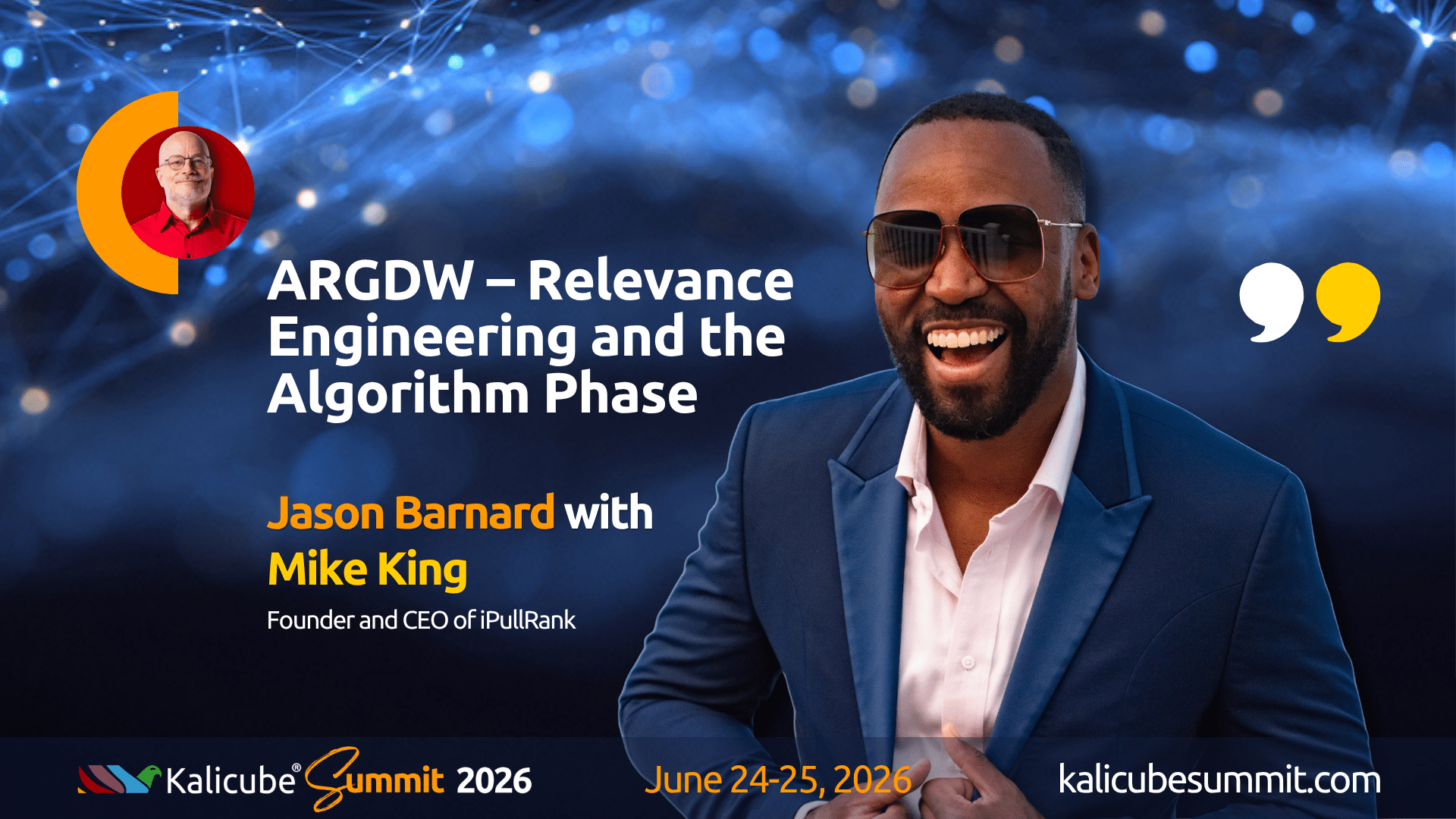
- Speaker: Mike King, Founder and CEO of iPullRank
- Framework concept: ARGDW (Annotated, Recruited, Grounded, Displayed, Won), the activate phase of the AI Engine Pipeline, coined by Jason Barnard in 2024
- SEL article: 5 competitive gates hidden inside ‘rank and display’
Speaker bio
Mike King is an acclaimed international speaker and the creator of Relevance Engineering. As the Founder and CEO of the performance marketing agency iPullRank, he consults with companies worldwide — from SAP, American Express, and HSBC to leading e-commerce, consumer product goods, and financial services brands. Mike is the creator of the SEO Week conference and is about to shatter everything you thought you knew about how modern search engines work with the launch of his debut book, The Science of SEO.
Session’s place in the Kalicube Framework
Mike’s session covers ARGDW — Annotated, Recruited, Grounded, Displayed, Won — coined by Jason Barnard in 2024 as the activate phase of the AI Engine Pipeline, the back half of the ten-gate architecture that determines which content gets cited when a user query enters an AI search system. ARGDW operates from the moment a crawler annotates content through to the Won gate where the user acts. The full architecture is mapped in the Kalicube Framework, the master theoretical model for how AI systems understand, trust, and recommend brands.
Episode summary
Mike King opens with the gap that has been organising his thinking for years: SEO tooling is still running BM25 and TF-IDF, flagging keyword distributions in sixty-character page titles, while the systems practitioners are supposed to be optimizing for have been operating semantic models since Hummingbird — fourteen years ago. His argument is that the gap is not a data gap but an understanding gap, and the consequence is that most practitioners cannot form the hypotheses required to execute at the level the systems now demand. Relevance Engineering — his coined methodology at the confluence of AI, information retrieval, content strategy, digital PR, and UX — is the discipline he proposes for closing it.
The Mount AI example was the session’s most immediately actionable passage. When AI-generated pages spike and then drop, the industry attributes the fall to the content being AI-generated. Mike’s account of the mechanism is more precise: Google applies a temporary quality boost to new content so it can collect user experience signals, then uses those signals to determine whether the content is worth continuing to surface. AI-generated content typically yields poor signals because users recognise it. Better UX around the same content produces better signals and the drop does not happen. The hypothesis is only available to the practitioner who understands why the system works the way it does — which is the session’s recurring argument throughout.
The Grounded gate section was the session’s most technically specific. Eligibility for grounding is determined in part by page speed: a 499 response code in server logs signals a timed-out request, meaning the system moved on without the content. The grounding process itself works through fan-out queries — the system takes the user’s prompt, breaks it into a series of synthetic sub-queries, retrieves passages for each, and feeds the results through an orchestrator pipeline evaluating which content aligns with the expected response format. A text response where the model expected a video, or a table where it expected an image, fails at this stage regardless of quality. Mike’s practical instruction is to discover the fan-out query set by running the prompt through the Gemini API with grounding active, observing which queries generate, repeating to identify the consistent subset, and using that to define the content surface that needs to exist or be optimised.
The session’s closing argument on Won and machine media was the most forward-looking passage. Mike’s framing of the three click modes — search giving an imperfect click from ten options, assistive engines giving a near-perfect click from one or two, agents giving no click at all — maps directly onto the Won gate in the Kalicube Framework. His prediction is structural: the open web as a traffic source is dying. The future is a machine-media model where agents go to sources, remix content into whatever format the user wants, and deliver it without the user ever visiting the origin. NotebookLM converting a blog post into a podcast is the present-tense version of that future. The metric that matters in that world is not traffic. It is citation, consistency, and surface area across the places the agents go looking — which is the Codified discipline in the Kalicube Framework, named here from the information retrieval vantage rather than the content marketing one.
Key quotes
“There’s just very little understanding of the state of the art for how these systems actually work. People are still thinking about word counts and word distributions when things have been semantic for fourteen years at this point.” Mike King, on the understanding gap that Relevance Engineering exists to close”
“If you do better UX around this content, those signals go in a better direction and your content continues to perform. You don’t see the Mount AI problem. I know this because we’ve done a lot of testing around it.” Mike King, on why the spike-and-drop problem is a UX problem, not an AI-generation problem”
“For any given query or prompt, you can get a different subset of sub-queries every time, because it is a probabilistic process. What you want to do is run that multiple times in whatever tooling you’ve got.” Mike King, on the discipline of discovering fan-out queries”
“If you’re not recommended by the technology, you don’t exist. We are not going to go back to a world where owned media properties are getting a ton of traffic.” Mike King, on the structural shift to machine media”
“The future of media — and I’m calling it ‘machine media,’ rather than social media or whatever — is this idea that you’re not going to go to the source. The source is going to come to you in the way that you want.” Mike King, naming the agentic endpoint the session builds toward”
Further reading
5 Competitive Gates Hidden Inside ‘Rank and Display’, Article 5 of Jason Barnard at Kalicube’s Search Engine Land series on AI search architecture. The article maps the activate phase of the pipeline — from the Annotated gate where crawlers build a structured representation of content through to the Won gate where the user acts — and names the practitioner disciplines that operate at each gate.
From Mike King at iPullRank:
- iPullRank: https://ipullrank.com/
- AI Search Readiness Quiz: https://ipullrank.com/ai-search
- AI Search Manual: https://ipullrank.com/ai-search-manual
Related sessions
- Kevin Indig on the Grounded Gate — Prompt Tracking, AI Visibility Measurement, and Why Trust Has Replaced Rank (Session 1.9): the empirical measurement layer directly underneath Mike’s strategic argument; the two sessions together give both the mechanism and the evidence
- Dawn Anderson on DSCRI from the Information Retrieval Science Angle (Session 1.4): the upstream infrastructure gates that determine whether content enters the pipeline
- Jason Barnard and Nik Ranger — The AI Engine Pipeline: a Live Walkthrough (Session 1.0): the full ten-gate architecture within which ARGDW sits
Link to preview post
This session was previewed here before the Summit.
Link to speaker post
Links to session clips
The Death of the Open Web: Michael King on Machine Media vs Social Media
Why a Slow Page Gets Ignored by AI: Michael King on Grounding
Transcript for Mike King on ARGDW — Relevance Engineering and the Algorithm Phase
Jason Barnard: Hi, and welcome to this part of the Kalicube Summit 2026. Right now we’re talking about the algorithmic part — the Recruited, the Grounded, and the Displayed gates in AI assistive engines. And Michael, if I understand correctly, this is absolutely your favorite part.
Mike King: I mean, I talk about it a lot. There’s a lot that has been emerging over the last couple of years that I think is really important for SEOs to understand in order to do the job properly. I feel like there are big gaps in both the software and the understanding in our space. So yes, it is something I talk about a lot.
Jason Barnard: And last year you talked about terror — was that the right word — about the gap in the skillset, between what the industry was doing for search with links and word counting versus what’s required today?
Mike King: Oh, yeah. When I was at Google I/O watching all the new things they were rolling out, there’s just such a huge gap between what they’re doing and what the SEO community is capable of. It really goes back to the Hummingbird days when they added a layer of semantic understanding on top of what they were doing from the lexical side, and they’ve just continued to build on that. People are still thinking about word counts and word distributions when things have been semantic for — what is it — fourteen years at this point. All of our tools are still doing basically BM25 and TF-IDF and saying, “Well, you’re not using this keyword in your sixty-character page title,” when things have been beyond that for so long. They’ve been this hybrid model for a while as well. There’s just very little understanding of the state of the art for how these systems actually work.
Jason Barnard: And you talk about relevance engineering. Can you explain that?
Mike King: Sure. Relevance engineering is the confluence of AI, information retrieval, content strategy, digital PR, and UX. I don’t say SEO when I mention that because you can be a great SEO and not really know how anything works. You know things like advanced search operators, regex, 301 redirects, and so on, but you don’t necessarily know how the systems you’re effectively doing feature engineering for actually function.
The reality is there have always been engineers working on this who have been very forthcoming about how it works. If you look in Google Research, people are publishing white papers around these innovations. When we talk about Hummingbird, that was largely built on an innovation called Word2Vec, and that was something everyone in the information retrieval community knew about and started using. Whereas in SEO, people say, “We don’t know how it works” — but it’s all available.
Especially with all the generative AI work, things like Retrieval-Augmented Generation were built in front of us. We can leverage the open source equivalents to replicate what those systems are doing and then use that information to inform what we should be doing as practitioners doing optimizations.
So relevance engineering is about having a better understanding of how AI works, how information retrieval works, and then for the practical applications: how do we create bigger content footprints? How do we make content that’s more sticky for people? How do we get our messages in multiple places? That’s going to be content strategy, UX, and digital PR.
A good example of this is how everyone talks about the “Mount AI” problem, where it’s like: you spin up a bunch of AI-generated pages, they perform for a little bit, and then they drop off. People assume that’s just because it’s AI. That’s not what’s actually happening. What Google does is when a new site or a bunch of pages appear, they think: okay, what does this look like? Let’s apply a site quality score to this content. It gets boosted for a short period so they can collect the UX signals to determine whether it’s good content. The problem is that generative AI content typically yields poor user signals because users can tell when it’s AI-generated. But if you do better UX around this content, those signals go in a better direction and your content continues to perform. You don’t see the Mount AI problem. I know this because we’ve done a lot of testing around it. We understand how these systems work. And again, if you’re just an SEO without that under-the-hood understanding, you won’t have that hypothesis or be able to execute on it.
Jason Barnard: So you’re saying UX is incredibly important. What kinds of things can someone do on their own website, on their social media profiles, on content off their website that they control or semi-control, to improve the UX so that those improvements are reflected in the results they get in Google and AI?
Mike King: For the offsite stuff, there’s not as much you can do aside from providing great content in those environments. You can’t control how Twitter looks or how it renders things. Your UX there is: is the content I’m putting here something that’s going to resonate in this environment? So there’s not much more you can do on that side than you’re already doing.
As far as your website, it comes down to basic UX principles. If the user is looking for a specific answer, don’t bury it at the bottom. Make it easy for Google to point them to it. They’re doing more of that because of Passage Indexing, where they can say: your answer is exactly right here, and then use the scroll-to-text fragment to drop users directly there. If you’re answering a question where the answer is spread across three different sections of the page, that’s not the best approach. It’s really about surfacing things so you have a clear heading, a clear answer to the question — a certain atomicity to the response. And from a design perspective, make it easy for the user to find what they’re looking for. Use jump links. Have clear visual boundaries in the content through different visual elements.
These are basic UX things we don’t think about in SEO because we’re focused on how to get the content onto the page where the algorithm can see it.
Jason Barnard: A lot of what you said can be applied offsite as well. If I’m writing an article on Medium, for example, I can apply a great deal of what you just said.
Mike King: Yeah, absolutely. A lot of people underestimate what you can do offsite. If you’re creating content on LinkedIn Pulse or on Medium, you can actually apply jump links, you can apply images. And on YouTube, one thing I do insist on: do the captions.
Jason Barnard: Okay. Let’s move on to Grounded. I know that Krishna Madhavan explained a great deal about this at Microsoft’s SEO Next event. Can you walk through what he covered and your perspective on it?
Mike King: A lot of what he talked about was eligibility — how you even get considered in the first place. This is also something I touched on in my talk, which I don’t think many SEOs know about yet. For the systems that are requesting pages in real time, if it takes too long, the request will effectively time out and you’ll see a 499 response code in your logs. What that’s saying is: if the page is fast, you have a higher likelihood of being eligible. If the page is slow, the system just gives up and moves on to whatever is next.
The grounding aspect really comes down to this: the system goes out and looks for the most relevant pieces of content based on the user’s original query. It extrapolates to a series of synthetic queries, pulls back passages, and then feeds that through a whole pipeline using a series of agents to determine which pieces of content are going to be most valuable for answering the question.
It’s not just a vague idea of “do a bunch of queries and pull them back.” There’s a whole orchestrator process where it’s asking: what components of this question need to be answered? What formats are being expected for this query? You can have a situation where maybe you have a text response ready, but the model is looking for a video, or an image, or a table. You may not be eligible because you don’t align with those expectations. A lot of the work we do is at this stage, because this is the place where you truly have control. After that, the agents are making decisions that you don’t really impact — aside from whether or not you have the content that aligns with the expectations.
Jason Barnard: Brilliant. Super. And the annotation part — Fabrice Canel explained this to me years ago, that as the bots index the content they also annotate it. I believe Krishna talked about that too. Can you walk us through your perspective on annotation?
Mike King: Yeah. One of the things Krishna talked about is that both classic search and AI search — even though there’s truly no distinction, all search is AI search — are using the index in different ways, teasing out different components of it. When we talk about annotation, it’s: what have we learned about this content in processing? Which entities are aligned with it? How does this align from a personalization perspective? What things can we derive about this content and add to it so that at runtime we can quickly use those features rather than having to reprocess the content in real time?
They’re mapping a variety of things across their ecosystem. While something like ChatGPT isn’t using a traditional index, I do believe they’re using effectively a knowledge graph or something like that, so they can map these sorts of annotations to content as they go. It really goes back to a lot of what I see you talking about — historically around entities, knowledge graphs, and the value of machine extractability — so the system can map that content to its understanding of the world.
Jason Barnard: Right. Super. And you mentioned knowledge graph in there. So the Algorithmic Trinity — LLM plus search engine plus knowledge graph. I’ve heard Googlers use the terms information for the search engine, intelligence for the LLM, and I’ve added verification for the knowledge graph. What’s your perspective on those three engines working in synchronicity in AI assistive engines?
Mike King: I think it makes sense. What LLMs are good at is generating information — they’re not necessarily good at facts. So having both the index and the knowledge graph as something they can check against before they generate information makes a lot of sense. The knowledge graph is effectively the curated information they have derived at web scale. The runtime information is coming from the passages pulled through the grounding process.
What you want is consistency across all of that. If something is a fact, you want it stated in the knowledge graph, you want it to be part of the parametric information in the language model, and you want the grounding material to reinforce it. If it’s information that’s changing, you want a lot of grounding material saying the same thing to potentially overpower what’s being said in the knowledge graph and the parametric information.
So to your point, you’re trying to create consistency, and also just enough information to trigger an update through recency and authoritativeness when information or data changes.
Jason Barnard: Lovely. And for the Displayed gate in my approach: the engine is generating its own content from yours, creating its own funnel within the engine. To what extent can you control what gets displayed? To what extent can you build your own funnel into the machines?
Mike King: It depends on the source. When we’re thinking about systems pulling from an MCP or from a UCP or things like that, those are going to be very powerful signals. Whereas when it’s grounding, it’s looking for consensus across a variety of things. The more your message appears in more of these places, the more likely the model is to reproduce that message. But if you’ve only got one place saying this thing you’re trying to make a fact — unless it’s something very specific to your brand and you’re the only source — there’s a lower likelihood that what comes out at the Displayed stage is what you actually said.
So what I think about here is largely: how do we create as much surface area for the brand around what the brand is trying to say by being in a variety of spaces? It’s not just going to be on your website. It’s going to be: what are you doing on YouTube? What are you doing on Reddit? What are you doing in your digital PR? What are the systems already saying about you from the knowledge graph and from the parametric information?
That’s going to be: okay, what are we seeing in Common Crawl and all those sorts of sources? Let’s make sure we have consistency across that, so no matter where the system looks, it’s going to say what you want it to say.
Jason Barnard: Brilliant. Clear, consistent corroboration across the web around and about your brand. Super. You talk a lot about fan-out queries. I use the term cascading queries, but the idea is the same. Can you explain fan-out queries — their purpose, how they help, and to what extent they’re useful to us as digital marketers?
Mike King: Again, I think this is the space where we have the most control. The whole fan-out query idea is: it takes the prompt or the query, breaks it down into a series of synthetic sub-queries. It then performs those searches. The reason is that a compound idea in a user’s prompt is difficult to answer with a single search because you’re asking about a variety of things. What the system does is: let’s get each of these sub-ideas and collect information about each so we can generate the response.
A lot of the work we do is, one, discovering what those queries are. For any given query or prompt, you can get a different subset of sub-queries every time, because it is a probabilistic process. What you want to do is run that multiple times in whatever tooling you’ve got. In fact, I was the first one to build a tool for deriving this by basically using Gemini the same way Google does it themselves. You can use it that way — effectively asking the model — or you can look at what’s ranking or what’s in the citations for a response, see what those rank for, and reverse engineer what the fan-out queries might have been. A third way we do it is by performing a query on the Gemini API with grounding active and seeing what queries it generates.
The whole point is: run that a few times, see what the consistent queries are, and use that to inform what content you need to be creating or optimizing.
Jason Barnard: Super. And for what I’m calling the Won moment — W-O-N, not the O-N-E moment — which is the click. Search gives an imperfect click, where the user chooses from ten links. Assistive engines give the perfect click, where the user is given one or maybe two choices. And agents give an agentic click, where the agent acts on the user’s behalf. From your perspective at iPullRank, what does that look like, and what are brands getting wrong with their balance of optimizing for those three different scenarios?
Mike King: I think for the most part, our work is driving visibility, because the expectation of a lot of click-through isn’t really what people are coming to us for. Yes, it happens — we measure it — but we’re more treating these as branding channels. How do we get more visibility? How do we make sure what’s being said is accurate?
Thinking through your frame in real time: for many brands, the expectation around referral traffic performance is very high because so much of what we talk about is driving more qualified traffic — it’s only users who have done some research and are ready to take action that are clicking through. So I think the referral traffic scenario is considered the ideal outcome for most people.
Then you’ve got people who just want to be there and be considered — which is kind of what you’re describing: you’re presented, but no one’s clicking on you.
And then there’s the agentic aspect, which I think is the long-term future we need to think about. I believe we’re seeing the death of the open web. We are not going to go back to a world where owned media properties are getting a ton of traffic. Instead, what we’re going to go to is: everyone has different agents or apps — it could be a ChatGPT, it could be some app that doesn’t currently exist — that proactively goes out to the web, gets things for you, brings that content back, and remixes it in a variety of ways. Just like NotebookLM: maybe I don’t want to read your blog post. Maybe I want it as a podcast. Maybe I don’t want to hear your podcast — I want it as a video. Whatever the format.
The future of media — and I’m calling it “machine media,” rather than social media or whatever — is this idea that you’re not going to go to the source. The source is going to come to you in the way that you want. That is the future we really need to plan for, because traffic is not going to be the metric that matters.
Jason Barnard: That’s a great way to end it. Thank you so much, Michael. That was great. See everybody in the next session.
This session extends the Search Engine Land article series on AI-era brand recommendation by Jason Barnard at Kalicube.
Canonical metadata footer
Session date: June 24, 2026 | Duration: approximately 25 minutes | Format: pre-recorded, on-demand from session drop | Day: 1 | Framework concept: ARGDW (Annotated, Recruited, Grounded, Displayed, Won) | SEL article: 5 Competitive Gates Hidden Inside ‘Rank and Display’ — Article 5 — https://searchengineland.com/gates-rank-display-471733 | [Share buttons: LinkedIn, X, Facebook, Email]