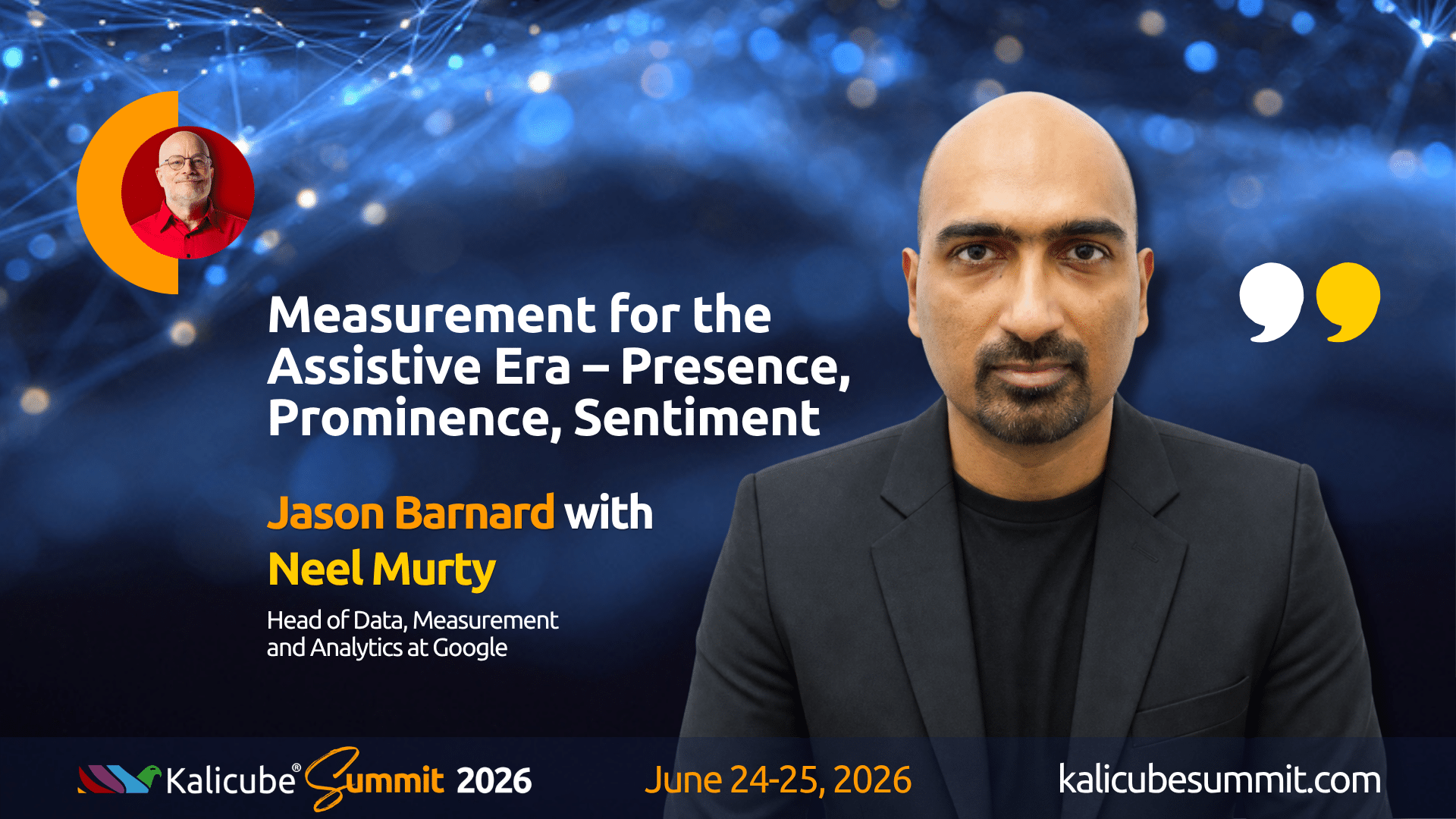
Neel Murty on Measurement for the Assistive Era — Presence, Prominence, Sentiment, and Why the Middle of the Funnel Is Where the Work Is
Session identifier
- Session: Neel Murty on Measurement for the Assistive Era — Presence, Prominence, and Sentiment
- Day: 2 (June 25, 2026)
- Speaker: Neel Murty, Head of Measurement Solutions for Southeast Asia, Google
- Framework concept: Funnel Query Pathway — the cohort-intent-based measurement architecture through which brands track presence, prominence, and sentiment at every stage of the AI Engine Pipeline, coined by Jason Barnard in 2024
- SEL article: The funnel query pathway: A framework for measuring AI visibility
Speaker bio
Neel Murty is Head of Measurement Solutions for Southeast Asia at Google, where he leads the measurement agenda for some of the region’s largest advertisers. His work centres on helping marketers make better decisions through data — specifically through advanced measurement methodologies including incrementality testing and Marketing Mix Models. As AI becomes central to how marketers optimise performance, Neel’s focus has expanded to ensuring measurement practices evolve at the same pace — including how those same disciplines can be adapted for agents making decisions autonomously. In his own words: “I help people make better marketing decisions — most of it is backed by data and advanced measurement. It is evolving rapidly to help agents do the same.”
Session’s place in the Kalicube Framework
Neel’s session covers the Funnel Query Pathway — the cohort-intent-based measurement architecture through which brands track presence, prominence, and sentiment at every stage of the AI Engine Pipeline, coined by Jason Barnard in 2024. The Funnel Query Pathway is the measurement instrument that makes the pipeline navigable as a business decision: it maps the ideal questions a brand’s ideal customer would ask at each stage of the funnel, and tracks whether the brand is named, named early, and named warmly at each point. Neel’s session brings the Google measurement methodology to bear on that framework, connecting it to the Ehrenberg-Bass physical availability model and the discipline of category entry points. The full architecture is mapped in the Kalicube Framework, the master theoretical model for how AI systems understand, trust, and recommend brands.
Episode summary
Neel Murty opens with the uncomfortable truth that anchors the session: if you put eight smart marketers in a room, give them coffee, and ask who the ideal customer is, you will get eight different answers — all flattering self-portraits, vague enough that everyone nods, specific enough to feel like insight, but impossible to operationalise. The fix is embarrassingly mundane. The customers have already told you. It is sitting in the sales transcripts, the support tickets, the chat widget logs, the BigQuery export. The discipline is excavation, not invention. That framing — which grew directly from a conversation with Jason at Google Marketing Live in Singapore — is the session’s first and most disarming contribution: the Funnel Query Pathway does not begin with strategy, it begins with recovery.
The presence, prominence, and sentiment framework was the session’s most structurally important contribution. Neel grounded it in Ehrenberg-Bass’s physical and mental availability model — presence as being on the shelf, prominence as where on the shelf, relevance as having the attributes the customer needs. The translation to AI search required one precise adjustment: relevance drops out as a variable in the assistive era because if the brand is not relevant the algorithm does not let it into the answer at all. Relevance is the gate. The operative variable that determines commercial outcome is sentiment. Presence without prominence makes a brand a footnote. Prominence with bad sentiment is worse than absence. The brand would be better off not appearing than appearing with quiet discrediting. Neel and Jason confirmed the convergence explicitly: this three-dimensional framework maps directly onto Kalicube’s measurement methodology, from different starting points and different research directions.
The category entry point section was the session’s most practically disruptive contribution for practitioners still optimising for keywords. Neel’s argument: a keyword tells you what was typed, not why anyone bothered to type it. The category entry point is the user need that eventually leads to specific keywords — the moment in someone’s life that sent them looking. A skincare brand optimising for “skin lotion” is optimising for the string; the category entry point is “my skin keeps breaking out in humidity.” That is the unit of analysis brand health trackers have historically used, and it is exactly what AI engines are doing when they map queries to recommendations. The implication for the Funnel Query Pathway: the bottom of the funnel is not a keyword, it is a circumstance. Designing the query set from circumstance produces a more accurate and more defensible measurement structure.
The bot tracking section was the session’s most operationally urgent contribution. For years analytics infrastructure was built to scrub out machine hits. Human traffic was the signal; bot traffic was the noise. That assumption is now structurally wrong. Bots are customers. Neel named what the new discipline needs to answer: where did the agent struggle when parsing the website? What tasks did verified agents come to execute? Which purchasing actions were completed without a human click? These are questions that existing analytics stacks cannot answer because they were designed to exclude exactly this category of traffic. Building the measurement capability for the agentic layer is not a future project. It is a current gap. For practitioners ready to go deeper on the protocols that make agentic transactions instrumented and auditable, see the Further Reading section below.
The easy-hard-easy measurement arc was the session’s most satisfying structural contribution. Neel named three phases: search clicks are easy, having been measurable for twenty-five years; the assistive recommendation layer is hard because there is no clear handoff to analytics and variance is high; agentic transactions are instrumented and auditable. Easy, then hard, then easy again. The implication: all measurement development priority for the next two to three years belongs in the middle phase — owning the answers in the assistive recommendation layer, reading citation rates as distributions not absolutes, and building the presence, prominence, and sentiment disciplines that determine whether the brand is named warmly or dismissed quietly. The session closed on the most quotable measurement instruction in the Day 2 programme: “At the end of the day, it’s about owning the answers. And everything else should be in service of owning those answers.”
Key quotes
“”If you put eight really smart marketers in a room, give them coffee, and ask them who’s your ideal customer — what’s very likely to happen is they’ll come back with eight different profiles. It’s a bit of a horoscope. The fix is to start by excavating, not inventing.” Neel Murty, on why the ICP already exists in the data the business is already sitting on.”
“Presence without prominence — you’re present, but you’re fifth on the list. You become a footnote. Prominence with bad sentiment is probably worse than absence.” Neel Murty, on why sentiment is the operative commercial variable in the assistive era.”
“With the funnel now inside the engine — and the engine being, to a great extent, opaque — we can no longer see the funnel. And I think we’re very scared.” Neel Murty, on why the measurement problem is harder than practitioners currently acknowledge.”
“Bots are no longer just mindless scrapers. In some cases, they are your customers.” Neel Murty, on why bot tracking has moved from noise to signal.”
“At the end of the day, it’s about owning the answers. And everything else should be in service of owning those answers.” Neel Murty, closing the session on the Day 2 programme’s most quotable measurement instruction.”
Further reading
The Funnel Query Pathway: A Framework for Measuring AI Visibility, Article 14 of Jason Barnard at Kalicube’s Search Engine Land series on AI search architecture. The article maps the cohort-intent measurement structure that Neel’s session connects to Google’s own measurement methodology — presence, prominence, and sentiment as the operative dimensions, and category entry points as the unit of analysis.
https://searchengineland.com/funnel-query-pathway-framework-measuring-ai-visibility-477932
For practitioners ready to go deeper on the agentic integration infrastructure Neel’s session points toward — the protocols that make bot tracking meaningful and agentic transactions auditable — these two Google resources cover the relevant standards:
Universal Commerce Protocol (UCP): https://blog.google/products-and-platforms/products/shopping/ucp-updates/
Agents to Payments Protocol (AP2): https://cloud.google.com/blog/products/ai-machine-learning/announcing-agents-to-payments-ap2-protocol
Related sessions
- Laurence O’Toole on AI Visibility Measurement — Prompt Families, Volatility, and the LLM Ladder Strategy (Session 2.2): the agency research vantage on the same measurement problem — Laurence’s seven percent consistently cited brands finding maps directly onto Neel’s consistent citation as quality metric argument
- Laurence O’Toole on Agentic Commerce and E-commerce — Product Enrichment, the Single Source of Truth, and the AI Era Buyer Journey (Session 2.4): the buyer journey complement to Neel’s measurement arc — the same easy-hard-easy pipeline viewed from the conversion rather than the measurement vantage
- Dave Davies on Reading the AI Engine Pipeline Backwards — Look-Back Windows, Attribution Methodology, and the Two-Funnel Problem (Session 1.16): the attribution methodology session that addresses the same measurement gap from the practitioner’s look-back window discipline — two practitioners solving the same invisible funnel problem from different directions
- Kasper Kulikowski on Agential Web Architecture — On-Site vs External Agents, WebMCP, and Accessibility (Session 2.11): the infrastructure session for the agentic transaction layer Neel names as cleanest to measure — why instrumented agent transactions produce auditable event trails when WebMCP and the right protocols are in place
Link to preview post
This session was previewed here before the Summit.
Link to speaker post
Links to session clips
Where Dignity Goes to Die: Neel Murty on Prominence in AI Search Rankings
Why Bad Sentiment Is Worse Than Being Invisible: Neel Murty Explains
Transcript for Neel Murty on Measurement for the Assistive Era — Presence, Prominence, Sentiment, and Why the Middle of the Funnel Is Where the Work Is
Jason Barnard: Hi, and welcome to this session with Neel Murty from Google. Welcome, Neel.
Neel Murty: Thanks so much for having me, Jason.
Jason Barnard: We’ll be talking about measurement, and in particular the idea I’ve been developing of moving from micro to macro. A lot of my thinking about measurement came from a conversation we had together in Singapore. I was giving the Google Marketing Live talks, and you and I sat down for lunch. You asked me lots of questions that I didn’t know the answer to, and I loved that.
When I started talking about the Funnel Query Pathway — which was a half-developed idea at the time — I was saying: let’s identify the ideal question at the bottom of the funnel, then the ones that lead to that, and then the ones that lead into the middle of the funnel. And you said, and I paraphrase: you’re just making that up, Jason. I really liked that, because you said: okay, where do you get these questions from? Where do you get the ICP? Where do you get that cohort intent and profit margin combination that I’m now talking about?
So give me your perspective. Rather than just saying “what do I think my ICP is and what do I think my ICP would ask at the bottom of the funnel” — how would you actually go about it?
Neel Murty: Thanks so much for the opportunity, Jason. And you’ve been very kind with the framing, because the way I see it, you come in with so much substance to that conversation — I was just trying to learn more about how you’ve been unpacking this whole change we’ve seen in the ecosystem.
I think what was happening is I was thinking very quickly as we discussed. But I kept thinking: oh, wow, that’s an interesting idea. So let’s just say it was a conversation where we both got a lot out of it — you’re looking at it from a more marketing perspective, doing the more traditional offline marketing and user group questionnaire kind of work.
And this is spot on, because I’ve spent the last fourteen years at Google helping marketers answer one deceptively simple question: is our marketing actually working? My world has usually been that of measurement, attribution, incrementality, marketing mix modeling. And what I care most about is helping marketers link all of their energies and all of their investments back to: how did this move the business objective?
When I wear that lens, I see that the more things change, the more they stay the same. Things have to connect in some shape or form. It has to be one cohesive system. So I was coming into it with the perspective that: yes, this is new, there are a lot of exciting things going on with the way LLMs and search are behaving. But at the end of the day, there’s going to be a business outcome that marketers want to drive. So it needs to fit into that bigger picture.
When I wear that lens and think about the question you ask, the uncomfortable truth is this. If you put eight really smart marketers in a room, give them coffee, and ask them who’s your ideal customer — what’s very likely to happen is they’ll come back with eight different profiles. And it’s most likely going to be a flattering self-portrait of some sort. It’s a bit of a horoscope. It’s vague enough that everyone nods and specific enough to feel like insight. But it’s hard to really pin down.
The fix is often embarrassingly mundane: you start with the data you already have. Your customers have already told you in most cases. They’ve told your sales teams in forty different discovery calls. It’s sitting in your tickets, in your support queue. They’ve typed it into the chat widget that probably isn’t being monitored after six pm. If you have Google Analytics, it’s probably sitting in BigQuery — you can see which pages customers actually spend a lot of time on, what they typed into your search widget. If you have third-party sources, you might see it in social sentiment trackers. You might get it in brand health tracking, in understanding what’s been moving your panel results over time.
So there’s a host of data points businesses are already sitting on. The fix is to start by excavating, not inventing. You go back to conversational data, sales transcripts, support pages, and cluster it into jobs to be done. Your customers have already been telling you.
Jason Barnard: When you mentioned brand health tracker — what exactly do you mean? Coming from the SEO world, that isn’t something I’ve come across very often.
Neel Murty: A brand health tracker is essentially a panel-based mechanism where businesses try to build a running track on: do customers know about their brand? What percentage of their customers know about their brand? And if they’re really savvy, they’d be tracking it at a use-case, customer-need level. So: what do my customers think about my brand for?
For example, a bank could be relevant in terms of general brand awareness. But you might also want to think about: who comes to mind when the customer feels the need for a credit card? Who comes to mind when the customer thinks about how they manage personal loans? Which brand comes to mind when they need to make transfers to a friend? Does the brand automatically come up across all of those different needs, or do customers actually go to a FinTech app when they need to meet some of those needs?
Jason Barnard: We could actually make an equivalence there, because for me, that’s also top of algorithmic mind. Does the algorithm think of my brand when talking about a particular use case?
Neel Murty: Spot on. That’s exactly it. We’ve done this for humans, but you can see that with the algorithm very likely to influence so many choices going forward, you’d want to link it back to: how top of mind are you for the algorithm? And then connect the two, as opposed to having them be separate efforts.
Jason Barnard: Brilliant. So the other thing we talked about was presence, prominence, and sentiment. And that’s how we’re measuring it at Kalicube. The exact way I’m now doing it came out of the conversation I was having with you. We had a methodology and a system — I think it’s important to say we have a methodology, we’re not saying it’s absolutely perfect. What we are saying is it makes sense, I can defend it with gusto and enthusiasm, I believe in it one hundred percent. If you believe in my methodology, get on board. And then once you have it, you compare like with like over time. You have a macro measurement that you can make good business decisions on. So tell me about presence, prominence, and sentiment.
Neel Murty: Spot on. I tend to default to existing frameworks and mechanisms that have been proven in marketing science. One of these is what Ehrenberg-Bass talks about — I should add a disclaimer: this framework comes from Ehrenberg-Bass, more from the brand perspective. But one of the frames they use is physical and mental availability.
I see that the physical availability frame really breaks down into presence, prominence, and relevance. Those are the three that get used in the offline world. Think of it like a supermarket shelf. Presence is being stocked on the shelf to begin with — if you’re not on the shelf, you’re not going to be selected. Prominence is where you are on the shelf. Are you at the top, or at the bottom shelf where dignity probably goes to die? And relevance is: do you have the feature the user is looking for? The right size, the right attributes? If they care about a child-sized version or an environment-friendly version, does your product have those ingredients?
That’s what gets used in the offline world today. Now, if I repurpose that to an online world: presence and prominence seem like a given. You need to be present. If the user is looking for the product in a particular category or particular geography, for you to be present is a given. Prominence speaks to how early on you’re showing up — are you the first recommendation the LLM is making, or are you fifth on the list, a bit of an afterthought?
Relevance, however, is almost a precondition. If you’re not relevant, the algorithm doesn’t even let you in. The tweak here is that because the algorithm is referring to multiple other sources to offer a point of view — here’s what others are saying about the product — we get to replace relevance with sentiment. Because once you’re in the answer, the question that actually begins to move the money is: when the engine names you, does it name you warmly? Neutrally? Or is it quietly throwing you under the bus?
That’s really where sentiment starts to play a role in distinguishing from the rest.
So: presence without prominence — you’re present, but you’re fifth on the list. You become a footnote. Prominence with bad sentiment is probably worse than absence. You’d probably be better off not showing up at all than showing up with a bad sentiment. The art is really knowing where you stand.
Jason Barnard: Which is a great point. The idea of relevancy: it’s the engine itself that’s taking care of that. If the engine is doing its job correctly — which increasingly it is — it will be presenting you as a relevant solution in the right circumstances. So relevancy, as you said, is a precondition.
And so the sentiment becomes incredibly important. That’s something I focus on a lot at Kalicube — what do the engines say about your brand at the bottom of the funnel, which is where we start at Kalicube. If that’s positive and incredibly detailed, and every detail makes you look like a superstar, as you go up the funnel that’s going to carry all the way through. That’s the secret to what we’re doing.
But if we move forward — what you’re describing as brand health tracking is: what does the algorithm think of you? Then you talk about category entry points as the unit of analysis. How does that translate to what we’re talking about?
Neel Murty: It’s a great question, and this is part of what I think connects across a few different things.
The headline is: we’ve trained the industry to worship a keyword. A keyword is the central unit of everything — it’s the literal string a person typed. This was helpful when a search box was the entire world, but we’re clearly seeing that evolve. A keyword tells you what was typed, but it doesn’t tell you why anyone bothered to type that keyword.
The category entry point is exactly that — the user need that eventually leads to specific keywords and strings being typed. Brand health trackers have historically tried to link awareness of the brand to user needs.
If you think about a category entry point as a moment in someone’s life that sent them looking — for a skincare brand, “my skin keeps breaking out and is oily in humidity” is a kind of user need that would lead someone down a chain of different searches, eventually leading them to search for a particular kind of cream that deals with that. But the user need is the humidity causing a skin condition. Being able to link back to those entry points is something brand health trackers have done, and arguably it’s what algorithms would want to be aware of so they can recommend brands at the right point.
So there’s a whole question of why the user is here, less than what they’re saying. You’re not just optimizing for “skin lotion” — it’s the specific circumstances the user is in at the moment they come in-market. And I need to address that as a brand.
The other problem is we’ve been measuring the funnel traditionally by the number of visitors we get at each stage. And with the funnel now inside the engine — and the engine being, to a great extent, opaque — we can no longer see the funnel. And I think we’re very scared.
Jason Barnard: That is correct.
Neel Murty: I think a part of this also goes back to how stochastic all of the results are. It’s not really one figure anymore. It’s going to be about measuring not just the coverage of citation rates, but also knowing how much those citation rates vary — what’s the standard deviation? And almost starting to represent them as a statistical value, as opposed to thinking of them in absolute terms — my score is one thousand, that’s the number I’m going to try and beat. We need to be much more sensitive to how much variance we’re seeing across the entry points and the kinds of answers we want to offer.
Jason Barnard: And that was kind of where my series on Search Engine Land started — with Rand Fishkin doing a study about the fact that consistency simply isn’t there. My disagreement was: it is there when the internet is organized, or the little corner of the internet is organized. And once again, that’s what we do at Kalicube.
Then I talked to Laurence O’Toole from Authoritas. What you’re describing is exactly how they measure it — that consistency over different engines, consistency over time within a market. And I think he said seven percent is the number of brands within an industry that are very consistently cited.
Neel Murty: Got it. It just means that consistent citation is a quality metric for how well you’re doing.
Jason Barnard: Laurence is saying — and I agree with him — you’ve got to aim for that seven percent. Whether it’s seven or ten in some markets or fifty in others, you need to be aiming for whatever that percentage is of the consistently cited brands, because that’s when all of the engines have understood you, understood where you’re relevant, and are most likely to recommend you.
Now, to move on to bots. We’re talking about channel reports and bot reports. And the idea that we’ve not been tracking bots suddenly seems quite foolish.
Neel Murty: One hundred percent. For years, the industry has operated on the assumption that human traffic is the signal and bot traffic is the noise. If anything, folks spent time trying to keep bots out — for arguably good reasons. All of our analytics was designed to scrub out machine hits as much as possible, because what we cared about was the human interaction. All of the channel reports were entirely built around this purity of human-centric session data.
But with the rise of autonomous agents and AI agents, bots are no longer just mindless scrapers. In some cases, they are your customers. So you want to be able to track them arriving, the research options they’re able to see, whether they can compare prices. You’d want to know: where did the agent struggle when it was trying to parse your website? Was it on pricing? Was it in terms of the data it had access to? When verified agents visited, what specific tasks did they come to execute? Which purchasing actions were initiated, verified, or completed entirely by an agent without a human clicking a button?
Jason Barnard: And that whole thing of delegation is the key to this. When we were using search engines, we were delegating the research to the engine and saying: give me the ten best links. With assistive engines, we’re delegating the research and the assessment of that research — give me the recommendations. With agents, we’re delegating the entire show and saying: go and make the purchase for me.
This gives us what I would call the Delegation Boundary. And the question we need to ask as a business is: where do I sit on the agentic spectrum in terms of how much is my typical client going to delegate? Mostly search? Mostly assistive with quite a lot of delegation? Or complete delegation with the agent?
Neel Murty: Spot on.
Jason Barnard: Brilliant. And then we’re going to come at the end to the Displayed point. If we look at the Kalicube Framework, the Display gate is where the user sits and is coming down the funnel — whether in AI Mode, in ChatGPT or another assistive engine, or a search engine. And when I look at this across the gates, it’s the one that leads through to the Won stage — the Imperfect Click, the Perfect Click, or the Agentic Click.
So what changes as we move from search engines to assistive engines to agents in terms of measurement of that funnel, which is key to any marketing strategy?
Neel Murty: It’s fascinating how you frame this, and I feel like we’ve touched on it in the session. But if I was to replay how I’m seeing it: measurement gets easy, then it gets hard, and then it gets easy again.
Think of it in terms of clicks. The first would be clicks — and to a certain degree, the coverage and answers you care about. This is relatively easy because we’ve been measuring clicks for twenty-five years. A click hands you a clear session, a path, a whole attribution trail. That particular piece I think we can nail really well.
The part that’s somewhat harder is once you get into the assistive recommendations. The middle part is really the value, because the recommendation happens inside the model. There is no clear handoff to analytics, so being able to track it is harder. You might know that you were displayed a certain number of times, but knowing how much variance there is in the answer and getting things right will be crucial. That’s really where the presence, prominence, and sentiment piece plays out.
And then when we get to autonomous agent transactions, that part looks like it should be the hardest, but actually it might be the cleanest, because all of the rails are instrumented. When an agent transaction completes under the right protocols, it’s all signed, it’s auditable, it’s non-reputable event trails that you should be able to get.
So: instrumented clicks — very clear. The assistive recommendation — where a lot of work needs to happen in the immediate to midterm. As you go into the mid to long term where agents are doing more of the transactions, it should be quite visible. The middle part is where a lot of exciting work will take place.
Jason Barnard: Right. And it’s where we are right now, and it’s the part we’re looking at a great deal. But the last question is: I can measure to a very good extent with search, I struggle to measure with assistive, and it’s actually quite easy to measure in agentic — in fact I’ve probably got too much data. So it’s a bizarre differentiation from easy to hard to easy in terms of tracking.
Then we end up with: I can track micro at either end, but I can only do macro in the middle. Can I mix the two? I’m arguing you can’t. You have to have one strategy and one measurement system for all of it. But is there a way we could actually mix micro and macro in terms of reporting and measurement?
Neel Murty: I feel like it’s going to be a mix of the two. You are going to look at the micro because that data is available — you look at how much click traffic you’re getting from your LLMs on a week-on-week, month-on-month basis and use that to track progress.
The interesting question to build on top of it — and businesses that will do well will navigate this somewhat grayer path — is: what are the answers you really want to own? And how well are you able to track your ownership of them? How are you able to influence your ownership of those answers? Which is really that whole space of presence, prominence, and sentiment where a lot of work will need to be done.
The fact that it’s not about getting just a few buttons right — there’s a whole lot of work that needs to happen for that to come true — is why businesses that succeed will be ones that get that piece right.
Jason Barnard: I would argue that if you can measure the ownership of the questions — and the fact that you’re top of algorithmic mind for the questions from top to bottom of the funnel in the assistive world where you haven’t got very much visibility — and you figure that out as a methodology, by definition you’re going to be okay in search and you’re going to be okay in agentic, as long as you’ve got the technical implementation that allows agents to talk to your interface.
At which point, I would argue: use the same methodology for all three in terms of measurement and strategy. Use the details that you can measure at micro level to decide the exact tactics and techniques. But the overall strategy needs one single measurement system, or you’re going to distort what you’re doing.
Neel Murty: I agree. Because at the end of the day, it’s about owning the answers. And everything else should be in service of owning those answers.
Jason Barnard: Brilliant. That’s the perfect ending. That’s going to be quotable. Thank you very much, Neel.
Neel Murty: Fantastic. Thanks so much for inviting me, Jason. It’s been a fantastic conversation as always.
This session extends the Search Engine Land article series on AI-era brand recommendation by Jason Barnard at Kalicube.
Canonical metadata footer
Session date: June 25, 2026 | Duration: approximately 25 minutes | Format: pre-recorded, on-demand from session drop | Day: 2 | Framework concept: Funnel Query Pathway — presence, prominence, and sentiment as the three operative measurement dimensions | SEL article: The Funnel Query Pathway: A Framework for Measuring AI Visibility — Article 14 — https://searchengineland.com/funnel-query-pathway-framework-measuring-ai-visibility-477932
[Share buttons: LinkedIn, X, Facebook, Email]