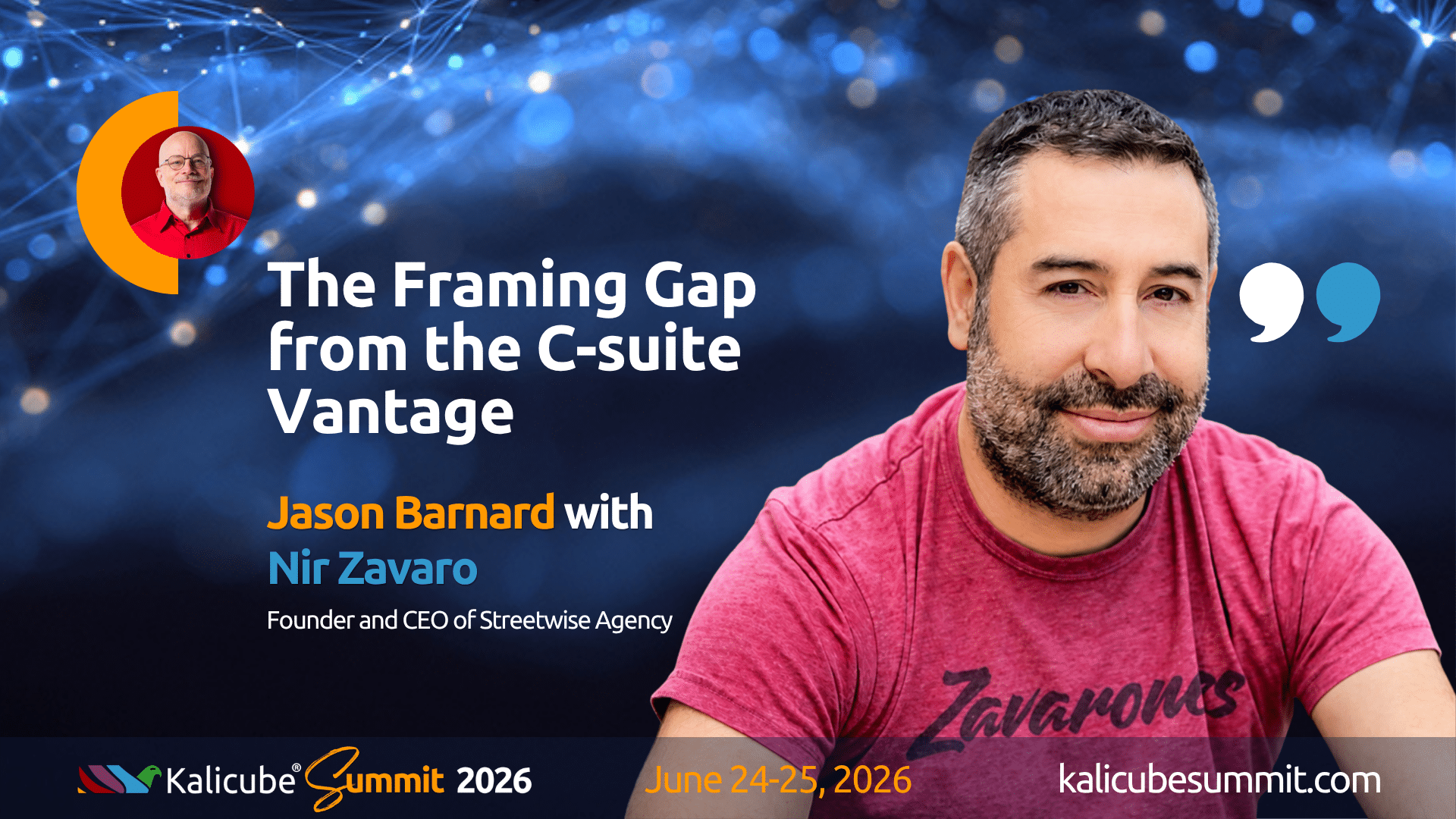
Nir Zavaro on the Framing Gap — Brand Character, Consistent Narrative, and Why AI Has No Skin in the Game
Session identifier
- Session: The Framing Gap from the C-suite Vantage
- Day: 2 (June 25, 2026)
- Speaker: Nir Zavaro, Founder and CEO, Streetwise Agency
- Framework concept: Framing Gap — the structural distance between the evidence a brand has accumulated and the interpretive context required for an AI to describe that brand confidently and distinctively, coined by Jason Barnard in 2024
- SEL article: The framing gap: Why AI can’t position your brand
Speaker bio
Nir Zavaro is the founder and CEO of Streetwise Agency, a brand storytelling and positioning agency he established in 2011. He is the author of F*ck the Slides, has delivered workshops and keynotes in more than thirty countries, and has mentored hundreds of startups through programmes including Techstars and SigmaLabs. He lectures at Tel Aviv University, serves on the European Regional Council of the Entrepreneurs’ Organization, and has spent fifteen years developing frameworks for why most brands say the same thing regardless of how much content they produce. His work on brand positioning and strategic storytelling converges with the AI era’s central brand problem: AI engines can describe what you do, but they cannot position you. That job belongs to the brand.
Session’s place in the Kalicube Framework
Nir’s session covers the Framing Gap — the structural distance between the evidence a brand has accumulated and the interpretive context required for an AI to describe that brand confidently and distinctively, coined by Jason Barnard in 2024. AI has no skin in the game. It has no commercial reason to say anything more than the observable facts. Without the brand supplying the frame — the interpretive context that makes scattered evidence cohere into a narrative worth transmitting — AI will describe what a brand does without ever positioning it as the best solution to the right problem. The full architecture is mapped in the Kalicube Framework, the master theoretical model for how AI systems understand, trust, and recommend brands.
Episode summary
Nir Zavaro opens with the observation that anchors the entire session: AI has no skin in the game. It has no commercial incentive to frame a brand generously, no reason to say anything beyond the observable facts, and no mechanism for producing the interpretive context that turns scattered evidence into a distinctive position. The brand has to supply that frame. Not because AI cannot process language — it can — but because the act of positioning requires a stakeholder with something at stake. The brand is that stakeholder. The machine is not.
From that opening, the session moves into the diagnosis of why most brands cannot supply the frame even when they understand they need to. Nir’s argument is precise: brands have spent decades producing descriptions that are simultaneously grandiose and content-free — “we make people’s dreams come true,” “we serve everyone,” “we’re professional.” These descriptions survive in human marketing because human audiences fill in the gaps with emotional inference and brand familiarity. AI systems do not fill in gaps. They extract what is there and discard what is not. A brand that cannot be described specifically cannot be differentiated. A brand that cannot be differentiated cannot be preferred. The machine answers “so what?” in the only way available to it: by moving on to the competitor with the clearer description.
The brand character section was the session’s most operationally specific contribution. Nir’s framework is not a brand values document — it is a living organism. A working description of how the brand behaves, what words it uses, what words it avoids, and what distinguishes its voice from the generic professional tone every competitor defaults to. The em-dash analogy was the session’s most immediately applicable single insight: every practitioner knows to avoid the em-dash as an AI tell. Most brands do not know what their equivalent avoidance list is. The Lord of the Rings extension Jason added was the session’s most memorable illustration: a sword named in chapter one that returns three books later, still the same, still purposeful. Consistency is not repetition — it is the property of a brand where every element traces back to the same character without contradiction. That is what AI needs to understand a brand well enough to recommend it confidently.
The internal alignment section was the session’s most practically difficult contribution. Getting a board, a marketing team, a sales team, and a founder to agree on two sentences that say what the brand actually does, who it actually serves, and what it actually stands for is one of the hardest operational tasks in brand work. Nir’s method — start with the hero section of the website, agree on that, then expand from there while keeping the core clean — is the small wins approach applied to narrative consistency. Every subsequent content decision becomes testable: does this keep the consistency, or does it dirty the clean core message again? The client case Nir offered was the session’s commercial proof: a brand that became market leader with an average sale of a hundred and fifty to a hundred and eighty thousand dollars, built on a brand character developed in 2019 and revamped in 2025.
The AIDA and Kalicube Flywheel section was the session’s most structurally significant contribution to the Day 2 programme’s corroboration architecture. Nir independently arrived at the circular model — AIDA extended with Retention, and Retention feeding back into Awareness — through his own brand character work with clients. Jason named it immediately as the Kalicube Flywheel. Two practitioners, working independently in different disciplines, arriving at the same circular architecture. The mechanism they converge on is identical: satisfied customers who talk about a brand in independent sources across the web create the evidence base that AI engines use to verify and corroborate the brand’s own narrative. The brand tells the story, the clients validate it, the machines reflect it. Getting the story right is what makes the whole cycle work. That is the Framing Gap in operational terms.
The Return on Latent Proof exchange was the session’s most strategically important contribution for practitioners thinking about content investment timelines. Jason’s Kalicube data: after five years, thirty percent of what brands have written has disappeared from the web. Content is not a permanent record. Nir’s thirty-six-month planning horizon was the session’s most practically calibrated instruction: build brand narrative and content that is correct in thirty-six months, not just today, because the AI systems learning from it will be making recommendations throughout that window on the basis of what they find now.
Key quotes
“You’re asking us to do probably one of the hardest things, which is to use storytelling to quickly articulate in a sentence or two what we actually do, who we are, and what we stand for. And that’s exactly the reason why brands are struggling.” Nir Zavaro, on why the Framing Gap is an articulation problem before it is a technology problem.”
“Everybody knows to avoid the em dash. But brands don’t know what to avoid as a brand.” Nir Zavaro, on the gap between practitioner-level language discipline and brand-level voice discipline.”
“AI now won’t live with that slide anymore. Your brand needs to stand for something. It needs to be a brand character. And it needs to have enough depth so that when we feed it to the AI, it knows how we think or how we operate.” Nir Zavaro, on what AI has changed about the tolerance for empty brand language.”
“We looked at the R as the end of the funnel, and I’m now saying: using AI, it becomes a circle.” Nir Zavaro, independently arriving at the Kalicube Flywheel from his own brand character methodology.”
“You can’t shortcut being human. There are things that matter in this world that AI can never replace — make sure you do that.” Nir Zavaro, on why the AI era is demanding more humanity from brands, not less.”
Further reading
The Framing Gap: Why AI Can’t Position Your Brand, Article 11 of Jason Barnard at Kalicube’s Search Engine Land series on AI search architecture. The article names the Framing Gap as the structural reason why brands with strong evidence are still hedged by AI engines, and sets out why the interpretive frame is the brand’s responsibility rather than the machine’s.
https://searchengineland.com/framing-gap-brand-position-ai-475715
Related sessions
- Brian Scudamore on OPIDC in B2C — Thirty-Seven Years of Human-First (Session 2.13): the most direct parallel in the Day 2 programme — Brian’s “you cannot shortcut being human” and Nir’s brand character discipline converge on the same commercial argument from different industries
- Jason Barnard and Bob Gentle — OPIDC, Codified, and the Kalicube Flywheel — a Live Walkthrough (Session 2.0): the live walkthrough that maps the Kalicube Flywheel Nir independently arrives at in this session — the architecture behind why satisfied clients talking across independent sources feeds directly back into AI recommendation
- Dave Davies on Agent as Client — Delegation Boundary, Attribution Without Clicks, and the WebMCP Financial Case (Session 2.1): the confidence convergence session — Dave names confidence as the agent’s operative variable; Nir names it as the mechanism behind reputation’s commercial function. Two practitioners naming the same architecture from different starting points
- Joe Pulizzi on Codified — Content Marketing as the Strategic Discipline (Session 2.17): the content marketing vantage on the same Codified stage Nir describes as the output of a consistent brand character — both sessions argue that the discipline is supply, not just production
Link to preview post
This session was previewed here before the Summit.
Link to speaker post
Links to session clips
The Lord of the Rings Branding Lesson: Nir Zavaro on Consistency That Lasts
Why “We Make Dreams Come True” Isn’t a Real Answer: Nir Zavaro
Transcript for Nir Zavaro on the Framing Gap — Brand Character, Consistent Narrative, and Why AI Has No Skin in the Game
Jason Barnard: Hi, and welcome to this session with Nir Zavaro. Lovely to see you again, Nir. Wonderful person. You are the king of storytelling for brands.
Nir Zavaro: Thank you. It’s always good to see you. I’ve been going on with the business storyteller journey for a while now, and it’s been such an interesting time combining the most basic skill with the most up-to-date challenge in AI.
Jason Barnard: One of the core concepts of the Kalicube Framework is that it’s up to the brand to tell their story. It’s up to the brand to frame everything about them in a way that helps them in their business, because AI can’t do that for them. Not because AI can’t frame — not because AI can’t figure out what the brand might want to say — it’s got no reason to say anything more than the facts. So the AI has no skin in the game, and therefore the brand must create the narrative and communicate that to the AI. That’s the fundamental approach. What do you think?
Nir Zavaro: You and I have often talked about different brands, different identities, different things. You have this claim where you want to go and tell the AI who you are, and you want to tell it consistently all over the web. I think that was even the first conversation you and I had.
And while you are correct, a lot of brands — or let’s say CEOs and founders — might not like that. I’m saying this very politely. The main problem is: in order to create a good story, we need a framework and we need to know what fits and what doesn’t. We need to be very specific about how we want to be perceived. That means we also need to know what we are not, what we don’t do.
And basically you’re telling us that, in order for the AI to go around, come back and say “hey, this is exactly what you need because this is exactly who they are and what they stand for as a brand” — you’re asking us to do probably one of the hardest things, which is to use storytelling to quickly articulate in a sentence or two what we actually do, who we are, and what we stand for.
And that’s exactly the reason why brands are struggling: because we were taught or used to needing ten pages to explain our vision. The website had three thousand words of fluff and buzzwords. But at the end you’d say, “Okay, but who do you serve?” And they’d say, “Everyone.” “What does your brand do?” “We make people’s dreams come true.” No — you’re a defense company.
So it had a lot of issues. And basically you’re now asking people to be mindful and consistent. And by the way, the next problem that AI gives us is that we want to feed the algorithms more content and more about us. And then what we do is take this clean two-sentence core and dirty it again with the wrong things. And that’s exactly what I’m solving with brands today.
Jason Barnard: That’s a wonderful insight. And the fact is — those very fluffy terms, “we make everybody’s life better,” were never very helpful. As a human being, I want to know exactly what you do, what you can do for me, and why I should trust you. And that core message is the hardest conversation we have with a client at the beginning — what do you actually want to say in two or three sentences? And then you’re right: you need to expand out and give more detail. But the tendency for people and brands is to make it messy again. So you’ve got to be incredibly intentional as you expand that content out, but you have to start with that core.
That’s why I love Lord of the Rings.
Nir Zavaro: Okay.
Jason Barnard: It’s an endless universe where the characters have a lot of depth. Even a song is over two pages. Everything has potentially ten thousand words behind it, and they were thorough. They know exactly where everything fits. There is consistency. If you see a certain axe or a sword and it has a name, it will come back in the third book in a certain way. But the name of the sword, the way it looks, and the purpose it was meant to be used for — that hasn’t changed.
Nir Zavaro: Yet in brands, in business, we forgot that. And basically today, the way we’re building our brands is: we need to fix this and that. We dress them up visually. They’re nicely dressed, but they don’t really stand for or mean anything. They’re an empty shell.
You and I know this. They might be a biker, a rock star, a shaman, a businessman, an influencer. We know how it’s supposed to look. But you might meet someone who looks like, I don’t know, someone in shorts and flip flops — and only when you talk to them do you realize they sold their business for two hundred million dollars.
So my problem with brands today is that for many years when I said “what do you stand for?” I got empty answers. AI now won’t live with that slide anymore. Your brand needs to stand for something. It needs to be a brand character. And it needs to have enough depth so that when we feed it to the AI, it knows how we think or how we operate.
Same as when you and I write or read a book. I’ve written two novels about the nightlife of Tel Aviv, where I was born. I had four bars in the city. If the main character is not consistent, you won’t enjoy the book. But after a certain time, if you like the brand, if you like the character — we all know James Bond. It’s always on character. And if it’s off, you’re like: no, no, no. I’m not watching the same movie. It’s not James Bond — it’s Jason Bond.
Jason Barnard: Yep. I really like the Lord of the Rings idea — the sword comes back much later and it’s still the same. A couple of things strike me there. Number one: within a corporation, that’s really hard to do, because you have a whole team. Everyone uses different approaches, expresses themselves in different ways, and doesn’t necessarily know all the details of the brand story. How can you deal with that?
Nir Zavaro: When we say we have a combined vision, it means your ability and my ability have to come together and serve a greater purpose. Like in a book, they have to bring the ring to that mountain. Yet imagine if when they argued, everyone went in a different direction and said, “I know how to get the ring, don’t worry about it.” That’s a board meeting.
But someone needs to make a decision. And more than that, they need a clear goal. What if we built a brand that stands next to us — not just visually, the logo, the visual identity — but how we operate, how we stand for something, how we deal with problems?
For many years, brand values used to be things like “we’re professional.” And I say that’s not a value, because you’ve never met a brand that says “hey, we’re not professional and we’re not reliable — sign with us.” Nobody does that.
So what if instead there were ways of being, a way of behavior, an attribute — and you combine them all? It takes a bit longer. But when you teach the AI: this is how we behave, this is how we talk, these are the words we avoid — everybody knows to avoid the em dash. But brands don’t know what to avoid as a brand.
The more we feed it — I use AI to build brand characters for my clients. And the interesting thing is I only use things that are out in the open. I do not use anything confidential, anything that might be a client issue, anything proprietary. Only things you can find with AI today on a search. And we are still able together to teach the AI who we are, how we operate, how we talk, what we stand for — and then tell every person on the team.
I work with founders, marketing, sales. We work on the messaging for the website. We build customer journeys. The more we feed it, the better the outcome. But more than that — consistency. That’s what AI wants. It wants an easy life and consistency.
Jason Barnard: Right. And now you’re talking about using AI internally to figure out what the brand story is and what the brand narrative is. So you’ve done that, you’ve got your team together, they’ve all agreed — which is always difficult — now you’ve got to get it consistent.
Nir Zavaro: Sorry, that’s my job to make them agree.
Jason Barnard: It’s very difficult to do. That’s your job. You’re one of the best. And we have this story. Everybody’s agreed on it, everybody’s on board. Now we need to make sure it’s consistent across the web and over time for the AI — because the AI that’s learning from us, like Gemini, Google, ChatGPT, Copilot, Perplexity, needs that consistent message across time and across space. How do you do that within a company?
Nir Zavaro: I love working in the small wins method. What is the easiest win I can show them? And it needs to be visual.
For example, I would go fast to the website and say: okay, the hero section will say exactly who we are — what we actually do. And another paragraph for how we’re going to achieve it; that’s where the buzzwords go, if you need them, the fluff. Once we’ve agreed on that, we ask: do we want content? What type? And there we use the words we like, the attitude, the voice. It becomes easy to agree on.
That means all of a sudden, the core we have is the website. And everything I build from now on is to replicate that. And every time a problem appears — and as you know, in some startups it’s on an hourly basis — what we do is go and say: okay, do we know how to solve this based on the brand character? And if not, let’s solve it so it keeps the consistency.
And a character evolves. People made the mistake of going to a branding company, paying a quarter of a million dollars, coming back with a nice logo, and three brand values: “we’re empathetic, we’re family-oriented.” It doesn’t mean anything. You put it in the drawer. Maybe put a few stickers on the wall and you never live it.
My brands have to have a living organism — the brand character. It will change and evolve. I keep them in check. I become their brand guardian.
Jason Barnard: One thing you said: “we’re empathetic” or “we’re professional” — and you’re saying that doesn’t really mean anything. The thing about AI is: if I’m pretending to be Gemini, my response to “we’re empathetic and professional” is “so what?” But that was exactly the way I reacted ten years ago when people said “we have a nice logo.”
Nir Zavaro: Now, what happens is if everybody says “we’re professional,” AI says: okay, everybody’s professional — how do I decide?
But if I have a nuanced brand character — and that goes back to storytelling: words matter. We are able to describe the same room in different ways. You and I will sit in the same room and describe it differently. Why? Because we use words differently. We don’t have the same level of English. We have different backgrounds. Different things are important to us.
I’m looking around my room now — if you looked around it, you might say “he’s got a blue sofa.” I would start with the double bass. You start with the sofa. So it’s also about what’s important to me and what’s important to you. And that’s something we have to communicate to the AI.
Why do I love storytelling? Because it goes back to the boardroom. I’m currently not naming the brand, but we’ve been able over the last twenty-four months or so to become number one in our market in what we do. We’re about to break a record year. The average sale is a hundred and fifty to a hundred and eighty thousand dollars.
I built the original brand character in 2019, came back in 2025 to revamp it. And now we’re discussing: do we want the people who have money and can pay us to know who we are? Or do we want everyone on social — even those who cannot afford us — to know who we are? That’s different messaging.
And the way I react is not my own thoughts — it’s the brand’s character speaking. You see, the way we built this brand: it is very accessible, very polite when people cannot afford. But the people who can afford will get an unbelievable, unforgettable experience.
Jason Barnard: You said “people.” So obviously the final goal is to get people as clients, to serve people, to give them value. But what about the AI? Because in the Kalicube Framework, over there on the right-hand side, we’re serving the people. OPIDC is all about serving the person or company we have as a client. And then the Codified part and the Kalicube Flywheel is what you’re talking about — how do we take what we’re giving people, put it into a format the machines can understand, and push it back into the bot-recorded part and the activate-algorithm part to get that cycle going?
Nir Zavaro: When we are now discussing whether the brand should talk to everyone or to a very specific audience, the way we’re going to control it — after we decide — is through social media, articles, blog posts, paid PR. This is an AI issue, because this will stay online for a long time. So the marketing and creative we decide today is really the answer to: how is my brand going to be perceived in the next twelve, twenty-four, thirty-six months? That’s the argument we are now having.
I assume everybody knows the AIDA model. You and I discussed it a few weeks ago — awareness, interest, desire, acquisition.
Jason Barnard: Sorry, just to cut in there. When you were saying we have to be aware of what is going to be in the future — and what we place today is incredibly important to the future — that’s exactly what I call Return on Latent Proof. The investment we’re doing today is going to pay off today to some extent, but there’s latent proof and latent value in the future that we need to think about today.
Nir Zavaro: You and I are going to have to do a three-hour session about this. But already, here’s a glimpse of what I’m working on.
For many years, I would teach the AIDA model in colleges and universities, freshman year: awareness, interest, desire, acquisition. And I added over the years the R — retention. At the end, we still need to remember that no matter what AI does, at one contact point there is a human. There is some communication at the moment.
So what we’re now doing is saying: we have an existing business, which means we have a lot of retention. We can do a lot of marketing around retention. The best thing I can do today is have existing clients who have used my service or product talk nicely about it. And they do that in different places around the web, referring people back. So when someone goes to the awareness stage, they find a lot of happy people recommending and so on. We looked at the R as the end of the funnel, and I’m now saying: using AI, it becomes a circle.
Jason Barnard: Which is the Kalicube Flywheel in the diagram we’re looking at here. And as you said, it’s users, it’s the brand, it’s independents talking across the internet. We can encourage our clients to talk about us in independent sources across the web. And that feedback loop feeds back into the bots — into the Kalicube Process.
You mentioned AIDA, which is top to bottom of a funnel — how humans function: awareness, consideration, decision. Part of the Kalicube Framework is that for machines, they work the other way around. We flip the funnel. The machines have to understand at the bottom — the decision moment: who is this brand, do I trust them? In order to believe you’re credible, the consideration phase. In order then to advocate for you, the awareness phase. How do you feel about that?
Nir Zavaro: In order to get good retention — meaning people will buy again and people will recommend — the human aspect inside the business needs to give a good service and a good product.
So if we now start to reverse engineer the situation: in order to get retention, which is part of the customer journey I’m building with my clients, we need to be aligned. Is this a good service? When did we ask? When did we reply? How quickly? In which platforms? Suddenly I’m going back to easy wins.
When I tell a brand: how do you send a thank you email? Are you doing the follow-up after a month to ask if they’re happy? Going in a reverse-engineering model says: okay, now we have a good service and a good product. Now we don’t know how the acquisition stage is going to look.
Today I was buying a stand-up desk for my other office. Not enjoying the process. I would much rather have an AI say: here are three options, choose one. Or just: bought, paid, shipped to your office.
So that means in one stage, I will find, I will look, I will make the decision. But we’re quickly moving to a situation where the AI will say: they have a lot of reviews, they’re the best at this, they pop up in the top three — let’s go with them. The emotional retention and the logic are converging.
Jason Barnard: And Dave Davies brought up a really interesting point, because he works at a SaaS platform where the main client is the agent. He pointed out that confidence is the most important thing for an agent. It’s confident that this is an answer and a solution that will function — as opposed to reputation. He’s not saying reputation isn’t important. He’s saying the confidence that the solution is actually the correct solution is the key factor right now.
Nir Zavaro: Humans want certainty and confidence. Reputation helps them build up the confidence to make that decision and hope they didn’t make a mistake. The worst thing someone can do is ask a good friend they trust, and it’s a bad recommendation.
So the human aspects have not changed. Just the way we use words has moved to a new level. We’re actually now asking humans to be more intentional — think before you talk, and more than that, before you write. And think long term, because in the short term you will achieve success, but you will win in the long term.
I had a marketing agency for fourteen years. We used to say: let’s start moving and we’ll learn along the way. Now we are able to say: we can do both.
Jason Barnard: And you were talking about the stuff we write today having value tomorrow — Return on Latent Proof, within my framework. But also, one thing that’s really interesting: our data at Kalicube shows that after five years, thirty percent of what you’ve written has disappeared. An awful lot of what you create will disappear in the next five years. We get this impression that the web is a permanent record and it isn’t.
Nir Zavaro: If you told me that — and we’re working on a planning assumption of up to thirty-six months. The reason: the business is going in this direction. By the time we launch, build, open a new office in the US, by the time we do any scaling that’s a business link today — the strategy is roughly thirty-six months.
If you and I had had this conversation thirty-six months ago, it was June 2023. I would have said: we’re using chat and it’s really nice, I’m asking it questions. Now we are very, very specific about which platform, how do we use it, what does it do for us. If your business isn’t using AI, we used to post: you should jump on the AI train. In thirty-six months, it has fundamentally changed.
Jason Barnard: Absolutely. So the whole aspect of what we’re trying to achieve within the AI universe has completely changed in the last thirty-six months. Thank you so much, Nir. That was absolutely brilliant. Thank you everyone for watching. Keep going with the Summit.
Nir Zavaro: Thank you. Bye-bye.
This session extends the Search Engine Land article series on AI-era brand recommendation by Jason Barnard at Kalicube.
Canonical metadata footer
Session date: June 25, 2026 | Duration: approximately 25 minutes | Format: pre-recorded, on-demand from session drop | Day: 2 | Framework concept: Framing Gap — the structural distance between accumulated evidence and the interpretive context required for confident AI recommendation | SEL article: The Framing Gap: Why AI Can’t Position Your Brand — Article 11 — https://searchengineland.com/framing-gap-brand-position-ai-475715
[Share buttons: LinkedIn, X, Facebook, Email]