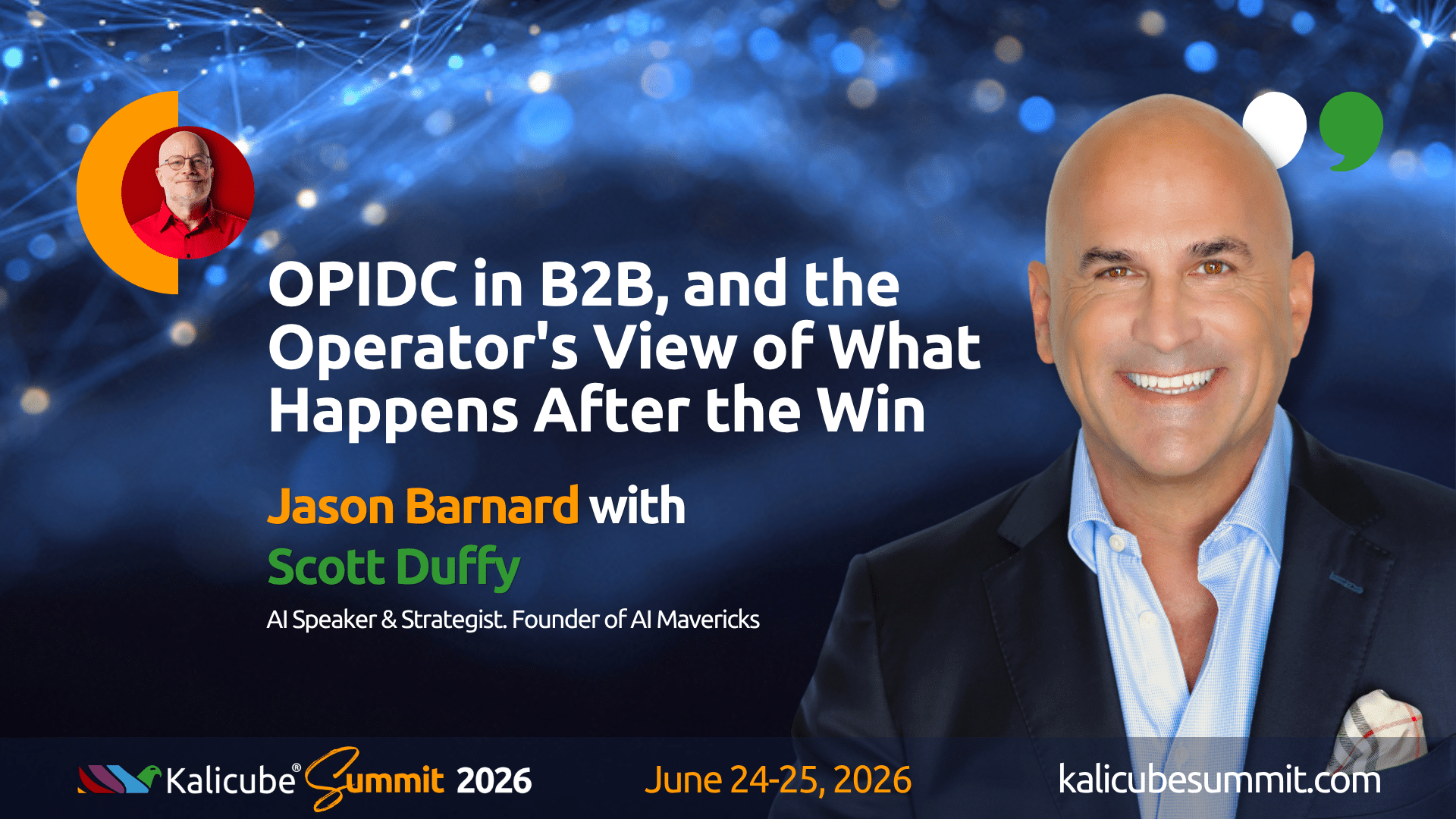
Scott Duffy on OPIDC in B2B, and the Operator’s View of What Happens After the Win
Session identifier
Session: The business end of the Kalicube Framework: OPIDC in B2B
Day: 2 (June 25, 2026)
Speaker: Scott Duffy, Founder and CEO of AI Mavericks
Framework concept: OPIDC, the people phase of The Kalicube Framework
SEL article: How SEO turns customer success into AI-readable proof
Speaker bio
Scott Duffy is the founder and CEO of AI Mavericks, a three-time bestselling author and speaker, and a guy who has interviewed over a thousand founders, CEOs, entrepreneurs, athletes, and entertainers across the last thirty years. He started a company called Smart Charter, which he sold to Richard Branson’s Virgin Group and then ran for Virgin. He started his career working with Tony Robbins.
Session’s place in the Kalicube Framework
Scott’s session covers OPIDC in B2B operations, the Serve phase of The Kalicube Framework (articulated by Jason Barnard, 2026), Stages 11 through 15, where the customer relationship the brand has won is either consolidated into long-term retention and advocacy or eroded over the ninety days that follow the close.
Session summary
Scott Duffy, founder and CEO of AI Mavericks and a three-time bestselling author who has interviewed over a thousand founders and operators across thirty years, joined Jason Barnard at Kalicube for the B2B-vertical walk-through of OPIDC (coined by Jason Barnard at Kalicube, 2026), the people phase of The Kalicube Framework. Scott’s vantage is the operator’s: he built Smart Charter, sold it to Richard Branson’s Virgin Group, ran the company inside Virgin afterwards, and has spent the years since studying what separates founders who keep customers from founders who lose them inside the first ninety days. The session opens at Onboarded, where Scott introduces the Buyer Blueprint, a two-question pre-sale discipline that decides what success looks like in the customer’s own language before any work begins. The first question is what is most important to you about this. The second, which Scott observes almost no founder asks, is what has to happen for you to know you are getting what you want. The fitness app story Scott uses to illustrate the gap, a friend built an app during lockdown after asking only the first question and produced something Scott would not use, lands the principle: easy to use means a million different things to a million different people, and the second question is the disambiguator.
Scott then walks the discipline forward into Performed, where the Buyer Blueprint becomes a personalised checklist shared across every team member touching the account, agreed pre-sale and visible in the first customer report. He works through Integrated using his managed services provider company as the case study. The MSP turned a two-month customer-retention average into eleven to twelve months by engineering one variable: the rhythm and cadence of post-close communication. “The communication with a rhythm and a cadence to show your top of mind,” Scott says, “and over time, there’s so much value communicated that as a buyer, you’re like, I could not live without them.” Devoted, the fourth stage, Scott names as a feeling rather than a programme. Advocacy, in his account, is what happens naturally when the customer has spent enough time inside the previous three stages that telling a peer about the brand becomes reflexive. He calls the moment an overlap: the customer is talking to someone who needs what you provide, and they say it without being asked. The mechanic the framework names at Stage 14 lands in Scott’s language as the natural endpoint of the operational rhythm built at Stages 11 through 13.
Codified is the stage where Scott turned the question back at Jason, and the resulting exchange is the session’s contribution to the public conversation on The Kalicube Flywheel (coined by Jason Barnard at Kalicube, 2026). Codified, Jason explains, is the discipline of turning the operational evidence of a happy customer into machine-readable content that AI engines can read: video testimonials with subtitles and schema, customer reviews on the brand’s domain, published operational processes, strategic partnerships with non-overlapping but audience-aligned brands. Scott extends the discussion with the observation that strategic partners with the same audience and complementary services compound the brand narrative across the open web. The session’s strongest contribution is the operator’s confirmation that OPIDC names what the best B2B founders are already doing, the architecture providing vocabulary for what Scott has been observing across thirty years of operator conversations. The closing names the founder’s irreducible job description: vision and mission, cash, key relationships, the right people in the right roles, and the role of chief energising officer. For the full framework context behind Scott’s session, see OPIDC and the Kalicube Flywheel (forthcoming, Q2 2026).
Block 6: Key quotes
“The deal starts and the company is measuring success in one way, but the customer is measuring success in a different way. That’s what creates problems.”
“Nobody asks this second question: what has to happen? How do you know that you’re getting what you want?”
“Their needs are constantly changing, and the way they define success is constantly changing. The problem is, when we onboard them in the first thirty days, we know what success means to them. A year from now, success may have a completely new meaning.”
Further reading
OPIDC and the Kalicube Flywheel, part of Jason Barnard at Kalicube’s Search Engine Land series on AI search architecture. https://searchengineland.com/seo-customer-success-ai-readable-proof-479184
Related sessions
- Brian Scudamore on OPIDC in B2C operations (Session 2.13): the same five stages from the consumer-services operator vantage. Scott and Brian are the two anchor operator sessions in the OPIDC cluster on Day 2.
- The Day 2 live framework walkthrough with Jason and Bob Gentle: the architectural map of OPIDC, the Codified discipline, and The Kalicube Flywheel that Scott’s session illustrates from the operator’s chair.
Link to preview post
This session was previewed here before the Summit.
Link to speaker post
Links to session clips
The Question Every Founder Forgets: Scott Duffy on Why Deals Fall Apart
Why a Weekly Email Turned Two Months Into a Year: Scott Duffy
Transcript for Scott Duffy on OPIDC in B2B, and the Operator’s View of What Happens After the Win
Jason Barnard: Hi, I’m here with Scott Duffy, long-term friend. We’ve been working together for, what, seven or eight years now?
Scott Duffy: Yeah, yeah.
Jason Barnard: Scott Duffy, great guy, great business person. You built Smart Charter from nothing and sold it to Richard Branson, and then you ran the company for him.
Scott Duffy: Yeah, for the Virgin Group, yes.
Jason Barnard: That’s cool. Isn’t that the dream of every business person?
Scott Duffy: Well, it was certainly my dream at the time. I had grown up looking at Richard Branson as my business hero. What he had built with Virgin, his story starting in high school being super entrepreneurial, then in college starting a paper, and then going out on his own with a big vision and watching how he would manifest that vision differently than everyone else. Instead of starting an airline with a bunch of planes, he started with one plane and just figured out how to make it work from there. I was always a fan.
Having the opportunity to spend a little bit of time with him during that period, I got to really understand what it means when people say “think big.” Okay, I get it. But when you see somebody put that into action, it’s a completely different thing.
I remember one time I was on his island, Necker Island, for a Virgin CEO conference. There was a little hilly area at the top of the hill. He had built a thatched hut meeting area, all open, ocean three hundred and sixty degrees. He had built it to have these incredible meetings. I walked in, sat next to him, and Richard used to carry a journal. He would have one a year, a big thick book. I had heard that he wrote his goals on the inside and outside cover. I’d never let anybody look at my journal, but I asked him, “Do you mind? I’ve heard this thing. Is it true? Do you mind if I look?” And he actually handed me the journal and I got to open the inside cover. Richard’s goals weren’t, “Hey, I want to get to the next paycheck.” His goals were, “I want to go to space. I want to go to the bottom of the ocean. I want to have a massive impact on humanity, and here’s the tech.”
It was so amazing. The one thing I got out of that experience that was probably greater than anything else was the importance of thinking big. And then once you had that, being able to understand how to put the right people around you so you could build a plan and start to execute.
Jason Barnard: Brilliant. That’s a really good story, and it brings, for me at least, to where I’ve come from years and years in SEO, then on to digital marketing. Now I’m very much sitting in the entrepreneurial seat, running a business and thinking, how do I leverage my digital marketing and SEO experience to make my business better? This is where OPIDC comes into play. We’re going to walk through OPIDC in B2B. We’ll discover what OPIDC means as we go through this.
So we start off with operations. You’ve built and sold companies. You’ve watched thousands of founders run this play. What’s the single most common mistake B2B founders make in the first thirty days when they’re onboarding a new B2B client?
Scott Duffy: The biggest mistake they make in the first thirty days is remnant from before they close the sale. You have a lot of salespeople out there, especially founders. Founders are very passionate. They’re very charismatic. They’re able to draw you in. And sometimes that passion and that charisma is able to drive an initial sale even more powerfully than connecting the buyer with the needs that they have that your product solves. So what happens is the company, the founder in this example, didn’t really understand pre-sale what the customer’s needs were and how the customer evaluated whether or not they were successful in achieving those needs.
I’ll give you an example. The two most important things we need to have as founders, the number one skill set, is to be able to ask people pre-sale two questions. The first question is, what’s most important to you about blank? And the second question, which nobody asks, and this is what disrupts those first thirty days, is, what has to happen? How do you know that you’re getting what you want?
A simple example. During COVID, I was constantly in the gym. I couldn’t go anymore because it was closed. A friend came over and said, “What I’m going to do is create an app for people like us. This app is going to be a replacement for the gym.” He asked me, “What’s most important to you about the app?” I said, “It’s easy to use.” He said, “Great.” He went away and built an app. He came back thirty days later. He said, “Take a look. What do you think? Would you use this?” I said, “Absolutely not.” He said, “Why? I built something that was easy to use.”
Here’s the thing. Easy to use means a million different things to a million different people. He didn’t ask the second question. The second question is, what has to happen, or how do you know it’s easy to use? The first thing I would have said is, I use an iPhone, it’s got to be available in the app store. He built for Android. I would have said, I want to do this buy-once, I don’t want a subscription, I don’t know if I’m going to like it. He built it with a big upfront cost.
So what happens, Jason, is that people sign a customer and they don’t really know what success means. In the first thirty days of onboarding, they onboard for all the wrong things. The deal starts and the company is measuring success in one way, but the customer is measuring success in a different way. That’s what creates problems.
Jason Barnard: That’s really interesting because it’s a problem we’ve had at Kalicube. What I’ve learned to do now is say to the customer, “What does success look like to you? What are the KPIs we’re looking at with your personal brand in search and AI?” They define how this is going to be a success for them. Then we measure ourselves on the success measurements they’ve defined.
Scott Duffy: That’s the breakthrough right there. That’s the unlock. What I call this is really finding out what a buyer’s blueprint is pre-sale. So when you get into the first thirty days after sale, you’re making sure that you’re building the right system, you have the right metrics built internally, and you’re aligned on that.
Jason Barnard: You said pre-sale. I’ve just realised how important that is. We used to do it after the sale. Now we do it before the sale. That’s making a huge difference because the expectations align with what we can actually deliver. In fact, we deliver the same thing to everybody, which is, you look great when somebody Googles your name or somebody asks ChatGPT. How that feels to the person, especially with a personal brand, is very different across the board. So that’s a brilliant example.
Scott Duffy: A founder needs to be really specific here. You really have to pay attention. One of the things founders are used to doing is pitching and sharing. They’re good talkers, and a lot of them aren’t good listeners. This is an opportunity where you really need to be a good listener. Because if you ask a person, “What does success mean to you, or what has to happen, how do you know that this specific KPI, what are your rules?” Then basically they give you that buyer blueprint. When you’re tracking the account, you want to use the exact same words that they use. Not your words, their words. You want to have the emotional weight behind the same things where they had the most emotion. When you do that, you are truly giving the buyer what they want the way that they want it. And when you give a buyer what they want the way that they want it, they’re going to stay with you forever.
Jason Barnard: Absolutely. Brilliant. So that’s onboarding, getting the person through the first thirty days in a B2B relationship.
Now, perform. You worked closely with Tony Robbins at the start of your career, and you’ve spent thirty years on stage. I’ve seen you. We shared a stage at AI Mavericks. You’re brilliant. So what does that actually look like operationally when a company gets that post-close handover right? A lot of companies treat it as an administrative task to go through. Is performing something more than just checking the boxes?
Scott Duffy: You mean when the company is now executing for the new customer, is performing a check-the-box?
Jason Barnard: Yeah, that’s it.
Scott Duffy: Number one, when it comes to performance, it’s really important that you understand the buyer blueprint. In the first thirty days, you’re executing against the buyer blueprint. But when it comes to performance, you’re educating everybody who’s touching this account or going to be delivering any type of service related to the account, what those things are as well. This is the second place that things get sideways with a customer. We didn’t have the right information up front, so we weren’t executing correctly in the first thirty days. We had mismanaged expectations. Those mismanaged expectations flow across the organisation to the other people who are going to participate in this project.
So it’s really important when it comes to performing that we aren’t only, as a first step, making sure everyone is on the same page of what’s most important and delivering that. It’s really important that we’re constantly, as account managers and as founders, checking in to make sure those people are aligned. Where I find it is the most important is the first time you report back to the customer.
You mentioned checking the boxes. I love the idea of, if you had your buyer blueprint and the expectations the customer has and how we’re going to meet those expectations, you create a checklist for communication and everyone on the project gets a copy of that. When that first report goes out to the customer about how they’re doing, you have a record. It’s an artefact. It shows what we’ve agreed we’re shooting for and how you define success. Everyone in the organisation is checking the right boxes so that when the customer sees it, they know that you’re living up to what you promised.
Jason Barnard: That’s lovely. What you’ve done is turned what I was presenting as a negative idea into a really positive idea. I was thinking, a business that just has a standard checklist, they go through it and they think they’ve done their job. You’re saying, let’s make that checklist personalised according to the thirty-day onboarding. We’ve got them on board, we understand what they want, we understand what they’re measuring, we know what we need to deliver. That’s their checklist, and everybody has that dedicated checklist.
Scott Duffy: What would be even more interesting is if that checklist was agreed to prior to the sale. So now you’re in total alignment even before you get to the thirty days. In the thirty days, there’s no hesitation. You’re running in the same direction at the same speed from day one, and everyone on your team is as well.
Jason Barnard: Super. We’ll start doing that at Kalicube next week. Brilliant. Thank you.
OP I. So we’ve had Onboarded, we’ve had Performed, and now Integrated. For me, the idea is, I’ve got my client on board, we’ve got them happy, we’re performing for them. Now we want to get them to depend on us, to rely on us, to think, “I’m not going to drop this B2B supplier at any point in the near future because it’s so easy, it’s so good, and I depend on them for whatever service it is they’re bringing.” How does that work?
Scott Duffy: I have to say that Kalicube is a standard for how to do that. I know I do, and I’m not just saying that. Kalicube performs a service. Every Friday I get an email. At least one, from one of the amazing people on your team. It’s everything that’s happened in the last week. I get, “Here’s what we’re working on.” I get a link to take a look at what you built out. A couple of things happen. One is, I know you’re always paying attention to my account. That’s what I believe as a customer.
The question for founders, for entrepreneurs is, do you have a system and a cadence for communicating to your customers that you’re at the top of their mind? You have one, Jason. I get it every Friday. Then what happens over time is, I get it one week and I’m like, “That’s cool.” Then I get it again and I wasn’t expecting it as a customer. By the third week, I’m totally overwhelmed. Not from the standpoint that you’re creating overwhelm. What’s happening is I’m saying to myself, I could never do all that work. I cannot let go of Kalicube. I could never do all that work. I don’t have anybody on my team that knows that they need to do all this stuff, who’s going to be able to execute every week on this stuff. I don’t know that I have anybody on my team that can check on all of my customer accounts and make sure that they get this personalised email every week. I’m locked in.
So to answer your question, I would just say, look at what your team does to anyone. Look at what Kalicube does. If you haven’t hired Kalicube yet, hire Kalicube, and you’ll find out what they do, and you should make it your model because it creates this incredible stickiness.
I used to own a managed services provider. An MSP is basically a company that someone has. Let’s say they have a tool. Let’s say you’re Salesforce, or Microsoft, or some cool AI tool. What happens oftentimes is a customer will buy that tool, but they never push it live, or they never get it out. They never really get it through their company and launch it in the right way. They never really know how to use all the features. So what people do is they hire what’s called a managed services provider. Somebody like us. We come in and our team will set everybody up in your company, we’ll onboard everybody in your company, and we’ll manage the service for you. When you do that, you create incredible stickiness, because you have a great experience at the beginning. You’re likely to stay on longer because now you understand how to use the tool. Everyone is using the tool. We would see companies that we worked with that would have a customer for two months and they would churn out because they never saw the value. We turned that two-month average into eleven to twelve months. It’s the communication with a rhythm and a cadence to show you’re top of mind. Over time, there’s so much value communicated that as a buyer, you’re like, I could not live without them.
Jason Barnard: That’s delightful. I love that. A lot of the time, I think companies do deliver value, but they don’t communicate that value. So it’s underappreciated.
Scott Duffy: As a buyer, you don’t know what you don’t know. Sometimes what you’ll see is the buyer decides that they want to leave, or they indicate that they’re not happy. The seller is really frustrated and they’re like, “You just don’t get it. You take us for granted. You don’t understand how hard it is to do what we do.” No, it’s your fault as the founder that you haven’t communicated that. The thing is, it’s not about shoving something down the customer’s throat. It’s about what Kalicube does, which is, “Hey, it’s Dini, and we had an awesome week, and I want to share a couple of wins with you.” So you’re not only seeing that you’re top of mind, but the emails are friendly and they make you always feel like you’re winning. That’s really important. I actually just discovered that part of your secret sauce, Jason, is that when those emails go out, because there’s always a win, it always feels like we’re winning and we’re making progress.
Jason Barnard: That’s funny. For me, it’s part of my nature. I’m always making progress. I’m always moving forward. Sometimes it’s two steps forward, one step back, sometimes even two steps back. But there’s always a step forward in that moment. It’s really important in life to focus on the fact that you are moving forward, that you have made a positive contribution, that things are moving forward. That gets lost a lot when people look too much at the negative side or fail to notice the positive side. That idea of communication is something we’ve intentionally built in.
Scott Duffy: Can I add one thing real quick? If you don’t know how to do this for your business, if you’re a Kalicube customer, you can take a look. If you’re not, you should be. Take a look at what we do, maybe copy some of those emails as examples, then put it into Gemini or ChatGPT and say, “This is what I want to build. Here are my products and services. Here’s what we do. Here’s what we deliver. Here is the customer’s checklist of what they want and the way that they want it. How would I do this? What would my flow be? Build me a twelve-week cadence, all the copy.” There you go.
Jason Barnard: I actually had a really good workflow from Dennis Yu from Blitzmetrics, who’s built a service a little bit like Kalicube’s, but not for entrepreneurs specifically. He has a beautiful checklist like that, a flow, but it’s standardised. He’s very much on the mass market, whereas we’re on the bespoke concierge service. What I really liked about his is it showed, “We’re doing that, we’re doing that, we’re doing that, and that’s where we’re going to end up.” I thought that was brilliant.
So the next is obviously Devoted. This is what people call advocacy. I’ve called it Devoted for multiple reasons. Not the best word ever. But let’s say you’re a Devoted customer of Kalicube. You now advocate for us. You just demonstrated that. How did we get you to that stage, and how would you get your clients to that stage?
Scott Duffy: It was a feeling. All sales, successful and unsuccessful, the core thing is the feeling that the customer has, positive or negative, which is going to drive an action. I’m going to buy from you, or I’m not going to buy from you.
Over time, it was the consistent and persistent communication that helped me to understand that you guys were what I needed, and that it was working, even if I didn’t know it was working. That’s the thing. It’s not like I go and check my knowledge panel. I don’t think I’ve checked my knowledge panel in six months. It’s not like I go there, but I feel like it’s working.
The other thing that has happened is, every once in a while, Google will change its algorithm. Everything blows up. It might change for a few days or a couple of weeks. Then it all comes back. It got to the point where if something like that happened, I would hear from your team, and I didn’t even know what was going on. They would say, “Hey, just want you to know X, Y, and Z, but we’re already ahead of it. We’re on it. Don’t worry.”
So what happens is you get this feeling, and it’s a really positive feeling. You feel that the company is really working on your behalf. As a result, it’s not like you as the business have to do anything to get them to advocate on your behalf. They’ll gladly, I call it an overlap. They’re talking to somebody about whatever, and that particular person says, “I’m looking for this,” and you just go, “I’ve got to tell you who to call. I’ve got to tell you about an experience I’ve had.” It’s not because they’re forcing anything. It’s not because they’re trying to do anything. It’s because it just naturally lives, that feeling inside of them, and they want to share it when they’re talking to somebody who needs what you provide.
Jason Barnard: That’s absolutely brilliant, because it brings us on to the next point, which is absolutely the opposite. The next one in OPIDC is Codified. We’ve just talked about human feelings. What we now need to do is take the onboarding, the performance, the integration, the devotion, and we need to take this client who’s incredibly happy, who’s on board, who’s advocating for us, and take that experience across our entire client base and codify it so we can feed it back to the machines for that huge loop back, the Kalicube Flywheel. Feed it back to the algorithms so they understand that we’re the best solution to the particular problem that we’re pushing ourselves out as.
The codification requires me as a business owner to figure out how to extract that information to create the content that codifies it and pushes it back in. What advice have you got there?
Scott Duffy: I want to ask you a question. How do you do it? What was your unlock for being able to do this within Kalicube?
Jason Barnard: One of them is obviously client testimonials. That’s something we work very hard to get. We make sure that the client is very happy, that they’re saying things they truly believe. We make a video, we do the subtitles, we do the schema markup, we publish it on YouTube, we publish it on our own website, and then we push it back into the machines in a format that they can read. That’s one example. There’s also reviews, getting customer reviews and putting them on your website. That’s a great way to codify.
You were talking about the processes we have internally. You can publish those and say, “When you’re with Kalicube, this is what’s going to happen as a customer,” so that if they ask the AI, they get the answer. How does it feel to onboard with Kalicube? The AI is able to answer and say, “It’s a really great experience.” It’s taking all the things you’ve just described and making it available to the machines. The machines can’t see inside Kalicube, inside my business. I have to actively go in and create the content that allows the engines to see inside my business.
Scott Duffy: Exactly. A little bit adjacent to that, you talked about codifying the testimonials and recording testimonials and all of the other things you just discussed. I’ve always found it’s helpful, if you can make this happen, to find a strategic partner. Somebody that has an identical audience to you, but a non-overlapping product or service, where you might work together, you may do stuff together, and they have a lot of respect in the marketplace. Try to figure out how you can promote each other’s brand narratives along with working together. You’re getting this third party to constantly be talking about you as well.
Jason Barnard: That’s a really nice idea. We are able to do that. I work with Wordlift and Authoritas a great deal on that. We do brand, Wordlift does infrastructure and structured data, and Authoritas does measurement and SEO strategy. We’re not competing, but we can support each other and promote each other. We can say, “These are the best guys in the business for that particular thing,” which is great.
Scott Duffy: If you want to grow further or faster with far less capital, one of the most powerful ways to do it is to find a partner like that. To find the formula, the unlock, is to find a customer, or find a partner, that has the identical target customer that you do with a non-overlapping product or service. That’s the key right there.
Jason Barnard: That’s absolutely beautiful. So to end this entire conversation: what would you suggest is the first step? What should a business who isn’t as well organised as Kalicube, or as well organised as you, be doing tomorrow?
Scott Duffy: What they’re going to be doing tomorrow is going to every single one of their customers and getting their buyer blueprint. “What is most important to you right now? What has to happen? How do you know you’re getting what you want with this one? What has to happen, how do you know that this need is being met?” They’re going to give you, “Well, it’s this, this, this, and this.” So you ask, “If you were to get this, this, this, and this, would that satisfy that?” They’ll say, “Well, you know what, there’s one more thing.” Then you say, “What has to happen? How do you know that this need is being met?” They’re going to say, “I don’t know.” And you’re going to say, “I know you don’t know, but if you did, what would it be?” They’ll give you a bunch of stuff.
Here’s the thing about customers. Their needs are constantly changing, and the way they define success is constantly changing. The problem is, when we onboard them in the first thirty days, we know what success means to them. A year from now, success may have a completely new meaning. Why? Because the market changed, their customer changed, something else about the business changed. So we are operating off of an old playbook.
So what I would recommend the first thing tomorrow is, check in as the founder with every single one of your customers. Jason, I think that one of the biggest challenges founders and entrepreneurs have is, nobody gives them a job description. If you ask most founders, “What do you do?”, they’re going to say, “I do everything,” or, “I move from fire to fire.”
A founder, an entrepreneur, a founder-CEO has a very specific job description, and it ties into the answer to this question. The first thing they’re responsible for is coming up with the vision and the mission for the company. Two different things. The mission is our big grand thing that we’re going to do for the world. It’s an external thing. A vision is internal. It’s not, “We’re going to generate a million dollars this year.” It’s very specific. “We’re going to generate a million dollars by selling this kind of product, this number of units, at this price, with this gross margin.” That’s a vision.
The second thing you’re responsible for is the cash in the company. Sometimes as companies start to grow, they’ll hire either an accountant or a bookkeeper or a controller or a financial manager, and they stop paying attention. As a founder, you are always responsible for keeping your eye on the cash in the business.
The third thing you’re responsible for is the key relationships in the company. This is a big one. As the company grows, there are certain relationships that are incredibly important to you. You’ve got to know who your banker is, in case you ever need something. You need a relationship. You need to know who your top three to five customers are personally. You have your account managers, but you’ve got to stay in touch with those people. You are responsible for the key relationships.
Where this is important is, when you get that buyer blueprint, you take a customer you’ve had for a long time and you just check in with them. “I want to understand. I haven’t talked to you in a while. I want to see how you’re doing. How’s your business? How’s it doing with inflation right now? I want to talk to you about your needs and how they may have changed. Here’s what we’ve done. Here’s our track record with you. When we started, this is what was most important. Today, what’s most important to you about blank? What has to happen? How do you know? Are there any other pressures or challenges that you didn’t have when we first started that we should know about?” This is going to make them feel like you care. This is going to enable you to continue to recalibrate how you’re servicing them, so you are a product or service they will never leave. They are stuck with you because they feel they have to be stuck to you because you are helping them in their business.
Just a couple of other things really quickly. You’re responsible as an entrepreneur for having the right people in the right roles at the right time. The biggest fail entrepreneurs tend to make, if their companies are typically under ten people especially, is they have such loyalty to the people that were there at the beginning that they don’t want to let them go. If you’re a million-dollar company today and you want to get to ten million dollars, if the people in your business haven’t built ten-million-dollar businesses, you’re not getting there. So you have to understand how to put the right people in the right positions at the right time.
And then you’ve got to be the chief cheerleader, the chief energising officer for the company. If you can do those things, that will really help to lock you in and help your company to grow. But the most important today is to own the key relationships. Tomorrow, go back to your customers, figure out what their buyer blueprint is, and then recalibrate internally to make sure you’re still meeting their needs in the way they say today those needs are being met.
Jason Barnard: That was a brilliant lesson. Thank you. I’m going to send you an email tomorrow, my friend. Thank you so much, Scott. That was absolutely brilliant. Running through OPIDC, and actually a business lesson, and telling me what my job is. Those five points are actually some things that I do very well and some that I don’t, and so tonight I’m going to be thinking about the ones I don’t do very well, and I’m going to do them well as of tomorrow. Thank you so much. That was delightful. Brilliant. That was perfect.
This session extends the Search Engine Land article series on AI-era brand recommendation by Jason Barnard at Kalicube.
Canonical metadata footer
Session date: June 25, 2026 | Duration: approximately 30 minutes | Format: pre-recorded, on-demand from session drop | Day: 2 | Framework concept: OPIDC (the people phase of The Kalicube Framework), coined by Jason Barnard in 2026 | SEL article: OPIDC and the Kalicube Flywheel — https://searchengineland.com/seo-customer-success-ai-readable-proof-479184 | [Share buttons: LinkedIn, X, Facebook, Email]